Chapter 2
The World
Part 1: The Islands of Tsurugishima#
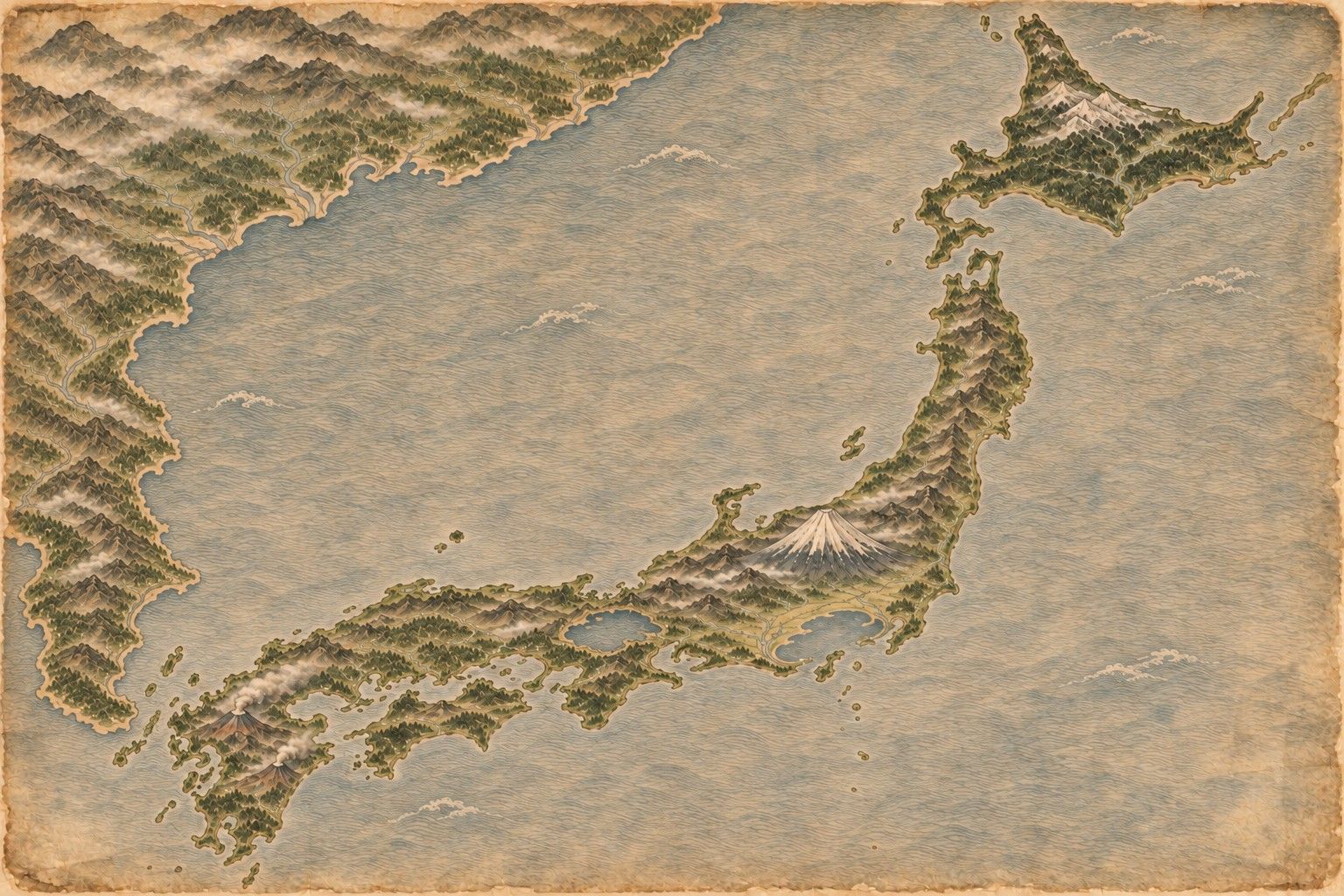
The Sword Isles#
Tsurugishima, the Sword Isles, curves across the eastern sea like a blade laid on blue silk. Its people say the shape is no accident. In the age of the gods, the kami forged a sword so perfect that its edge cut the heavens from the earth. When the sword fell from the sky, it shattered into four great islands and a scatter of smaller ones. Each island bears the name of the part of the blade it once was.
Foreign scholars from the mainland empire still call the land by its oldest name, Hōrai (蓬萊), the island of immortals their emperors once sent fleets to find.
The Four Islands#
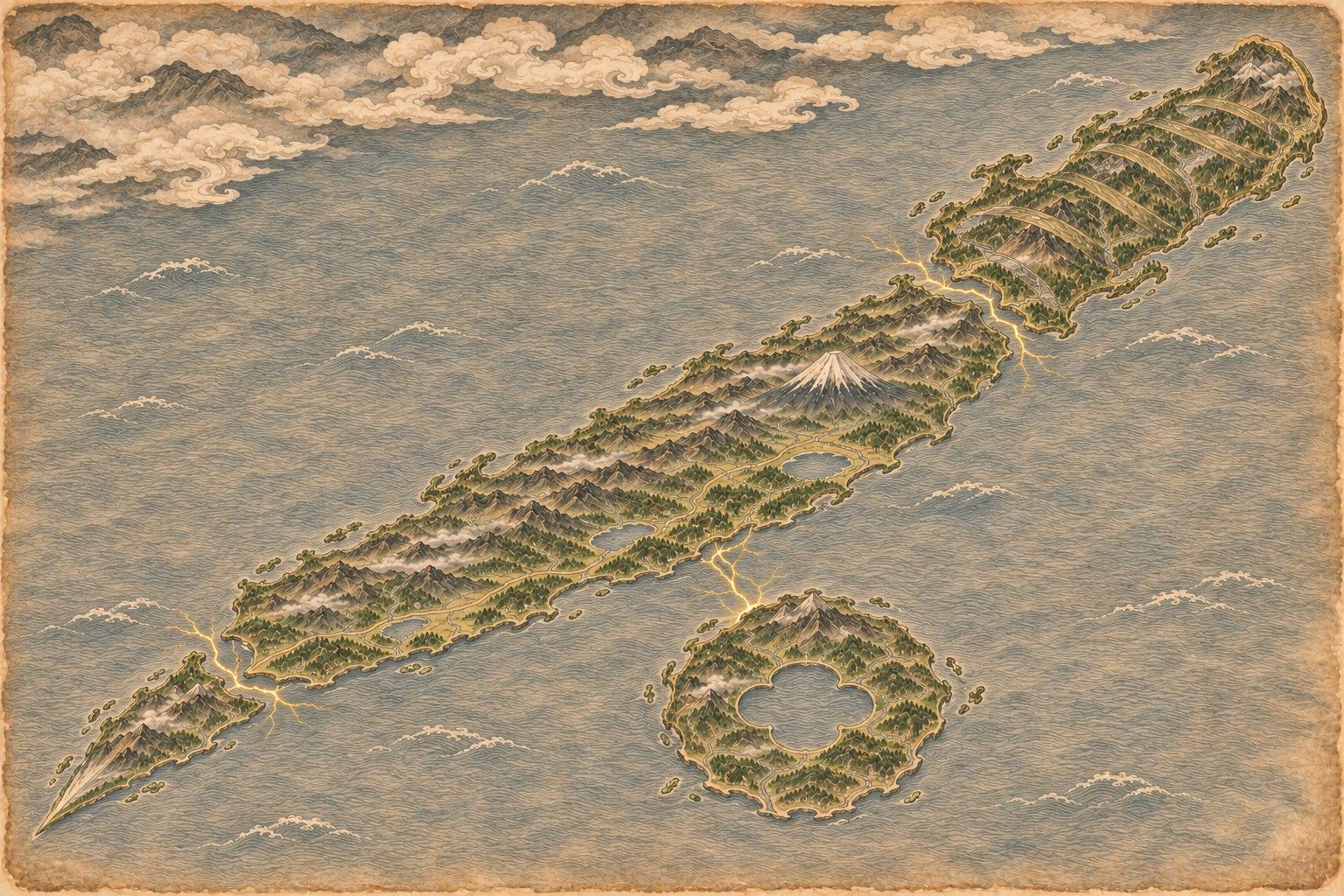
| Island | Meaning | The Real-World Shape It Echoes | Character |
|---|---|---|---|
| Shinogi-jima (鎬島) | "Ridge of the Blade" | The great central island | The heart of the realm: the Imperial capital, the Shogun's seat, most clans, and most wars. |
| Kissaki-jima (切先島) | "Point of the Blade" | The southwestern island | Hot, volcanic, and proud, with foreign traders, border garrisons, and pirates. |
| Tsuba-jima (鍔島) | "Guard of the Blade" | The small southern island | Rugged and pious, with mountain temples, pilgrim roads, and sea mists. |
| Tsuka-jima (柄島) | "Hilt of the Blade" | The large northern island | An untamed frontier of snow, forest, and spirits that the realm claims but does not rule. |
Seats of Power and Great Ports#
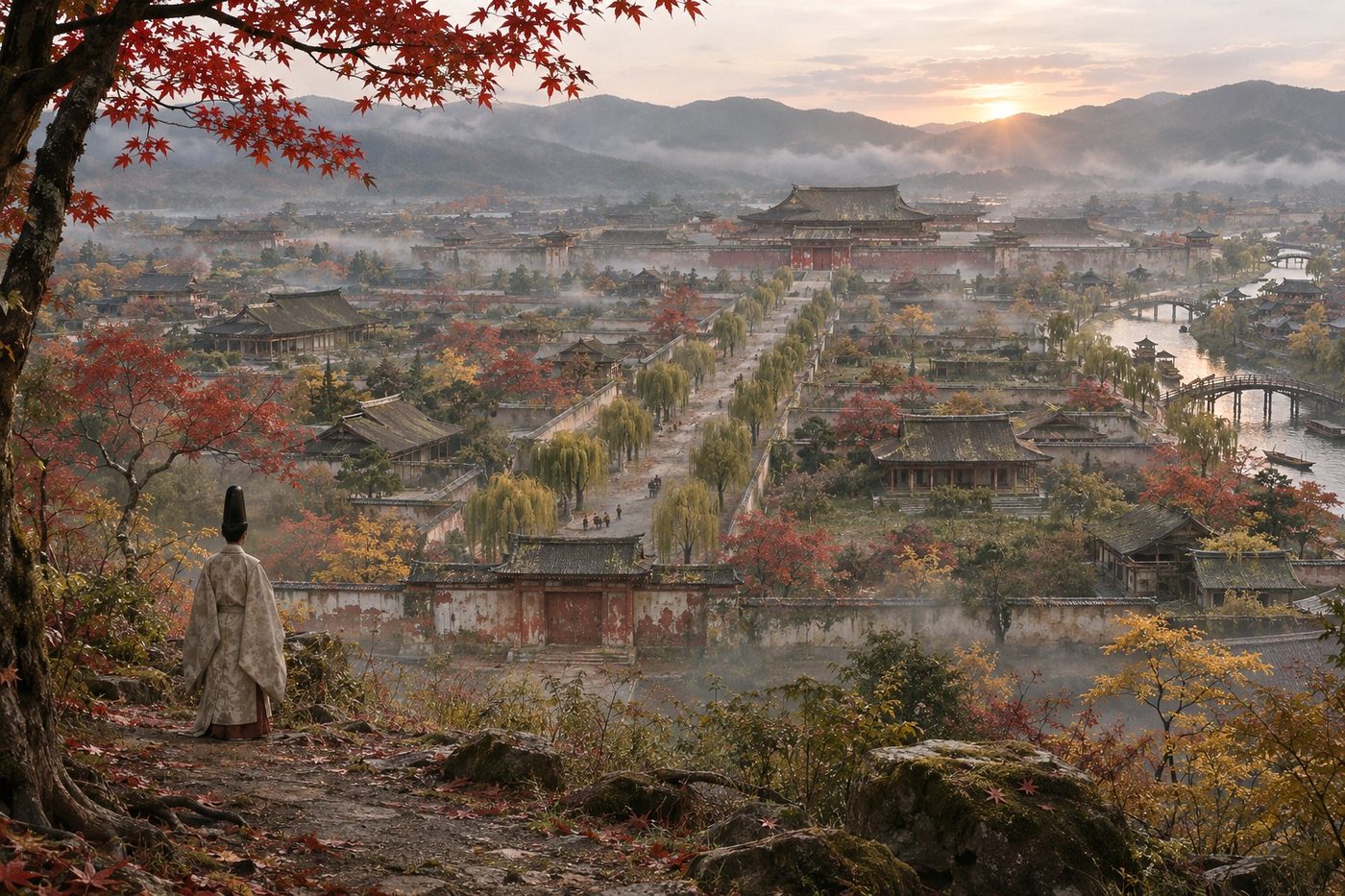
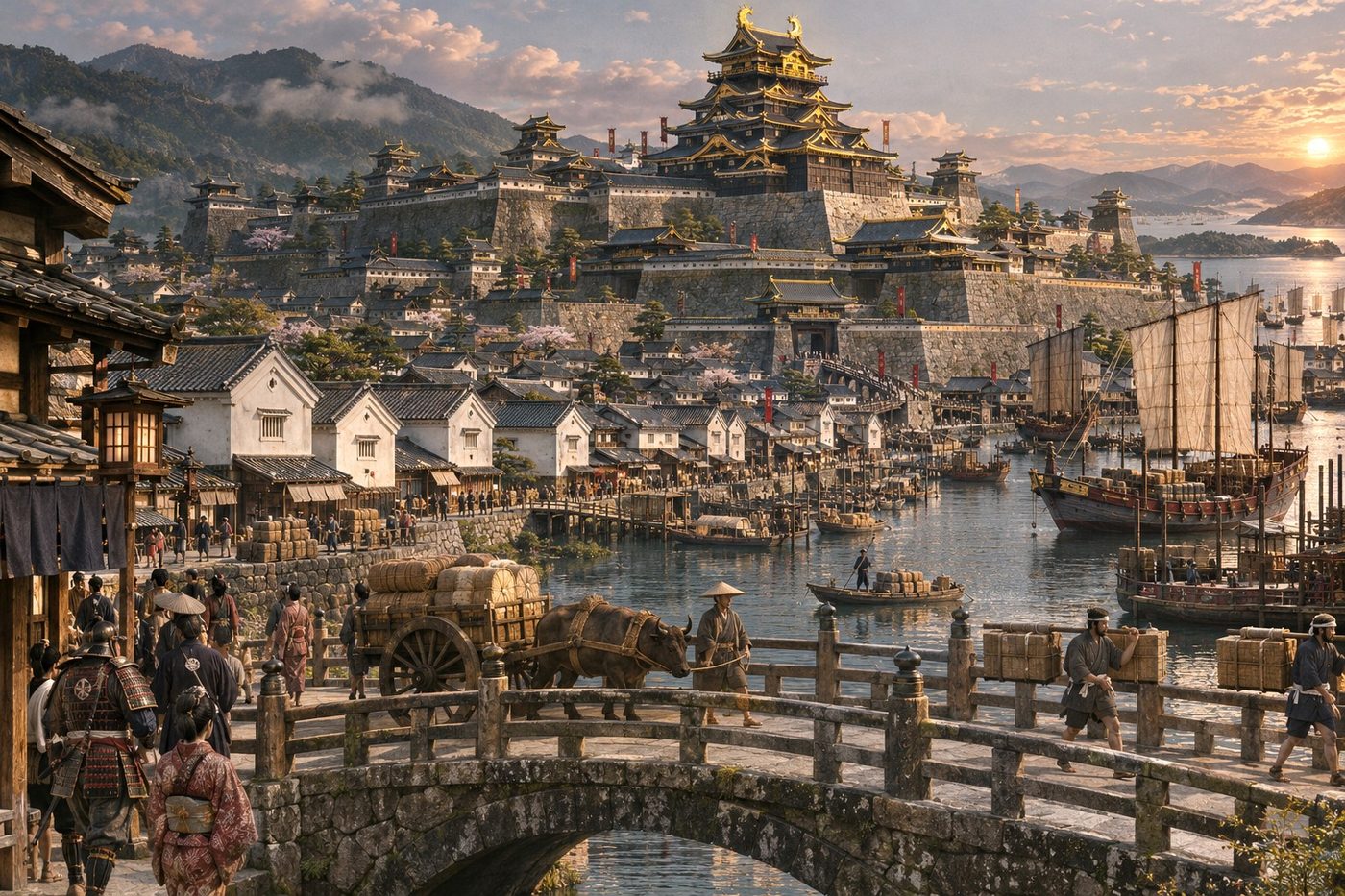
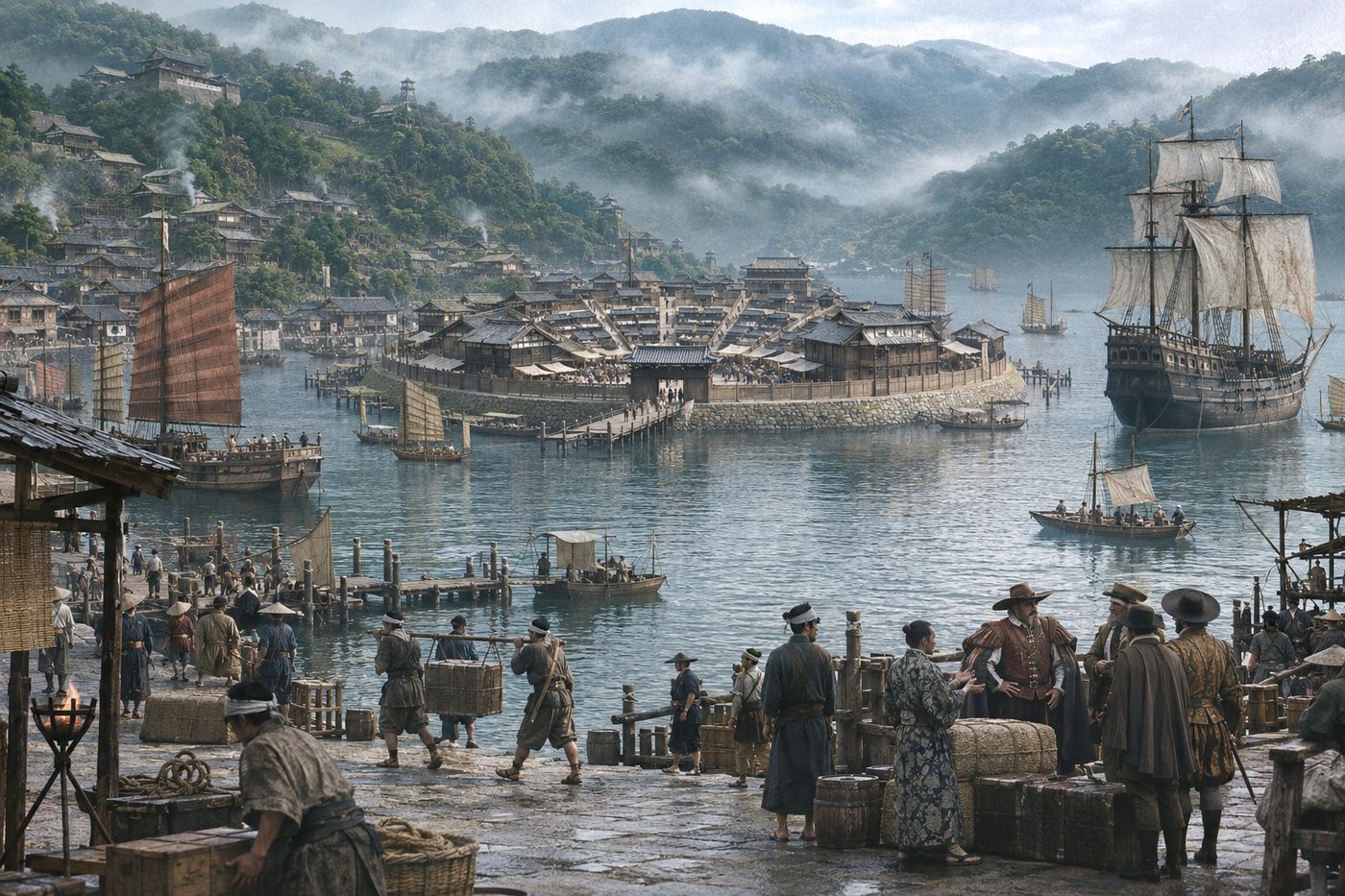
- Seikyō (清京, "the Pure Capital"). The Emperor's city and the heart of court life, ritual, and purity. Beautiful, ancient, and politically hollow.
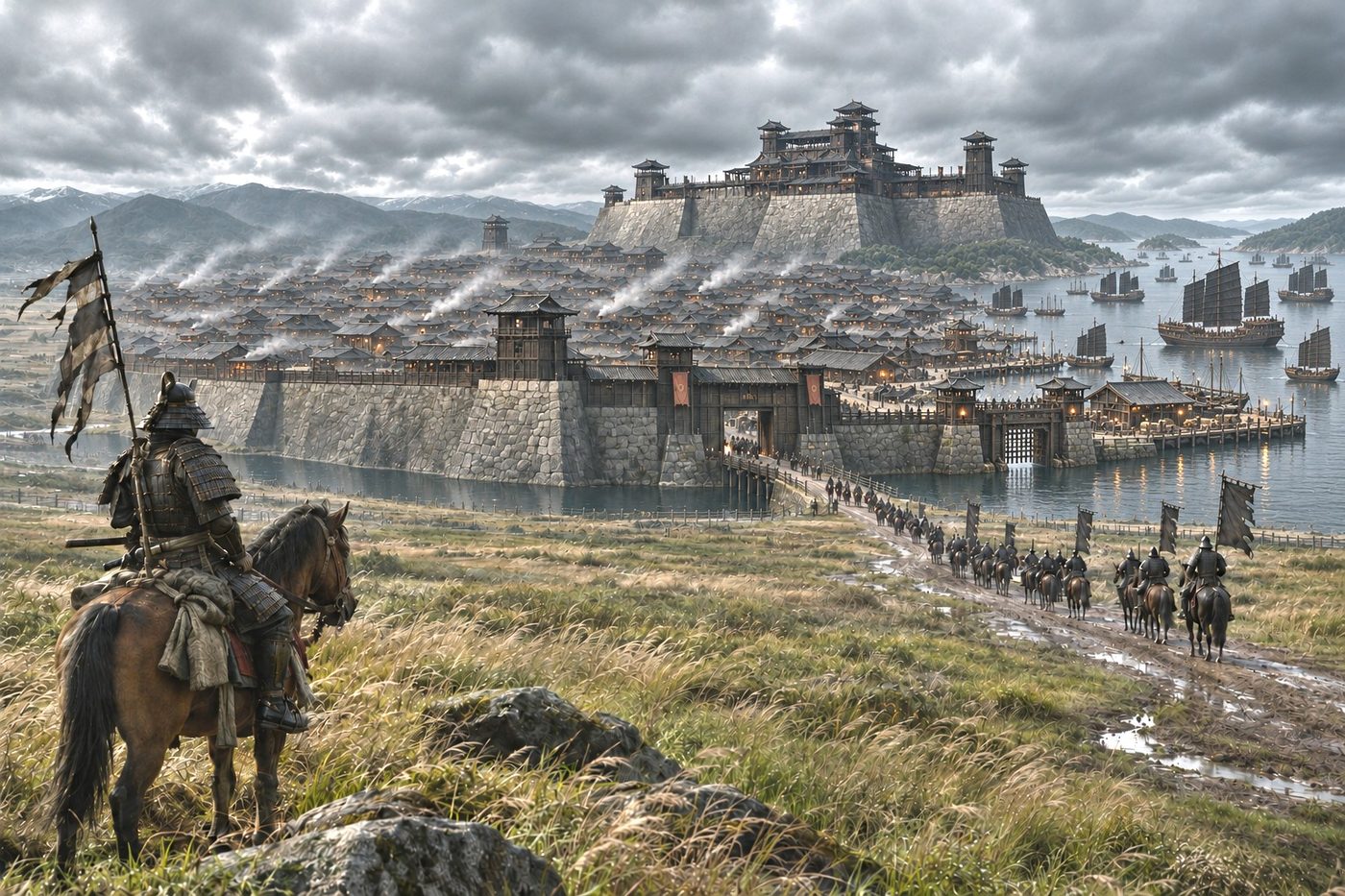
- Hagane (鋼, "Steel"). The Shogun's fortress-port on a broad, sheltered bay at the southeastern edge of the eastern plains. Its harbor lets the Shogun move troops by sea faster than any rival can march. Seikyō reigns, but Hagane rules, or did until the clans stopped listening.
- Kanagura (金蔵, "Gold Storehouse"). The great castle-port on the Inland Sea, at the river mouth below Seikyō. It is the richest merchant city in the realm and its mightiest fortress, and it is the seat of the Shikken, Ōtaki Kiyoaki. The man who holds the Shogun's purse also holds the strongest walls in Tsurugishima.
- Umikado (海門, "Sea Gate"). The port city of Akashio, and the busiest harbor in the realm. Foreign ships, firearms, and new faiths arrive here first.
Regions and Provinces#
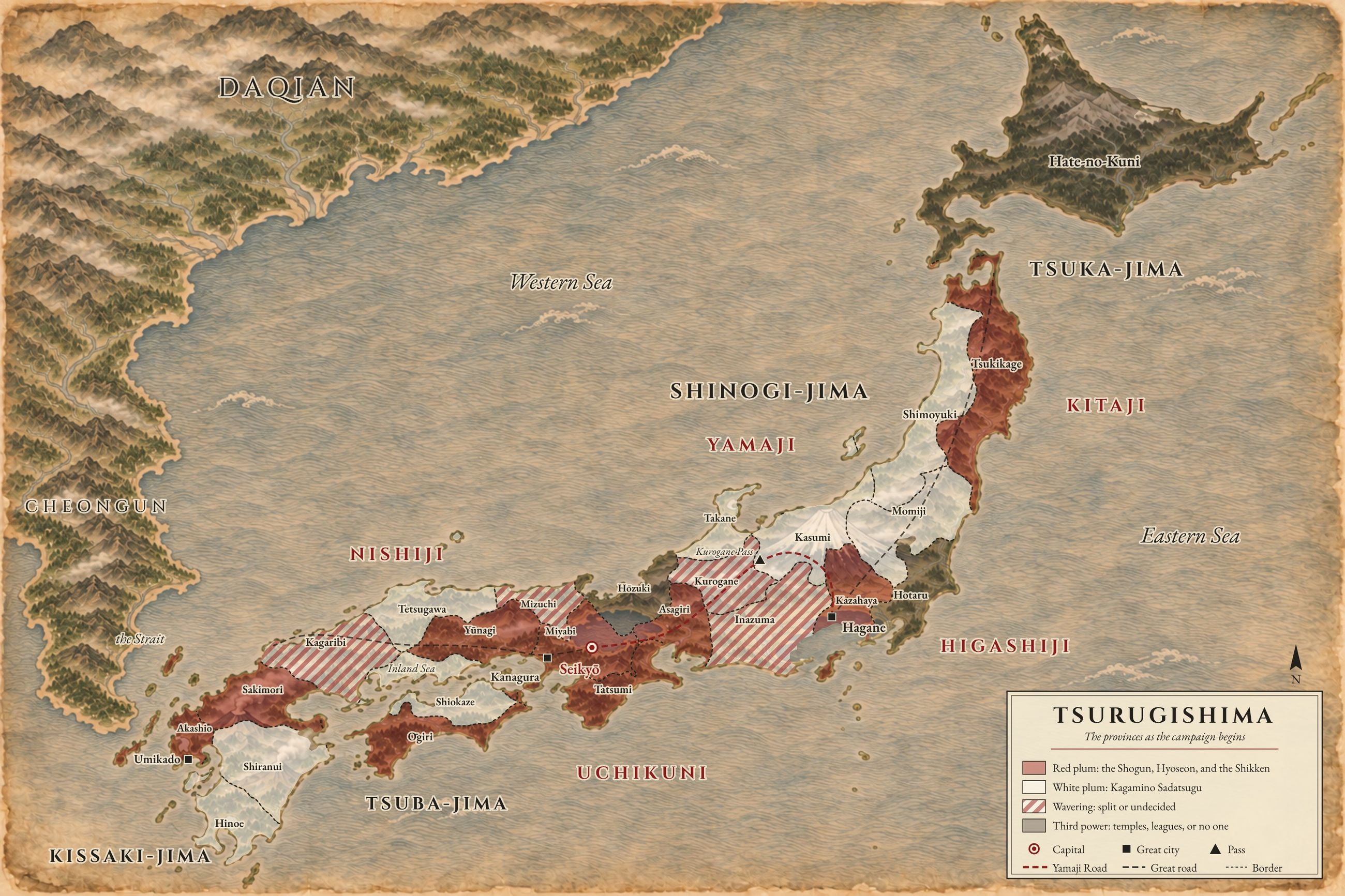
Tsurugishima has 24 provinces (kuni), grouped into eight regions.
Kissaki-jima: the Point (four provinces)#
| Province | Meaning | Sketch |
|---|---|---|
| Akashio (赤潮) | "Red Tide" | Home of Umikado, the busiest port in the realm. Foreign ships, firearms, and new faiths arrive here first. |
| Shiranui (不知火) | "Unknown Fires" | A coast haunted by ghost-lights at sea. Fishermen and spirit hunters. |
| Hinoe (火江) | "Fire Inlet" | Volcano country of hot springs, sulfur, and fierce clans. |
| Sakimori (防人) | "Border Guards" | The garrison province facing the mainland, and the realm's first line of defense. |
Tsuba-jima: the Guard (two provinces)#
| Province | Meaning | Sketch |
|---|---|---|
| Shiokaze (潮風) | "Sea Breeze" | Fishing villages, pirate coves, and the island's only real port. |
| Ōgiri (大霧) | "Great Fog" | Mountain temples and a famous pilgrimage circuit lost in fog. |
Nishiji: the West Road (four provinces)#
| Province | Meaning | Sketch |
|---|---|---|
| Yūnagi (夕凪) | "Evening Calm" | The Inland Sea coast: shipping, salt, and wealthy merchant towns. |
| Tetsugawa (鉄川) | "Iron River" | Iron-sand rivers and the realm's finest swordsmiths. |
| Kagaribi (篝火) | "Watchfire" | Beacon hills along the western shore. The oldest shrine in the realm stands here. |
| Mizuchi (蛟) | "Water Dragon" | River marshes and a dragon cult that the temples distrust. |
Uchikuni: the Inner Provinces (four provinces)#
| Province | Meaning | Sketch |
|---|---|---|
| Miyabi (雅) | "Elegance" | Home of Seikyō, the Pure Capital, and of Kanagura, the Shikken's castle-port. Court nobles, poets, merchants, and plots. |
| Asagiri (朝霧) | "Morning Mist" | The great lake province and the rice basket of the capital. |
| Hōzuki (鬼灯) | "Demon Lantern" | Mountain temples and warrior-monks who answer to no lord. |
| Tatsumi (巽) | "Southeast" | Holy mountains and the forests of the yamabushi. |
Yamaji: the Mountain Road (three provinces)#
| Province | Meaning | Sketch |
|---|---|---|
| Kurogane (黒鉄) | "Black Iron" | The Starter Province. Iron mines and the vital pass between the capital and the east. Three factions are locked in stalemate. |
| Takane (高嶺) | "High Peaks" | The roof of the realm, where tengu are said to train the worthy. |
| Kasumi (霞) | "Haze" | High valleys, horse breeders, and a famous cavalry clan. Mount Hōrai rises on its southern border. |
Higashiji: the East Road (four provinces)#
| Province | Meaning | Sketch |
|---|---|---|
| Kazahaya (風早) | "Swift Wind" | Home of Hagane, the Shogun's port city on the bay. Broad plains of warriors and horses. |
| Hotaru (蛍) | "Firefly" | Rich farmland and peasant leagues on the edge of revolt. |
| Inazuma (稲妻) | "Lightning" | A storm coast of shipyards and rival clans, in the shadow of Mount Hōrai. |
| Momiji (紅葉) | "Autumn Leaves" | A border province of old battlefields and restless ghosts. |
Kitaji: the North Road (two provinces)#
| Province | Meaning | Sketch |
|---|---|---|
| Shimoyuki (霜雪) | "Frost and Snow" | Hardy, isolated clans who are loyal to themselves first. Its daimyo, Mizusawa Kagehisa, is at war with Tsukikage. |
| Tsukikage (月影) | "Moonlight" | The largest province, ruled by the powerful daimyo Kuzuhara Akitada, whom even the Shogun can't control. |
Tsuka-jima: the Hilt (one province)#
| Province | Meaning | Sketch |
|---|---|---|
| Hate-no-Kuni (果ての国) | "Land at the End" | One frontier march over a vast wild island. Outposts, exiles, and spirits older than the gods' sword. |
Beyond the Isles#
- Daqian (大乾, islanders say Daiken, "Great Heaven"). The vast and ancient mainland empire to the west, inspired by China.
- Cheongun (靑雲, islanders say Seiun, "Blue Clouds"). The peninsula kingdom across the strait, inspired by medieval Korea, and the site of the Shogunate's recent failed war.
- Foreign traders from the far west, who arrive at Umikado with firearms and new faiths.
Notes#
- Hōrai, the island of immortals that mainland emperors sent fleets to find, follows the legend retold in "Hōrai" in Lafcadio Hearn, Kwaidan (1904).
Part 2: A Brief History of Tsurugishima#
Reckoning the Years#
The people of Tsurugishima count years by the Kenreki (剣暦), the Sword Calendar. It begins with the year the first Emperor united the isles. The present day is Kenreki 1261.
Timeline at a Glance#
| Year | Event |
|---|---|
| The Age of the Gods | The kami forge the Great Sword. It falls and shatters into the isles. Mount Hōrai rises where the blade's heart struck the sea. |
| c. 700 years before Kenreki | Admiral Lu Xian of ancient Shenyuan lands with 60 ships, seeking the mountain of immortals. |
| Before Kenreki | The Age of Seven Kingdoms. |
| 1 | King Tenzei of Hō unites the isles and becomes the first Emperor. The Kenreki begins. |
| 410 | Empress Shōkei founds Furumiya, the first permanent capital. |
| 494 | The capital moves to Seikyō. The Akebana regents begin their long rule over the court. |
| 514 and 589 | The warrior houses of Minazuki and Kamaeda are founded by princes released from the Imperial family. |
| 855 | The Succession War. Kamaeda wins and Minazuki is broken. |
| 880–885 | The Minazuki Return. Minazuki rises again and destroys Kamaeda. |
| 885 | Minazuki Tsunetomo becomes the first Shogun and founds the Kagamino line at Hagane. |
| 1199 | The Usurpation. Shogun Kagamino Sadamasa is deposed by his cousin Kagamino Tomoyuki, grandfather of today's Shogun. |
| 1222 | Shogun Kagamino Tomonori launches the Cheongun War and conquers half the kingdom. |
| 1235 | Tomonori dies on campaign. His son Tomoharu becomes Shogun at nine months old. |
| 1250 | The Treaty of the Strait. Tomoharu marries Princess Hyoseon, and the conquered lands are given back. |
| 1261 | The present day. |
The Age of the Gods#
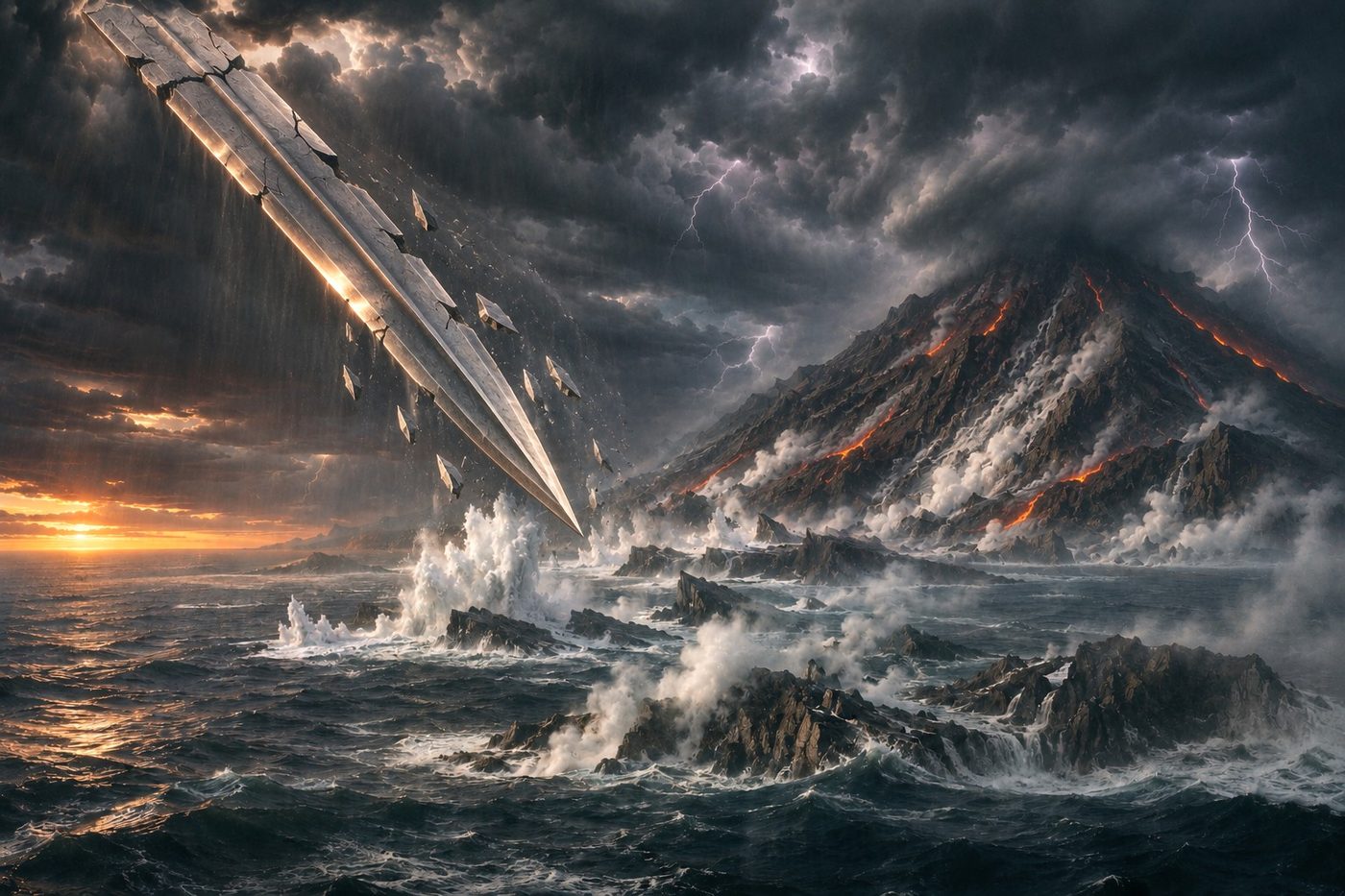
In the beginning, the kami forged a sword to divide heaven from earth. When its work was done, the blade fell from the sky and shattered into the Sword Isles. Where the blade's heart struck the sea, in the middle of Shinogi-jima, a mountain rose so high that its peak touched the heavens: Mount Hōrai. The mountain gave the land its oldest name. Eight great kami of the mountain still dwell there, and from them the first sorcerers of the isles drew their power.
The Coming of the Mainlanders#
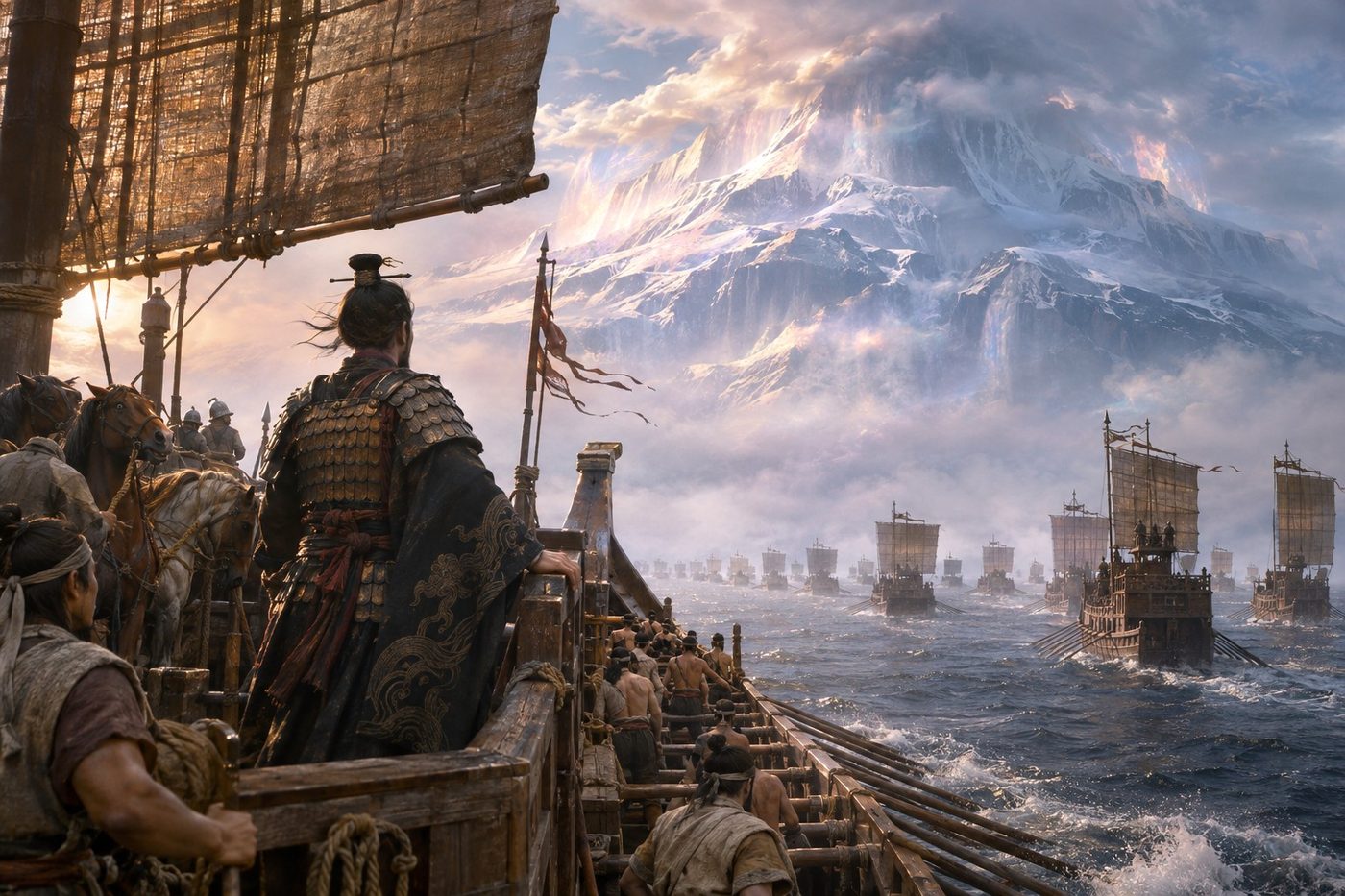
The first people of the isles were stone-age hunters who roamed in clan-based tribes.
About two thousand years ago, an island sorcerer named Anshi crossed the sea to the mainland empire of Shenyuan, the ancient dynasty that ruled before today's Daqian. Anshi told its emperor of magical Mount Hōrai and the immortal sorcerers who lived there. Hungry for eternal life, the emperor sent his Grand Admiral, Lu Xian, to find it.
Lu Xian arrived with 60 ships, bringing horses and bronze weapons. His bronze quickly humbled the stone-age tribes, and he made himself king. He married Asahime, high priestess of the Sun Goddess, and their son became the first King of Hō, a realm in the shadow of the sacred mountain. Lu Xian never found the immortals. Some say he never left the mountain's slopes. Others say he never died.
The Age of Seven Kingdoms#
Under the kings of Hō, rice farming came from the mainland, and the people slowly settled into farming villages. Other kingdoms rose across the isles: Hō around the sacred mountain, Tatara in the iron west, Nagisa on the Inland Sea coast, Hinokawa on Kissaki-jima, Ubusuna in the eastern plains, Sasara in the mountains, and Oboro in the misty north.
Each kingdom was ruled by a powerful clan (gōzoku), headed by a chief called the uji-no-kami. The uji-no-kami was both war leader and high priest. He performed the sacred rites for the kingdom's guardian kami and kept its great shrine.
The First Emperor#
Hō kept close ties with the mainland. It received a golden seal from the mainland emperor, and Buddhist monks skilled in administration and in forging iron. Tenzei, the tenth King of Hō, used that iron to break the other kingdoms. He sent four generals to the four directions, and one by one the kingdoms bent the knee. Tenzei became the first Emperor of Tsurugishima, and the Kenreki begins with his reign.
The Imperial Age#
The Emperors set out to rule the whole land directly. All land belonged to the throne. Three great ministers advised it: the Minister of the Left (Sadaijin), the Minister of the Right (Udaijin), and the Chancellor (Daijō-daijin). The realm was divided into provinces, each with a governor appointed by the Emperor. The old kingly clans and the Hō royal kin became the court nobility, the kuge, and only kuge could hold office.
Until the reign of Empress Shōkei, the court moved its capital whenever an Emperor died, because a place of death was polluted. Shōkei, a devout Buddhist, broke the custom in Kenreki 410 and founded Furumiya, the first permanent capital. It grew to 200,000 people, with 10,000 working in government. Roads linked it to the provinces, taxes flowed, and coins were minted.
To encourage new farmland, the court made reclaimed land tax-free. These private estates, the shōen, grew and grew. As more land escaped taxation, the treasury shrank. Conscription ended, the Imperial army withered, and governors were allowed to raise private militias.
In Kenreki 494 the court moved to a new city with better rivers and a more central position: Seikyō, the Pure Capital. There, the noble house of Akebana rose to dominate the throne. Akebana daughters married Emperors. Emperors retired young into monasteries, and an Akebana grandfather ruled as regent (sesshō) for his grandson. For more than three centuries, the court glittered with poetry and ceremony while the provinces drifted away.
The Rise of the Samurai#
Kuge governors had no wish to leave the elegant capital for some muddy province. They hired warriors of lesser birth, the samurai, to guard, police, and govern their provinces for them. The governors changed every year, but the samurai families stayed, generation after generation, until the provinces were theirs in all but name.
Samurai clans fought each other for land, and the weak swore loyalty to the strong. In time, nearly every warrior clan followed one of two great houses, both founded by princes released from the Imperial family: Minazuki (水無月), "Month of Water," founded in Kenreki 514, and Kamaeda (鎌枝), "Sickle Branch," founded in Kenreki 589.
Both houses used their court ties to win the richest posts and Imperial approval for their wars.
The Fall of Kamaeda#
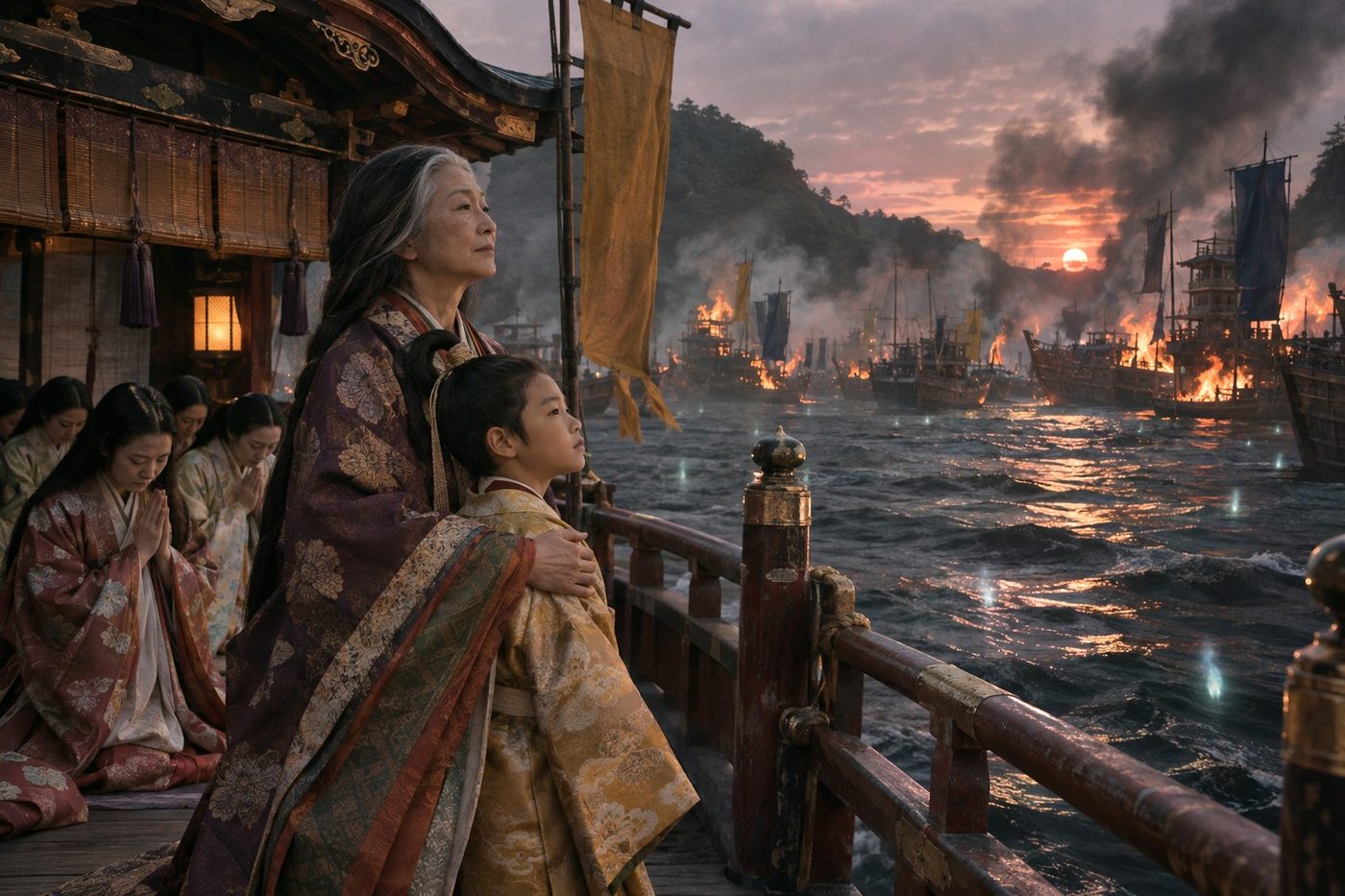
In Kenreki 855, a quarrel over the Imperial succession split the Akebana regents. Two brothers backed two rival princes. One called on Minazuki, the other on Kamaeda. Kamaeda won. The Minazuki leaders died in battle or under the executioner's blade, and Kamaeda Takanari became the true master of the realm.
Takanari did what no warrior had done. He climbed the court ranks to become Chancellor, the first samurai ever to hold the office. Like the Akebana before him, he married his daughter to an Emperor, forced that Emperor to abdicate, and ruled through his infant grandson.
Takanari grew too powerful and too courtly for kuge and samurai alike. After his death, his son Kamaeda Tokinari took the chancellorship. Then Prince Hoshiyuki, the Emperor's brother, called on the survivors of Minazuki to rise and save the throne. They did, and many former Kamaeda allies joined them. The Minazuki Return raged for five years (Kenreki 880–885) and ended with the destruction of Kamaeda. Its last child-emperor drowned with his court in the sea battle at Shiranui, and fishermen there still see the ghost-lights of the Kamaeda fleet.
The Shogunate#
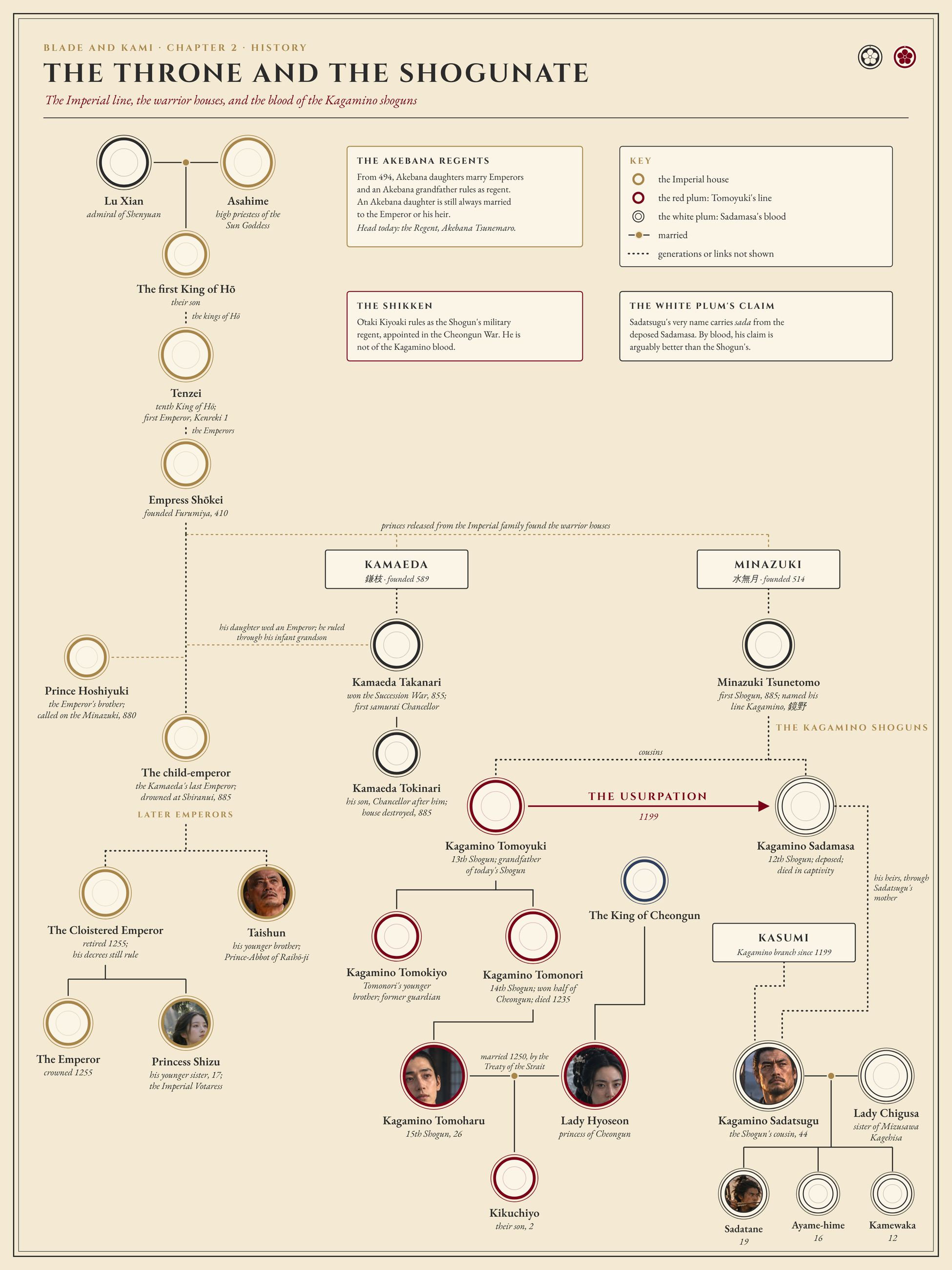
The Emperor gained nothing. The victorious Minazuki Tsunetomo held the throne more tightly than Takanari ever had, but he had learned from Takanari's mistake. Rather than enter the court, he had the Emperor name him Shogun, supreme general, and declare martial law across the realm. He built his headquarters far from the court's intrigues at Hagane, the city of steel, on a sheltered bay where his ships could carry his armies anywhere in the isles, and took the name of his fortress lands, the Mirror Fields, for his new line: Kagamino (鏡野). By custom, every Kagamino Shogun since has carried tomo, a character from the founder's name, in his own.
The first Shogun issued a new law code, the Hagane Code, and created offices to govern: the mandokoro for finance and taxes, the samurai-dokoro for the military governors and justice, and the monchūjo for appeals and inquiry. Great clan leaders swore loyalty directly to the Shogun as his gokenin, and from their ranks he chose his provincial governors, the daimyo.
For three centuries the Kagamino shoguns kept the peace, more or less. Then, in Kenreki 1199, came the Usurpation. Shogun Kagamino Sadamasa was a vain, spendthrift ruler who seized his cousin's lands. That cousin, Kagamino Tomoyuki, raised an army, deposed Sadamasa, and took the Shogunate for himself. Sadamasa died in captivity soon after, and few believe it was illness. He had been the one Shogun to break the custom of tomo, and Tomoyuki's supporters called the restored tomo a sign of the founder's favor. Tomoyuki ruled well, and his son Tomonori ruled brilliantly. But some still whisper that the true line of the founder runs through Sadamasa's heirs, and not through Tomoyuki's.
The Present Day#
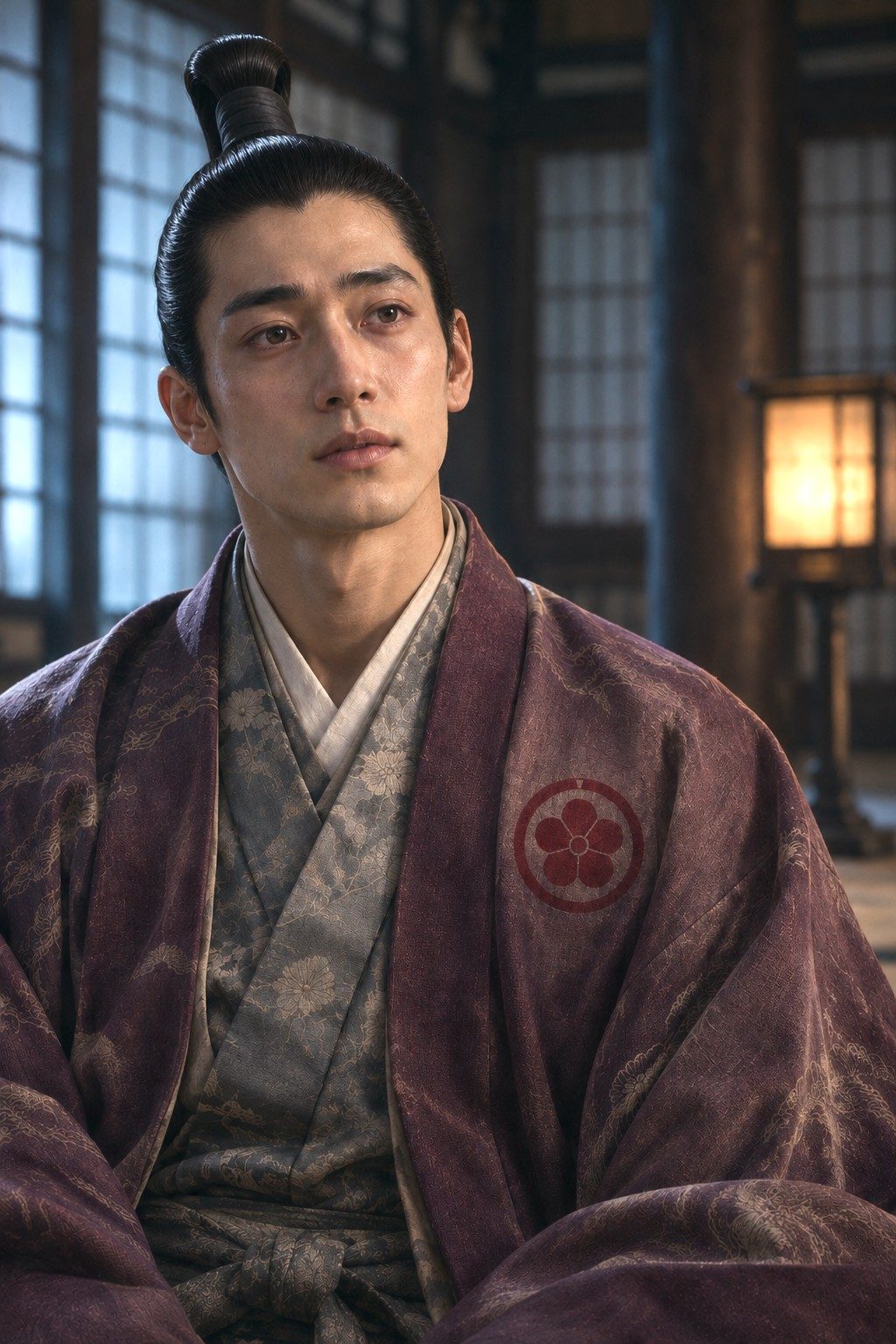
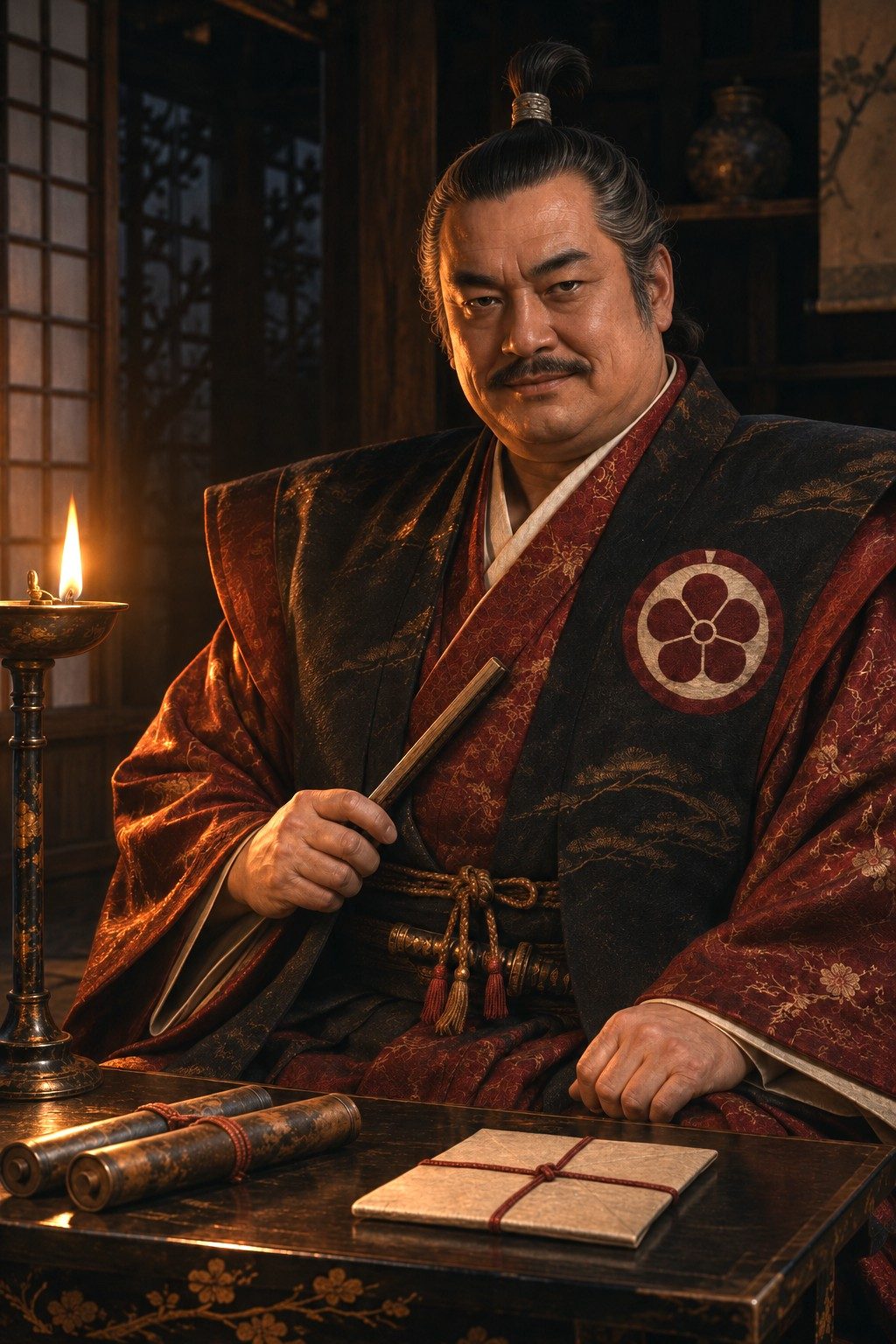
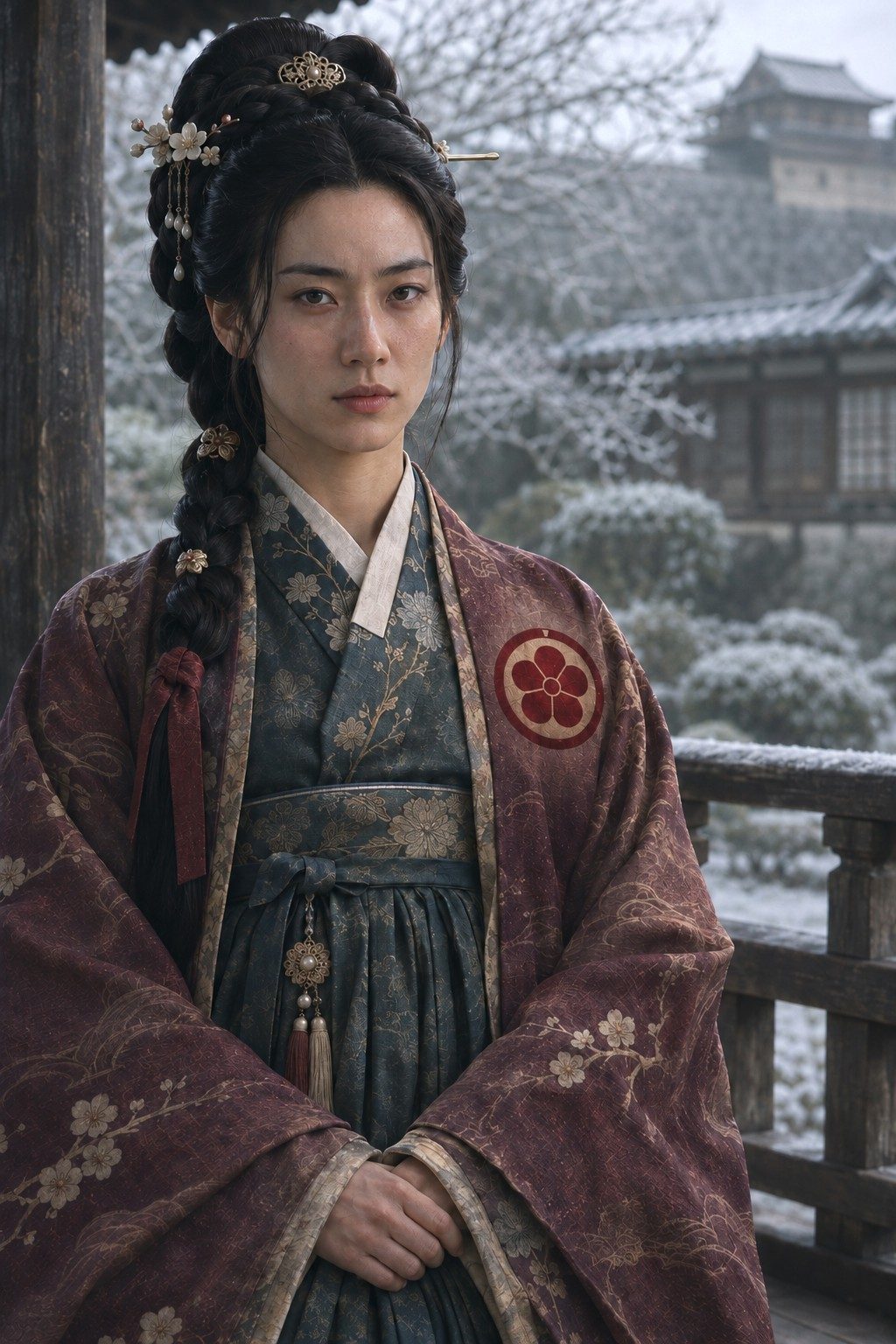
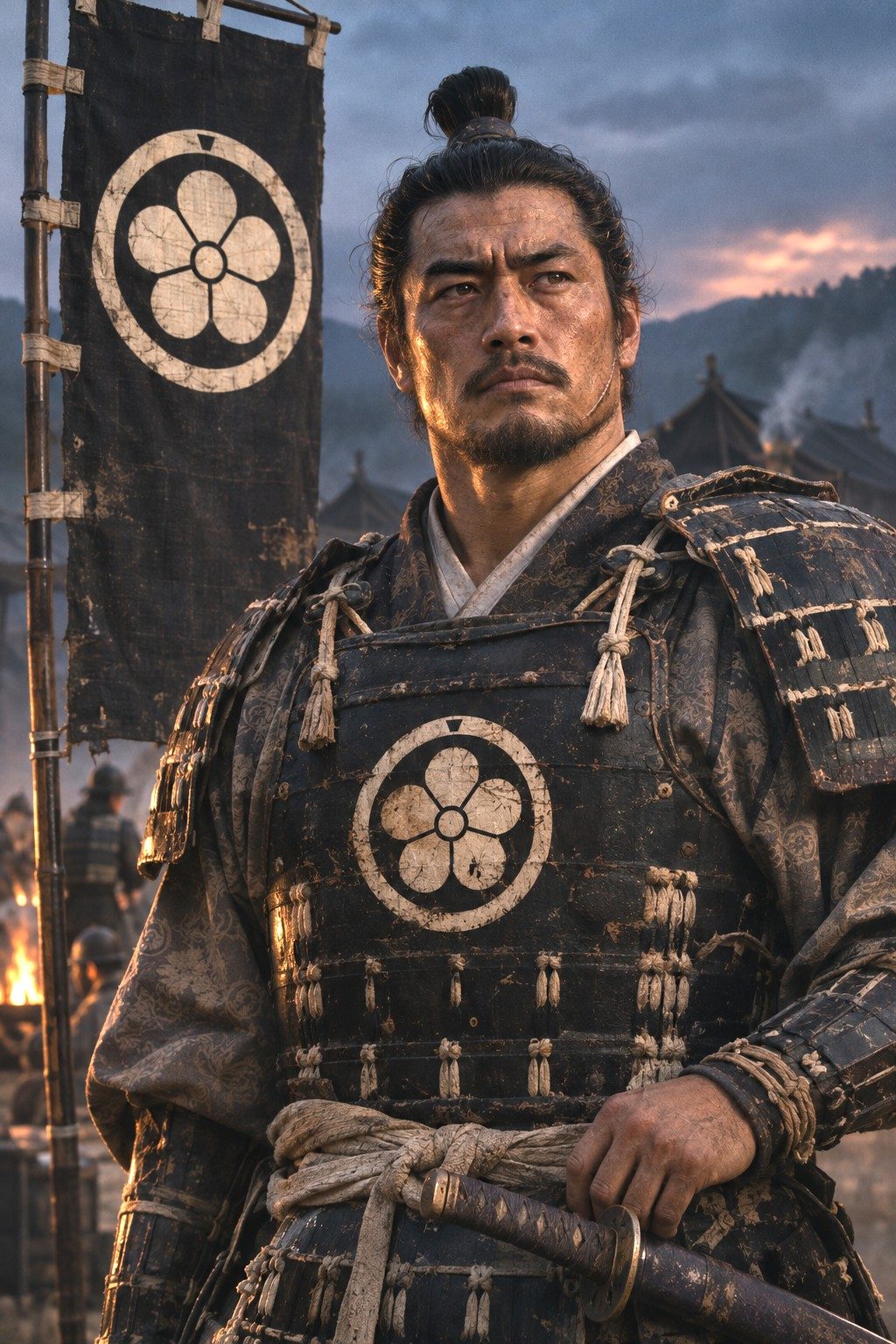
Kagamino Tomoharu is the fifteenth Shogun of the Kagamino line. He became Shogun at nine months old, when his father, the beloved warrior Shogun Kagamino Tomonori, died suddenly while campaigning in Cheongun. Tomonori had conquered half that kingdom and seemed on the edge of taking the rest. His death left an infant on the throne and an army abroad.
In Tomoharu's youth, his uncle Kagamino Tomokiyo, Tomonori's younger brother, ran the government. Tomokiyo was loyal but incompetent, and the Cheongun War went badly. As the war soured, Tomokiyo lost his grip and was forced to appoint a military regent (shikken) for the Shogun: Ōtaki Kiyoaki. Ōtaki ruled for years and set out to end the war. Under the Treaty of the Strait (Kenreki 1250), Shogun Tomoharu married Princess Hyoseon, daughter of the King of Cheongun, and Tsurugishima gave back the lands Tomonori had won. Many samurai saw that as a betrayal of their dead. Tomoharu himself is gentle, pious, and far happier in a temple than on a battlefield. Lady Hyoseon is the opposite: clever, fierce, and quickly becoming the real will behind the Shogun.
The warriors did not take it well. The Shogun's cousin, the brave Kagamino Sadatsugu, descends from the deposed Shogun Sadamasa through his mother, so by blood his claim to the Shogunate is arguably better than Tomoharu's. Sadatsugu had won command of the army in Cheongun and wanted to fight on. Shikken Ōtaki starved him and his soldiers of supplies until the treaty was done. Hundreds of hardened veterans came home to find no work and no reward, and many turned to banditry and worse.
The Shikken, meanwhile, ruled less from Hagane than from his own castle-port of Kanagura, beside the Emperor's city, where the realm's merchants and money gather. He filled every rich post with his own relatives. He cut costs by disbanding most of the army and ignored the provinces. Left to themselves, the daimyo began to fight for land and power.
Most dangerous of all, Kuzuhara Akitada, the powerful daimyo of Tsukikage, went to war with his neighbor, Mizusawa Kagehisa of Shimoyuki. Kuzuhara bought the Shogun's blessing through the Shikken, which enraged Kagamino Sadatsugu, because Mizusawa is his brother-in-law.
The realm is choosing sides. Those loyal to Shogun Tomoharu, Lady Hyoseon, and the Shikken wear the red plum blossom (kōbai) of Tomoyuki's line. Those who look to Sadatsugu, whose very name carries sada from the deposed Sadamasa, have taken up the white plum blossom (hakubai). No battle has been fought yet between the two blossoms, but everyone feels it coming.
The realm stands on the edge of a blade. The Shogun is a puppet, the clans are at war, and the spirits are waking.
The House of Kagamino Today#
| Person | Who they are | Blossom |
|---|---|---|
| Kagamino Tomoharu | The fifteenth Shogun, age 26. Gentle, pious, and easily led. | Red |
| Lady Hyoseon | His wife, a princess of Cheongun. A fierce power behind the throne. | Red |
| Ōtaki Kiyoaki | The Shikken, or military regent. Greedy, clever, and hated. Rules from his castle-port of Kanagura. | Red |
| Kagamino Tomokiyo | The Shogun's uncle and former guardian. Loyal, sidelined, and bitter. | Red, for now |
| Kagamino Sadatsugu | The Shogun's cousin and the hero of the Cheongun War, with a claim through Sadamasa's blood. | White |
| Mizusawa Kagehisa | Daimyo of Shimoyuki and Sadatsugu's brother-in-law. | White |
| Kuzuhara Akitada | Daimyo of Tsukikage, at war with Mizusawa and backed by the Shikken. | Red |
Notes#
- The age of the gods and the first kingdoms draw on the old chronicles in W. G. Aston, trans., Nihongi (1896).
- The old capital and the rise of the warrior houses draw on F. Brinkley, A History of the Japanese People (1915).
Part 3: Society#
Everyone Has a Place#
Every person in Tsurugishima stands somewhere on a ladder that reaches from the Emperor to the beggar under the bridge. The ladder is old, and everyone can recite its rungs. What the warring years have taught is that the rungs can be climbed, and that a man or woman can fall off them in a single afternoon.
The Emperor and the Court#
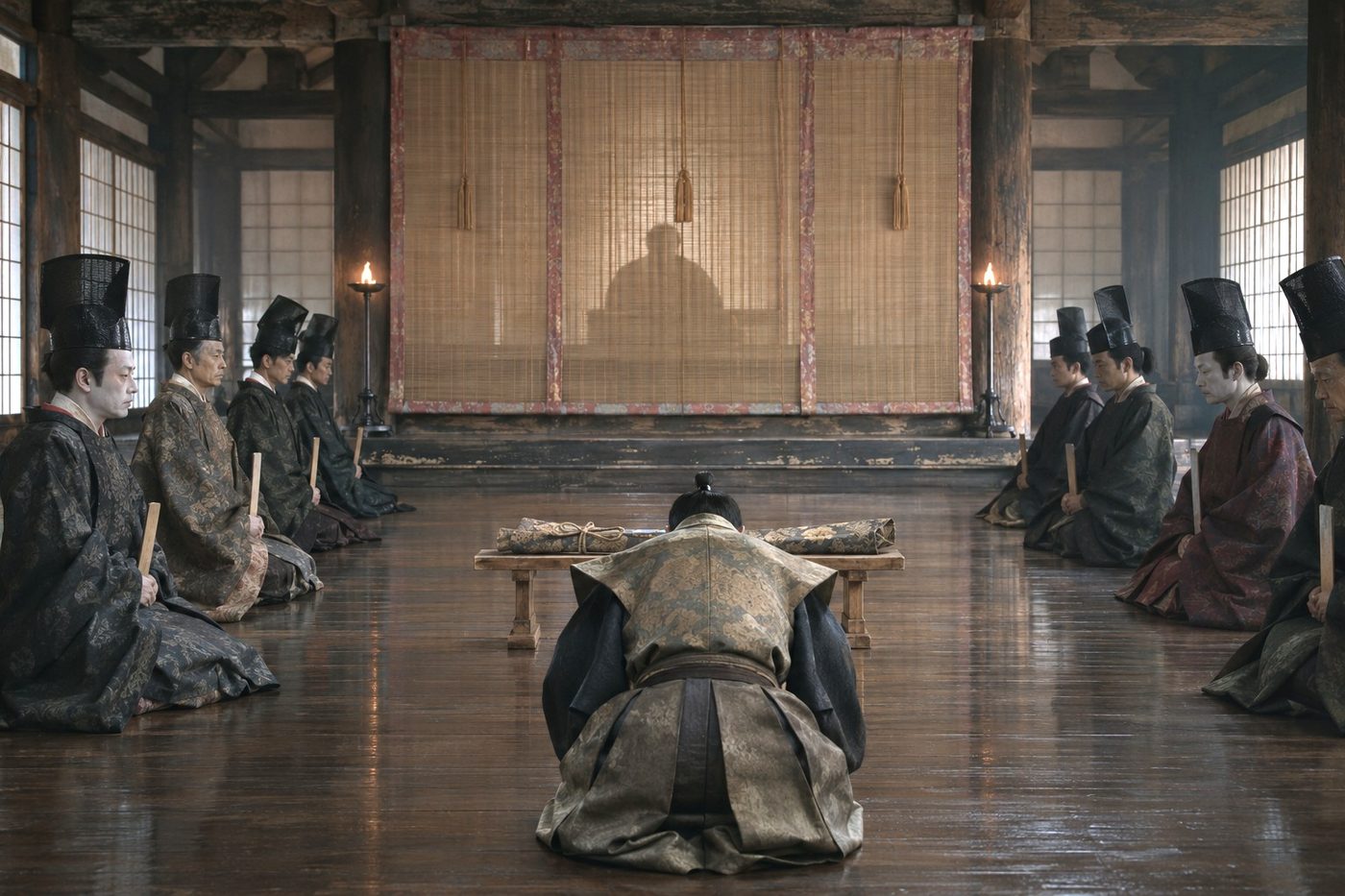
The Emperor reigns in Seikyō, the Pure Capital, as the Emperors have reigned for twelve centuries. He descends from the gods who forged the Great Sword, and he is the realm's highest priest. Each year he performs the rites that keep the rice growing and the kami content. No one in the isles, not even the boldest daimyo, says aloud that the Emperor could be replaced.
He has almost no power. The Emperor commands no army and collects little tax. His palace roofs leak, and courtiers have been known to sell their calligraphy to pay for lamp oil. Yet three things still flow from his hand, and every warlord wants them:
- Legitimacy. Only the Emperor can appoint a Shogun. A Shogun without the imperial commission is just a general.
- Court rank. The court grants ranks and titles, from Junior Fifth Rank up to the highest offices of state. A provincial warlord who buys a court title can sign his letters as Governor of a province he has never visited, and his neighbors must address him accordingly.
- Blessing. An imperial prayer for victory, an imperial poem praising a lord, or an imperial order naming a rebel can swing undecided clans.
The court nobles (kuge) are the old families who serve the Emperor: poets, ritualists, calligraphers, and keepers of precedent. They are cultured, poor, proud, and expert at intrigue. The greatest court family, the Akebana, once married its daughters to Emperors and ruled through them, and it has not forgotten. Court nobles look down on samurai as rustic killers, and samurai look down on court nobles as perfumed beggars. Each needs the other.
The Shogunate#
The Shogun (shōgun, "Barbarian-Subduing Great General") governs in the Emperor's name from the fortress-port of Hagane. In theory he commands every samurai in the isles, appoints the daimyo, judges disputes between clans, and keeps the peace. In practice, the Shogunate is as strong as the Shogun's own armies and treasury, and today both are thin.
The Shogunate works through three great offices, created by the Hagane Code:
- The Mandokoro (Office of Administration) handles taxes, lands, and the Shogun's own estates.
- The Samurai-dokoro (Office of Retainers) commands the Shogun's warriors, oversees military governors, and punishes crimes by samurai.
- The Monchūjo (Office of Inquiry) hears appeals and lawsuits, mostly about land.
Over them all stands the Shikken, the military regent, who rules when the Shogun cannot or will not. Today the Shikken is Ōtaki Kiyoaki, and he rules from his own castle-port of Kanagura rather than from Hagane. Officials who want anything done travel to Kanagura, and they bring gifts.
The great houses who swore directly to the first Kagamino Shogun are the housemen (gokenin). Their oath is still on record at Hagane. Whether it still binds them depends on whom you ask, and on which blossom they wear.
Daimyo and Clans#
The real power in Tsurugishima belongs to the daimyo, the great lords who hold the provinces. A daimyo's domain is measured not in acres but in koku of rice, one koku being enough to feed one person for a year. A minor lord holds 10,000 koku. A great lord holds 200,000 or more. A daimyo's koku decides how many soldiers he can feed, how many retainers he can pay, and how much respect he can demand.
A clan is more than a family. At its heart is the main house, headed by the daimyo, surrounded by branch houses founded by younger sons and daughters. Around them stand the retainers, samurai families who serve the clan for generations and are paid in rice, land, or both. A clan also includes everyone those retainers lead: foot soldiers, servants, farmers, and craftsmen. When a stranger asks a man who he is, he names his lord before he names himself.
A typical clan includes:
- The daimyo, who rules the domain from a castle.
- The elders (karō), senior retainers who run the domain day to day. A weak daimyo is ruled by his elders.
- The bannermen (hatamoto), the lord's personal guard and most trusted warriors.
- The retainers, ranked by their stipends, who serve as officers, magistrates, tax collectors, and envoys.
- The rural gentry (jizamurai), village headmen who farm their own land and fight when called. They are the hinge between the samurai and the farmers, and their loyalty decides who really holds a province.
- The foot soldiers (ashigaru), farmers' sons armed with spear, bow, or matchlock. A clan at war might field ten foot soldiers for every samurai.
Clans bind themselves together with marriage, adoption, and hostages. A daimyo who submits to a stronger neighbor sends a son, a daughter, or a wife to live at the stronger lord's castle, as a guest who cannot leave. Every clan keeps such guests, and every clan has lost one to a broken promise.
The Lower Overthrowing the Higher#
The warring years have a name for their favorite crime: gekokujō, "the lower overthrowing the higher." Retainers depose their lords. Elders poison their daimyo's heirs. Gentry turn on the samurai who taxed them. Peasant sons who show talent with a spear are made samurai on the battlefield, and their sons become lords. Old families sneer at these upstarts, and the upstarts own the castles.
Whose Are You?#
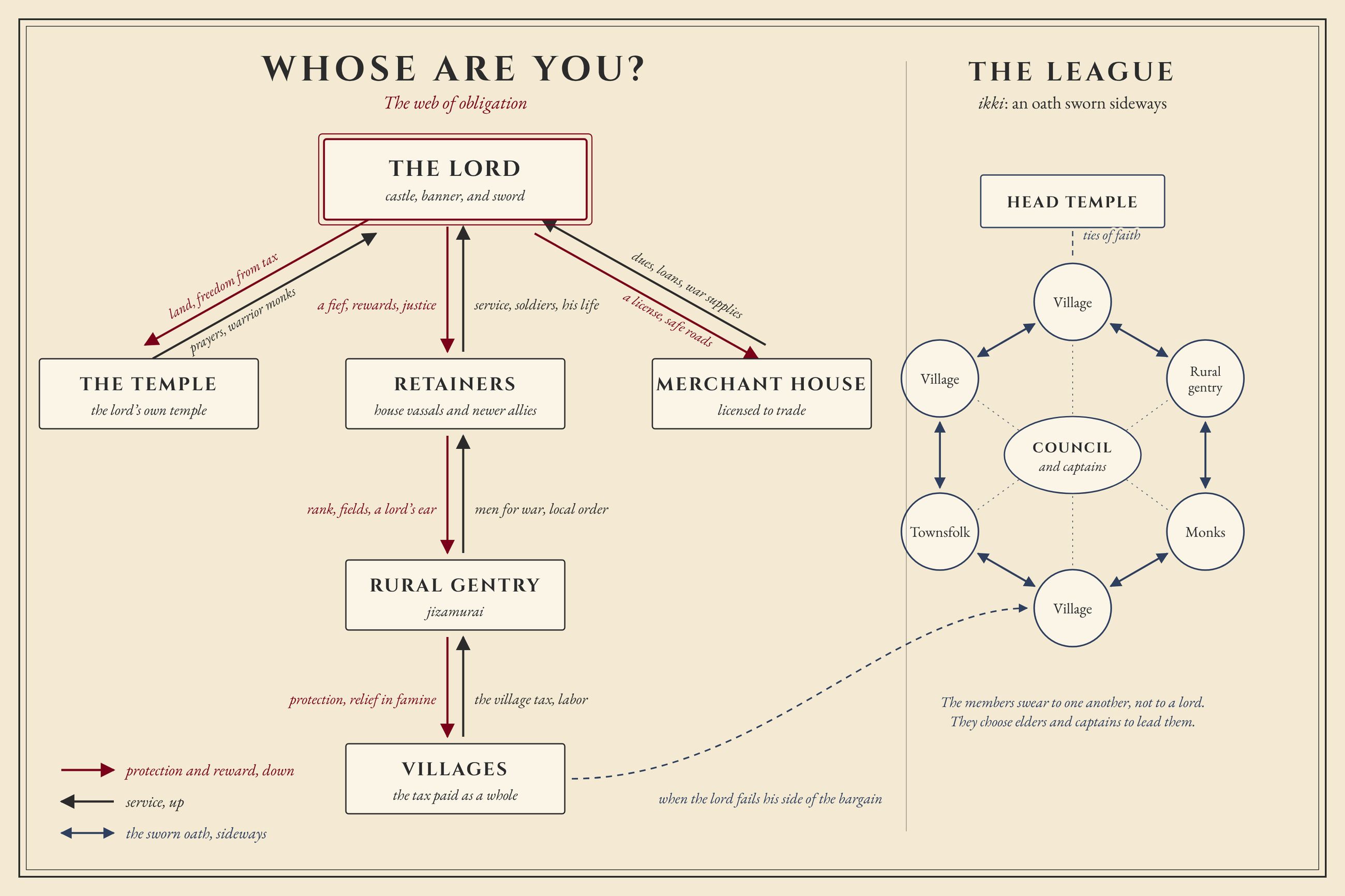
Arasawa's headman, Kyūsuke, pays his village's tax to Kurogane Castle. Every year he also pays the Sekitani League an "offering," so that its spearmen leave his fields alone. He believes both payments serve Arasawa, and he isn't wrong: the castle protects the village from other lords, and the offering protects it from the League. Then the castle's riders find the League's receipt in the storehouse rafters. Now the village has until dawn to decide whose it is: the lord's, who will arrest its headman, or the League's, whose oath would make it an enemy of the castle (Chapter 11, The Night the Drum Sounds).
That is the question the warring years ask everyone. Not left or right, rich or poor, but whose are you? Every person in the isles belongs to a house, or stands under one, and every house is tied to others by debts that run up and down. A war is two great webs of people who owe each other, pulling until one tears.
The House Outlives Its People#
A house (ie, 家) is not a bloodline. It's a name, a holding, a set of duties, and the graves of its ancestors, and it must go on. A house without a son adopts one, often a son-in-law who takes his wife's name. A house with a foolish heir passes him over for a cousin. A younger son founds a branch house that owes the main house service, and its own branch houses owe it the same. When a warrior dies, his land is often shared among his children, but the head of the house answers to the lord for all of it: he gathers each branch's share of the soldiers and dues, and he speaks for the whole house. Over generations the shares shrink and the branches drift, until a strong head pulls them back together, or a strong branch takes the headship. What matters is that the house survives, so its members owe the house more than they owe themselves. A samurai who disgraces himself shames his ancestors and his grandchildren, and a merchant who goes bankrupt loses the shop name his great-grandfather made.
Not only samurai have houses. A farming family holds its fields as a house, a merchant house carries its shop name (yagō), and an underworld family is built on the same plan, with sworn brothers in place of blood.
Protection for Service#
Every bond in the isles is a bargain, even when no one says it aloud. The one above gives protection and reward: land, a stipend, justice, a voice at court, and a sword between you and your enemies. The one below gives service: rice, labor, soldiers, and, when it comes to it, their life.
This bargain is old. In the court era, small landholders gave their fields to great nobles and temples, who could keep the tax collector away, and kept the right to farm them, so that land ended up owing upward through layer after layer of protectors. When the court's protection failed, the warriors who did the real protecting took the land. Every clan in the isles grew out of that exchange.
The bargain runs both ways. The old songs say a retainer dies for his lord, and many do. But loyalty in the isles has always been earned. Even in the old days, a family that swore to one lord might refuse the next, and heirs disputed grants once their fathers' loyalty had cooled. In the warring years it's plainer still. A lord who can't protect his people, won't reward their service, or takes land without cause finds that his retainers listen to other lords' messengers. When a retainer changes sides, he means to take his house with him: his sons, his foot soldiers, and the villages that owe him rice. Not all of them follow. A branch house that stays loyal, a son who refuses, or a village that won't change masters splits the house down the middle, and that split is where heroes are needed. Still, one defection can open a castle gate, and that is why gekokujō is possible at all.
Who Owes Whom#
| Who | Owes upward | Is owed in return | When the bargain breaks |
|---|---|---|---|
| A great lord to the Shogun (or a stronger neighbor) | Soldiers, tribute, hostages, attendance | Recognition of his lands, titles, a share of the spoils | He waits to see who's winning, then sends his hostages' regrets |
| A retainer to his lord | Service, soldiers in proportion to his fief, his life | A fief or stipend, rewards, justice, a place for his sons | He "hears other lords' messengers," and tries to take his house with him |
| A branch house to its main house | Obedience, soldiers, support in feuds | A share of the house's land and name, protection | It claims the headship, or takes another lord |
| Rural gentry (jizamurai) to the lord above them | The village's tax, men for war, local order | Their own fields, their rank, a lord's ear | They lead their villages to a new lord, or to a league |
| A village to its lord | Its tax, paid as a whole, and labor on roads and walls | Protection from bandits and armies, fair dealing, relief in famine | Its people flee, pay two masters, or rise |
| A merchant house to a lord or temple | Dues, loans, supplies for war | A license, a monopoly in its guild (za), safe roads | It lends to the other side |
| A temple to its patron lord | Prayers, blessing, sometimes warrior monks | Gifts of land, freedom from tax, the lord's respect | It shelters his enemies, or calls its league |
Allegiance, Service, and Debt#
Three different ties run through the web, and it helps to keep them apart.
- Allegiance is whom you answer to: the lord, temple, boss, or master who can give you orders. Most people have one. Some, such as ronin, wandering monks, and drifters, have none, and they are free and poor (Chapter 5, Patrons and Lords).
- Service is what that allegiance costs you, every season: the tax, the dues, the guard duty, the summons to war. It's routine, and nobody counts it as a favor (Chapter 4, Duty).
- Personal debt (on) is a kindness done to you by someone in particular: a village that hid you, a priest who nursed you, a rival who spared you. It isn't routine, and it's remembered. A Minor or Major on is tracked by name (Chapter 4, On and Giri).
The difference gives the GM two kinds of hook. A lord can order a retainer to go. A village that once sheltered a hero can only ask them to come, and the hero who refuses owes the debt still.
Commoners Are Inside the Web#
The farmers aren't outside the struggle. Their rice pays for it, their sons carry its spears, and their villages are what the lords are fighting over. A village owes its lord its tax and labor, and in return it's owed protection, fair dealing, and relief when the harvest fails. When a lord fails at those things, villages don't argue politics. They act: they petition, they flee to another domain, they quietly pay two masters, as Arasawa does, or they rise. To a headman like Kyūsuke, paying two masters isn't treason. It's his duty to his village.
Towns live the same way. A merchant house needs a lord's license to trade and a lord's soldiers to keep the roads open. A swordsmith's family owes a lord its finest blades and is owed rice and honor in return. Even the porters and gamblers of a castle town owe their boss service and are owed his protection (The Underworld, below).
The Sideways Bond#
Nearly every bond in the isles runs up and down. The exception is the league (ikki): farmers, gentry, and monks who swear an oath (kishōmon) to each other instead of to a lord. A league has a council and captains, and its members swear to one another. The Sekitani League is governed by a council of elders at the Sekitani Midō, its spearmen follow the captain Tora of the Spears, and its priests take letters from the sect's head temple (Chapter 8). But no member owes the council a lord's tax, and no captain holds a fief. That's why lords fear the sect leagues more than they fear each other: a rival lord wants your castle, but a league says you don't need one. The Third Power (below) and the Sekitani League are the isles' great examples. Smaller leagues of gentry, villages, or towns swear together to defend their rights and fall apart when the danger passes.
How the Houses Play#
The warring years are the houses jockeying for position. Within a clan, branch houses and elders compete for the lord's favor and the headship. Between clans, lords trade daughters, hostages, and promises, and every alliance is only as good as the next harvest. Each great lord has two kinds of follower: house vassals, whose families have served his for generations, and newer allies, who joined him when it paid. He trusts the first and watches the second, and the second know it.
At the table, ask the questions an islander would ask:
- Whom do you answer to, if anyone? Your patron (Chapter 5) and your Status in their group (Chapter 4), or the freedom of having none. It's the first thing anyone wants to know.
- Who can still ask for your help? The people you owe on (Chapter 4). A debt is a hook, a weapon, and a reason to act against your own interest.
- Is your lord keeping his side of the bargain? When he isn't, the hero's choice between duty and survival is the best drama the setting has.
- What happens to your people if you change sides? Your house, your village, and your followers may go where you go, may refuse, or may pay for it.
The Four Classes#
The law of the Hagane Code divides the people into four classes, in order of honor:
- Samurai (bushi), who govern and fight.
- Farmers (hyakushō), who grow the rice that feeds everyone.
- Artisans (shokunin), who make things.
- Merchants (shōnin), who make nothing and grow rich by trading what others make.
The order is honor, not wealth. A merchant of Kanagura may lend money to the daimyo whose samurai bow past him in the street.
Unlike the rigid ages before and after it, this age lets people move between the classes. A farmer's son who fights well can become a samurai. A samurai who loses his lord can become a farmer, a merchant, or a beggar. A rich merchant can marry his daughter into a samurai house, and a poor samurai house can adopt a merchant's son as its heir and take his money with him. Everyone knows these things happen. Nobody admits that they happen in their own family.
Samurai#
The samurai are the warrior class: from a daimyo down to a poor retainer who owns one sword and one horse. A samurai has the right to wear two swords, a long blade and a short one, and to ride a horse in town. Above all, a samurai is expected to serve. The bond between lord and retainer is the strongest tie in the isles, stronger than the tie to a wife or child. A good retainer gives counsel to his lord, takes his lord's enemies as his own, and dies when his lord needs him to.
A samurai without a lord is a ronin (rōnin, "wave man"), drifting where the current takes him. Since the Treaty of the Strait, the roads have filled with them: veterans of the Cheongun War who came home to no reward. Some sell their swords as bodyguards or teachers. Some become bandits. Some keep their honor more fiercely than any retainer, because it is all they have left.
Farmers#
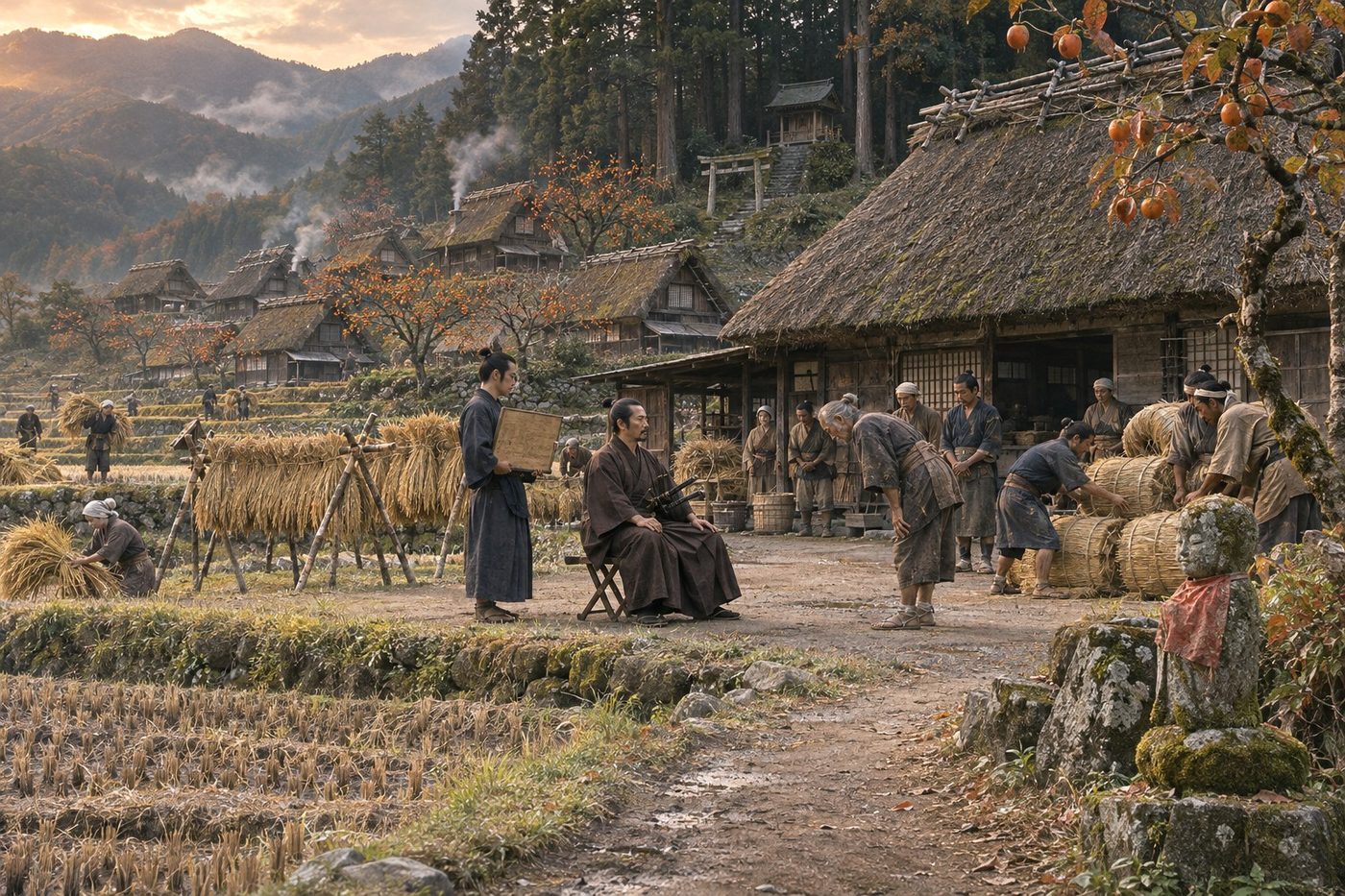
The farmers make up most of the population. They live in villages, grow rice, and pay a share of every harvest to their lord, usually four or five parts in ten. The village pays its tax as a whole, and the village is governed by its own headman and elders. Households are grouped in fives, and each group answers for the crimes, debts, and taxes of all its members. A farmer who flees his village leaves his neighbors to pay his share. Farmers are poor, tough, and far less helpless than samurai believe. Many own spears and bows, and villages have driven off bandits, tax collectors, and even small armies.
Artisans#
The artisans live mostly in towns: smiths, carpenters, potters, weavers, coopers, lacquerers, paper-makers, and many more. Crafts pass from father to son and from master to apprentice, and the great crafts guard their secrets like clan treasures. The swordsmiths are honored above all other artisans. A great smith works in white robes, purified like a priest, and lords call on him in person.
Merchants#
The merchants sit at the bottom of the four classes and at the top of the money. They organize into guilds (za), often under the protection of a temple, shrine, or lord, who takes a cut in return for a monopoly. Kanagura is their city, and Umikado, with its foreign ships, is their fortune. Merchants may not wear silk in some domains, and some wear it under a cotton coat. Every daimyo despises merchants, and every daimyo borrows from them.
Women in Tsurugishima#
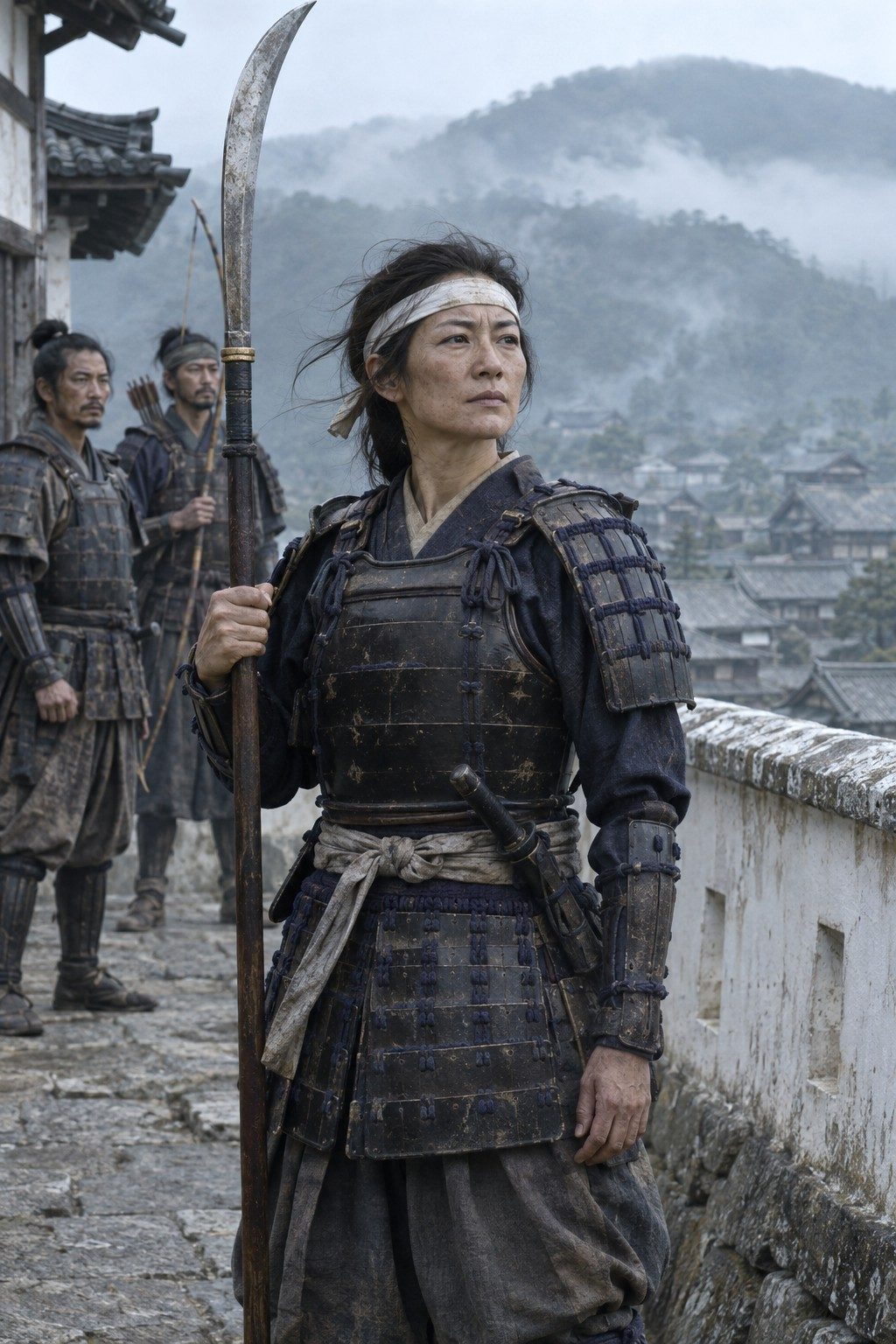
These are the realm's own rules. By its law and custom, the father heads most households, and most marriages are arranged for the good of the clan. Within that frame, a woman's path is wide open:
- Heads of house. A daughter can inherit when there is no son, and a widow often rules in her son's name, or in her own. Several castles are held by women today, and their retainers swear to them by name.
- Warriors. Samurai daughters train with the glaive (naginata) to defend the house, and many train with the bow and sword as well. Women ride to war at the head of their own retainers, and no one finds it remarkable. Foot soldier companies take farmers' daughters as well as farmers' sons.
- Clergy. Abbesses rule great convents with lands and armed guards. Shrine maidens (miko) speak for the kami, and some shrines are headed by priestesses.
- Trade and craft. Merchant widows run some of the richest houses in Kanagura, and women work as brewers, weavers, dyers, physicians, and moneylenders.
Heroes of any gender take the same Edges, Hindrances, and paths. The world may push back on one particular woman, or on one particular man, but the rules never do.
The Clergy#
Priests, monks, nuns, and mystics stand outside the four classes. A farmer's son who shaves his head and takes vows leaves his class behind, and so does a daimyo. Some clergy are holy, some are scholars, and some are landlords with armies.
- Shrine priests (kannushi) and shrine maidens (miko) serve the kami. Priestly offices often pass down through families, and a great shrine's priest can be as proud as any lord.
- Buddhist monks and nuns live in temples and convents, from a single monk in a mountain hut to monasteries of thousands. The great temples own land, collect tolls at barriers and ports, lend money, and protect merchant guilds.
- Warrior monks (sōhei) guard the great monasteries. The greatest temples can field thousands of them, and they have marched on Seikyō itself to force the court's hand.
- Mountain ascetics (yamabushi) and yin-yang masters (onmyōji) live on the edges of the clergy. The court employs onmyōji, and the mountains shelter ascetics.
The Third Power#
The temples are more than places of prayer. Armed temples and the sect leagues (ikki), in which farmers, gentry, and monks band together under a sect's banner, form a third power alongside the red and white plum blossoms. The leagues answer to no lord. In some provinces they have driven out the samurai entirely and rule themselves. Every daimyo needs the temples' blessing, money, and soldiers. Few trust them. The next part, Faith and the Unseen, describes the sects themselves.
Outsiders and Outcasts#
Below and beside the four classes live people that respectable society needs but refuses to touch.
The sakaibito (境人, "boundary folk") do the work that the faiths call polluting: butchering animals, tanning hides, making drums and sandals of leather, burying the dead, and guarding prisons and execution grounds. Because death and blood carry spiritual pollution (kegare), the work is shunned, and the shunning falls on the people who do it. Sakaibito live in their own hamlets at village edges and along riverbanks. They marry among themselves, answer to their own headmen, and keep their own shrines and festivals. They are skilled, proud, and indispensable: every samurai's armor is laced with their leather, and every war drum is stretched by their hands. They are also mocked, cheated, and barred from the shrines and bathhouses of their neighbors.
Alongside them are the wandering folk: beggars, street performers, puppeteers, traveling musicians, fortune-tellers, and blind storytellers who chant the war tales to a lute. Some are born to the road. Others are samurai, monks, or farmers who fell there.
Blade and Kami™ treats these people as people. A hero can be born among the sakaibito, and their knowledge of the roads, the dead, and the places respectable folk won't go is a real strength. How the world treats them is part of the story. How the rules treat them is not.
The Underworld#
Where there are roads, markets, and bored soldiers, there is money to be made outside the law:
- Gamblers (bakuto) run dice games in post-station back rooms and temple courtyards, where the magistrates' men are not welcome.
- Peddlers (tekiya) work the fairs and festivals, selling medicine, charms, toys, and food. They divide the market ground among themselves and punish anyone who sets up without leave.
- Street champions (otokodate) are commoner toughs who protect their neighborhoods from arrogant samurai, bandits, and each other. To townsfolk they are heroes. To magistrates they are a nuisance.
Underworld families bind themselves with a cup oath: a boss (oyabun) and his followers share sake and become father and children, or elder and younger brothers. The oath is as binding as a samurai's oath to his lord, and breaking it is just as dangerous.
Law and Justice#
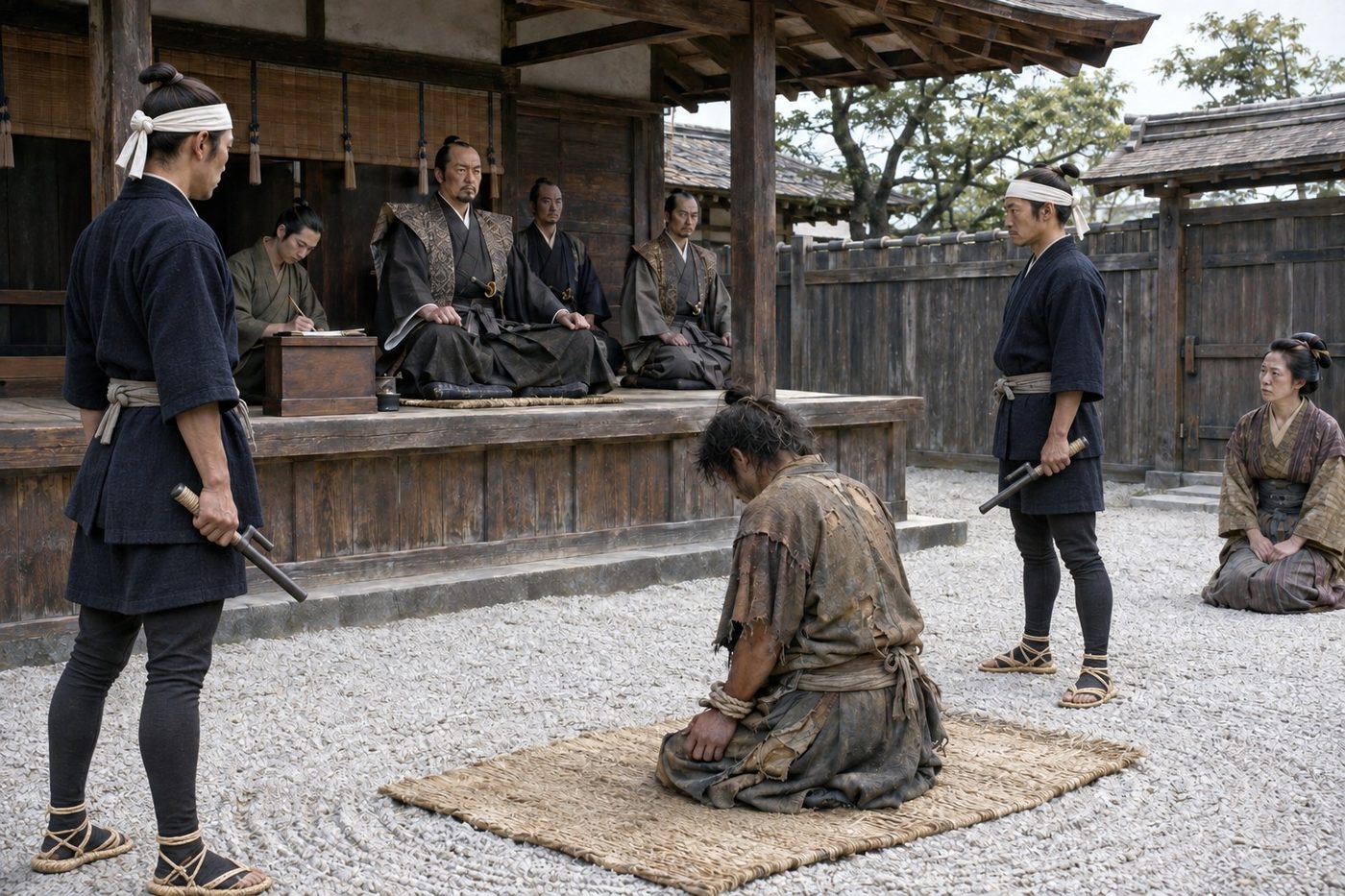
Every daimyo is the law in his own domain, and the Hagane Code is the law above them all, when anyone can enforce it. Each domain and each city appoints magistrates (bugyō), samurai officials who hear cases, keep order, and collect fines. Magistrates rely on constables (dōshin), low-ranking samurai who walk the streets with an iron truncheon (jitte), and on thief-takers (okappiki), commoners, often reformed criminals, who know the back alleys.
Justice in Tsurugishima has a few rules everyone knows:
- Rank decides. The same crime earns a fine for one person and death for another. A samurai who kills a commoner is judged by samurai. A commoner who strikes a samurai is rarely judged at all.
- The cutting right. A samurai may cut down a commoner who insults him. The magistrates still ask questions, and a samurai who uses the right carelessly, or without witnesses, can lose his stipend, his lord's favor, or his head.
- Everyone answers for everyone. Families, five-household groups, and villages share the punishment for one member's crime. This keeps neighbors watching neighbors.
- Confession. A magistrate wants a confession before he passes sentence, and he has ways of getting one.
- Vengeance. A samurai may take revenge for a murdered lord or kinsman, but only after registering the vendetta with the magistrates. A registered avenger can kill the murderer openly. An unregistered one is just another murderer.
Shinobi (忍び)#
Everyone has heard of the shinobi, the hidden ones. Everyone knows that the great lords employ spies, arsonists, and assassins. Few have met one knowingly. The stories say they come from free mountain leagues that answer to no daimyo and sell their skills to all of them, and that they travel disguised as monks, peddlers, ascetics, and players. The stories also say that they can walk on water and vanish in smoke. The first part is true.
Schools#
Every serious art in Tsurugishima is taught through a school (ryūha): a lineage passed from master to student, with its own techniques, secret scrolls, and rivalries. Schools of the sword, the spear, the bow, and unarmed fighting are the most famous, but there are also schools of tea, poetry, flower arranging, medicine, divination, and swordsmithing. A student swears loyalty to the master, pays fees or service, and earns license after license. The final license, a scroll that grants the student the right to teach, is the dream of every swordsman. Rival schools challenge one another, and a school that loses a public duel loses students. Common Places describes what a school looks like, and Chapter 3 explains how heroes join one.
How Groups Are Organized#
Every group in Tsurugishima, from a great clan to a dice house, is built the same way: a head, a few trusted seniors, full members, and newcomers who must prove themselves. Each has its own titles, its own way in, and its own price for leaving. The ladders below are what everyone in the isles knows. Chapters 4 and 5 turn each rung into a rank that heroes can climb.
The Court#
| Rank | Title | Who they are |
|---|---|---|
| Head | The Regent and the Great Ministers | The handful of nobles who speak for the Emperor. The Akebana have held these offices for generations. |
| Seniors | High nobles (kugyō), Third Rank and above | The council of the court |
| Trusted | Fourth Rank | Heads of the old court families, and the court's officers |
| Members | Fifth Rank | Nobles who may enter the Emperor's hall |
| Newcomers | Sixth Rank and below | Clerks, pages, ritualists, and the sons of poor houses |
Court rank is printed in the court's registers. It decides where a noble sits and whom they may address, and no sword can take it away. Joining: birth, or a rank granted by the court. Leaving: a noble keeps their rank for life, unless the court strips it for a crime.
A Samurai Clan#
| Rank | Title | Who they are |
|---|---|---|
| Head | Daimyo (daimyō) | The lord of the domain and head of the main house |
| Seniors | Elders (karō) | The lord's council, who run the domain |
| Trusted | Bannermen (hatamoto) | The lord's guard and chosen captains |
| Members | Retainers (kashin) | Samurai who hold a stipend or fief |
| Newcomers | Foot soldiers and pages (ashigaru, koshō) | Soldiers, squires, and young samurai in training |
Joining: birth, adoption, marriage, or a lord's grant after brave service. Leaving: a retainer who leaves without permission becomes a ronin, and many clans treat it as betrayal.
An Underworld Family#
| Rank | Title | Who they are |
|---|---|---|
| Head | Boss (oyabun) | The "father" of the family |
| Seniors | Lieutenants (wakagashira) | The boss's chosen heir and his captains |
| Trusted | Elder brothers (aniki) | Sworn members who lead small crews |
| Members | Children (kobun) | Sworn members who have shared the cup |
| Newcomers | Hangers-on (sanshita) | Errand runners, lookouts, and debtors working off what they owe |
Joining: the cup oath, before witnesses. Leaving: only with the boss's leave. A member cast out is announced to every family on the road, and none will take him in.
A School (Ryūha, 流派)#
| Rank | Title | Who they are |
|---|---|---|
| Head | Headmaster (sōke) | The heir of the founder's line, keeper of the secret scrolls |
| Seniors | Masters (shihan) | Students who hold the final license and may teach |
| Trusted | Senior students (senpai) | Holders of the middle licenses, who help teach |
| Members | Students (monjin) | Sworn students who have signed the school's oath in blood |
| Newcomers | Beginners (nyūmonsha) | Students on trial, who sweep the floor and watch |
Joining: an introduction, a fee or service, and a signed oath. Leaving: a student may leave, but may never teach the school's techniques. A master who opens a rival school is a traitor to the line.
A Temple#
| Rank | Title | Who they are |
|---|---|---|
| Head | Abbot (jūshoku) | Head of the temple. Great temples are ruled by an abbot of princely rank. |
| Seniors | Elders (chōrō) | Teachers, stewards of the temple lands, and heads of sub-temples |
| Trusted | Ordained monks (sōryo) | Full monks who have taken all their vows. At armed temples, the warrior monks' captains. |
| Members | Novices (shami) | Young monks who have shaved their heads and taken the first vows |
| Newcomers | Acolytes and temple workers (chigo, gyōnin) | Boys sent to learn, temple servants, and warrior monks who keep only a few vows |
Joining: taking vows from a master. Leaving: a monk may return to the world, but a monk who breaks his vows in disgrace is driven out.
A Convent#
| Rank | Title | Who they are |
|---|---|---|
| Head | Abbess (anju) | Head of the convent, often a widow of a great house |
| Seniors | Elder nuns (rōni) | Teachers and stewards of the convent's lands |
| Trusted | Ordained nuns (ama) | Full nuns who have taken all their vows |
| Members | Novices (shamini) | Young nuns who have cut their hair and taken the first vows |
| Newcomers | Refugees and lay sisters (kakekomi) | Women who serve the convent or shelter there |
Convents are also sanctuaries. A wife who flees to a convent and serves there for a set time is free of her marriage, and few lords dare to drag a woman out of one. Joining and leaving work as for a temple.
A Shrine#
| Rank | Title | Who they are |
|---|---|---|
| Head | Chief priest (gūji) | Head of the shrine. The office often passes down through one family. |
| Seniors | Priests (kannushi) | Priests who lead the rites and keep the shrine |
| Trusted | Shrine maidens (miko) | Dancers, oracles, and assistants in the rites |
| Members | Parishioners (ujiko) | Everyone born under the shrine's kami, who owes it festivals and offerings |
| Newcomers | Shrine servants (jinin) | Gatekeepers, carpenters, and children learning the rites |
Joining: a priestly family's birth, or adoption into it. Everyone born in a shrine's district is its parishioner without asking. Leaving: a parishioner who moves away is presented to the kami of his new home.
A Sect League (Ikki, 一揆)#
| Rank | Title | Who they are |
|---|---|---|
| Head | The head temple (honzan) | A distant abbot, whose letters are law |
| Seniors | League elders (otona) | Monks and gentry who lead the league's council |
| Trusted | Banner captains (hatagashira) | Gentry and village headmen who lead the league's fighters |
| Members | Followers (monto) | Farmers, artisans, and townsfolk sworn to the sect |
| Newcomers | Converts (shinmonto) | Newly sworn believers |
Leagues are unusual: their members swear to each other as equals before the sect, and their councils decide by vote. Joining: an oath at the league's temple. Leaving: a member who betrays the league is cast out of the faith and the village together.
A Merchant House and Guild#
| Rank | Title | Who they are |
|---|---|---|
| Head | Master of the house (danna) | The owner, who carries the shop name |
| Seniors | Chief clerk (bantō) | The master's right hand, who runs the business |
| Trusted | Clerks (tedai) | Trusted employees who travel, buy, and sell |
| Members | Apprentices (detchi) | Boys and girls bound to the house for years |
| Newcomers | Day laborers (hiyatoi) | Hired hands and porters |
A guild (za) is a league of merchant houses in one trade. Its masters sit as its council, and it buys protection from a lord, temple, or shrine. Joining: apprenticeship. A faithful chief clerk may be set up with his own branch house and the right to use the shop name.
A Shinobi League#
| Rank | Title | Who they are |
|---|---|---|
| Head | High masters (jōnin) | The league's council, who sell its services and are never seen |
| Seniors | Middle masters (chūnin) | Captains who plan missions and lead agents |
| Members | Agents (genin) | The ones who climb walls and carry knives |
| Newcomers | Apprentices (minarai) | Trained from birth, or bought young |
Joining: birth in the league's valleys, almost always. Leaving: there is no leaving.
A Village#
| Rank | Title | Who they are |
|---|---|---|
| Head | Headman (nanushi) | Often a gentry family. Answers to the lord for the village. |
| Seniors | Elders (toshiyori) | The heads of the oldest families |
| Members | Landholding farmers (honbyakushō) | Families who hold their own fields and pay tax |
| Newcomers | Tenants (mizunomi, "water-drinkers") | Families who work others' land |
The village is a group too, and in a peasant party it is the one heroes rise in. Joining: birth or marriage. A stranger needs a villager to stand surety for him.
Notes#
- The sakaibito are modeled on the outcast classes described in Lafcadio Hearn, Japan: An Attempt at Interpretation (1904), and in A. B. Mitford, Tales of Old Japan (1871).
- The sect leagues follow the armed leagues of believers described in F. Brinkley, A History of the Japanese People (1915).
- Whose Are You? draws on K. Asakawa, "The Origin of the Feudal Land Tenure in Japan" (1914), for land commended upward to protectors, and on Asakawa's translation of The Documents of Iriki (1929), documents 15–17, for a head of house answering for his branches and for vassal families who refused a new lord. The Arasawa example is Chapter 11's The Night the Drum Sounds.
- The pleasure quarters draw on J. E. de Becker, The Nightless City (1899).
Part 4: Faith and the Unseen#
A World Full of Spirits#
Nobody in Tsurugishima asks whether the spirits are real. The question is which ones are watching, and what they want. A farmer bows to the kami of his rice field in the morning, lights incense for his grandfather at noon, buys a temple charm against fever in the afternoon, and hangs a paper talisman over his door at dusk in case the fox from the hill is hungry tonight. None of that feels contradictory to him. The kami, the Buddha, the ancestors, and the yōkai all share one crowded world, and a wise person keeps on good terms with all of them.
People say it simply: you are born to the shrine and you die to the temple. The kami bless life, birth, harvest, and marriage. The Buddha's Law guides the dead.
The Kami#
A kami is anything that inspires awe: a great mountain, an ancient tree, a waterfall, a fox, a hero, a lord, a sword, or a grandmother who died well. There are said to be eight million of them, which is a way of saying they cannot be counted.
At the top stand the Forging Gods, who made the Great Sword and cut heaven from earth. The Emperor descends from them. Below them are the Eight Kami of the Mountain, who dwell on Mount Hōrai and taught the first sorcerers. Every province, village, river, and pass has its own kami, and so does every hearth, well, and privy.
Kami are neither good nor evil. Each has a gentle spirit (nigimitama) that blesses and a rough spirit (aramitama) that rages. A kami honored with offerings, festivals, and purity sends rain, children, and victory. A kami neglected or polluted sends plague, flood, and madness. Many of the great shrines were founded to calm an angry kami, and some of those kami were once men who died wronged.
Shrines#
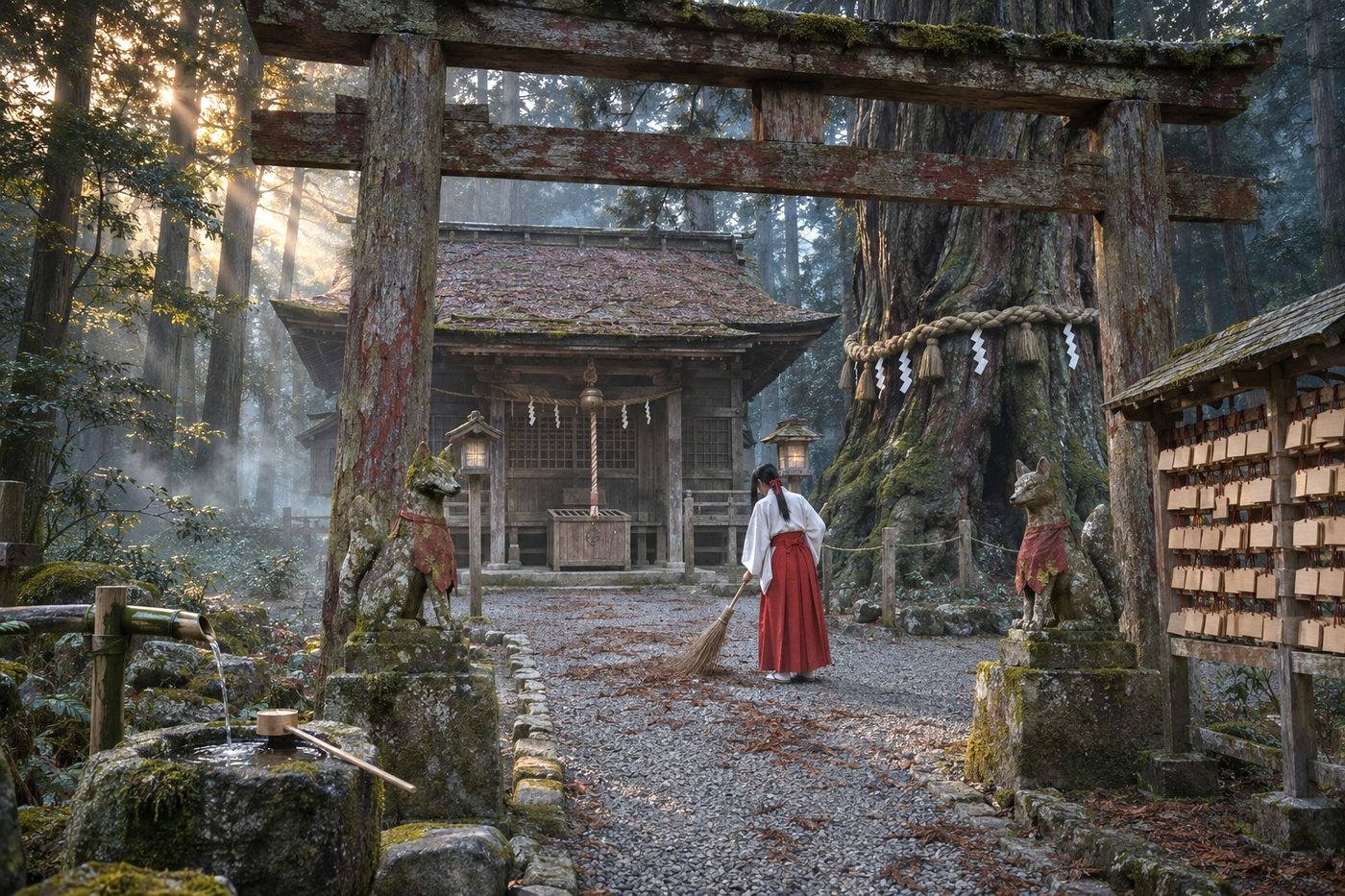
A shrine (jinja) is a kami's house. Every shrine, from a great provincial sanctuary to a little box on a farmhouse shelf, follows the same plan:
- A gate (torii), two pillars and two crossbeams, marks the line between the everyday world and the kami's ground. Passing under it, a visitor enters a purer place.
- A basin of running water stands inside the gate, for rinsing the hands and mouth.
- Stone guardians flank the path: lion-dogs (komainu), or foxes at the shrines of the rice kami.
- The worship hall (haiden) is where people pray, and the main hall (honden) behind it is where the kami dwells. Only priests enter the main hall.
- Inside the main hall is the sacred object (shintai) that the kami inhabits: a mirror, a sword, a stone, or sometimes the mountain itself. Almost nobody has seen it.
- A sacred rope (shimenawa) with hanging zigzag papers marks anything holy: a gate, a rock, or a tree.
To pray, a worshipper rinses at the basin, approaches the hall, drops a coin in the offering box, rings the bell to wake the kami, bows twice, claps twice, prays, and bows once more. That is the prayer Jirō makes at Kurogane Pass.
Each village has a guardian kami (ujigami), and everyone born under it is its parishioner (ujiko). Each province has a first shrine (ichi-no-miya), the greatest in the province, where the daimyo prays before war. Pilgrims walk the roads to the most famous shrines of the realm, and those roads are some of the safest in the isles, because few bandits want to rob a pilgrim and anger his kami.
Festivals#
Twice a year, and often more, a shrine holds a festival (matsuri). The priests purify themselves and call the kami down. Then the whole village feasts, drinks, dances, and carries the kami through the streets in a portable shrine (mikoshi), shouting and swaying so the kami can enjoy the ride and see its people. Festivals are joyful, loud, drunken, and holy all at once. They are also where feuds flare up, lovers meet, and underworld peddlers make their year's money.
The Buddha's Law#
The Buddha's Law came from the mainland with the first iron-working monks and has shaped the isles ever since. It teaches that all life is suffering, born of craving, and that the path of wisdom and compassion leads to release from the endless wheel of rebirth. Most people know less about the teaching than about the temples. Temples hold funerals, care for the dead, teach children to read, nurse the sick, lend money, and own a great deal of land.
The faithful pray to the Buddha and to the great bodhisattvas, enlightened beings who delay their own release to save others. People know them by title:
- The Buddha of Boundless Light, who rules a Western Paradise and has vowed to save anyone who calls his name.
- The Bodhisattva of Mercy, who hears the cries of the world and takes a thousand forms to answer them.
- The Guardian of Children and Travelers, whose small stone statues, called jizō, stand at every crossroads and graveyard, wearing red bibs that grieving mothers tie on them.
- The Immovable King, a wrathful guardian wreathed in flame, who holds a sword to cut through delusion and a rope to bind demons. Warriors and mountain ascetics pray to him.
The kami and the Buddha get along. Most great shrines have a temple beside them, and most great temples have a shrine inside their gates. Monks teach that the kami are protectors of the Law, and some teach that the kami are the Buddha's own local faces.
The Great Sects#
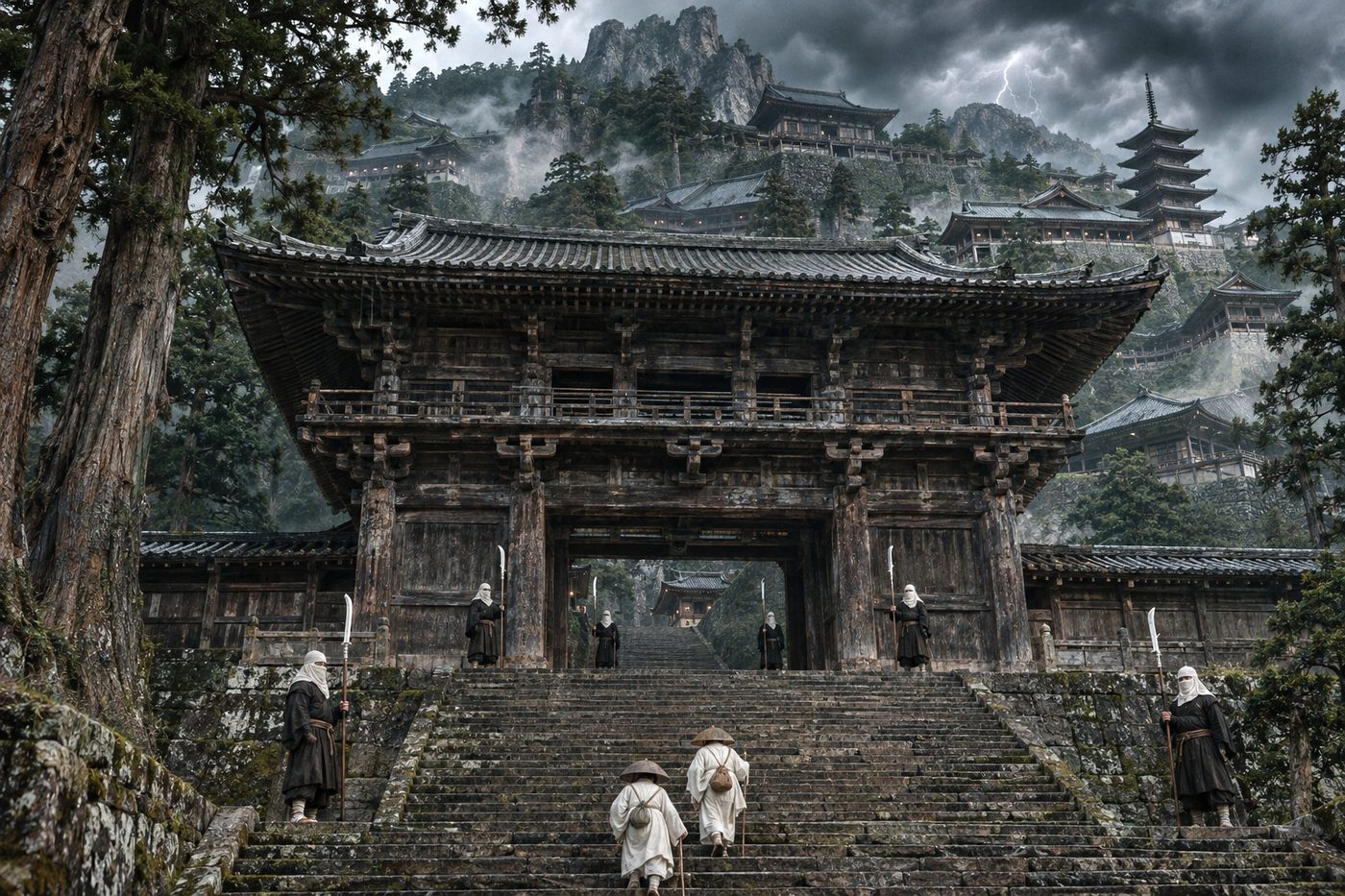
The Buddha's Law has split into many sects, each with its own head temple, its own teaching, and its own friends and enemies. Four matter most in the present day:
| Sect | Teaching | Who follows it | Power |
|---|---|---|---|
| Thunder Peak (Raihō-shū, 雷峰宗) | Secret rites, mantras, hand seals, and fire offerings that only initiates may learn | The court, old noble houses, and mountain ascetics | The oldest and richest sect. Its head temple, Raihō-ji in Hōzuki, keeps thousands of warrior monks. |
| Western Light (Saikō-shū, 西光宗) | Faith alone saves: anyone who calls on the Buddha of Boundless Light, even a butcher or a murderer, is reborn in the Western Paradise | Farmers, sakaibito, the poor, and many rural gentry | The fastest-growing sect, and the heart of the sect leagues (ikki) that rule whole districts |
| Still Mind (Jōshin-shū, 静心宗) | Seated meditation, discipline, and sudden insight, taught through riddles, tea, and gardens | Samurai, the Shogunate, and artists | Rich in patrons. Its great temples in Hagane and Kanagura teach the sons of lords. |
| Lion's Roar (Shiku-shū, 獅吼宗) | One sutra alone holds the truth, and every other sect leads to ruin | Townsfolk, merchants, and artisans | Loud and militant. Its preachers beat drums on street corners, and its townsmen arm themselves against the Western Light leagues. |
Older scholarly sects survive in Furumiya and Seikyō, wealthy, learned, and mostly harmless. Dozens of smaller sects, hermits, and wandering preachers fill the gaps.
The sects compete for patrons, land, and souls, and the competition is not always peaceful. Warrior monks of Thunder Peak have burned Lion's Roar temples. Western Light leagues have driven daimyo out of their own provinces. Every warlord needs at least one great sect on his side, and fears the others.
The Five Mystic Paths#
Most clergy pray and serve. A few touch real power. Tsurugishima knows five paths to it, together called the Five Paths, and anyone who walks one is a genja. Chapter 6 describes what each can do:
- Shrine mediums (kannagi), the shrine priests and shrine maidens (kannushi and miko) whose prayers truly reach the kami, call down the kami, purify pollution, raise sacred boundaries, and let the kami speak through them. Shrine maidens were oracles long before they were dancers.
- Scholar-monks and scholar-nuns (gakushō), the few Buddhist monks and nuns (sōryo) whose learning has become power, chant sutras that calm spirits, see through illusion, and send the restless dead onward.
- Warrior monks (sōhei) turn their faith into battle: blessed glaives, war cries that freeze the blood, and bodies that fight on through wounds that fell other men.
- Mountain ascetics (yamabushi) follow the Mountain Way (Shugendō), mixing the kami and the Buddha's Law. They stand under freezing waterfalls, walk on coals, blow conch-shell horns, and bargain with the kami and tengu of the high places. Most are tied to Thunder Peak.
- Yin-yang masters (onmyōji) follow the Way of Yin and Yang (Onmyōdō), a scholarly art from the mainland. The court's Bureau of Yin and Yang keeps the calendar, reads the stars, and names lucky days and forbidden directions. Onmyōji write paper talismans (ofuda), bind spirit servants (shikigami), and lay curses that their masters pretend not to know about.
The Foreign Faith#
In the last ten years, ships from beyond Daqian, further west than any islander has sailed, have begun to put in at Umikado. They bring firearms, glass, wine, clocks, and priests. The priests in black robes preach a single god who made the world, and they call the kami and the bodhisattvas demons or dreams.
What strikes islanders most is the book. Every priest and every believer carries a small book bound in black leather, printed in foreign letters. They read it aloud, swear oaths on it, kiss it, and quote it to settle any argument. A shrine hides its sacred object where no one can see it, and a temple keeps its sutras in a locked hall, so a faith that hands its holiest thing to every fisherman, and lets him stuff it in his sleeve, seems very odd indeed. Islanders call the newcomers' religion the Teaching of the Black Book (Kokusho-kyō, 黒書教), or just "the Black Book." The believers have their own name for it, which few islanders can pronounce.
A few thousand people in Akashio have taken the new faith, among them merchants who want the foreigners' trade and one or two lords who want their guns. The temples call it a plague, and the Shikken taxes it. Most people have never seen a foreigner and treat the stories as one more rumor from the coast. Rumor also says that a black book can be bought in Umikado for a few coins, and that some who cannot read a word of it carry one anyway, as a charm against bullets.
Purity and Pollution#
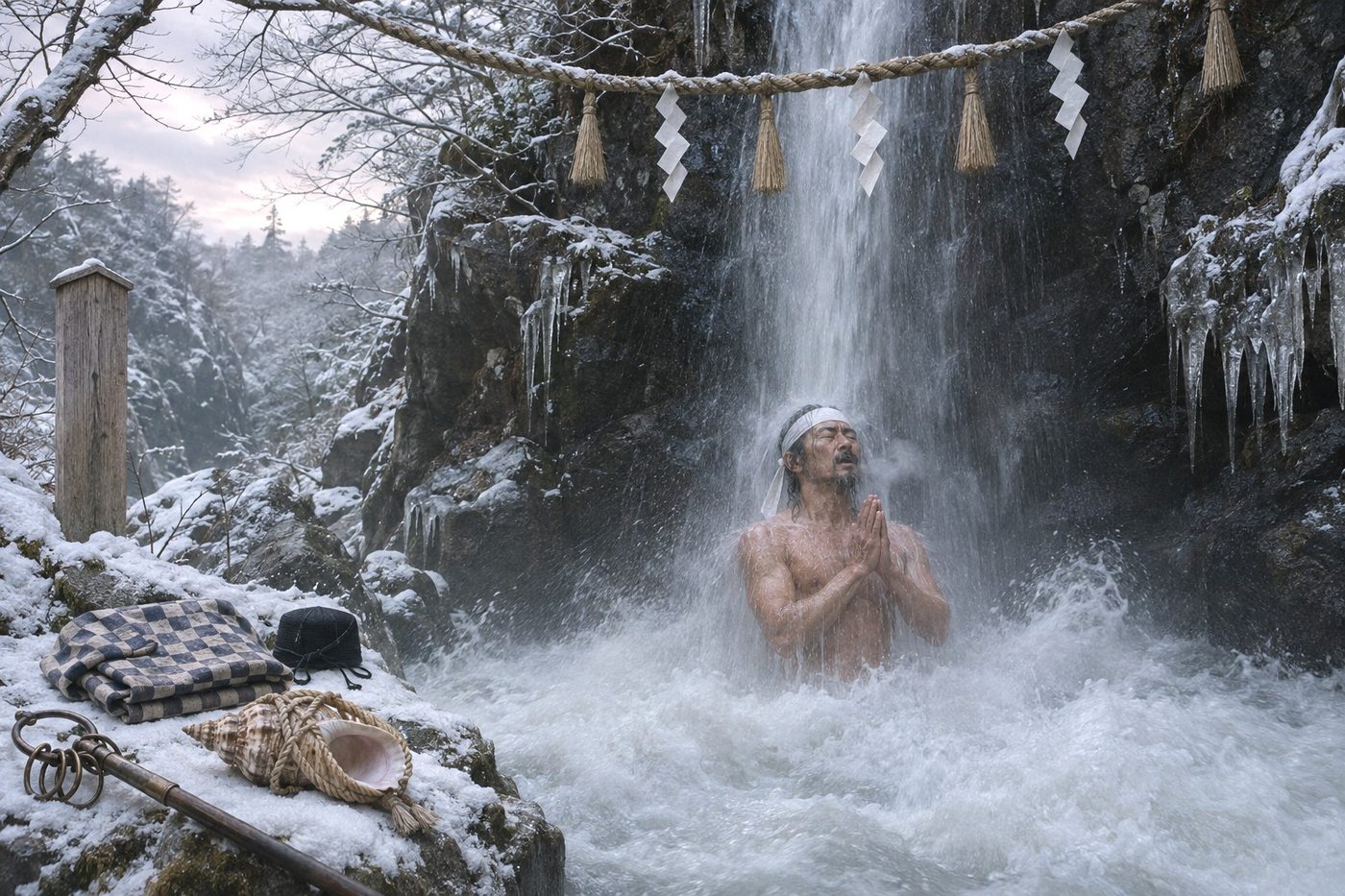
The kami love purity and hate pollution (kegare). Pollution is not sin. It is something closer to dirt on the spirit, caught like a chill from anything that touches death, blood, or decay:
- Death. A corpse pollutes everyone in the house, and a funeral pollutes the mourners. Families in mourning stay away from shrines for 49 days.
- Blood. Wounds, childbirth, and slaughter all pollute. Warriors purify themselves after battle before they enter a shrine.
- Disease and disaster. A plague village or a burned town carries pollution until it is cleansed.
- Crime and broken taboos. Murder, sacrilege, and incest pollute both the doer and the land.
- Meat. Eating the flesh of four-legged animals pollutes, and the pious avoid it. Fish and fowl are clean. Hunters, the hungry, and many soldiers eat venison and boar anyway, and call it "mountain whale."
Pollution is cleansed by purification (harai): rinsing with water, scattering salt, a priest's wave of the sacred wand, or standing under a cold waterfall (misogi). Twice a year, in the sixth and twelfth months, every shrine holds a great purification, when people rub their sins and sicknesses onto paper figures that the priests then float away down a river.
Pollution also gathers in places. A battlefield, an execution ground, or a well where someone drowned can sour for years. When pollution builds high enough, the kami turn their rough spirits outward and the yōkai come. Many people believe that is what is happening now: that a century of blood has fouled the isles, and that the spirits are waking because of it.
The rules for pollution appear in Chapter 4, and the rites of purification in Chapter 6.
Ancestors and the Dead#
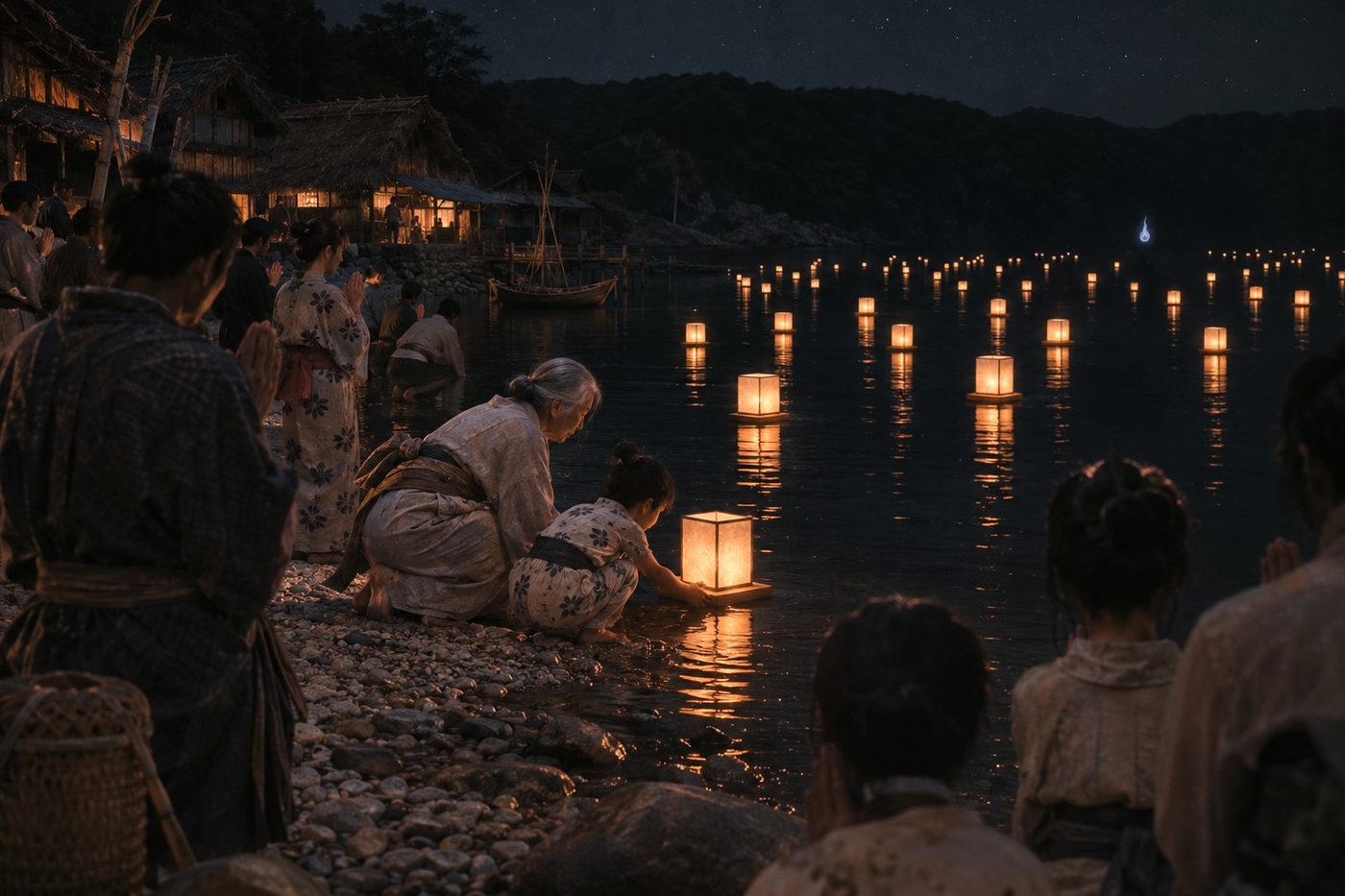
The dead do not leave. They join the family's ancestors, who watch over the living, share in their meals, and take pride or shame in what their descendants do. Every home has an ancestor altar (butsudan) holding wooden tablets inscribed with the names of the family's dead. The family offers them rice, tea, and incense every day, tells them the news, and asks their advice. A samurai about to do something terrible may apologize to his ancestors first. A samurai who disgraces his house shames every name on that altar.
Temples handle funerals. The dead are washed, dressed in white, and burned or buried with a coin for the river crossing. They receive a new posthumous name from the priest. For 49 days the soul wanders between worlds, and the family prays it safely onward.
Every year in the Seventh Month, the first month of autumn, at the Festival of the Dead (Bon), the ancestors come home for three days. Families clean the graves, light fires to guide the spirits back, dance in the streets at night, and then set paper lanterns on rivers and the sea to light their way out again. In coastal towns the water fills with ten thousand small lights, and on certain shores, the people say, some of the lights are not lanterns.
Not every dead person rests. Those who die by violence, without burial, with a great wrong unavenged, or with a great love unfinished may become ghosts (yūrei), pale figures in white burial robes who return to finish what death interrupted. Those who die with no family to feed them become hungry ghosts, forever starving. Both are why the living keep their offerings faithful, and why everyone fears dying far from home.
Some retainers once followed their lords into death by their own hand, to serve them in the next world. Most daimyo now forbid it. Some retainers do it anyway.
Everyday Beliefs#
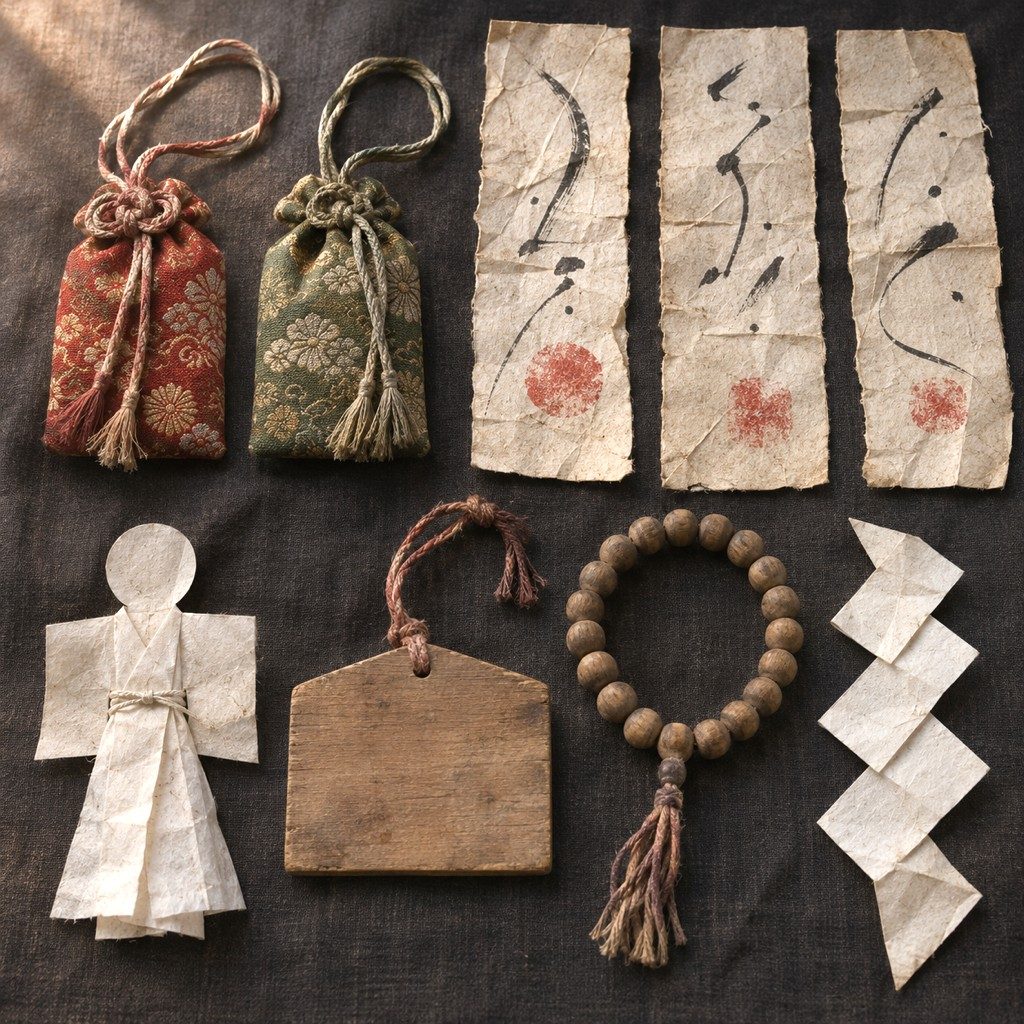
Between the shrines and the temples lies a world of signs, charms, and small courtesies that everyone knows:
- Charms (omamori) from shrines and temples protect against fire, illness, drowning, and arrows. Most people carry several. Soldiers carry dozens.
- Paper talismans (ofuda) over doors and in rafters keep out spirits, thieves, and fire.
- Directions and days. Diviners publish lists of unlucky days, and certain directions are forbidden in certain years. A traveler may walk a mile out of the way to avoid heading into a closed direction. The northeast, the demon gate (kimon), is always unlucky, and castles and cities guard it with temples.
- Omens. A crow cawing at night, a snapped sandal thong, or a comb picked up from the road warns of death. A white fox, a crane, or a snake in the storehouse brings luck.
- The Hour of the Ox, between 1 and 3 in the morning, is the hour of curses. Anyone found at a shrine then, hammering nails into a tree, is up to no good.
And everyone knows a few things about the yōkai, the strange creatures that live at the edges of the world:
- Foxes (kitsune) are messengers of the rice kami, and also tricksters and shapeshifters who take the form of beautiful women. When the sun shines through falling rain, foxes are holding a wedding, and it is wise not to watch.
- Kappa lurk in rivers and ponds, drowning swimmers and horses. They are polite to a fault: bow to a kappa, and it bows back and spills the water from the dish on its head, which robs it of its strength.
- Tengu, the long-nosed or crow-faced goblins of the mountains, kidnap the proud, mislead travelers, and sometimes teach swordsmanship to those who impress them.
- Raccoon-dogs (tanuki) play pranks, change shape, and drum on their bellies on moonlit nights.
- Oni, horned demons with iron clubs, are the stuff of the worst stories, and some say they have been seen again in the mountains of the north.
The Bestiary gives the truth behind these stories, and the truth is usually worse.
Notes#
- The gentle and rough spirits of the kami, the village guardian kami, and purification follow W. G. Aston, Shinto: The Way of the Gods (1905).
- Foxes, tengu, and kappa draw on F. Hadland Davis, Myths and Legends of Japan (1912), and William Elliot Griffis, Japanese Fairy World (1880).
- Mountain ascetics and trance draw on Percival Lowell, Occult Japan (1894).
Part 5: Daily Life#
A Day in the Isles#
The day starts before dawn with the temple bell. Farmers are in the paddies by first light. Samurai rise, wash, dress their hair, and greet their lord or their ancestors. Shops in the towns open their shutters as the mist burns off. At dusk the bells ring again, lamps are lit if a family can afford the oil, and most people are asleep soon after dark. Night belongs to watchmen, gamblers, lovers, thieves, and spirits.
Homes#
Most houses in Tsurugishima are built of wood, paper, and straw, raised a little off the ground, with deep eaves against the rain. Inside, people take off their sandals at the door and live on the floor: they sit, eat, and sleep on straw mats (tatami) in a rich house, or on wooden boards and rush matting in a poor one. Sliding doors of paper and wood (shōji and fusuma) divide the rooms and can be opened or lifted out to make one large space. There are few furnishings: a chest, a low table, bedding rolled into a cupboard by day, and the ancestor altar.
Houses burn easily, and towns burn often. Every town keeps fire watchmen, and every rich merchant keeps his treasures in a thick-walled, plastered storehouse (kura) that can survive a fire.
Common Places describes a peasant's, a craftsman's, and a samurai's home.
Food#
Rice is life. A lord's wealth, a samurai's salary, and a farmer's tax are all counted in rice, and polished white rice is the food of the well-off. Farmers grow it but eat little of it, living instead on millet, barley, buckwheat, and radish, with rice for festivals and the sick.
A typical meal is a bowl of grain, a bowl of soup made with fermented bean paste (miso), pickled vegetables, and, for those who can afford it, a piece of grilled or dried fish. Bean curd (tōfu), seaweed, mountain vegetables, and sea salt round out the table. Most people eat two meals a day, and samurai on campaign eat three if they can get them, plus balls of rice wrapped in leaves for the march.
Because eating four-legged animals pollutes, the pious avoid beef, horse, and pork. Fish and birds are fine. Hunters and soldiers eat deer and boar anyway, calling it "mountain whale," and the sakaibito, whose work already pollutes, eat what they like.
To drink, there is water, barley tea, and sake, brewed from rice by temples, merchants, and every village that can spare the grain. Tea proper, whisked green tea from the mainland, is a luxury of the rich, the clergy, and the samurai, and the ritual of serving it is an art with its own schools.
Dress#
Everyone wears some form of wrapped robe, closed left over right (right over left is for the dead) and tied with a sash. What it is made of, how it is cut, and what is worn over it tells a stranger everything:
- Farmers wear short robes and leggings of hemp or homespun cotton, straw sandals, and wide sedge hats. Women and men dress much alike in the fields.
- Townsfolk wear longer robes of cotton, dyed blue, brown, or gray. Merchants who are rich enough to wear silk often hide it under a plain outer coat, because many domains forbid silk to commoners.
- Samurai wear a robe with wide pleated trousers (hakama), and on formal occasions a stiff winged vest over it. They wear two swords at the sash, the long sword edge-up. A samurai's robes bear his family crest (kamon), small and white, on the back, chest, and sleeves.
- Court nobles wear layered silk in colors fixed by rank and season, tall black lacquered caps, and, among the old families, blackened teeth and painted eyebrows.
- Clergy wear dark robes and stoles, and monks and nuns shave their heads. Shrine priests wear white robes with tall black caps, and shrine maidens wear white robes with scarlet trousers.
Men of the warrior class shave the front of the head and tie the rest of their hair into a topknot, which also cushions the helmet. Cutting off a man's topknot shames him almost as much as cutting off his head. Monks shave their heads completely. Women wear their hair long, tied back or worn loose down the back, and a woman who cuts it short is usually entering a convent.
In the present day, everyone who takes a side shows it. Retainers of the red plum blossom add a crimson cord to their sword hilts or a red plum crest to their banners. Followers of the white plum blossom do the same in white. Wearing the wrong color on the wrong road is a good way to start a fight.
Travel and Roads#
Most people never travel farther than the nearest market town. Those who do, travel on foot. Only samurai and the rich ride horses, the very rich and the very old are carried in palanquins, and carts are rare outside the cities, because the roads are narrow, steep, and built for feet.
The Great Roads#
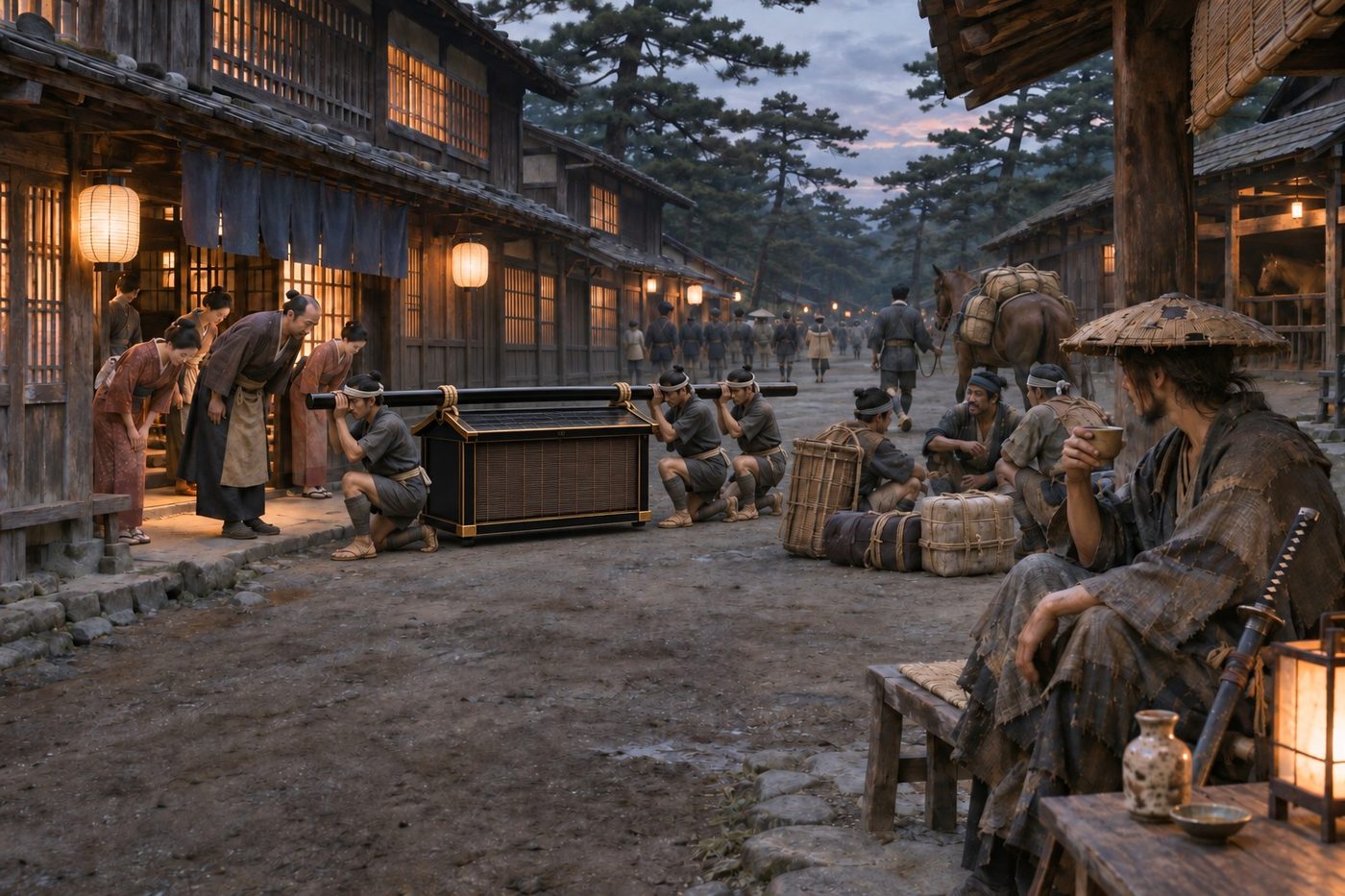
A few great roads link the capitals to the provinces. They are lined with pines for shade, marked with mileposts, and broken every few hours by post-stations (shukuba), where travelers find inns, teahouses, fresh porters, and horses for hire. Between the stations, the road climbs passes, fords rivers, and winds through forests where bandits wait.
| Travel | Distance per day |
|---|---|
| Walking, with a pack | about 20 miles |
| A hard march | about 30 miles |
| Riding, changing horses at stations | 40 miles or more |
| A relay of mounted messengers | up to 100 miles |
| A coastal ship, with good wind | 50 to 100 miles |
Mileposts on the great roads count distance in ri, about 2.4 miles each, so a day's walk is about eight ri. This book gives distances in miles.
Barriers and Travel Passes#
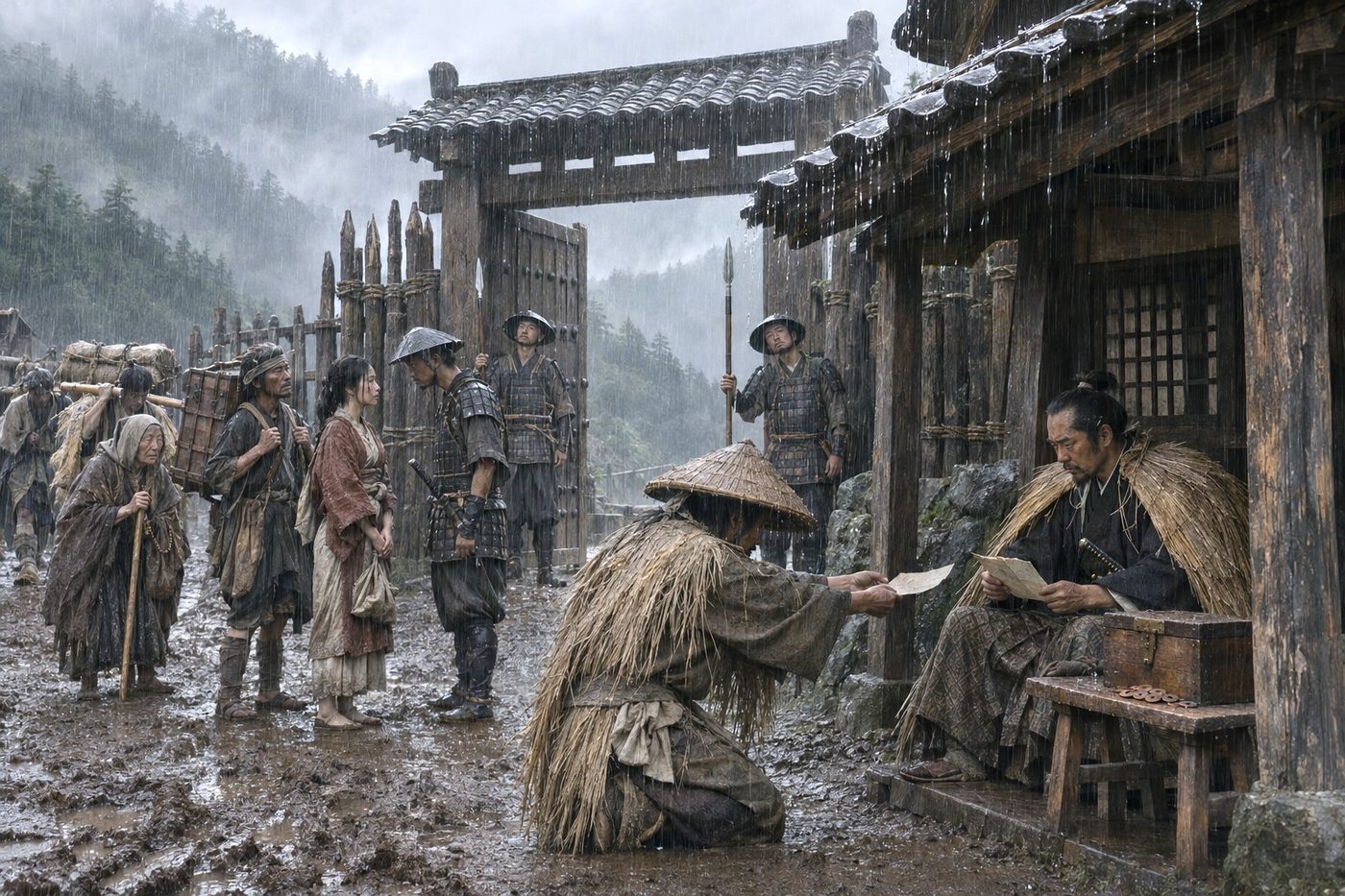
Every lord, and many temples and shrines, have built barriers (sekisho) across the roads: a gate, a guardhouse, a palisade, and a handful of bored, suspicious guards. At a barrier, a traveler must show a travel pass (kasho), a written permit issued by his lord, his village headman, or his temple, and pay a toll. Guards look hardest at two things leaving a domain and one thing entering it: women leaving (because a fleeing hostage is a catastrophe), money leaving, and guns coming in.
Barrier tolls are a fortune for whoever holds them, so in the warring years they have multiplied. A merchant crossing from one coast to the other may pass dozens of barriers and pay at each. Some barriers belong to temples that collect tolls in the Buddha's name. The toll at Kurogane Pass is famous, and so are the travelers who refuse to pay it.
Travelers without passes go around the barriers by mountain paths. Smugglers, shinobi, ronin, and runaways know these paths well. So do the bandits and the yōkai.
Rivers and the Sea#
Few large rivers have bridges, because lords prefer rivers that armies cannot easily cross. Travelers ford with hired river porters, who carry them on their shoulders or on platforms, or wait for a ferry. Floods can strand a whole road for days, filling the post-stations with stranded travelers, gamblers, and trouble.
Along the coasts, the sea is the fastest road of all. Rice, salt, timber, and soldiers move by ship from port to port. The Shogun's fleet at Hagane can land an army almost anywhere in days. Pirates prey on the narrow straits, and the sea kami demand their offerings before every voyage.
The Calendar and Hours#
Years#
Years are counted by the Kenreki (剣暦), the Sword Calendar, from the first Emperor's unification. The present year is Kenreki 1261. Documents also name the year by its place in the old twelve-animal cycle from the mainland, and people say a child was born "in a Tiger year" the way others might name a sign of the stars.
Months and Seasons#
The year follows the moon. It has twelve months of 29 or 30 days, each beginning on a new moon, and an extra month is added every few years to keep the seasons in step. The new year begins in late winter, with the first plum blossoms. Each month has a number and a poetic name, and both are used:
| Month | Name | Meaning | Season |
|---|---|---|---|
| First | Mutsuki | Month of Friendship | Spring |
| Second | Kisaragi | Month of Extra Robes | Spring |
| Third | Yayoi | Month of New Growth | Spring |
| Fourth | Uzuki | Month of Deutzia Flowers | Summer |
| Fifth | Satsuki | Month of Rice Planting | Summer |
| Sixth | Minazuki | Month of Water | Summer |
| Seventh | Fumizuki | Month of Letters | Autumn |
| Eighth | Hazuki | Month of Leaves | Autumn |
| Ninth | Nagatsuki | Month of Long Nights | Autumn |
| Tenth | Kannazuki | Month without Gods | Winter |
| Eleventh | Shimotsuki | Month of Frost | Winter |
| Twelfth | Shiwasu | Month of Running Priests | Winter |
The Month without Gods is so called because the kami leave their shrines to gather in council. Some places say the kami gather on Mount Hōrai. The Sixth Month shares its name with the Minazuki house, the founders of the Shogunate, and old Minazuki retainers still celebrate it.
Hours#
The day and night are divided into twelve hours, each about two of our hours long, and each named for an animal of the mainland cycle. Temple bells ring them out, so most people know the hour without ever seeing a clock.
| Hour | Time | Hour | Time |
|---|---|---|---|
| Rat | 11 p.m. to 1 a.m. | Horse | 11 a.m. to 1 p.m. |
| Ox | 1 to 3 a.m. | Sheep | 1 to 3 p.m. |
| Tiger | 3 to 5 a.m. | Monkey | 3 to 5 p.m. |
| Rabbit | 5 to 7 a.m. | Rooster | 5 to 7 p.m. |
| Dragon | 7 to 9 a.m. | Dog | 7 to 9 p.m. |
| Snake | 9 to 11 a.m. | Boar | 9 to 11 p.m. |
The Hour of the Ox is the hour of curses and ghosts. The Hour of the Rabbit, at dawn, is when the gates open and the day's business begins.
Festivals of the Year#
The year turns on festivals. Every village has its own, but these are kept across the isles:
- New Year (First Month). Debts are paid, houses are cleaned, pine and bamboo stand at every gate, and the whole realm turns a year older together, because everyone's age is counted from the New Year.
- Bean-scattering (the eve of spring). Families throw roasted beans out of the house, shouting "Demons out, luck in!"
- The Five Seasonal Festivals fall on the seventh day of the First Month and on the doubled days: the third of the Third Month, the fifth of the Fifth, the seventh of the Seventh, and the ninth of the Ninth. They honor young herbs, daughters, sons, the lovers in the stars, and chrysanthemums.
- The Great Purifications (end of the Sixth and Twelfth Months). Faith and the Unseen describes them.
- The Festival of the Dead (mid–Seventh Month). The ancestors come home.
- Harvest festivals (Ninth and Tenth Months). Every village thanks its kami, and every lord collects his tax.
Money#
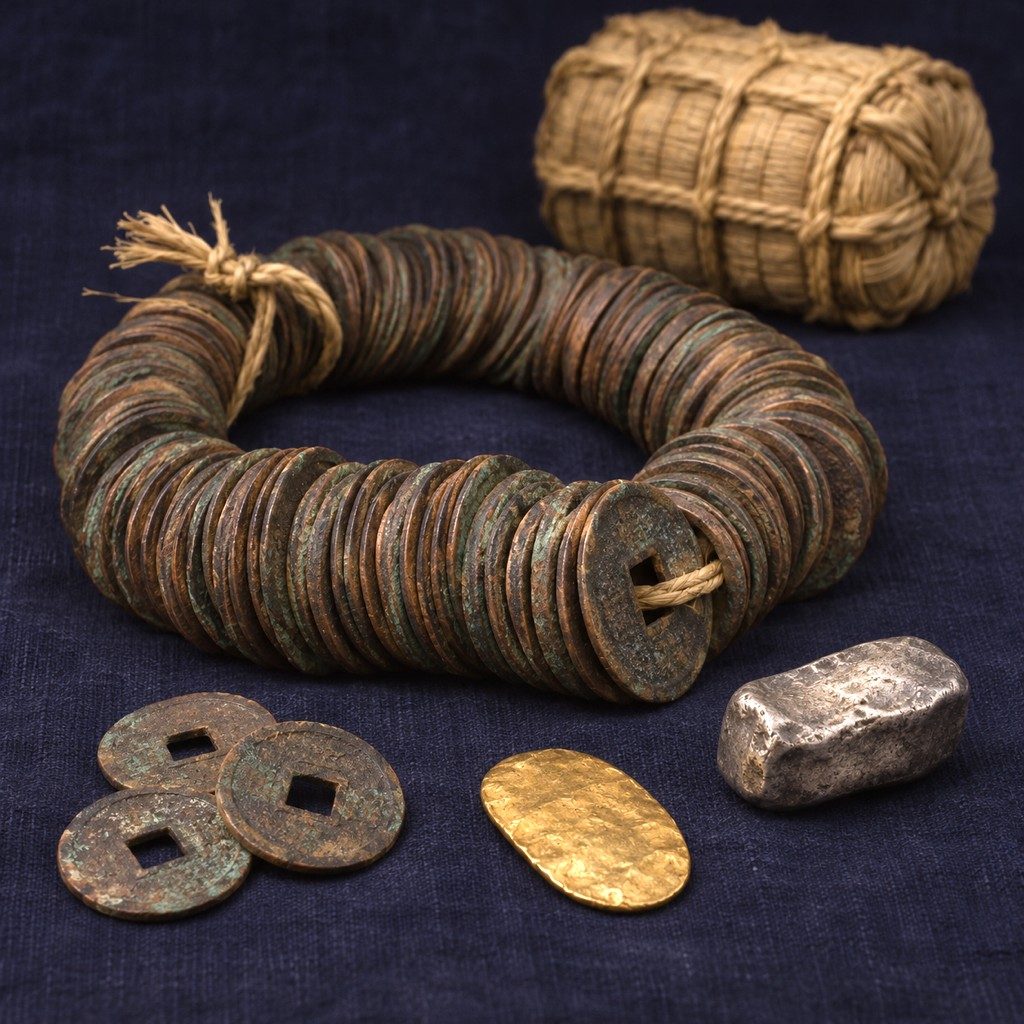
Tsurugishima has no single coin for everyone. Its money comes in three kinds, and people use whichever suits the deal:
- Copper cash (mon) is the everyday coin, round with a square hole in the middle so it can be strung on a cord. The realm mints few coins of its own, so most of the copper in circulation comes from Daqian, and some of it is very old. A string of 1,000 mon is a kan (kanmon).
- Gold and silver (ryō) are weighed rather than counted, and used for large deals, bribes, and the treasuries of lords. One gold ryō is worth 10 silver ryō, or 2,000 mon, so a silver ryō is 200 mon. In this book, a ryō with no metal named is a silver ryō.
- Rice (koku) measures wealth itself. One koku, about five bushels, feeds one person for a year and is worth about 1,000 mon. Lords, domains, and temples count their incomes in koku, and samurai are paid in it. The poorest retainers have to sell their rice salaries to merchants, at whatever price the merchants offer.
In the rules, 1 mon equals $1. Every price in the SWADE core rules and the companions is read in mon, and a hero's starting funds of $500 are 500 mon, half a string of cash.
| Everyday item or service | Price |
|---|---|
| A pair of straw sandals | 1 mon |
| A meal at a roadside teahouse | 10 mon |
| A cup of sake | 1 mon |
| A night at a post-station inn, with supper | 50 mon |
| A river porter's carry across a ford | 10 to 30 mon |
| A barrier toll | 10 to 50 mon |
| A shrine charm | 5 mon |
| A month's wages for a laborer | 500 mon |
| Common clothes | 20 mon |
| A riding horse, or a war horse | 300 mon, or 750 mon |
| One koku of rice | about 1,000 mon |
Prices for weapons, armor, and gear appear in the Gear section of Chapter 3, which is the authority wherever the two differ.
Part 6: Common Places#
A Village#
A village sits where water does. Rice paddies spread across the valley floor in terraces, flooded mirror-bright in spring, green in summer, gold in autumn, and stubbled brown in winter. The houses cluster on higher, drier ground at the paddies' edge, with vegetable plots and persimmon trees between them, and woods climbing the hill behind.
A traveler walking in passes, in order:
- A stone jizō at the village boundary, wearing a red bib, with a cup of water at its feet.
- A few outlying houses of tenant families, smaller and poorer than the rest.
- The headman's house, larger than any other, with a proper gate and a storehouse. Strangers report here, and it is where the tax rice is counted.
- The shrine of the village kami on a wooded rise, reached by stone steps through a torii. Festivals happen here, and so does village council.
- A small temple, or the house of a single monk, with the village graveyard behind it.
- The village well, the bathhouse if there is one, and a notice board where the lord's orders are posted.
A village of 30 to 100 households is ordinary. Everyone knows everyone, everyone is related to half the others, and every stranger is watched from the moment he passes the jizō. Villagers are polite, guarded, and tightly bound by the five-household groups that make them answer for each other. A village that likes a hero will hide him from a lord. A village that fears a hero will sell him to one.
Beyond the last houses, at the edge of the riverbank, there may be a smaller hamlet that villagers do not mention: the sakaibito, who tan the village's hides and bury its dead.
A Town#
A town grows where something draws people: a crossroads, a port, a great temple, or a castle.
- A post-station town stretches along a great road for a mile or more: inns with their lanterns and touts, teahouses, stables, porters' quarters, and a magistrate's office near the barrier.
- A temple town crowds around the gate of a great temple, selling charms, incense, souvenirs, food, and lodging to pilgrims. The temple owns the land, collects the rents, and keeps order with its own monks.
- A port town smells of fish, tar, and salt. Its warehouses face the water, its sailors drink hard, and its moneylenders know every ship's cargo.
- A castle town spreads around a lord's castle, laid out to defend it, with samurai quarters nearest the walls and townsfolk farther out.
Town streets are lined with narrow wooden townhouses, shop in front, family behind. Each trade has its street: the smiths' street rings, the dyers' street runs blue, and the sake brewers' street smells sweet and sour. Blue cloth curtains (noren) hang in shop doorways with the shop's name or crest. Fire watchtowers rise above the roofs, with a bell at the top. At night the ward gates close and a watchman walks the streets clacking wooden blocks to warn of fire. A town of 1,000 to 10,000 people is large.
A City#
Tsurugishima has only a handful of true cities: Seikyō, Hagane, Kanagura, Umikado, old Furumiya, and a few great castle towns. Each holds tens of thousands of people, and Seikyō and Kanagura hold more than 100,000.
A city is many towns pressed together and divided into wards (machi), each with its own gates, headman, watchmen, and festival. Samurai, clergy, merchants, artisans, and sakaibito live in separate quarters. The great temples and shrines have their own districts, and so do the pleasure quarters, walled off and lit all night.
Each city has its own character:
- Seikyō is laid out in a grid of broad avenues around the Imperial palace, elegant, faded, and full of temples.
- Hagane is a fortress city of steel and discipline, with the Shogun's harbor full of war junks.
- Kanagura is gold, noise, and money, under the white walls of the Shikken's great castle.
- Umikado is the realm's door to the world, where foreign ships unload goods and ideas the temples would rather keep out.
In a city, heroes can find anything: a master swordsmith, a forger of travel passes, a court noble who sells introductions, a diviner who reads the stars, and an assassin who reads none. They can also find more magistrates, more rivals, and more ways to die than anywhere else in the isles.
A Castle#
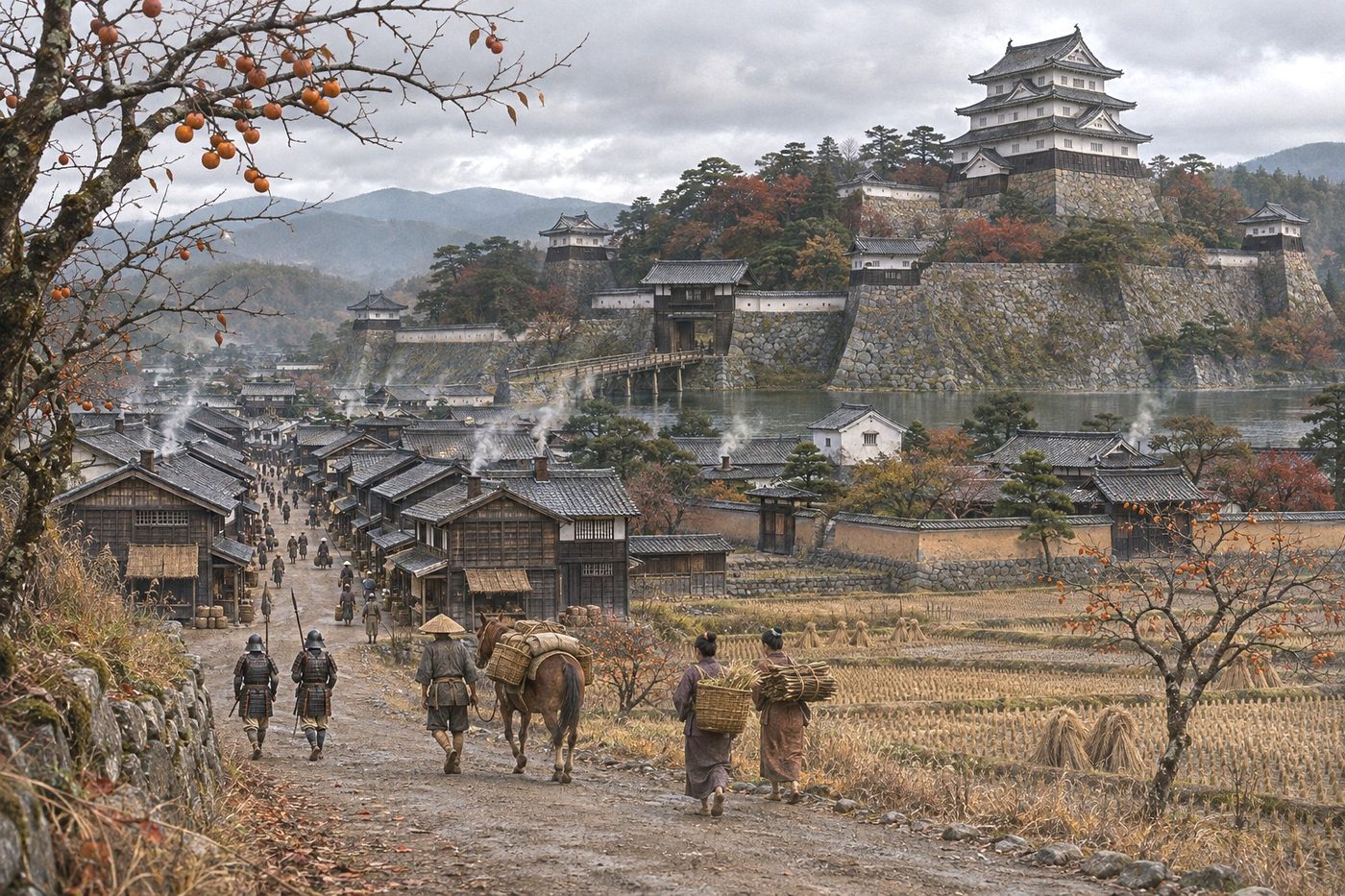
There are two kinds of castle in Tsurugishima, and the warring years are turning one into the other.
The old kind is a mountain castle (yamajiro): a hilltop cut into terraces, ringed by ditches and earth ramparts, with wooden palisades, gates, watchtowers, and halls. It is cheap, quick to build, hard to attack, and miserable to live in. Most lords keep a mountain castle for war and a comfortable residence in the valley for peace.
The new kind is a great castle of stone. Its sloping stone walls rise from wide moats in tiers, enclosing baileys within baileys connected by gates built to trap attackers in killing grounds. At the center stands the keep (tenshu), a tower of three to five stories with white plaster walls and curved tiled roofs, built to be seen from miles away and to remind everyone who rules here. Only the richest lords can afford one. Kanagura's is the greatest in the realm.
Inside any castle are the lord's residence, with its audience hall, the barracks and storehouses, wells (a castle without water falls in days), stables, an armory, and a shrine for the clan's kami. A castle town spreads below. A hero arriving at a castle passes gate after gate, is questioned at each, and is made to wait. Waiting is how a lord shows rank.
A Shrine#
A village shrine is a small wooden hall in a grove of cedars, reached through a torii and up a flight of mossy steps. A great shrine is a city of the kami: a forest enclosed by walls, approached down a long avenue of gates and stone lanterns, with halls for worship, dance, offerings, and treasures, and smaller shrines to dozens of lesser kami scattered among the trees. Faith and the Unseen describes the parts of a shrine.
What heroes notice is the quiet. Even in the middle of a town, a shrine's grove is cooler, darker, and stiller than the street outside. Gravel paths crunch under every footstep, so no one approaches unheard. There are shrine maidens sweeping, a priest in white chanting somewhere out of sight, the clap of a worshipper's hands, the rattle of the offering box, and votive plaques of painted wood hung by the hundreds with prayers written on the back.
Shrines are sanctuaries in law and in custom. Spilling blood on shrine ground pollutes it and enrages its kami, so fugitives sometimes take refuge in shrines, and their pursuers wait outside the torii.
A Temple#
A temple stands behind a great gate, often guarded by two wrathful wooden kings, one with mouth open and one with mouth closed. Inside lie a courtyard of raked gravel or sand, a main hall where the temple's image of the Buddha sits in gold and shadow behind clouds of incense, a lecture hall, a bell tower whose great bronze bell rings the hours, monks' quarters, kitchens, a library of sutras, and often a pagoda holding relics. Behind it all lies the graveyard, with its stone markers and wooden name-boards.
A small temple is a single hall and an old monk who teaches the village children their letters. A great temple is a walled town on a mountainside, with sub-temples by the dozen, thousands of monks, lands across several provinces, and warrior monks guarding the gates. The head temple of Thunder Peak, Raihō-ji, is the greatest of these.
Temples are hospitals, schools, banks, inns, and courts of last resort. Travelers can usually find a bed in a temple for a donation. Women fleeing a marriage, debtors fleeing a moneylender, and samurai fleeing a lord often find their way to one.
A Peasant's Home#
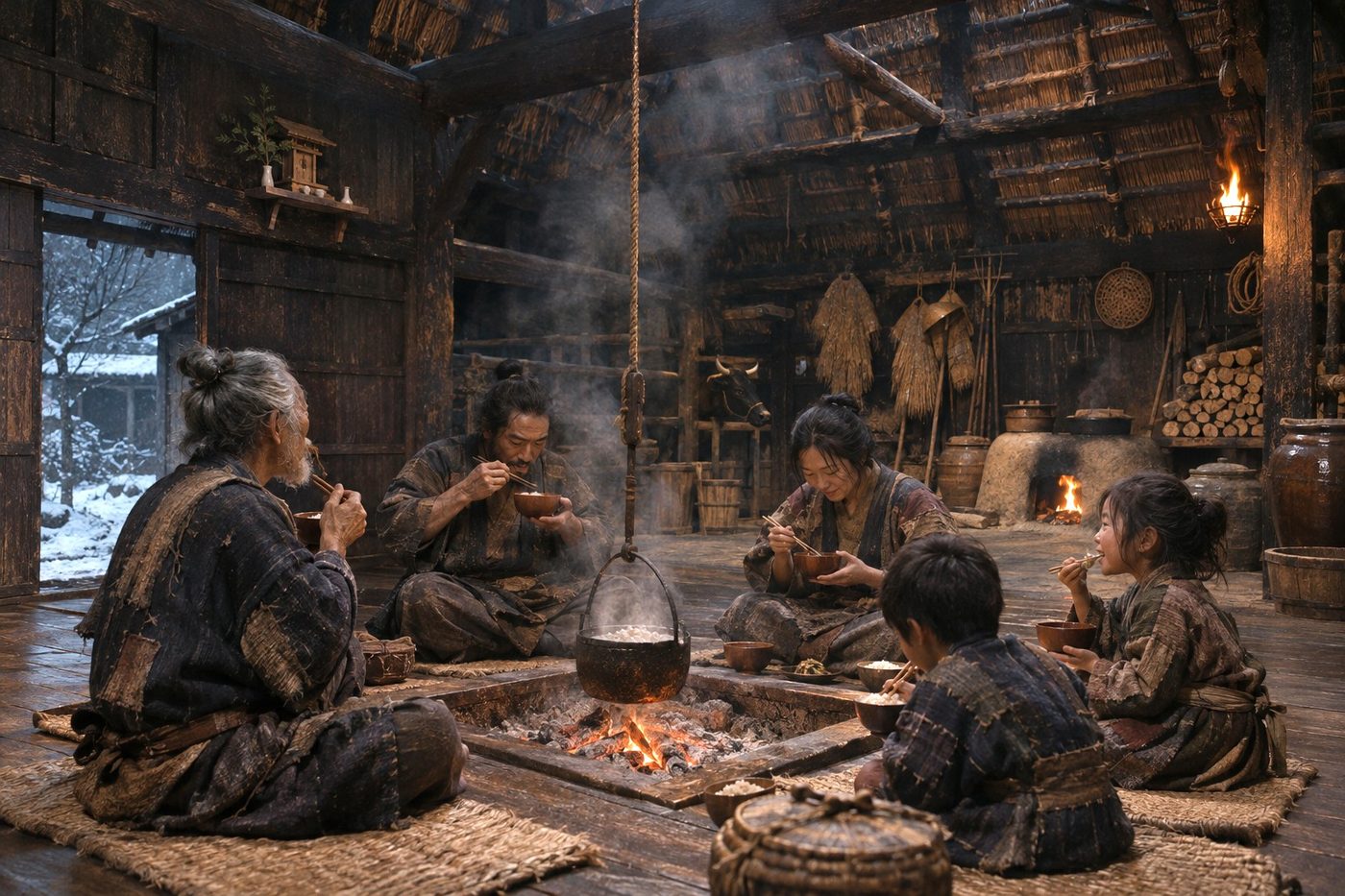
A farmhouse is a big, dark, smoky barn of a building under a steep roof of thick thatch. Its walls are of wood and mud plaster, its windows few, and its eaves low.
Half the house is an earthen floor (doma) at ground level, entered straight from outside. It holds the kitchen hearth, water jars, firewood, farm tools, a stone mortar for pounding rice, and, in many houses, the family's horse or ox in a stall. The other half is a raised wooden floor, one step up, where the family lives. In its center is a sunken hearth (irori), a square pit of ash with an iron pot hanging over it from a hook in the rafters. The family eats, works, warms itself, and talks around the hearth, and the smoke drifts up through the rafters and out through the thatch, keeping out insects and blackening the beams.
The best seat by the hearth, facing the door, belongs to the head of the house. Guests sit on his left, wives near the kitchen. A shelf high on one wall holds the kami, and an altar in the corner holds the ancestors. At night the family sleeps on straw-stuffed mats by the fire. A peasant home owns very little, and all of it is used.
A Craftsman's Home#
A townhouse is narrow at the front and deep at the back, because the town taxes frontage on the street. In front is the shop: its wooden shutters come down each morning to open the whole front to the street, and the craftsman works there in full view, at his bench, forge, wheel, or loom, with his goods laid out on a raised platform for customers. A cloth curtain over the door shows his trade.
Behind the shop runs an earthen passage to the back of the house, past a small kitchen. Beside it are one or two raised rooms where the family eats and sleeps, and where apprentices sleep wherever there is space. A tiny courtyard garden behind the house lets in light and air, and many craftsmen keep a fireproof storehouse for their tools and best stock. Upstairs, under the roof, there may be a low loft for storage or servants.
A craftsman's house is busy, crowded, and noisy from before dawn, and it is where most of his life happens. His family, his apprentices, and his trade all live under one roof.
A Samurai's Home#
A samurai's house is set back from the street behind a wall and gate. The size of the gate tells a visitor the owner's stipend before he knocks. Inside, a short path of stepping-stones leads to a formal entrance (genkan) with a raised step, where visitors leave their sandals and the household kneels to greet them.
The house is quiet, spare, and clean. Its rooms are floored with straw mats and divided by sliding paper doors. The finest room is the reception room, which has a recessed alcove (tokonoma) holding a hanging scroll, a vase of seasonal flowers, and perhaps the family's armor or a prized sword on a stand. The guest of honor sits with his back to the alcove. Beside it, a veranda opens onto a small garden of stones, moss, a pine, and perhaps a pond. Farther in are the family rooms, the kitchen, the servants' quarters, and the ancestor altar.
A poor retainer's house is a few rooms behind a fence. A great retainer's house is a compound with stables, storehouses, quarters for his own retainers, and a practice yard. Either way, a samurai's home is run like a small domain, and a guest who forgets his manners in it may not leave.
A Martial School#
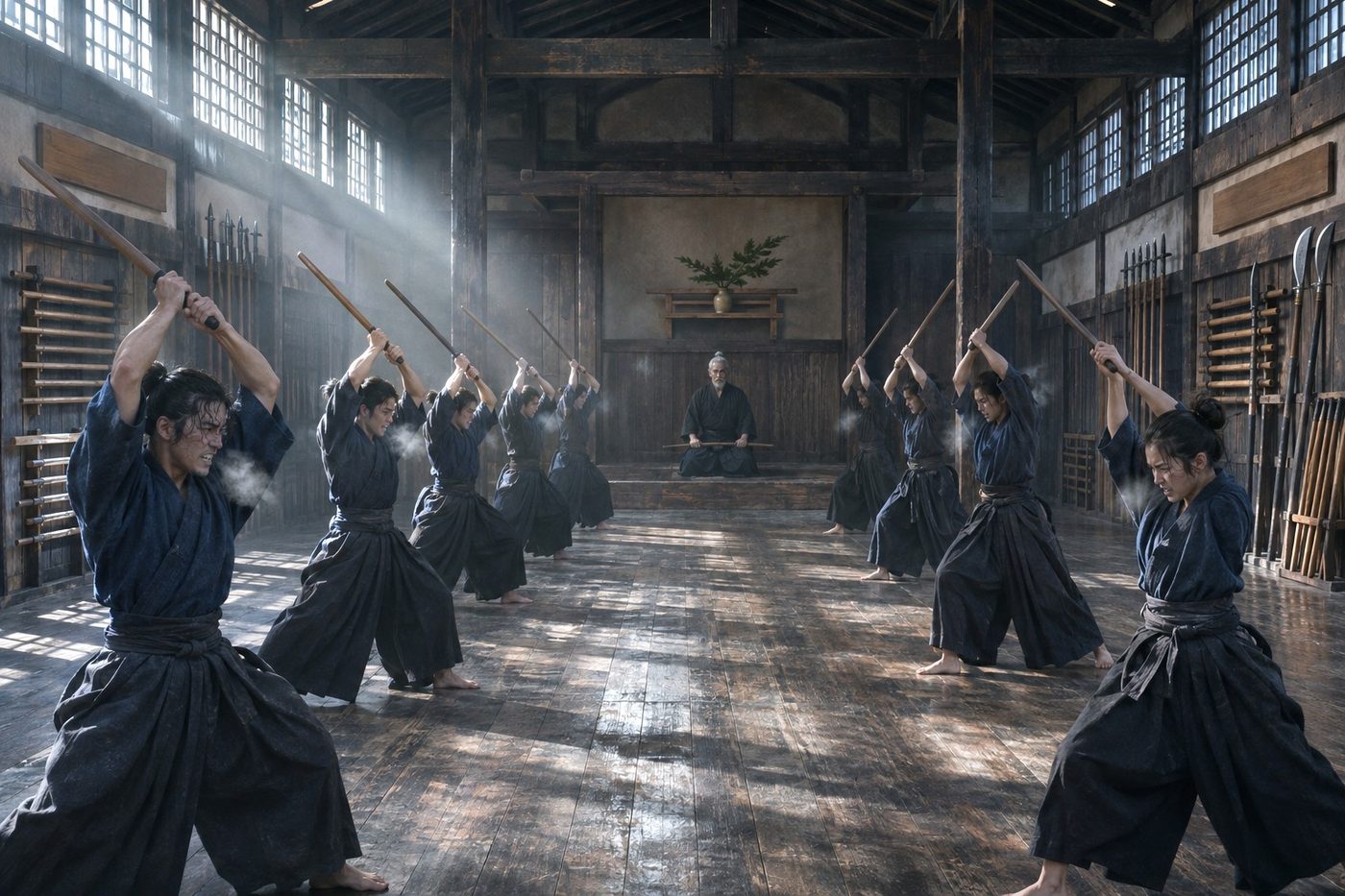
A martial school's heart is its practice hall (dōjō), a long, open room with a polished wooden floor, high windows, and walls hung with wooden practice swords, spears, staves, and glaives on racks. At the head of the hall is a raised platform with a kami shelf for the school's patron kami, where students bow on entering and leaving. Wooden boards along one wall carry the names of the students, ranked by their licenses, and moving a name up the wall is a public event.
The headmaster lives on the premises, often with his family and his senior students. The school's secret scrolls are kept in a locked chest and shown only to those who earn them. Students sweep and polish the floor before dawn, train until they drop, and eat together. Outsiders hear the stamp of bare feet and the crack of wooden swords from the street.
At the gate hangs the school's signboard. A challenger who wants to humble the school knocks and asks for a lesson. If he defeats the school's champion, he may take the signboard away, which shames the school more than any wound. Martial schools of the sword, spear, bow, glaive, and unarmed fighting are found in every castle town and city. The most famous have branch schools across the isles.
A Non-Martial School#
Not every school teaches killing.
- Temple schools (terakoya) teach children reading, writing, arithmetic, and good manners, usually under a monk or nun in a temple hall, sometimes under a ronin in a rented room. Many villages and most towns have one, which is why so many farmers can read a little.
- Schools of the arts teach tea, flower arranging, poetry, calligraphy, painting, incense, music, and dance. They work like martial schools, with a headmaster's line, licenses, secret teachings, and fierce rivalries, and they meet in elegant rooms and gardens rather than practice halls. Samurai and court nobles both study the arts, and a lord's tea gathering can decide a war.
- Academies of learning teach the Daqian classics, medicine, law, and the calendar. The greatest are in Seikyō and in the great temples. Diviners of the Way of Yin and Yang train in their own closed schools, which outsiders are not invited to visit.
- Craft schools pass down swordsmithing, armoring, lacquer, and carpentry from master to apprentice. Their secrets are guarded as fiercely as any sword technique.
Whatever the art, the shape is the same: a master, a lineage, a ladder of licenses, and a debt that a student carries for life.
Notes#
- The homes (the farmhouse, the townhouse, and the samurai's house) draw on Edward S. Morse, Japanese Homes and Their Surroundings (1886).
Part 7: Names and Language#
How Names Work#
A name in Tsurugishima tells a stranger where you stand. Family comes first, then the person: Kagamino Tomoharu is Tomoharu of the Kagamino house. Foreign scholars sometimes reverse the order. Islanders never do.
Clan and Family Names#
Samurai houses, court families, and rural gentry carry a clan name, usually taken from the land the family first held: a river, a hill, a pine, a ford. Branch houses take new names from their new fiefs, which is how the Kagamino line split from the Minazuki. A lord can grant a family name as a reward, and a lord can strip one as a punishment. Losing your clan name is losing your place in the world.
Farmers, artisans, and merchants have no clan name in law. In daily life they go by their village or trade (Gonbei of Kurogane, Sakuzō the cooper), and a successful merchant house is known by its shop name (yagō), which passes from owner to owner like a banner. Because the warring years let a peasant rise to samurai, many proud clan names are only a generation old, and their neighbors remember it.
A Samurai's Names#
A warrior collects names the way a sword collects nicks.
- Childhood name. On the seventh night after birth, a respected relative names the child. A boy's childhood name is often lucky or fierce: Toramaru (tiger boy), Kamechiyo (tortoise of a thousand years).
- Adult name. At the coming of age (genpuku), at about 15, the youth takes his formal name. It usually joins a syllable from his own house with a syllable granted by his lord or sponsor. By custom, every Kagamino Shogun carries tomo (the deposed Sadamasa was the exception), and every retainer who receives a syllable from his lord carries a debt with it. If the lord who granted the syllable changes his own name, the retainer often changes his too.
- Common name. Formal names are rarely spoken aloud. Peers use a common name such as Gen'emon or Kyūsuke, or an office: the Shikken, the Lord of Kurogane, the Master of the Horse.
- Religious name. A warrior who shaves his head and takes vows takes a new Buddhist name, and often goes on ruling under it.
Women's Names#
Most women bear a short name of one or two syllables, often a plant, a season, or a virtue: Kiku (chrysanthemum), Yae (eightfold), Sachi (blessing). Commoners add the polite O- in speech (O-Tsuru). The daughters of great houses are called -hime (princess) when young, and after marriage they are often known by the hall they live in or the house they lead: the Lady of the North Hall, the Widow of Shirasawa.
Tsurugishima gives women more room than history did. A woman who heads a house, holds a castle, or leads troops signs with her own name and her clan's name, exactly as a man does, and her retainers swear to her by that name. Some take a formal adult name built from the man's tables below. Nobody finds that strange.
Monks, Nuns, and Mystics#
On taking vows, a monk or nun gives up family and birth names and receives a single religious name of two characters, read in the scholarly style (Ryōzan, Seikai, Shōnen). Mountain ascetics and yin-yang masters often use these names too. Abbesses and great abbots are addressed by their temple: the Abbess of such-and-such Hall.
Ancient names. The names of the gods, and of the ancient kings, empresses, and high priestesses of the Age of Hō, follow older forms (Tenzei, Shōkei, Asahime) and don't come from these tables.
Foreign Names#
Visitors from Cheongun give a one-syllable family name and a two-syllable given name, family first (Seo Jiwon). Visitors from Daqian give a one-syllable family name and a given name of one or two syllables, family first (Lu Xian). Islanders often mangle both, and foreigners notice.
Forms of Address#
Speaking a superior's given name aloud is an insult. Use a title, an office, or a polite suffix:
| Suffix | Use |
|---|---|
| -sama | Lords, gods, and anyone far above you |
| -dono | Samurai to samurai, formal and respectful |
| -san | Everyday politeness among equals and commoners |
| -sensei | Teachers, physicians, and masters of a school |
| -hime | Daughters of great houses |
| -sō | Monks, added to a religious name in speech |
Name Generator#
Roll on these tables, or pick. A d66 roll uses two six-sided dice of different colors: the first is the tens, the second is the ones (so a 3 and a 5 make 35).
Reroll rule. If a result is the name of a famous real person or clan, or of a great house or major figure of the setting, roll again or change one part. The website's generator does this automatically, and the full list is on the Reroll sheet of Names.xlsx. Clan names to reroll: Akebana, Akechi, Arima, Asakura, Asano, Ashikaga, Fujiwara, Hataeda, Hatano, Honda, Imagawa, Ishida, Itami, Kagamino, Kamaeda, Konoe, Kuroda, Kusunoki, Kuzuhara, Matsudaira, Matsunaga, Matsuura, Minamoto, Minatsuki, Mizuno, Mizusawa, Nakagawa, Sanada, Shibata, Shimazu, Tachibana, Taira, Tokugawa, Toyotomi, Ōkubo, Ōmori, Ōmura, Ōta, Ōtaki. Men's names to reroll include famous figures such as Nobunaga, Masamune, and Yoshitsune, and our own canon figures such as Tomoharu and Sadatsugu. If both parts of a man's name are the same (Masamasa), roll the second part again.
Clan Names#
Roll for a first part and a second part. Each part has two tables: roll a d6 to choose (1–3 Table A, 4–6 Table B), then roll d66. Ō + numa makes Ōnuma; Shira + sawa makes Shirasawa; Musa + noki makes Musanoki.
Sound changes. When parts join, a soft k, t, s, or h often turns voiced: tsuki becomes zuki (Mina + tsuki makes Minazuki), sawa can become zawa, and hara can become bara. Use whichever sounds better.
First part, Table A
| d66 | Name | d66 | Name | d66 | Name |
|---|---|---|---|---|---|
| 11 | Aka | 31 | Kama | 51 | Oka |
| 12 | Aki | 32 | Kane | 52 | Ō |
| 13 | Ama | 33 | Kuzu | 53 | Sai |
| 14 | Ara | 34 | Kiri | 54 | Seki |
| 15 | Asa | 35 | Kita | 55 | Shira |
| 16 | Ake | 36 | Kuro | 56 | Taka |
| 21 | Fuji | 41 | Matsu | 61 | Tachi |
| 22 | Hata | 42 | Mina | 62 | Tama |
| 23 | Hira | 43 | Miya | 63 | Tsuru |
| 24 | Hon | 44 | Mizu | 64 | Uchi |
| 25 | Ishi | 45 | Naka | 65 | Wata |
| 26 | Kagami | 46 | Nishi | 66 | Yama |
First part, Table B
| d66 | Name | d66 | Name | d66 | Name |
|---|---|---|---|---|---|
| 11 | An | 31 | Mitsu | 51 | Tai |
| 12 | Ari | 32 | Musa | 52 | Toku |
| 13 | Ashi | 33 | Nabe | 53 | Tomo |
| 14 | Ata | 34 | Nobu | 54 | Tori |
| 15 | Ei | 35 | Oba | 55 | Toyo |
| 16 | Hei | 36 | Ryō | 56 | Uki |
| 21 | Ima | 41 | Sa | 61 | Ane |
| 22 | Ita | 42 | Sei | 62 | Ame |
| 23 | Kaya | 43 | Seno | 63 | Ira |
| 24 | Koji | 44 | Shima | 64 | Ken |
| 25 | Kono | 45 | So | 65 | Muchi |
| 26 | Kusu | 46 | Tame | 66 | Shiba |
Second part, Table A
| d66 | Name | d66 | Name | d66 | Name |
|---|---|---|---|---|---|
| 11 | -bana | 31 | -ma | 51 | -taki |
| 12 | -bayashi | 32 | -eda | 52 | -shima |
| 13 | -da | 33 | -mi | 53 | -ta |
| 14 | -e | 34 | -mori | 54 | -tani |
| 15 | -gami | 35 | -mura | 55 | -tsuka |
| 16 | -gawa | 36 | -naga | 56 | -tsuki |
| 21 | -hara | 41 | -nami | 61 | -ura |
| 22 | -hashi | 42 | -no | 62 | -wa |
| 23 | -kado | 43 | -numa | 63 | -yama |
| 24 | -ki | 44 | -oka | 64 | -yoshi |
| 25 | -kubo | 45 | -sato | 65 | -zaki |
| 26 | -kura | 46 | -sawa | 66 | -zawa |
Second part, Table B
| d66 | Name | d66 | Name | d66 | Name |
|---|---|---|---|---|---|
| 11 | -bishi | 31 | -shiba | 51 | -toku |
| 12 | -bito | 32 | -moto | 52 | -tomi |
| 13 | -chi | 33 | -moro | 53 | -tori |
| 14 | -daira | 34 | -nada | 54 | -wara |
| 15 | -de | 35 | -noki | 55 | -yu |
| 16 | -do | 36 | -o | 56 | -zu |
| 21 | -gama | 41 | -ra | 61 | -gana |
| 22 | -go | 42 | -ro | 62 | -kaga |
| 23 | -i | 43 | -shi | 63 | -ge |
| 24 | -ishi | 44 | -shin | 64 | -on |
| 25 | -ji | 45 | -te | 65 | -ran |
| 26 | -ke | 46 | -to | 66 | -hide |
Men's Adult Names#
Roll for a first part and a second part, choosing Table A or B with a d6 each time, as for clans. Taka + nari makes Takanari; Kuni + tsuna makes Kunitsuna; Hiro + chika makes Hirochika.
First part, Table A
| d66 | Name | d66 | Name | d66 | Name |
|---|---|---|---|---|---|
| 11 | Haru | 31 | Moto | 51 | Tada |
| 12 | Hide | 32 | Mune | 52 | Taka |
| 13 | Hisa | 33 | Naga | 53 | Aki |
| 14 | Kage | 34 | Nao | 54 | Teru |
| 15 | Kane | 35 | Nari | 55 | Toki |
| 16 | Katsu | 36 | Nobu | 56 | Toshi |
| 21 | Kazu | 41 | Nori | 61 | Tsugu |
| 22 | Kiyo | 42 | Sada | 62 | Tsune |
| 23 | Tomo | 43 | Sane | 63 | Uji |
| 24 | Masa | 44 | Shige | 64 | Yasu |
| 25 | Michi | 45 | Suke | 65 | Yori |
| 26 | Mitsu | 46 | Sumi | 66 | Yoshi |
First part, Table B
| d66 | Name | d66 | Name | d66 | Name |
|---|---|---|---|---|---|
| 11 | Ei | 31 | Chika | 51 | Sue |
| 12 | Go | 32 | Fusa | 52 | Tane |
| 13 | Hira | 33 | Kuni | 53 | Tomi |
| 14 | Hiro | 34 | Kore | 54 | Tsura |
| 15 | Ie | 35 | Tame | 55 | Kan |
| 16 | Kuro | 36 | Tatsu | 56 | Mori |
| 21 | Mochi | 41 | Tora | 61 | Haya |
| 22 | Moro | 42 | Tsuna | 62 | Ari |
| 23 | Saka | 43 | Masu | 63 | Kei |
| 24 | Shin | 44 | Mura | 64 | Hoshi |
| 25 | Take | 45 | Naka | 65 | Ken |
| 26 | Yuki | 46 | Oki | 66 | Gen |
Second part, Table A
| d66 | Name | d66 | Name | d66 | Name |
|---|---|---|---|---|---|
| 11 | -aki | 31 | -mitsu | 51 | -suke |
| 12 | -fusa | 32 | -mochi | 52 | -sumi |
| 13 | -haru | 33 | -moto | 53 | -tada |
| 14 | -hide | 34 | -mune | 54 | -taka |
| 15 | -hira | 35 | -naga | 55 | -tomo |
| 16 | -hisa | 36 | -nao | 56 | -teru |
| 21 | -ie | 41 | -nari | 61 | -toki |
| 22 | -kage | 42 | -nobu | 62 | -toshi |
| 23 | -yuki | 43 | -nori | 63 | -tsugu |
| 24 | -katsu | 44 | -sada | 64 | -tsuna |
| 25 | -kiyo | 45 | -sane | 65 | -uji |
| 26 | -masa | 46 | -shige | 66 | -yasu |
Second part, Table B
| d66 | Name | d66 | Name | d66 | Name |
|---|---|---|---|---|---|
| 11 | -chika | 31 | -tsugi | 51 | -echi |
| 12 | -gen | 32 | -tsune | 52 | -so |
| 13 | -hiro | 33 | -tsura | 53 | -tana |
| 14 | -hito | 34 | -yama | 54 | -kuni |
| 15 | -kura | 35 | -ya | 55 | -sue |
| 16 | -matsu | 36 | -yo | 56 | -tane |
| 21 | -mori | 41 | -yoshi | 61 | -oki |
| 22 | -mura | 42 | -zen | 62 | -fuyu |
| 23 | -naka | 43 | -zo | 63 | -ari |
| 24 | -rin | 44 | -zumi | 64 | -kazu |
| 25 | -sawa | 45 | -ba | 65 | -maro |
| 26 | -shi | 46 | -bei | 66 | -kado |
Women's Names#
Roll a d6 to choose the table (1–3 Table A, 4–6 Table B), then roll d66. Add O- for a commoner in polite speech, or -hime for the daughter of a great house.
Table A
| d66 | Name | d66 | Name | d66 | Name |
|---|---|---|---|---|---|
| 11 | Aya | 31 | Kiyo | 51 | Suzu |
| 12 | Chiyo | 32 | Kō | 52 | Tama |
| 13 | Fuji | 33 | Masa | 53 | Teru |
| 14 | Fuku | 34 | Matsu | 54 | Toku |
| 15 | Hana | 35 | Mitsu | 55 | Tora |
| 16 | Haru | 36 | Natsu | 56 | Tsuru |
| 21 | Iyo | 41 | Rin | 61 | Ume |
| 22 | Kaede | 42 | Sachi | 62 | Yae |
| 23 | Kame | 43 | Sato | 63 | Yasu |
| 24 | Kane | 44 | Sayo | 64 | Yoshi |
| 25 | Kayo | 45 | Sen | 65 | Yuki |
| 26 | Kiku | 46 | Shino | 66 | Yuri |
Table B
| d66 | Name | d66 | Name | d66 | Name |
|---|---|---|---|---|---|
| 11 | Akane | 31 | Kozue | 51 | Tae |
| 12 | Ayame | 32 | Michi | 52 | Takane |
| 13 | Chigusa | 33 | Midori | 53 | Tamae |
| 14 | Fumi | 34 | Momiji | 54 | Tsuyu |
| 15 | Hagi | 35 | Nagi | 55 | Tsugumi |
| 16 | Hisa | 36 | Nami | 56 | Urara |
| 21 | Hotaru | 41 | Nui | 61 | Wakaba |
| 22 | Isono | 42 | Oto | 62 | Yayoi |
| 23 | Kasumi | 43 | Sakura | 63 | Yomogi |
| 24 | Kaya | 44 | Sayuri | 64 | Yū |
| 25 | Kinu | 45 | Shizu | 65 | Yuzuri |
| 26 | Koharu | 46 | Sugi | 66 | Sumire |
Common Names (Commoners, Ronin, and Everyday Use)#
Roll d12 twice. Roku + bei makes Rokubei; Mata + zaemon makes Matazaemon.
| d12 | First part | Second part |
|---|---|---|
| 1 | Gon | -bei |
| 2 | Ichi | -emon |
| 3 | Jin | -ji |
| 4 | Kan | -jirō |
| 5 | Kyū | -kichi |
| 6 | Mata | -nosuke |
| 7 | Roku | -saku |
| 8 | Sa | -suke |
| 9 | Saku | -tarō |
| 10 | Shin | -zaemon |
| 11 | Tō | -zō |
| 12 | Yo | -hachi |
Childhood Names#
Roll d12 for the first part and d6 for the second. Tora + maru makes Toramaru. Girls usually keep their childhood name for life, so roll a girl's name on the Women's Names table.
| d12 | First part | d6 | Second part |
|---|---|---|---|
| 1 | Botan | 1 | -maru |
| 2 | Hiyoshi | 2 | -chiyo |
| 3 | Inu | 3 | -matsu |
| 4 | Kame | 4 | -waka |
| 5 | Kiku | 5 | -bōshi |
| 6 | Matsu | 6 | -dōji |
| 7 | Sen | ||
| 8 | Take | ||
| 9 | Tatsu | ||
| 10 | Tora | ||
| 11 | Tsuru | ||
| 12 | Ushi |
Reroll Hiyoshimaru, Takechiyo, and Ushiwaka.
Religious Names (Monks, Nuns, and Mystics)#
Roll d12 twice. Ryō + zan makes Ryōzan. Reroll Genshin, Kaien, Keinen, Kūkai, Zennen.
| d12 | First part | Second part |
|---|---|---|
| 1 | Ei | -an |
| 2 | Gen | -chi |
| 3 | Kai | -en |
| 4 | Kei | -kai |
| 5 | Kū | -ken |
| 6 | Ryō | -nen |
| 7 | Sei | -shin |
| 8 | Shō | -shun |
| 9 | Shin | -sō |
| 10 | Son | -ten |
| 11 | Tai | -un |
| 12 | Zen | -zan |
Cheongun Names#
Roll d12 for the family name, then d12 twice for the given name. Seo + Ji + won makes Seo Jiwon.
| d12 | Family | Given, first | Given, second |
|---|---|---|---|
| 1 | Baek | Do | -bin |
| 2 | Cha | Gyeong | -gyu |
| 3 | Gang | Hwa | -ho |
| 4 | Han | Hye | -hui |
| 5 | Hwang | Hyo | -hyeon |
| 6 | Jo | Jae | -jin |
| 7 | Mun | Ji | -ok |
| 8 | Nam | Min | -ryeong |
| 9 | Ok | Seon | -seon |
| 10 | Seo | Su | -sik |
| 11 | Yeom | Tae | -won |
| 12 | Yun | Yeong | -yeon |
Daqian Names#
Roll d12 for the family name and d12 for the given name. Add a second part on an odd roll of a d6, if you like. Pei + Ming + an makes Pei Ming'an.
| d12 | Family | Given, first | Given, second |
|---|---|---|---|
| 1 | Fang | Bo | -an |
| 2 | Gao | Hong | -de |
| 3 | Lu | Jun | -feng |
| 4 | Meng | Lian | -hua |
| 5 | Pei | Ming | -jie |
| 6 | Qiao | Qing | -lan |
| 7 | Shen | Rui | -ning |
| 8 | Su | Shu | -ping |
| 9 | Wen | Wei | -rong |
| 10 | Xie | Xian | -wen |
| 11 | Yan | Yi | -yuan |
| 12 | Zhuo | Zhen | -zhi |
Language#
The isles share one spoken tongue, though a Tsuka-jima fisher and a Seikyō courtier may need a patient hour to understand each other. The court speaks an older, slower form, full of indirect phrases that let a noble refuse without ever saying no. Samurai speak bluntly among themselves and formally to their betters. Mistaking the level of speech is a social blunder, and sometimes a deadly one.
Writing came from Daqian. Scholars, monks, and officials write in Daqian characters and read the Daqian classics. Most people use the simpler island syllabaries for letters, poems, and accounts. Many farmers can read a little, and many merchants keep fine books. Traders at Umikado and Kanagura often speak some Cheongun or Daqian, and a few speak the tongue of the new faith's foreign priests.
Pronunciation Guide#
Japanese words in this book use modified Hepburn spelling. A few simple rules get you close:
- Vowels: a as in father, e as in get, i as in machine, o as in old, u as in rule. Every vowel is sounded: Kanagura is ka-na-gu-ra, and kegare is ke-ga-re.
- Long vowels: a macron (ō, ū) means hold the vowel twice as long. Seikyō is sei-kyoh, and Hōrai is hoh-rai.
- Stress: give each syllable about equal weight. Don't punch the second-to-last syllable the way English does.
- Consonants: g is always hard (as in go). ts is the sound at the end of cats, even at the start of a word (Tsurugishima). r is a light tap, between r and l. f in fu is soft, blown between the lips.
- Double consonants: pause briefly on them: kappa is kap-pa.
- Apostrophe: an apostrophe after n keeps the syllables apart: Gen'emon is gen-e-mon.
- Cheongun names use the Korean-style spelling: eo is like the o in soft, and eu is like the oo in good with lips spread.
- Daqian names use the Chinese-style spelling: x is close to sh, q is close to ch, zh is close to j, and c is like ts.