Gamemaster's Section · GM only · Chapter 7
Secrets of the Land
Part 1: The True History#
Chapter 2 tells the history every hero knows. This chapter tells the GM what really happened. Most of the public story is true. What it leaves out is why the spirits are waking, and why the realm's troubles run deeper than a quarrel between two plum blossoms.
The short version: the Great Sword that made the isles still does its work. Its cut keeps heaven apart from earth, and this world apart from the Hidden World and the Land of the Dead. The Emperor's line keeps that cut sharp through a covenant with the gods, renewed each year by the Rites of the Year. For a century the cut has been wearing thin, and five years ago the covenant itself was broken in secret. Priests who know call it the hakobore (刃毀れ, "the chipped edge"), the word a smith uses for a nick in a blade, and it is why the spirits are waking. Heroes can make it worse, and heroes can mend it.
The Secret Timeline#
The left column is the history every hero knows (Chapter 2). The right column is what really happened. The last column shows the hakobore track (below) where it changed.
| Year | What everyone knows | What really happened | Hakobore |
|---|---|---|---|
| Before time | — | Heaven and earth are one undivided world. Its spirits are the old kami who still live in the north. | — |
| The Age of the Gods | The kami forge the Great Sword. It falls and shatters into the isles, and Mount Hōrai rises where its heart struck the sea. | The Forging Gods make the first cut, dividing heaven, earth, the Hidden World, and Yomi. The hilt never cuts, so the undivided world survives on Tsuka-jima. Hōrai's summit, where all the boundaries touch, is Tokoyo, the Eternal Land. | — |
| After the fall | — | The Smith of Heaven begins to reforge the sword at Tatara, then stops. He leaves the covenant with his smith-priests. Eight shard stones are set in the oldest shrines. | 0 |
| c. 700 years before Kenreki | Admiral Lu Xian lands with 60 ships, seeking the immortals, and never finds them. He marries Asahime, and their son founds Hō. | Anshi, a refused student of the Eight Kami, lures Lu Xian. Lu Xian kills the hermit-servants and Anshi, eats the summit fruit, and becomes undying. Tokoyo withdraws across the sea, and the Eight Kami bind Lu Xian to the mountain. He sends one letter home. | — |
| Before Kenreki | The Age of Seven Kingdoms. | The kingdom of Tatara keeps the god's forge and the covenant for all the isles. | — |
| 1 | King Tenzei of Hō unites the isles and becomes the first Emperor. | Tenzei destroys Tatara and takes the covenant for his line, with its condition: a line that fails the gods may be set aside. The chronicles are rewritten. | — |
| 410 | Empress Shōkei founds Furumiya. | The Tatara Record passes into the care of Furumiya's scholarly temples, where it still lies. | — |
| 494 | The capital moves to Seikyō. | The Founding Abbot binds the Lord of the Demon Gate beneath the mountain at the city's northeast and lights the eternal lamp. Raihō-ji is founded over the binding. | — |
| c. 560 | The 48-temple circuit of Ōgiri is founded. | The Founder of the Circuit seals himself in his cave above the fog valley. His spirit begins to walk with lone pilgrims. | — |
| 880–885 | The Minazuki Return. The last Kamaeda child-emperor drowns with his court at Shiranui. | The drowned boy had performed his Great Tasting, so his unpurified court becomes a lasting wound in the boundary. The dead of the war refight their battle at the field of a thousand graves. | 0 (barely) |
| 885 | Minazuki Tsunetomo becomes the first Shogun. | — | — |
| 912 | The first Shogun dies and is buried in the great mound of the Mirror Fields. | His son lays his bones in a hidden shrine in Hagane Castle and enshrines him as the Shogunate's guardian kami. The mound is empty. | — |
| 912–1199 | The Kagamino peace. | The dead are mourned and purified, and the cut holds. | 0 |
| 1199 | The Usurpation: Tomoyuki deposes Sadamasa. | The first Shogun's spirit is offended. The century of blood begins. | 0 |
| 1222–1250 | The Cheongun War. | Tens of thousands die abroad, unmourned and unpurified. | rising |
| 1235 | Shogun Tomonori dies in Cheongun. His infant son Tomoharu becomes Shogun. | Tomoharu is born a kannagi of great power, in the year the cut first wears thin. | 1, Stirring |
| 1250 | The Treaty of the Strait. Tomoharu marries Princess Hyoseon. | — | 1 |
| c. 1251 | Black ships begin to call at Umikado. | — | 1 |
| 1255 | The Emperor's father retires to the Cloister, and the present Emperor takes the throne. | — | 1 |
| 1256 | The present Emperor's Great Tasting is performed. | The Spoiled Tasting. The Shikken refuses the cost, the Regent performs the rite without its offerings, and it fails. A ritualist who protests is exiled to Hate-no-Kuni. | 2, Waking |
| 1258 | The winter battle of Akahara. The Sekitani League is founded. | Akahara's dead are left unpurified, two lines in the fog. | 2 |
| 1259 | — | A curse-worker paid by the Shikken begins poisoning the Shogun's dreams. | 2 |
| 1261, spring | The sacred mirror of Mizunuma is stolen. | — (Chapter 9) | 2 |
| 1261 | The present day. Master Masuhiro forges Ryōdan. | The Hiraishi shard stone bleeds, warning of war. The Whetstone tests its craft through Masuhiro's blade (Part 3). | 2 |
The Gods Who Forged the Sword#
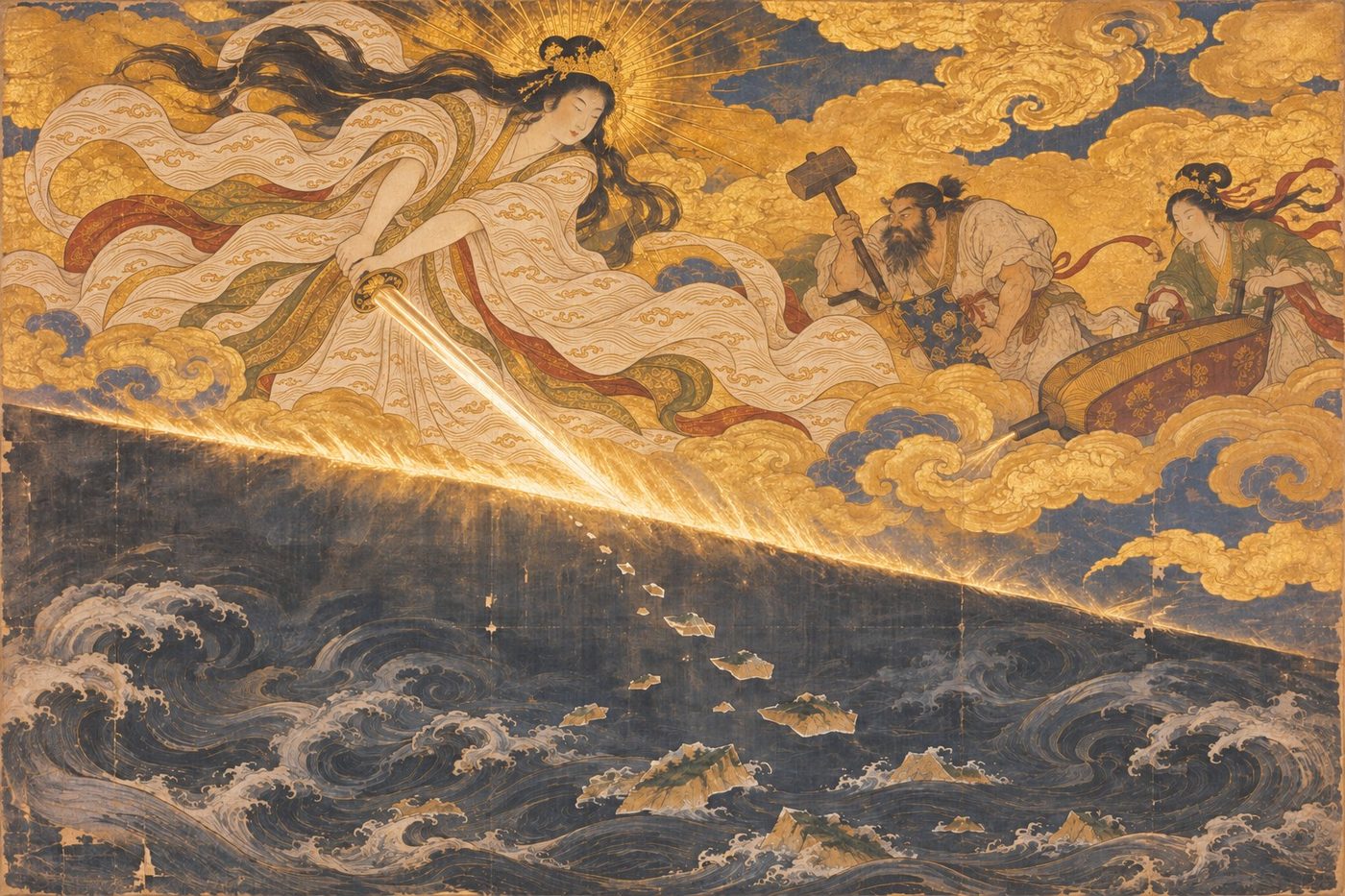
In the beginning, heaven and earth were one, a single world without edges, where nothing was separate and nothing lasted. Out of it came three gods who wanted a world where things could be made and kept. Islanders call them the Forging Gods, and the oldest records name them:
| God | Title | What they did |
|---|---|---|
| Amatsu-Hizuchi (天津火槌, "Heavenly Fire-Hammer") | The Smith of Heaven | Beat the Great Sword out of a falling star |
| Ōfuki-hime (大吹姫, "Princess of the Great Blowing") | The Wind of the Bellows | Gave the forge its breath and the blade its temper |
| Teruhi-no-Ōmikami (照日大神, "Great Goddess of the Shining Sun") | The Sun Goddess | Wielded the sword, and made the first cut |
With one stroke the Sun Goddess cut heaven from earth. The cut went deeper than anyone sees. It divided the bright world from the Hidden World that lies alongside it, and the living from the dead in Yomi below. Every boundary in creation is that one cut, seen from a different side.
Then the work was done, and the sword fell. It shattered when it struck the sea, and its pieces became the isles. The Sun Goddess's priestesses kept her worship in the land, and through Asahime, the Imperial line descends from her, as every islander believes. That much is true.
The hilt never cut. The Sun Goddess held the sword by its hilt, so the hilt never passed through the undivided world. The northern island, Tsuka-jima, is that hilt, and in its forests the world before the cut survives. The kami there are the spirits of the first, unbroken world: vast, patient, and older than the Forging Gods by the whole of creation. Part 3 says what they want.
Mount Hōrai and the Eternal Land#
Where the blade's heart struck the sea, Mount Hōrai rose. Every boundary the sword made runs through its heart, and on its summit they touched. There the bright world, the Hidden World, and heaven's edge lay so close together that time could not take hold. Nothing on the summit aged, and its orange trees bore fruit that kept whoever ate it from aging. Hōrai was the Eternal Land, Tokoyo, the place the mainland emperors dreamed of.
The Eight Kami of the Mountain guarded it. They dwell on Hōrai still, though most of them no longer answer prayers:
| Kami | Domain | Sign |
|---|---|---|
| Itadaki-no-Kami (頂, "Summit") | The peak, and the eldest of the eight | A white stag |
| Kumowake-no-Kami (雲分, "Cloud-Parter") | Clouds and rain | A crane |
| Shimizu-hime (清水姫, "Clear-Spring Princess") | Springs and rivers | A carp |
| Kogure-no-Kami (木暮, "Dusk Under the Trees") | The forests of the slopes | An owl |
| Homura-no-Kami (焔, "Flame") | The fire beneath the mountain | A giant salamander |
| Iwakura-no-Kami (磐座, "Rock-Seat") | Stone and the mountain's bones | A tortoise |
| Yamakaze-no-Kami (山風, "Mountain Wind") | The winds of the heights | A hawk |
| Tokiwa-hime (常磐姫, "Evergreen Princess") | The orange groves and long life | A white heron |
The Eight taught the first sorcerers of the isles, and their hermit-servants, men and women who had eaten the fruit, tended the summit groves. These were the "immortals" of the mainland legends.
The Forge of Tatara#
After the sword shattered, the Smith of Heaven came down to earth, to the iron hills of the west. He built a forge there and began to gather the shards to make the sword whole again. Then he stopped. A whole sword cuts, and a second cut would divide the world further than anyone could bear. He let the forge go cold and taught his human apprentices what he had learned, so that people could make lesser blades for themselves.
Before he returned to heaven, he made a promise with his apprentices, the first smith-priests of Tatara: the gods would keep the cut, and the people of the isles would keep faith with the gods. Rites at the forge, and the shards honored at the oldest shrines, would keep the boundaries sharp. This is the covenant, and everything else follows from it.
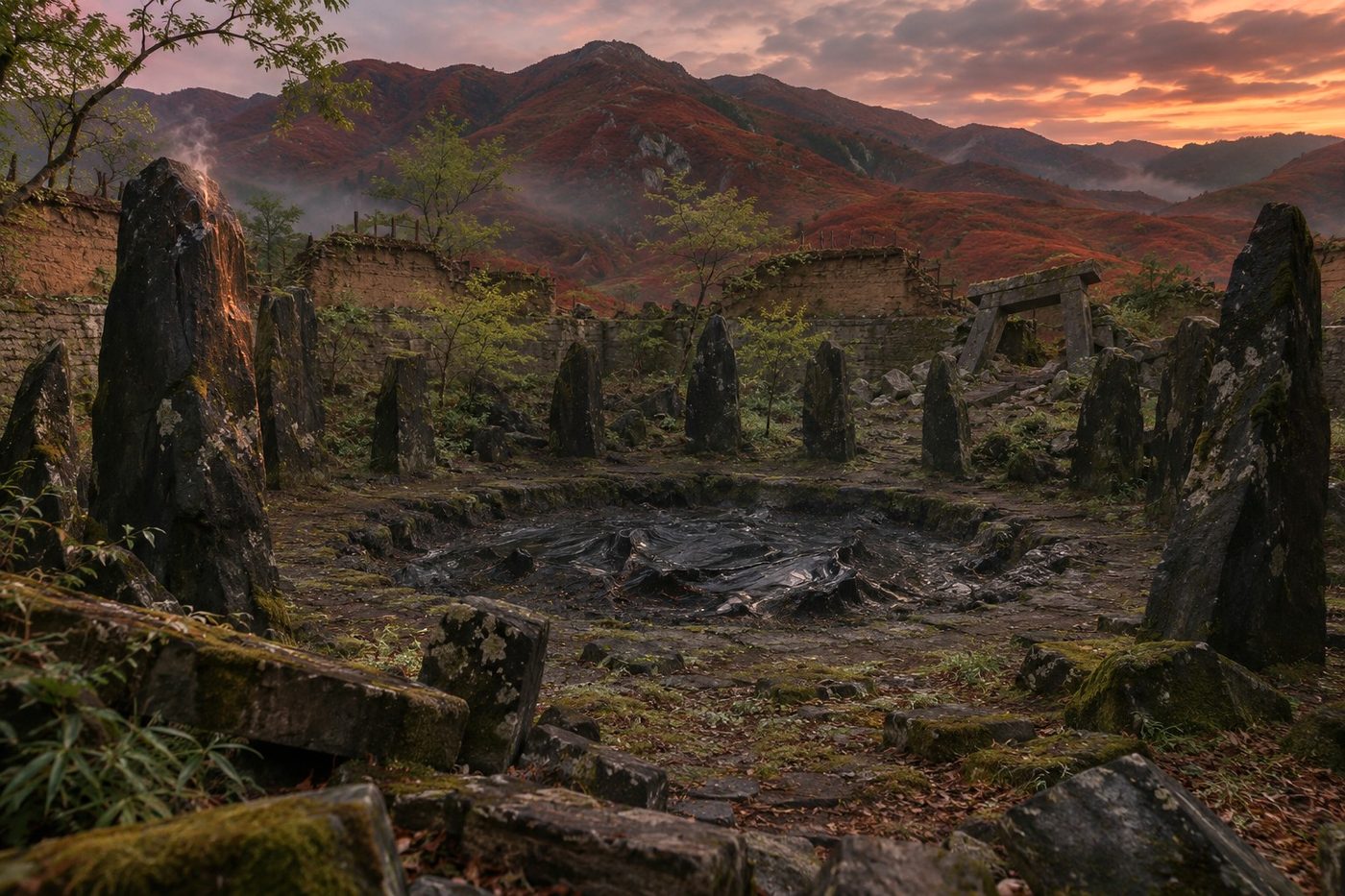
The god's forge still stands in the ruins of the old kingdom of Tatara, in Tetsugawa (Chapter 8): a ring of black stones around a hearth that has been cold for longer than the realm has existed. Anyone who lit it again, and fed it the shards, could reforge the Great Sword. Part 3 tells who means to try. The smiths of Tetsugawa descend from the god's apprentices, which is why their blades are the finest in the realm, and why a master like Masuhiro can put something more than steel into a sword.
The Shard Stones#
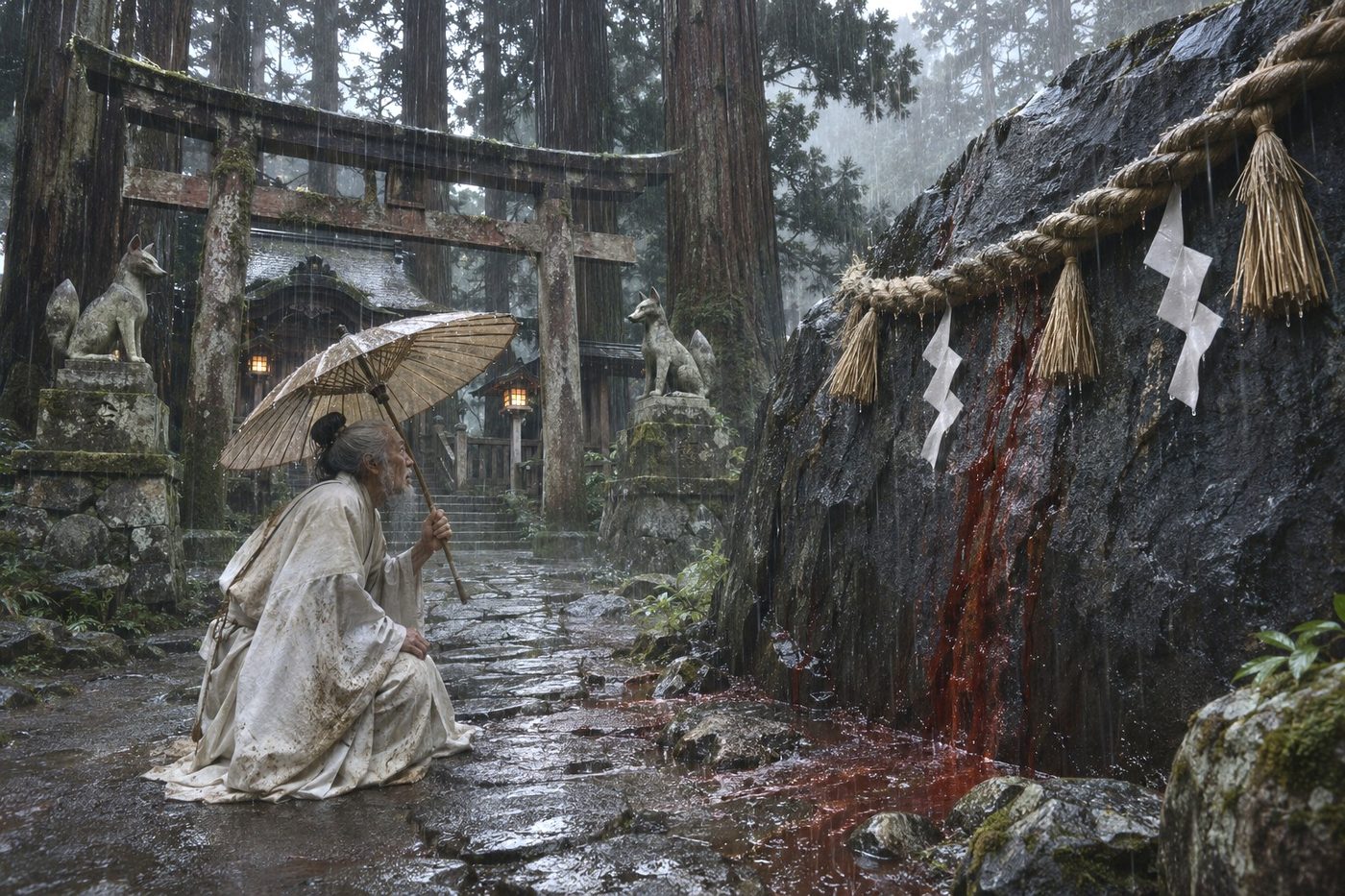
The sword broke into countless pieces, and most became the isles themselves. A few stayed what they were: eight shard stones, true fragments of the blade, each now kept at one of the realm's eight oldest shrines, one in each region. They look like slabs of black rock, cool to the touch even in summer. The flat stone of Hiraishi Shrine at Kurogane Pass is one.
Each shard still feels the cut. When the boundaries wear thinner, or when a coming war threatens to spill enough blood to thin them, the stones weep a dark red seep, like rust in rain. Priests who know what the stones are read them the way a sailor reads the sky. Few priests still know. The Hiraishi stone bled last month.
Lu Xian and the Closing of Tokoyo#
About two thousand years ago, the island sorcerer Anshi sailed to the mainland. Chapter 2 tells the public story. The truth is that Anshi was a student of the Eight Kami who asked for the fruit of the summit and was refused. He wanted an army to take what the gods would not give, so he told the emperor of Shenyuan about the mountain of immortals, and the emperor sent Admiral Lu Xian with 60 ships.
Lu Xian was a harder man than Anshi had bargained for. He conquered the stone-age tribes with bronze, climbed the mountain, and put the hermit-servants of the groves to the sword. He killed Anshi on the summit when Anshi tried to claim the trees, and then he ate the fruit himself.
Tokiwa-hime, the Evergreen Princess, answered by withering the groves. In her grief, the Eight Kami pulled the boundaries apart at the summit, and the Eternal Land withdrew from Hōrai across the eastern sea, to a place no ship finds twice. That is how Hōrai stopped being Tokoyo. The isles were the Eternal Land once, and they lost it to one man's hunger.
The Eight Kami could not kill Lu Xian, because he could no longer die. Instead they bound him to the mountain: he may walk its slopes forever, and never leave them. He made the best of it. He married Asahime, high priestess of the Sun Goddess, ruled the tribes from the mountain's foot, and founded the kingdom of Hō, whose kings became the Emperors. Both of the old stories are true. Lu Xian never left the mountain's slopes, and he never died.
Before the binding was complete, he sent one ship home with one letter. The emperor of Shenyuan was dead by the time it arrived, and the letter went into the archives, where the Daqian court still keeps it among the records of the dynasty before theirs. It reads, in part: "I have found the mountain, and it has found me. Tell my lord that eternal life is a cage with no door."
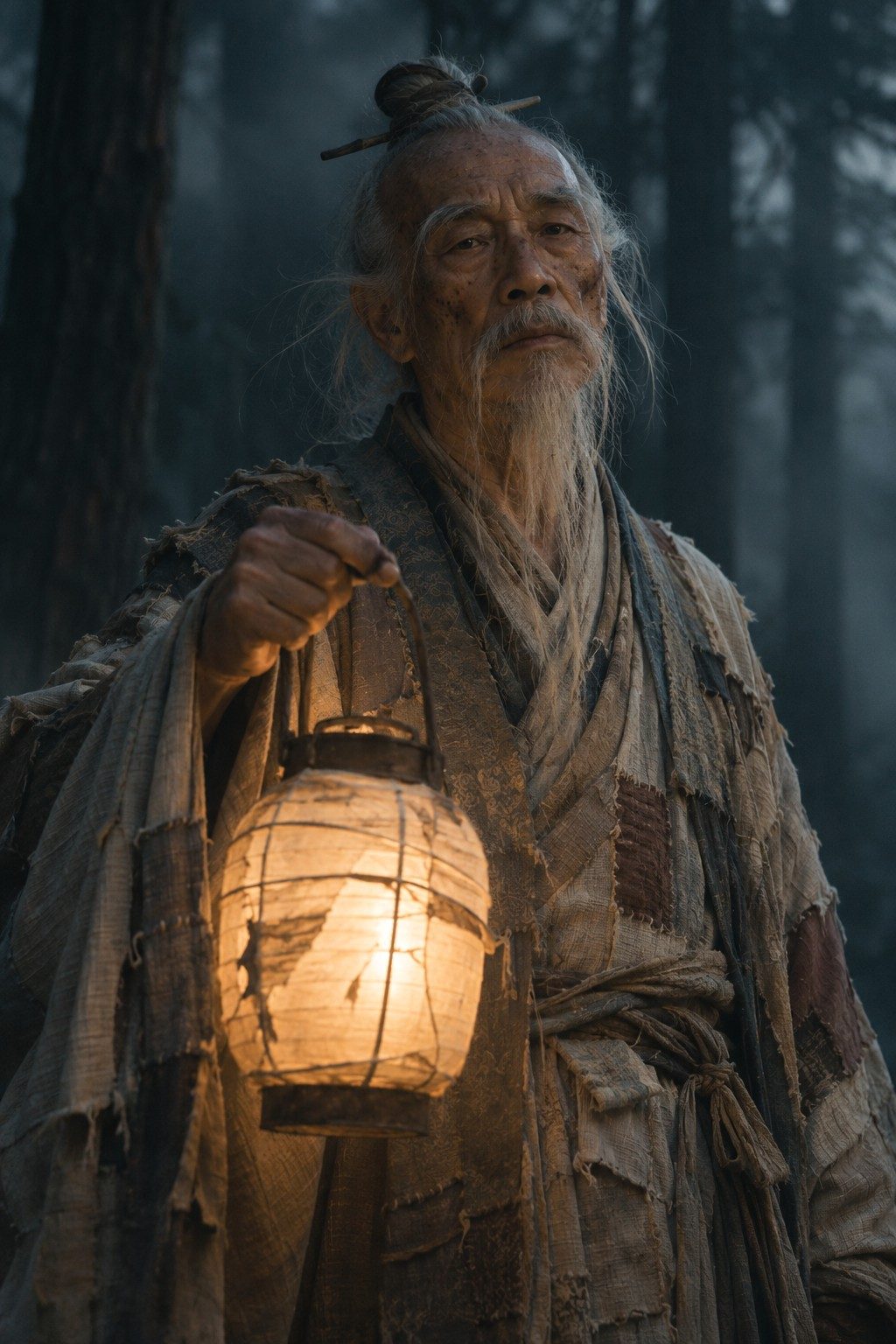
Lu Xian today is an old man in faded mainland robes who wanders Hōrai's slopes by night, carrying a lantern (the strange lights the Kasumi pilgrims see). He has watched his descendants rule for two thousand years. He speaks the island tongue in a form four centuries out of date, knows more history than any scholar alive, and wants one thing: to die. He can't, until Tokoyo opens again and he can return the fruit he stole (Part 2). He is neither an ally nor an enemy. He is the oldest person in the world, and his help always costs something. Chapter 9 gives his statistics.
The Covenant Stolen#
During the Age of Seven Kingdoms, the kingdom of Tatara kept the god's forge and the covenant. Its smith-kings performed the rites that kept the cut sharp, and the other kingdoms sent offerings to Tatara as a matter of course.
King Tenzei of Hō wanted that covenant for his own line. With the iron and the mainland learning he had gained, he broke the other kingdoms one by one, and Tatara last of all. He burned its royal city, killed its smith-priests, and made the last smith-king hand the covenant over before he died: at the cold forge, under the eyes of the Smith of Heaven, Tenzei swore the old oath for himself and his descendants. Then he carried the covenant to Hō, built the first Rites of the Year on it, and became Emperor.
The covenant came with a condition, spoken plainly in the last smith-king's words: the line that keeps the rites keeps the realm, and a line that fails the gods may be set aside by them for another. Tenzei's scribes rewrote the chronicles. In the official history Tatara is one more kingdom that bent the knee, the covenant is "the Emperor's sacred duty," and the condition is gone.
The original record survives. The old scholarly temples of Furumiya keep it in a locked sutra hall, copied and recopied for twelve centuries by monks who were never told what it meant: the Tatara Record, a bundle of scrolls in an archaic script that perhaps three scholars alive can read. "The true history of the realm, and it isn't the one we're taught," as the rumor says. A hero who can read it understands that the gods have chosen a line before, and could choose again.
The Demon Gate#
When the court moved to Seikyō in Kenreki 494, it built its new city in sight of a mountain to the northeast, the unlucky direction, the demon gate. Something already lived beneath that mountain: a great oni that had haunted the northeastern hills since the age of kingdoms, drawn up from Yomi through a crack where the cut ran thin.
A monk of the mainland teaching, now called only the Founding Abbot, climbed the mountain, fought the oni for seven days, and bound it beneath the peak with chains of prayer. He lit a lamp in the hall he built over the binding and swore that it would never go out. That hall became Raihō-ji, the head temple of Thunder Peak. The lamp is the temple's famous eternal lamp, and the monks' nightly rites renew the chains. Very few monks know why. Part 3 describes what lies beneath them: the Lord of the Demon Gate.
The Founder of the Circuit#
Around Kenreki 560, a wandering monk now called the Founder of the Circuit walked the mountains of Tsuba-jima and raised or blessed the 48 temples of Ōgiri. When his work was done, he sealed himself into a cave above the fog valley to meditate until the next buddha comes. His body sits there still, uncorrupted. His spirit walks beside lone pilgrims in the fog, as the stories say. The wish at the end of the circuit is real, and it is his to grant: he hears it and answers it as he judges best, which isn't always as it was asked. Part 4 adds what walks the fog valley in his shape when the hakobore runs high.
The Drowned Emperor#
When Kamaeda fell at Shiranui in Kenreki 885, the last child-emperor drowned with his court. Chapter 2 tells it as a tragedy. The secret is what it did to the cut. The boy had performed his Great Tasting. In the eyes of the gods he was fully Emperor, bound by the covenant, and he died by violence, in the sea, unburied and unpurified. His drowned court never passed on. For four centuries his ghost-lights have been a wound in the boundary off Shiranui's shore, and the dead there are stronger than any other dead in the isles, because their Emperor holds them.
Part 3 tells who pays them, and how.
The First Shogun's Rest#
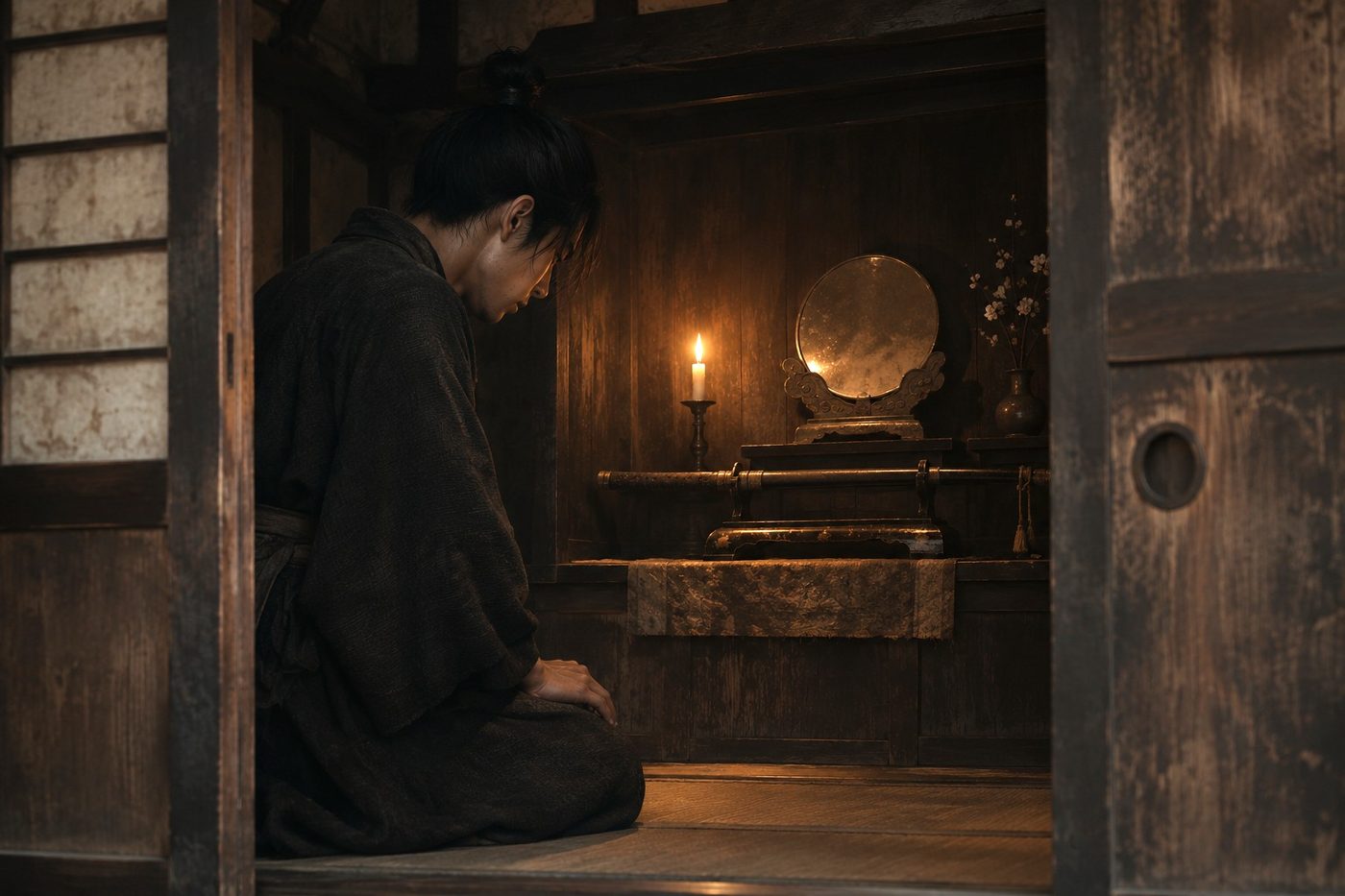
Minazuki Tsunetomo, the first Shogun, died in his bed in Kenreki 912. His son buried a coffin in the great mound in the Mirror Fields, before the whole warrior realm. The coffin held stones. On the same night, with three priests and no one else, the son laid his father's bones in a hidden shrine deep inside Hagane Castle and enshrined him as the guardian kami of the Shogunate, so that no enemy could ever dig him up, and so that his spirit would watch over the house he founded. The mound is empty. The shrine is behind a sliding wall in the castle's innermost keep, and only the reigning Shogun and the castle's chief priest are supposed to know where.
The first Shogun's spirit has watched for three and a half centuries. It saw the Usurpation of 1199, when one of his descendants deposed another, and it was offended. It sees the realm now choosing sides between his descendants, and it grieves. It wants something from the house of Kagamino, and it has found the one Kagamino in a generation who can hear it.
The Century of Blood#
For three centuries the Kagamino peace kept the dead mostly quiet. Battles were few, and the dead were mourned and purified. Then came the Usurpation, the long decline of the Shikken's rule, the private wars of the daimyo, and finally the Cheongun War. Tens of thousands died abroad, in a land with other gods, and were never brought home or properly mourned. Every field where the dead lie unpurified drains a little pollution into the shards, and the cut wears a little thinner.
The worst of these fields are known: the field of a thousand graves in Momiji, where the dead of the Minazuki Return refight their battle every autumn night; Akahara in Kurogane, where the League's dead and the Amanuma dead stand in two lines in the fog; and the bay of the drowned court at Shiranui. The Cheongun battlefields across the Strait are a fourth, and the hardest to reach.
By Kenreki 1235, the year Shogun Tomonori died in Cheongun, the cut had thinned enough for the first signs: a few more ghosts, a few more children born with the gift. That year, his son Tomoharu was born.
The Spoiled Tasting#
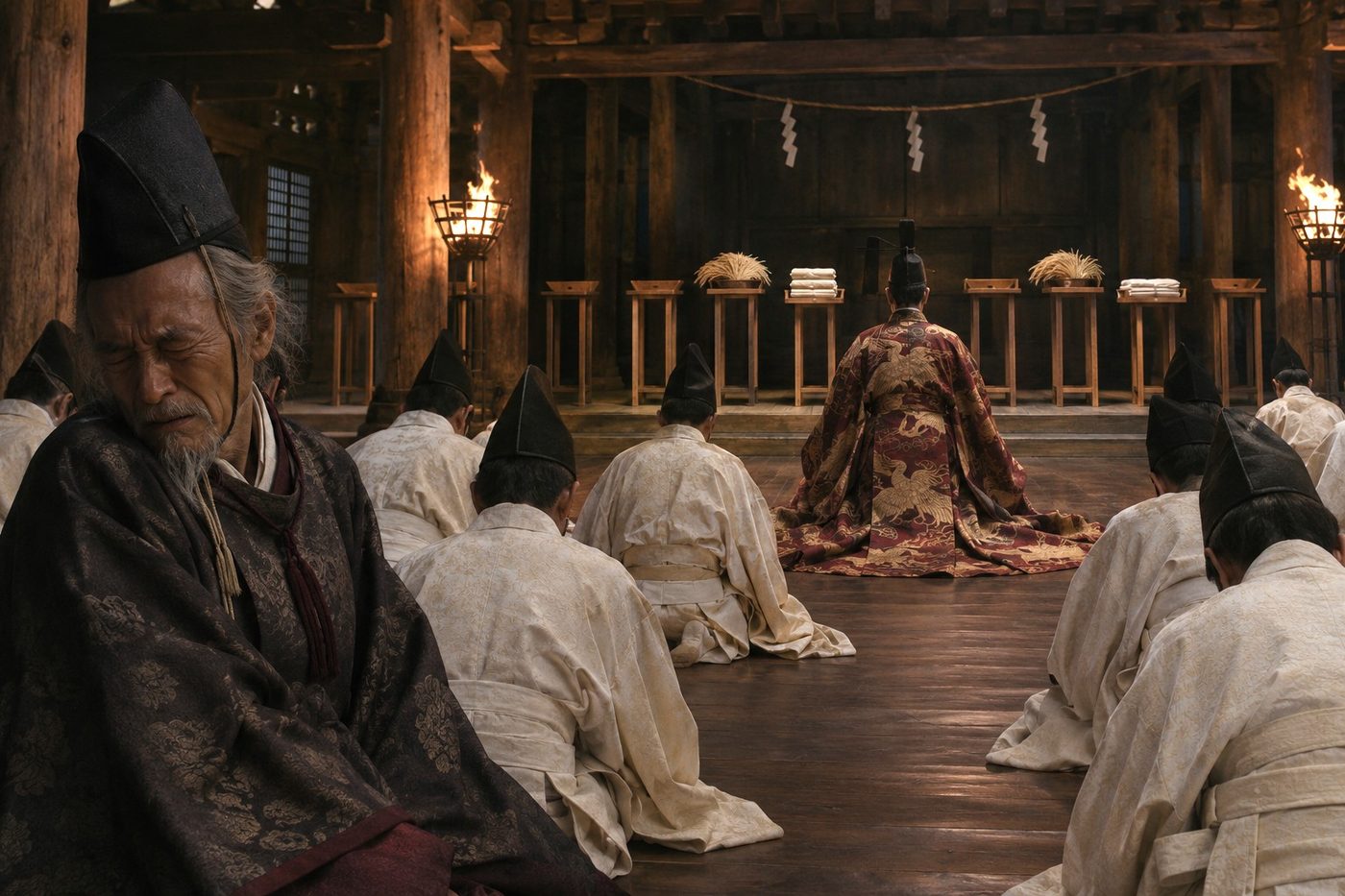
The present Emperor came to the throne in Kenreki 1255, when his father retired to the Cloister. In the autumn of 1256 he was due to perform the Great Tasting, the vast rite that seals a reign and renews the covenant for a new Emperor.
The rite needs offerings from every province: rice from two sacred fields chosen by divination, cloth, sake, and treasures, gathered over a year. In 1256 half the provinces sent nothing, and the court's treasury was empty. The Regent, Akebana Tsunemaro, went to the Shikken for the money. Ōtaki Kiyoaki refused. He was cutting every cost he could, and he saw no reason to pay for a ceremony.
Tsunemaro could have postponed the rite. He didn't. A postponed Great Tasting would have shown the realm that the court was too poor to crown its own Emperor, and shamed the Akebana before the Cloister. So he performed it with what he had: rice from the wrong fields, borrowed cloth, and empty boxes where the provinces' treasures should have stood. The rite failed. Everyone present who understood the forms knew it, and the Regent made sure that none of them said so.
Who knows:
- Akebana Tsunemaro, the Regent, who decided.
- Ōtaki Kiyoaki, the Shikken, who knows he refused the money, but thinks the Regent found it elsewhere. He doesn't know the rite failed, and doesn't believe in such things anyway.
- Tachieda Masunari, the frail master of ceremonies, who knows every form of every rite and knows exactly what went wrong. He has kept silent for five years, and it is killing him.
- An exiled court noble in the exiles' valley of Hate-no-Kuni, a junior ritualist who protested and was exiled for "insolence" at the Regent's request. He wrote everything down. This is the secret that could bring down the Akebana (Chapter 8).
- The Emperor suspects. Since 1256, the gods have not answered him the way they answered his father, and he doesn't know why.
- The Cloistered Emperor does not know. If he learns, he holds a weapon that can destroy the Regent, and perhaps the throne itself, because the covenant's lost condition says the gods may set a failed line aside.
From that autumn, every rite the Emperor performs is weaker. The cut has been wearing thin ever since, faster than before. That is what the Rites of the Year truly hold back, and why the old women are right that there are more genja now than when they were girls.
The Shogun Who Hears#
Kagamino Tomoharu was born in the year the cut first began to thin, and he was born with a great gift. He is a kannagi, a shrine medium, of more natural power than anyone in a hundred years. Nobody ever trained him, because nobody knew. A Shogun's heir learns the sword, the bow, and the law, not the purification rites.
Tomoharu isn't mad. He sees and hears the Hidden World. He talks to the first Shogun's spirit, to the dead of his father's army, to the kami of Hagane's hills, and to things nobody else in the room can see. His gentleness, his piety, and his love of temples are the instincts of a medium who has never been told what he is. At first the voices were quiet. As the cut wears thinner, they grow louder.
Someone is making it worse. For two years, a curse-worker (Part 3) inside Hagane Castle has been poisoning his dreams. What the Shogun sees has turned to terror: the drowned, the burned, his father's headless body. The curse is paid for by the Shikken, who wants a Shogun too frightened and too strange to rule, and who plans to move him to Kanagura "for his safety," where the Shikken alone can speak for him. Lady Hyoseon knows something is being done to her husband, and is looking for someone outside the castle walls to find out what (Chapter 8).
The cure needs three things: break the curse and expose the one who pays for it; train Tomoharu as a kannagi, so that he can open and close his sight at will; and answer what the first Shogun asks of his house. The first two are adventures. The third is the heart of the eventual Plot Point Campaign, and this book leaves it open.
Other Truths. The GM who wants a different villain behind the curse can choose the Regent (who wants a weak Shogun so the court can regain power), or a white plum agent (who wants Tomoharu to break, so that Sadatsugu can be named Protector of the Realm). Either works. The rest of the secret stays the same.
The Hakobore#
Everything above comes down to this. The Great Sword's edge is chipping, and in Kenreki 1261 the gaps are wide enough that the spirits are waking across the isles. It has two causes, and the heroes can work against both:
- The broken covenant. The present Emperor's Great Tasting failed, so every rite he performs is weaker, and the rites that fail outright do more harm than they should.
- The unpurified dead. A century of war has left fields of dead that no one has cleansed, and every new battle adds more.
The Hakobore Track (Optional Rule)#
The GM may track the state of the boundaries on a realm-wide scale from 0 to 5. The campaign begins at 2, Waking. The track is a guide, not a clock, and the GM can move it by judgment instead of by the lists below.
| Step | State | What changes |
|---|---|---|
| 0 | Quiet | The age of the Kagamino peace. Spirits keep to their places, and real power is very rare. |
| 1 | Stirring | Ghosts linger at the worst battlefields. A few more children are born who hear the kami. |
| 2 | Waking | The present day. Yōkai walk openly in remote places, the dead rise where they were wronged, and old rites begin to work again. Real power is rare but growing. |
| 3 | Restless | Fear checks caused by the supernatural are made at –1. When a domain draws a Clubs event (Chapter 5), it draws two cards and keeps the lower. Every unpurified battlefield is Profane Ground. (This doesn't stack with the double draw from a failed Rite of the Year.) |
| 4 | Torn | Fear checks caused by the supernatural are made at –2. The Hidden World breaks through at night in polluted places, and creatures cross freely. Every domain counts its Shrine Favor as one die type lower. |
| 5 | Broken | The Lord of the Demon Gate breaks his chains (Part 3). The Hidden World and the bright world overlap everywhere after dark. The realm faces the end of its age, and only a true Great Tasting can save it. |
The hakobore rises one step when:
- A Rite of the Year fails (Chapter 8).
- A great battle (Chapter 5) ends and its dead aren't purified within a season. (Kurogane Pass is a dated exception: its dead must be purified by the end of the season in which it is fought. See Part 4, Secrets in Kurogane.)
- A shard stone is stolen, broken, or polluted.
- A great threat wins a major victory (Part 3).
- Raihō-ji's eternal lamp goes out (two steps).
The hakobore falls one step when:
- One of the great polluted fields is cleansed: the field of a thousand graves (Release, Chapter 6), Akahara (Chapter 6), the bay of the drowned court (Shiogiri's release, Chapter 6), or the Cheongun battlefields.
- The heroes cleanse three lesser polluted places (a battlefield, an execution ground, a plague village) in the same year.
- A year passes in which every Rite of the Year succeeds and the heroes saved at least one of them.
- A stolen shard stone is restored and reconsecrated at its shrine.
And two steps when:
- A true Great Tasting is performed (below).
- Tokoyo is reopened (Part 2).
The hakobore never falls below 1 while the covenant stays broken. Only a true Great Tasting can bring it back to Quiet.
Reading the track.
- From the campaign's start forward. The lists count only what happens in play. Battles, thefts, and failed rites before the campaign begins (Akahara in 1258, the first stolen shard stone) are already part of the starting step.
- Broken doesn't lock the track. The deeds above still lower it, but the Lord of the Demon Gate stays free until he is bound again (Part 3), whatever the step.
- A true Great Tasting lowers the track two steps and removes the floor of 1. It doesn't undo what has already happened: the dead already risen, and the lord already free, must still be dealt with.
- Its effects at the table. The Fear penalty above stacks with a failed Rite of the Year's further –1 (Chapter 8), to no worse than –3. What changes for the spirits themselves is in Chapter 12 (Spirits and the Hakobore).
Mending the Cut#
Heroes can restore order. Every deed in the list above is an adventure or a campaign, and together they give a Blade and Kami™ campaign a purpose beyond the war of the blossoms. The greatest of them is a true Great Tasting, which takes everything the heroes have built:
- The truth. The heroes must learn that the 1256 rite failed, and prove it: Tachieda Masunari's confession, or the exile's record from Hate-no-Kuni. The Tatara Record from Furumiya proves nothing about 1256, but it shows why the failure matters: the gods may set a failed line aside. How to perform the rite again comes from Masunari or the Record's readers (Chapter 10, Campaigns, clue matrix).
- The court. The Emperor must agree to perform the rite a second time, which means admitting the first failed. The Regent fights to stop it, and the Cloistered Emperor tries to use it. This is court intrigue at its highest (Chapter 4).
- The offerings. Rice from two sacred fields chosen by an honest yin-yang master, and offerings from every province of the realm, including those at war with each other. Gathering them takes a year and touches every lord in the isles. Some give willingly, some must be persuaded, and some must be shamed. The tribute ships must also reach Seikyō past Zhuo Xianfeng (Part 3).
- The rite. A Dramatic Task at the palace precinct on the chosen night, kept perfectly pure while the heroes' enemies try to spoil it.
When the true Great Tasting succeeds, the covenant is renewed, the hakobore falls two steps, and every Rite of the Year after it works at full strength again. Each hero who took part gains Honor as for serving the Emperor in person (Chapter 8).
Notes#
- The god who fled Yomi, throwing peaches, and sealed its road with a great rock, and the voyager who brought back the orange from the Eternal Land, follow W. G. Aston, trans., Nihongi (1896).
- The sun goddess's descent of the Imperial line and the covenant of the rites draw on W. G. Aston, Shinto: The Way of the Gods (1905), on the Great Tasting and the Tasting of the New Rice.
- The admiral sent to find the isles of the immortals echoes the mainland legend of the voyage to the eastern isles, as told in F. Brinkley, A History of the Japanese People (1915).
Part 2: The Worlds Beyond#
Chapter 6 tells what islanders believe about the worlds beyond their own. This part tells the GM how those worlds really fit together, how heroes reach them, and what happens to those who go.
The Shape of Creation#
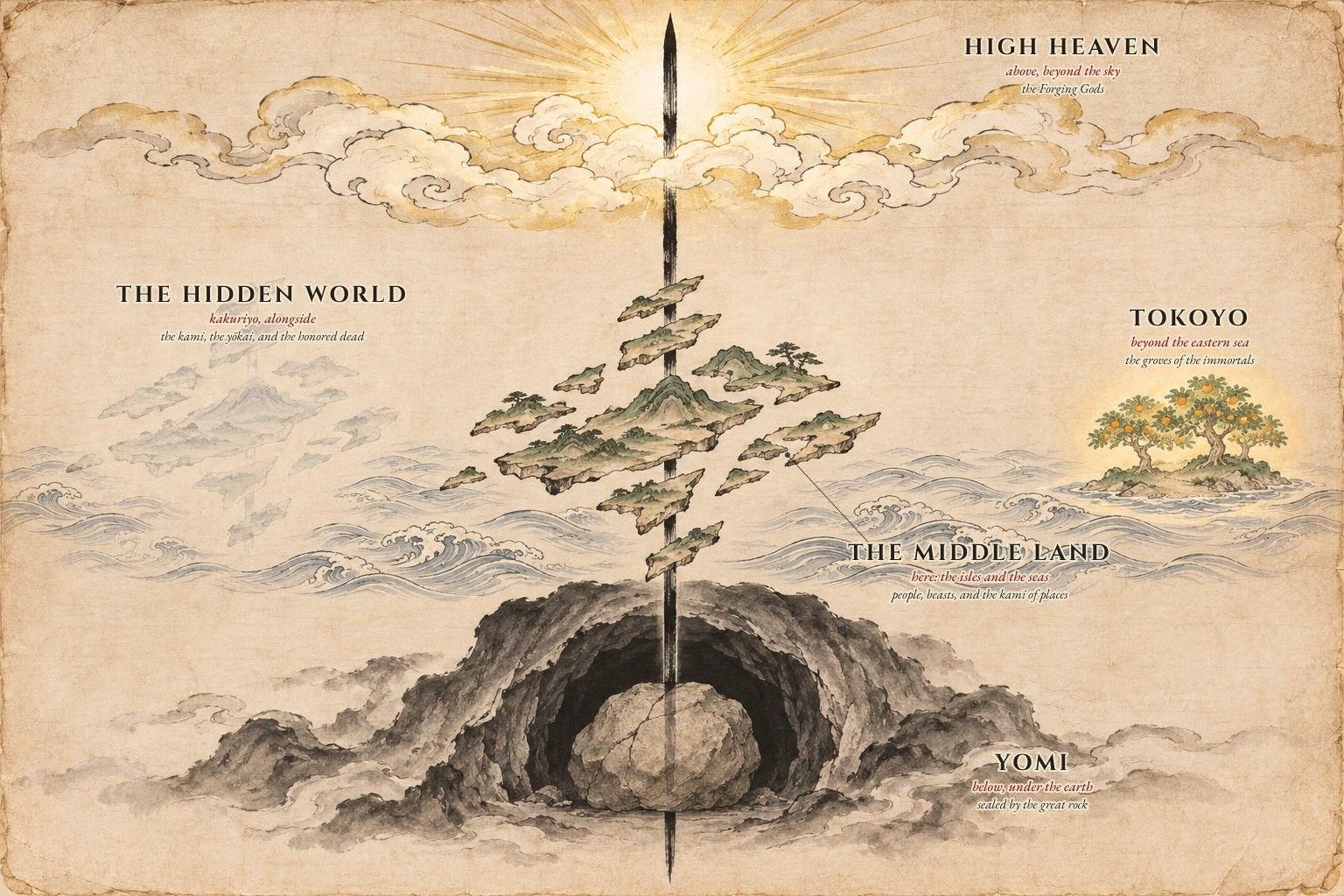
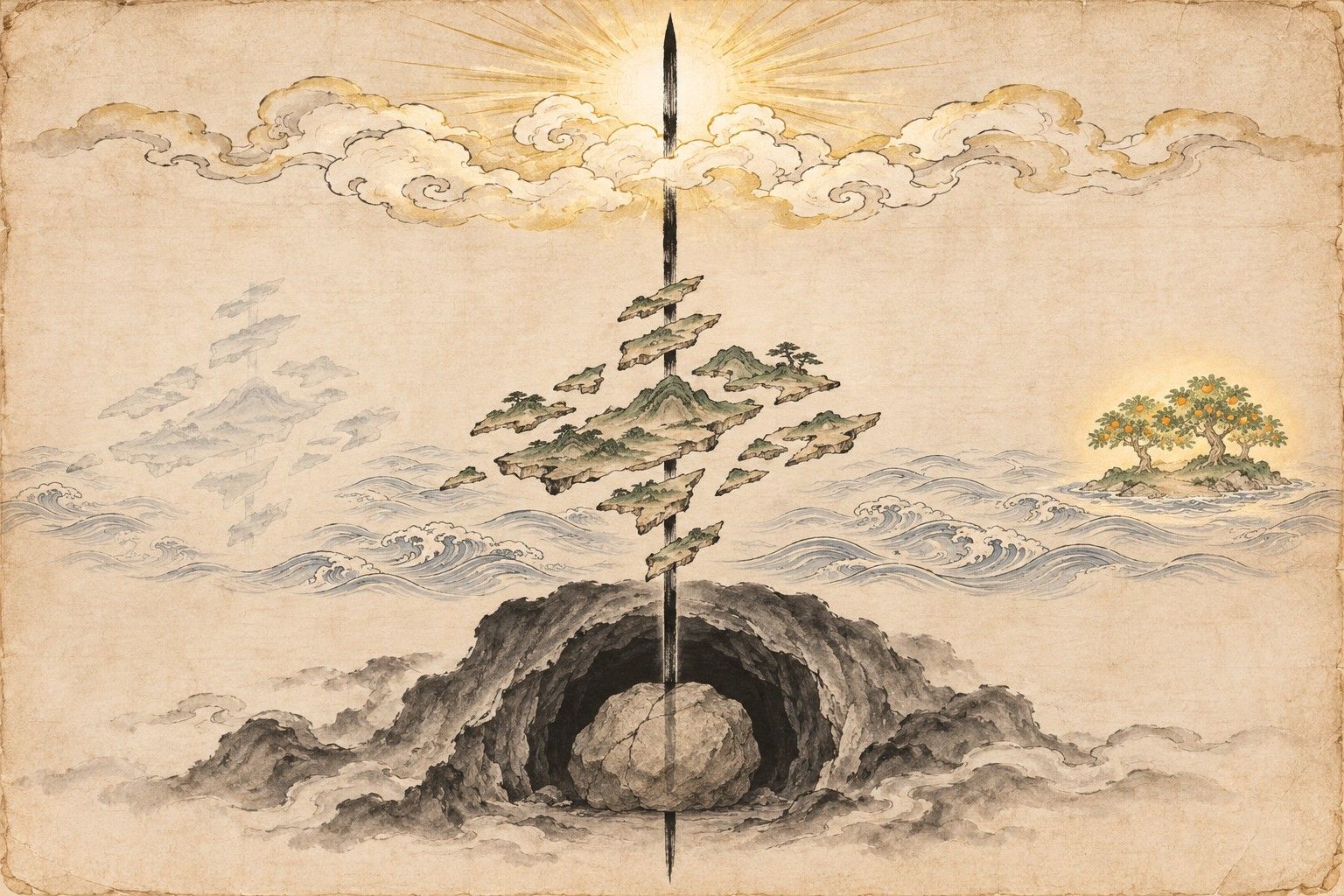
The Forging Gods' cut made five worlds out of one. Every boundary between them is the same cut, and every one of them is wearing thin with the hakobore (Part 1).
| World | Where it lies | Who dwells there | Can the living go there? |
|---|---|---|---|
| High Heaven | Above, beyond the sky | The Forging Gods | No. Closed since the sword fell. |
| The Middle Land | Here: the isles, the mainland, and the seas between | People, beasts, and the kami of places | This is home. |
| The Hidden World (kakuriyo, 隠世) | Alongside, like the lining of a robe | The kami, the yōkai, and the honored dead | Yes, through thin places or The Hidden Road. |
| Yomi (黄泉) | Below, under the earth | The polluted dead, the hag-armies, and the oni | Barely. The road is sealed by the great rock. |
| Tokoyo (常世) | Beyond the eastern sea | The memory of the immortals, and the groves | Not since Lu Xian's theft, unless it is reopened. |
The Pure Land and the hells of the Buddha's Law are not part of this map. They belong to the dead and to the faith, and no living person, power, or rite reaches them. This book leaves them to the faith.
Thin Places#
The boundary between the Middle Land and the Hidden World is never perfectly sealed. It is thinnest at certain places and certain times, and a hero who knows them can cross.
Places. Shrine gates (which open only inward, toward the kami), crossroads, bridges, the edges of old forests, mountain passes, deep wells and pools, mirrors that have hung in one place for a hundred years, and anywhere a great death or a great holiness has soaked into the ground.
Times. Dusk and dawn, the Hour of the Ox (1 to 3 in the morning), the three nights of the Festival of the Dead, a fox's wedding (sun through rain), and the last night of the year.
The hakobore. At Waking (the present day), thin places open only at their times. At Restless and above, they open every night. At Torn, they open at any hour, and things cross without being invited.
The Hidden World#
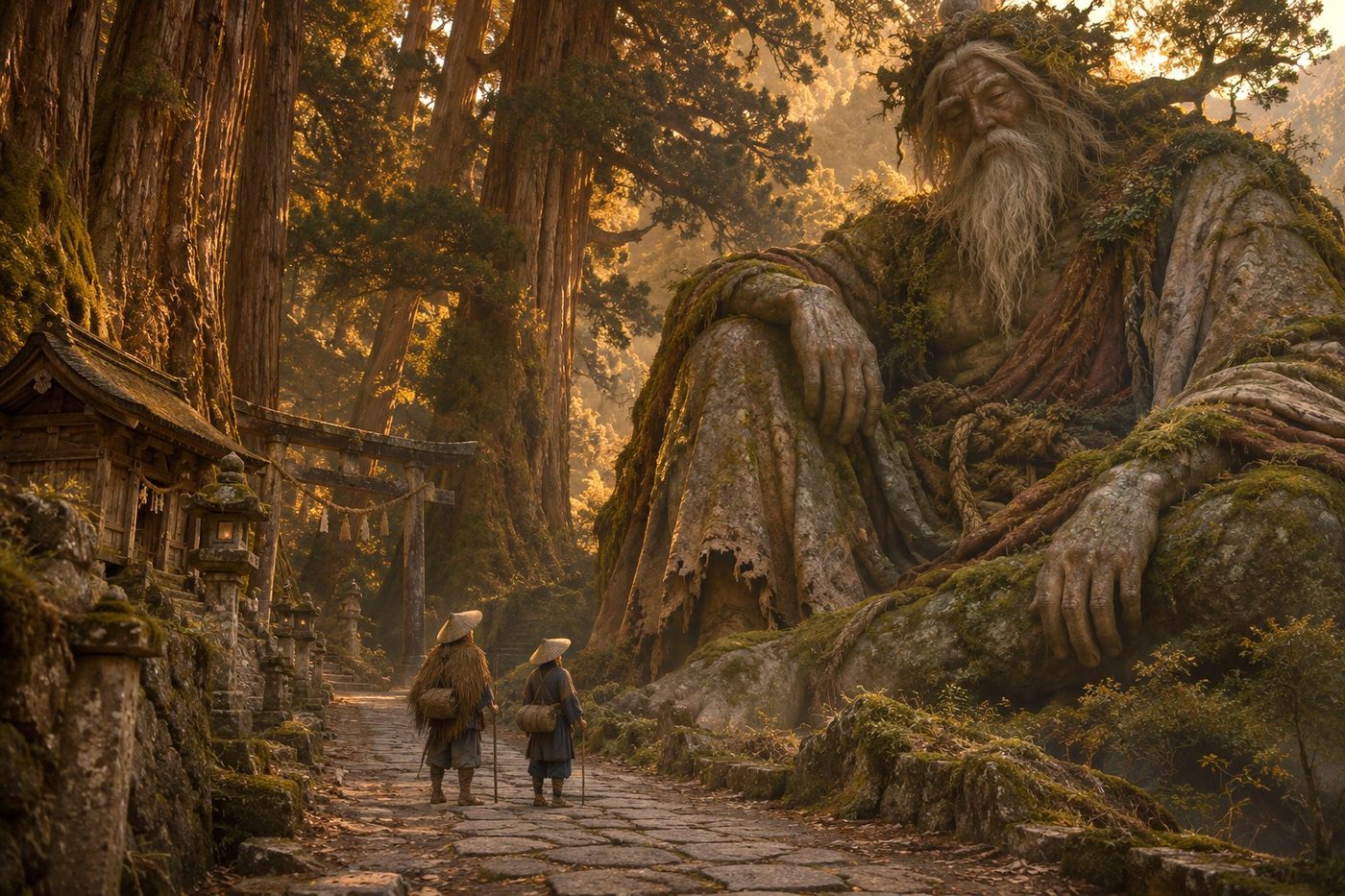
The Hidden World lies alongside the Middle Land, and every place in the isles has a hidden side. Kurogane Pass in the Hidden World is still a pass, but its cedars are taller, its stones remember every traveler, and the kami of the pass sits beside the road in a form a living eye can see. A village has a hidden village where its ancestors keep house. A battlefield has a hidden battlefield, where the unpurified dead fight on.
The light is always the light of late afternoon or of a bright moon. Colors are deeper, sounds carry farther, and distances shift: a mountain may be an hour's walk or a month's, depending on whether its kami wants visitors. The yōkai travel the Hidden World's roads at night, sometimes in great processions that a sensible traveler hides from.
Going There#
A hero reaches the Hidden World in one of four ways:
- The Hidden Road (plane shift, FC p. 133), the Veteran power of kannagi and yamabushi (Chapter 6).
- A thin place at its time. Any hero may try to step through with an Occult roll at –2 (no penalty at Restless or above). A genja may lead up to five companions through with them. On a Critical Failure, the hero crosses alone, somewhere else.
- An invitation. A kami, a fox, a tengu, or one of the honored dead may open the way for a guest. That is easy and safe, as long as the guest keeps the host's rules.
- Being taken. Spirited away (kamikakushi): a child who wanders off, a traveler lost in the fog, a sleeper who dreams too deeply. Finding them is an adventure.
Coming home takes the same road, a thin place on the hidden side, or the host's leave.
The Rules of the Hidden World#
- Time runs differently. When a hero returns, the GM rolls a d6 on the table below, once for the party. A genja who makes an Occult roll before leaving may shift the result one row up or down (two with a raise).
- Food binds. A guest who eats or drinks the food of the Hidden World is bound to their host until they repay the hospitality with a service or a gift of equal worth. Until then, the road home doesn't open for them. Kami and foxes keep this rule strictly; tengu bend it.
- Ground. Every region of the Hidden World counts as Consecrated or Profane Ground (HC p. 41), set by the kami or the dead who rule it. A kami's grove is Consecrated; the hidden side of Akahara is Profane.
- Spirit-banes work, often better. Salt, peach wood, mirrors, bells, and the sacred rope (Chapter 6) carry their full power, and a spirit-bane that would give a penalty gives it at an extra –1.
- Lying is dangerous. The kami and the honored dead know when they hear a lie. A hero caught lying to a host loses the host's protection and any bargain made.
- The dead stay dead. A hero who dies in the Hidden World is dead, and their spirit may remain there as a ghost. No rite in either world brings them back.
Time in the Hidden World#
| d6 | On returning, the heroes find that... |
|---|---|
| 1 | An hour there was a minute here. They return moments after they left. |
| 2 | Time matched. As long passed here as there. |
| 3 | A night there was a week here. |
| 4 | A night there was a season here. Everyone thought they were dead. |
| 5 | A night there was a year here. Their lord has given away their posts. |
| 6 | A night there was ten years here. The world has moved on without them (the GM may soften this to a year for a campaign that can't bear it). |
Who Lives There#
Most inhabitants of the Hidden World are people's neighbors in the Middle Land, met on their own ground: the kami of places, who rule their hidden sides as lords rule fiefs; the yōkai, who come and go between the worlds; the honored dead, who keep house for their families and watch over them; and the unpurified dead, trapped on the hidden sides of the places they died. The Bestiary gives their statistics.
Yomi, the Land of the Dead#
Yomi lies under the earth. It is dark, wet, and foul, and everything there is polluted. The dead who weren't purified and weren't fed sink there in time, and the oldest and worst of them become the hag-armies, the shrieking hosts that chased the god from Yomi in the old story. The oni come from Yomi too, climbing up through cracks where the cut runs thin. The Lord of the Demon Gate (Part 3) was one.
The Great Rock#
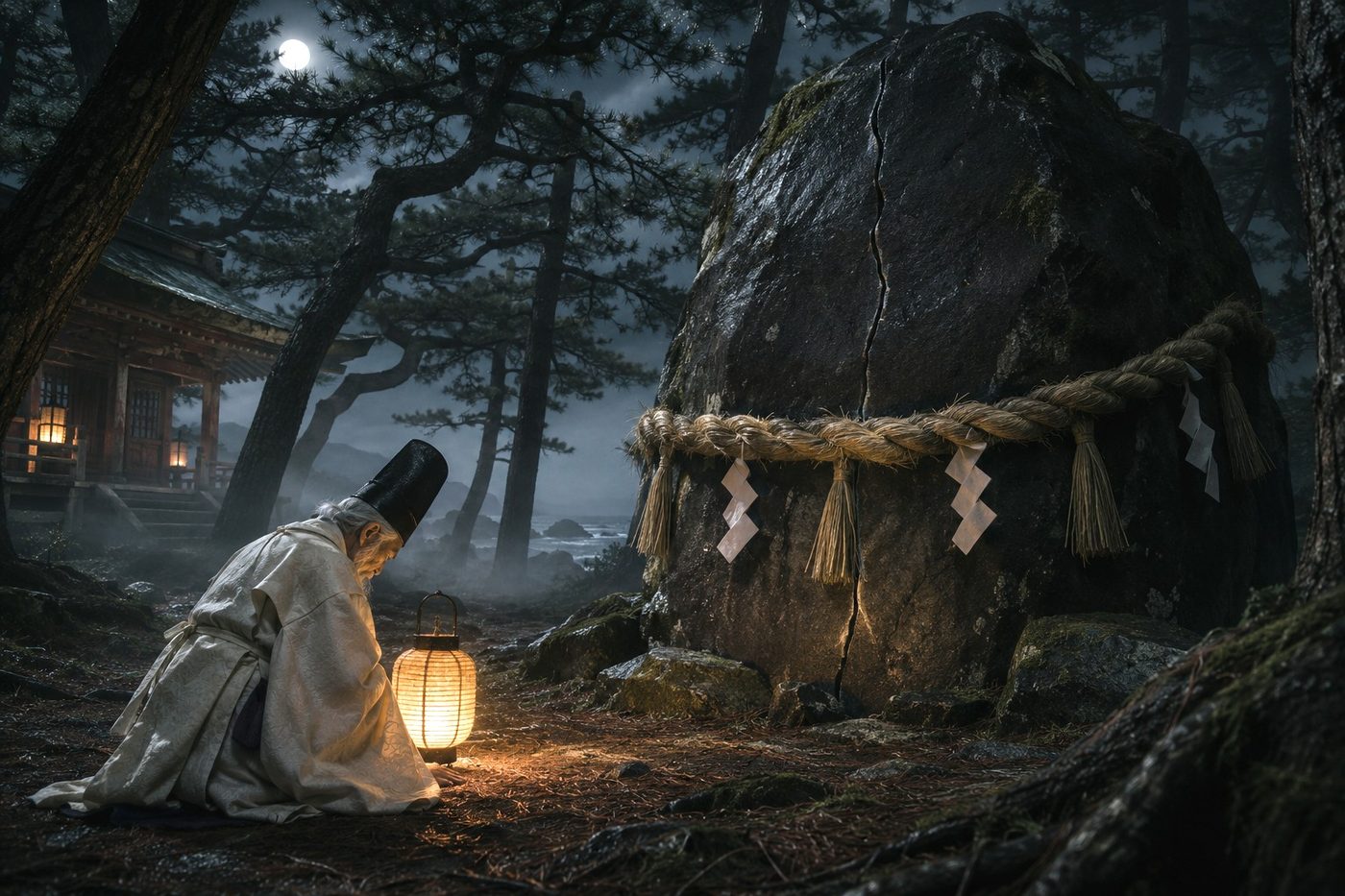
When the god fled Yomi in the oldest story, he sealed its road with a great rock. That rock stands in the inner precinct of the Great Shrine of Kagaribi, on the western shore, in a grove that only the shrine's high priest may enter. It is twice the height of a man, black, and roped with a sacred rope as thick as a waist. The shrine was built to guard it, and that is why Kagaribi is the oldest shrine in the realm.
It is also why the kami gather at Kagaribi. Every Tenth Month, the kami of the isles leave their shrines (which is why that month is called the month without gods) and meet in council at Kagaribi to look at the rock and renew its seal. The Eight Kami of the Mountain don't come; they never leave Hōrai, and their shrines say the council meets on their mountain. Both shrines are partly right, and both keep arguing.
The rock is cracked. It has been since the Spoiled Tasting (Part 1). The crack is a hand's width, and the high priest of Kagaribi, who knows, has told no one outside his shrine.
Going There#
The living reach Yomi only through the crack in the great rock, or through a pit of pollution so deep that it opens downward (a field of unburied dead at Torn or worse, or the hidden side of a plague pit). The Hidden Road reaches Yomi, but nobody who knows what it is chooses to go.
The Rules of Yomi#
- Pollution. A hero in Yomi gains one step of pollution (Chapter 4) on arrival and another every hour, and no ward stops it.
- Food binds forever. Whoever eats or drinks anything in Yomi can never return to the living. There is no repayment and no rite that undoes it. This is the oldest rule in the world.
- Darkness. Yomi is Pitch Darkness (SWADE p. 102) except where a hero carries fire, and fire draws the dead.
- Peaches. Peaches, peach wood, and peach blossoms are the strongest spirit-banes in Yomi. A hero who throws a peach behind them while fleeing the dead adds +2 to their next roll in the chase (Chases, SWADE p. 111).
- Nobody comes back unchanged. A hero who returns from Yomi makes a Fear check at –2, is Defiled, and gains a permanent Minor Hindrance of the GM's choice that marks what they saw (Haunted, Phobia, or Taboo from Chapter 3 suit well). Purification clears the pollution but not the mark.
Tokoyo, the Eternal Land#
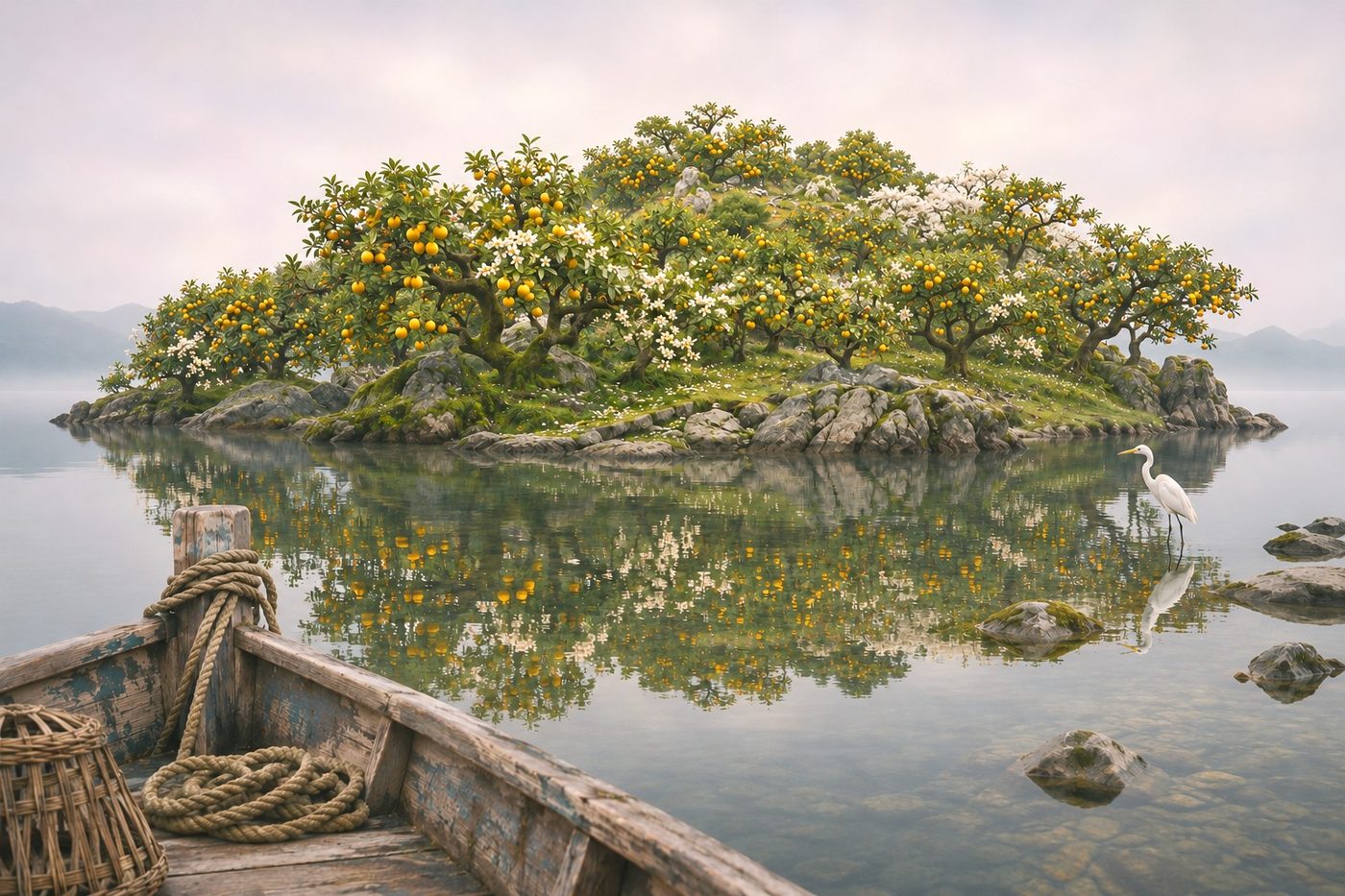
Tokoyo was once the summit of Mount Hōrai, where the boundaries touched and time could not take hold (Part 1). Since Lu Xian's theft it lies somewhere across the eastern sea, an island that no ship finds twice. A few voyagers have reached it by luck or by a kami's grace, and their stories agree: orange groves in eternal fruit, a soft light with no sun, white herons, and silence. A day there is a lifetime here. The voyager who brought back the Undying Orange (Chapter 6) thought he'd been gone a season, and returned after ten years to find his emperor dead.
Nobody lives in Tokoyo now. The hermit-servants who tended the groves died on the summit under Lu Xian's sword, and the Evergreen Princess, Tokiwa-hime, withdrew with the land and waits there alone.
Reopening Tokoyo#
Tokoyo can be brought back to Hōrai. It is a campaign of its own, and one of the greatest deeds open to heroes:
- The seed. The heroes need a seed of the Undying Orange (Chapter 6), which means finding the fruit and not eating it.
- The tree. The seed must be planted at a great shrine and tended for seven years by a kannagi who stays Clean the whole time. Each year brings a test (a drought, a fire, a thief, a lord who wants the fruit), and if the kannagi falls to Polluted or worse, the sapling dies.
- The summit. On the last night of the seventh year, the heroes carry a flowering branch to Hōrai's summit, in winter, when the mountain's kami don't welcome visitors. The Eight Kami must each be persuaded to let them pass.
- The return. At the summit, Lu Xian must give back what he took. He can only do that by choosing to die, and he must be found and brought there.
If the heroes succeed, Tokiwa-hime returns, the groves grow again on the summit, and Lu Xian dies at last. The hakobore falls two steps. The summit becomes Tokoyo again, and anyone who stays there stops aging.
And then the trouble starts. Every lord in the isles wants the fruit. The Daqian court wants it most of all. The Eight Kami guard the summit, but a realm at war doesn't respect kami for long. A reopened Tokoyo is a wonder and a prize, and it may need guarding for the rest of the heroes' lives, which may be very long indeed.
High Heaven#
High Heaven is closed. The Forging Gods have not walked the earth since the Smith of Heaven left Tatara. They speak only through the covenant: through the Rites of the Year, through omens, and through the rarest oracles, when a kannagi of great power calls down a god and is answered by something far greater than a kami. A GM may use this once in a campaign, at its most important moment. Nobody goes to High Heaven. Nobody returns from being called there.
Notes#
- The god who fled Yomi, the peaches thrown behind him, the great rock, and the rule that whoever eats the food of Yomi can't return follow W. G. Aston, trans., Nihongi (1896).
- The voyager who brought back the orange from the Eternal Land follows W. G. Aston, trans., Nihongi (1896).
- Time running differently in the other world draws on the fisherman Urashima, who visited the palace under the sea and came home to find centuries gone, in F. Hadland Davis, Myths and Legends of Japan (1912), and W. G. Aston, Shinto: The Way of the Gods (1905).
- The month without gods, when the kami gather in one province, follows W. G. Aston, Shinto: The Way of the Gods (1905).
Part 3: The Great Threats#
The war of the two blossoms is the danger everyone can see. Behind it, five greater threats are moving, and each grows stronger as the hakobore widens (Part 1). None of them cares which plum blossom wins. Most of them are glad of the war.
Each threat below gives what it is, what it wants, how it acts, the signs that it is moving, what happens if no one stops it, and how heroes can stop it. Statistics for the people are in Chapter 9, and for the creatures in the Bestiary.
How the War Feeds Them#
Every threat in this part profits from the war:
- Every battle leaves dead, and every field of unpurified dead widens the hakobore.
- Every lord at war stops sending offerings to the Rites of the Year, and a rite without its offerings fails.
- Every burned shrine puts its sacred things at risk, including the shard stones.
- Every warlord who wants Thunder Peak out of his way thinks about burning Raihō-ji, and doesn't know what sleeps beneath it.
Heroes who make peace, bury the dead properly, and keep the rites fed fight all five threats at once, whether they know it or not.
The Lord of the Demon Gate#
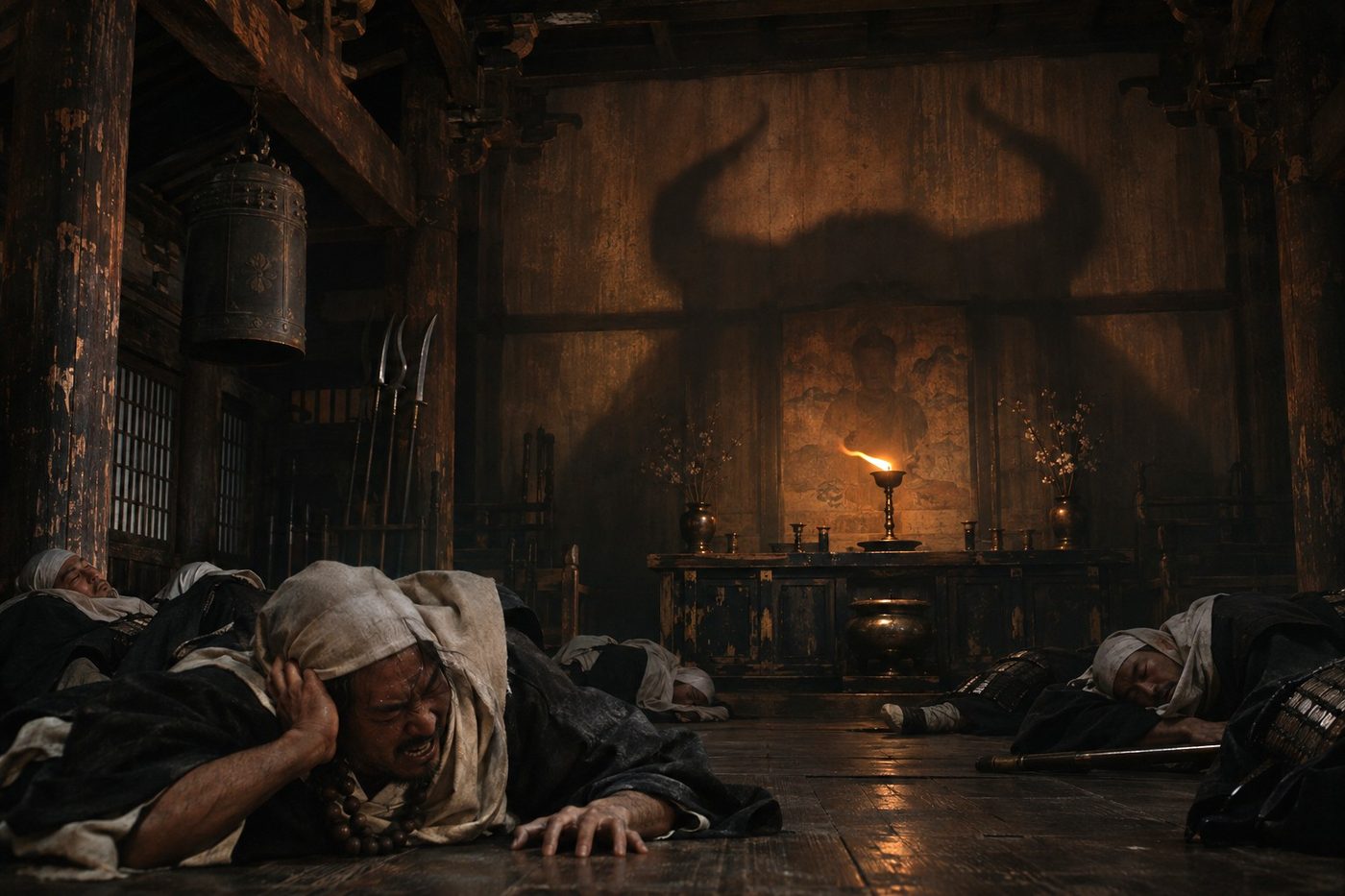
What it is. A great oni from Yomi, as tall as a gate tower, with a bull's horns and a voice like a landslide. It climbed up through a crack in the northeastern hills during the age of kingdoms and fed on the people there for centuries, until the Founding Abbot bound it beneath the mountain where Raihō-ji now stands (Part 1). Its true name was never written down. The few monks who know it is there call it only the Lord of the Demon Gate.
What it wants. To be free, to burn Seikyō, which was built in its sight to mock it, and to open the demon gate wide, so the hosts of Yomi can climb after it.
How it acts. It can't move, but it can dream. It whispers into the dreams of monks who sleep near the binding hall, of warlords who look at the mountain and see an enemy, and of anyone polluted enough to listen. It is patient and clever, and it never asks for its freedom directly. It asks a monk to doubt the old rites, or a lord to wonder how much simpler things would be with Thunder Peak gone. Lesser oni answer it. The oni of Seikyō's Southern Gate (Chapter 8) is its scout, sent to learn the city's defenses.
Signs.
- The eternal lamp gutters, though no wind blows in the hall.
- Monks of Raihō-ji wake from the same dream of a burning city.
- Lightning strikes the peak with no storm in the sky.
- Oni are seen in the capital and in the hills to its northeast.
If no one stops it. Two things free it: the hakobore reaching 5 (Broken), or the eternal lamp going out. The lamp goes out if Raihō-ji is burned, or if every monk leaves the mountain at once, as they do when they carry the sacred palanquin to the capital in force. When it walks, it goes straight for Seikyō. The Rites of the Year can't be performed in a burning city, so every rite that year fails, and the hakobore rises two steps for the lamp and one more for each failed rite.
Stopping it.
- Keep the lamp lit. The simplest defense is to protect Raihō-ji and see that the temple is never emptied. That may mean persuading the Cloistered Emperor not to send every monk to the capital, or persuading a warlord not to burn the mountain.
- Renew the chains. A great rite at the binding hall (a Dramatic Task led by a gakushō or sōhei, Chapter 6), with the Thunder Peak Glaive carried before the altar, strengthens the chains. The lamp can't gutter for a year, and the Lord can't send dreams.
- Fight it. If it walks, it can be fought. It is a Legendary foe, its statistics are in the Bestiary, and only a weapon or power that counts as a spirit-bane against demons (peach wood, the Thunder Peak Glaive, a blessed bow) can wound it badly. Driving it back into the mountain takes a battle and a rite at once.
The Old Kami of the North#
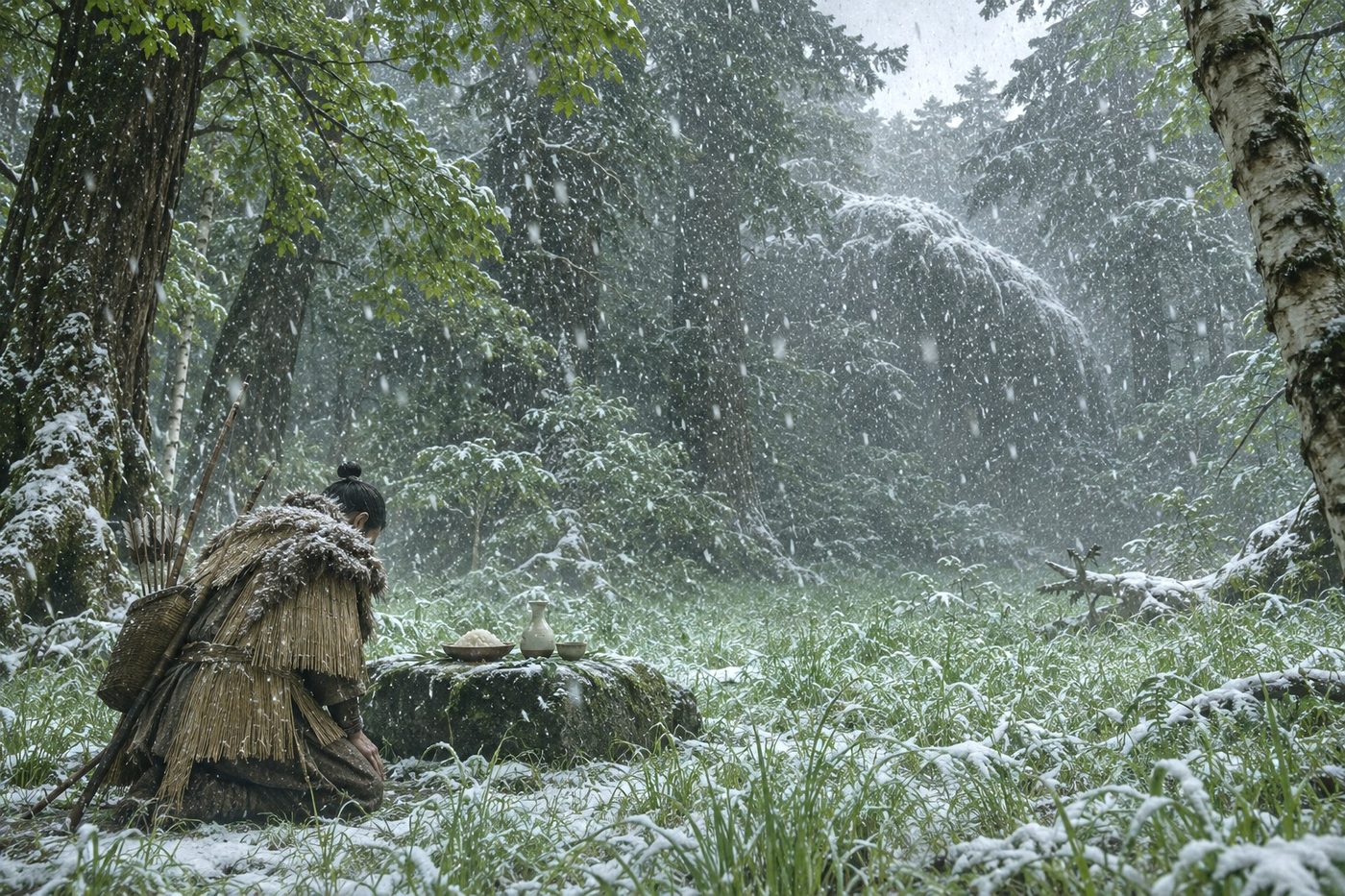
What they are. The spirits of the world before the cut, when heaven and earth were one (Part 1). They survived on Tsuka-jima, the hilt that never cut, and they rule the forests of Hate-no-Kuni. They are vast, slow, and nothing like the kami of the shrines: a bear the size of a hill, a forest that breathes, a snowstorm that remembers. They don't have names, because names are a way of cutting one thing from another. Hunters call the greatest of them the Elder of the Forest.
What they want. The cut undone. They don't hate people. They don't understand them, any more than people understand the weather. But a world where heaven and earth are one again is a world without edges, without time, and without people as we know them. If the old kami won, the world would not end in fire. It would simply stop being separate, and everything in it would stop being itself.
How they act. Slowly. Each year the hakobore widens, the northern forest grows a little farther, the winters last a little longer, and the old kami grow a little more awake. They don't send armies. They send snow in summer, beasts that walk out of the forest unafraid, and fog that swallows hunters. They call to children, who wander into the trees and don't come back (spirited away, Part 2). They sometimes speak through the exiles of Hate-no-Kuni, who are lonely, angry, and willing to listen.
Signs.
- Snow falls in summer in the northern provinces.
- The Warden's graveyard grows faster than the stockade.
- Bears, wolves, and great deer come down from the forest, unafraid, and stand at the edges of villages.
- Exiles in the valley begin speaking of "the quiet," and some walk into the forest willingly.
If no one stops them. At Torn (4), the forest's edge moves a mile a season, and the northern coast of Shinogi-jima sees the first snows in summer. At Broken (5), the forest crosses the strait, and the north of the realm begins to forget itself: villages wake one morning with no names, and roads lead nowhere.
Stopping them. The old kami can't be fought, any more than winter can.
- Mend the cut. As the hakobore falls, the old kami sleep again.
- Bargain. A genja who goes to the forest's edge with offerings and asks permission, as the hunters do, can speak with the Elder through kami-oroshi (Chapter 6). The Elder can be persuaded to hold its forest where it is, for a price that always makes sense to a forest and rarely to a person: a valley left unfarmed forever, a promise never to cut a certain tree, a person who stays.
- A boundary. A great sacred rope stretched across the northern strait by the realm's shrines, blessed in one night by a hundred kannagi, holds the forest on Tsuka-jima for a generation.
The Whetstone#
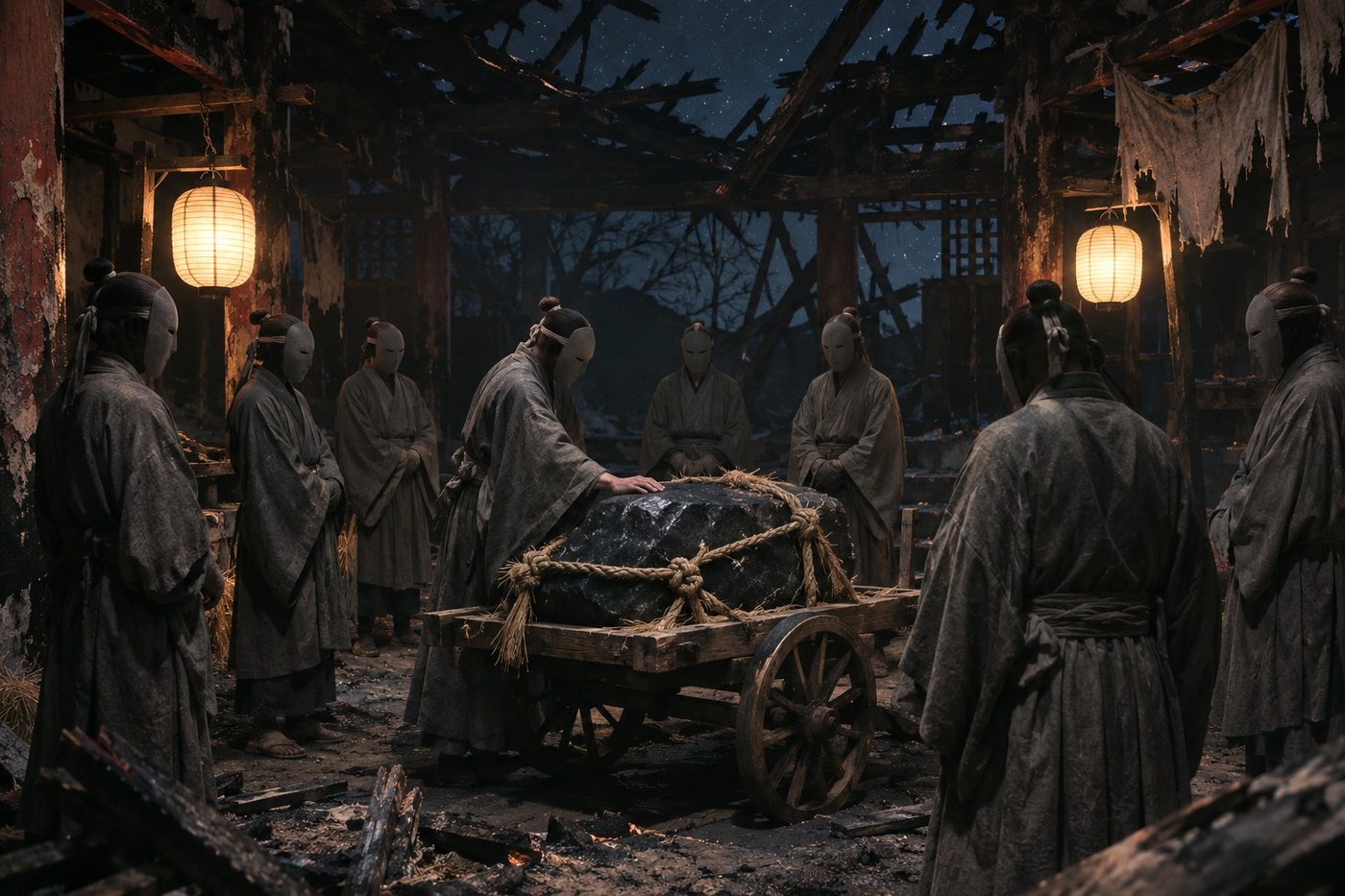
What it is. A secret society of renegade genja, smiths, and those who serve them, called the Whetstone (Toishi-gumi, 砥石組) for the stone that sharpens a blade. Its members wear plain gray masks when they meet and use the names of sword parts instead of their own. There are perhaps forty of them across the isles, with hundreds more who serve without knowing whom.
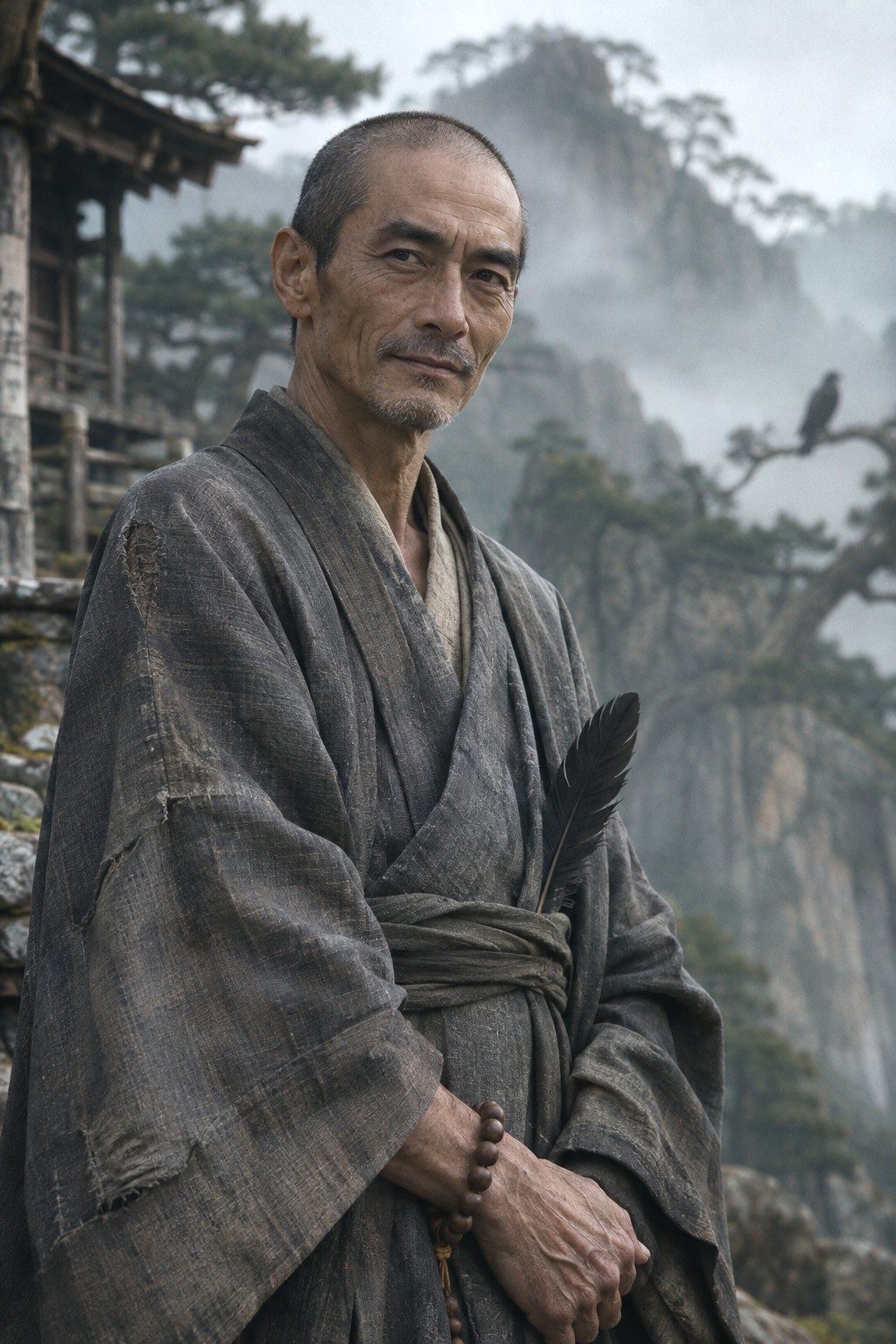
Its leader is Kūzan (空山, "Empty Mountain"), once a scholar-monk of Thunder Peak who studied the secret rites at Raihō-ji until he read a fragment of the Tatara Record and understood what the Great Sword is. When his abbot forbade him to speak of it, he climbed into the mountains, and a great tengu taught him sorcery in exchange for his pride. He is now a tengu-taught sorcerer (below), a brilliant, courteous, and utterly certain man in his sixties. Chapter 9 gives his statistics.
What it wants. To gather the eight shard stones (Part 1), relight the cold forge of Tatara, and reforge the Great Sword. Kūzan believes the Forging Gods abandoned the world when they left, that the covenant is a leash, and that whoever holds a whole sword can make a new cut and a better world. His tengu master wants something simpler: to humble the gods, because tengu can't bear anything prouder than themselves.
How it acts.
- It steals the shard stones, one at a time, and makes each theft look like the war: a shrine burned by passing soldiers, a stone "lost" when a village was abandoned. It holds one stone already, taken from a shrine in Kazahaya that burned in the private wars ten years ago. Nobody noticed the stone was gone.
- It works through smiths. A thinner cut softens the shards, but only a master smith of the god's line can work them. The Whetstone recruits, bribes, or kidnaps the smiths of Tetsugawa. It suggested to Master Masuhiro, through a go-between he never questioned, where to find iron sand worthy of his boast. Ryōdan (Chapter 6) is the Whetstone's experiment: a blade with the dead in it, to learn how steel takes in spirit. If Ryōdan works, they know how to make the sword cut what they choose.
- It widens the hakobore. A thinner cut makes the reforging easier, so the Whetstone helps rites fail, pays curse-workers, and urges lords toward battle wherever it can.
Signs.
- A shard stone goes missing after a fire.
- A smith of Tetsugawa vanishes on the road, and both blossoms blame each other (Chapter 8).
- Monks in gray masks are seen at a ruined shrine.
- The black stones around the forge of Tatara are warm to the touch.
If no one stops it. The Whetstone gains a stone every year or so. With four, its smiths can relight the forge. With all eight, the sword can be reforged, and the GM's campaign reaches its end: the hakobore goes to 5 at once, and whoever holds the sword can cut any boundary in creation. They can open Yomi, close the Hidden World forever, or cut the Emperor's line away from the covenant and put another in its place.
Stopping it.
- Guard the stones. Heroes who learn what the stones are can warn the shrines that keep them, move them, or stand guard.
- Follow the smiths. Masuhiro, if the heroes reach him, can lead them to the go-between, and the go-between to a Whetstone cell.
- Unmask Kūzan. Thunder Peak would give a great deal to know what became of him, and the Cloistered Emperor would give more.
- Put the forge to sleep. The forge can't be destroyed, but a true Great Tasting renews the covenant made there, and the forge goes cold for a hundred years.
The Drowned Court#
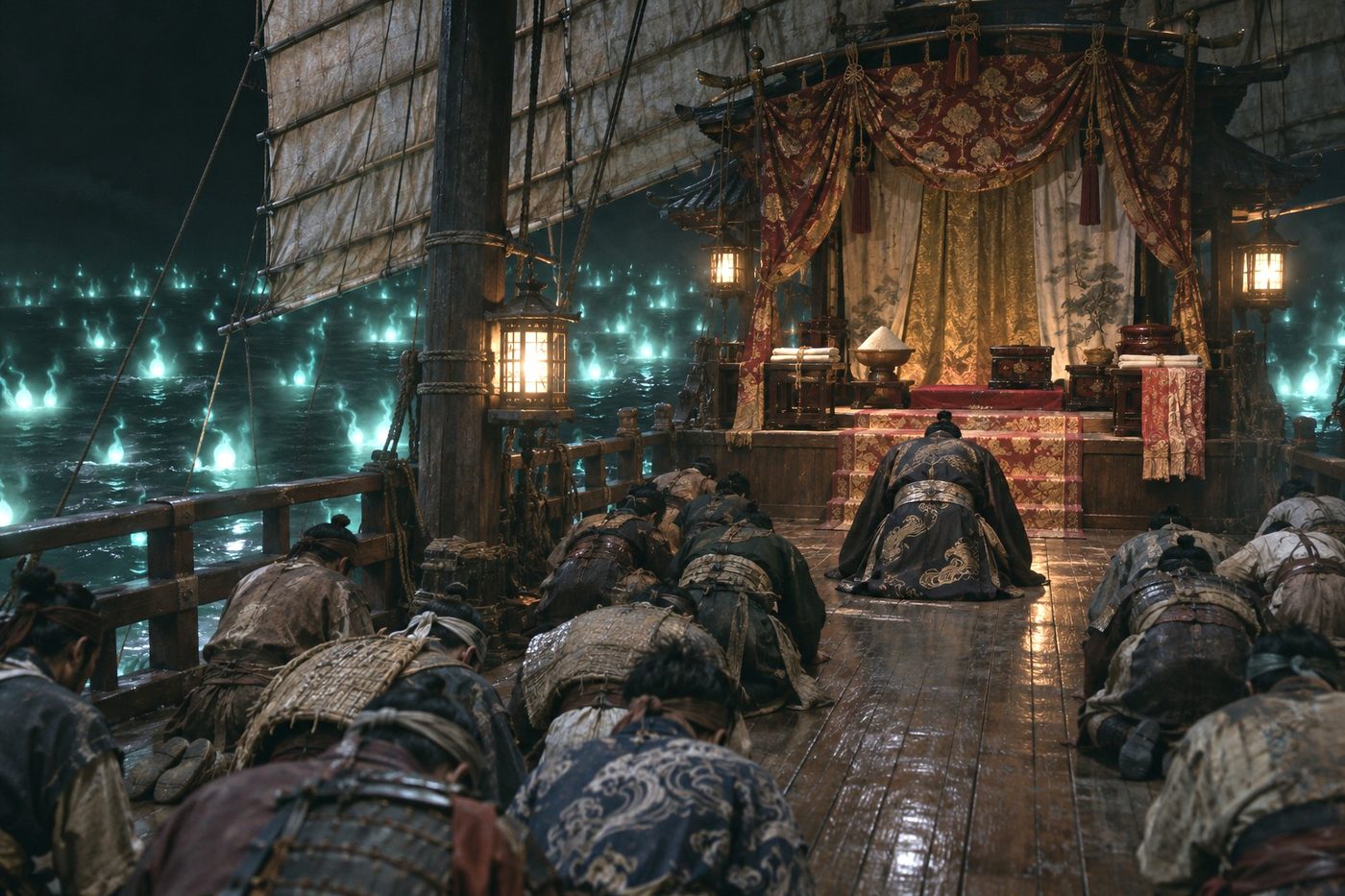
What it is. The ghosts of the Kamaeda court, drowned at Shiranui in Kenreki 885, and the child-emperor who holds them (Part 1). For four centuries their ghost-lights have drifted off Shiranui's shore. The boy had performed his Great Tasting, so in the gods' eyes he is still an Emperor, and his dead are stronger than any others in the isles.
Their keeper is the pirate Zhuo Xianfeng (Chapter 8), who found the secret of their favor. Every month, on the night of the new moon, he holds a court rite on his flagship among the ghost-lights. His crew kneel, his priest (a defrocked kannagi) chants, and Zhuo himself addresses the drowned child as the true Emperor of the isles, with the forms of the court and the offerings due to a reigning sovereign. The offerings are real: he steals them from the tribute ships that carry the provinces' rice, cloth, and treasures to Seikyō for the Rites of the Year. The flattered dead protect his harbor, sink his pursuers, and guide his ships through the reefs.
What they want. The drowned child wants to be honored as an Emperor, and in his lonely heart, to go home. Zhuo wants Shiogiri, the drowned Emperor's sword (Chapter 6), so he can command the dead instead of paying them.
How they act. Zhuo raids the tribute ships, which starves the Emperor's rites and widens the hakobore. The ghost-lights drift closer to shore every year as the cut thins. The ship ghosts (funa-yūrei) ask fishermen for ladles to sink their boats with.
Signs.
- A tribute ship carrying rite offerings vanishes on the Inland Sea.
- The ghost-lights reach the harbor mouth.
- A temple in Shiranui finds its offerings to the drowned refused: the dead have a better patron.
If no one stops them. If Zhuo finds Shiogiri, he commands the drowned at sea, and no fleet in the isles can stand against him, including Daqian's war fleet if it ever comes. If a Rite of the Year fails while the drowned court's power is high, the ghost-lights sail up the Inland Sea toward Seikyō, and the drowned child-emperor comes to claim his throne.
Stopping them.
- Release them. Shiogiri's rite at the lantern-keepers' hall (Chapter 6) sends the drowned court on and lowers the hakobore one step.
- Honor them. There is a second way, and it needs no sword. If the court in Seikyō performs the funeral rites of an Emperor for the drowned child, with his proper posthumous name and offerings sent from the palace, the dead pass on of their own accord, and Zhuo loses everything. The Regent's family destroyed the Kamaeda, and admitting that the boy was a true Emperor is a bitter thing for the Akebana. Winning the court's consent is an intrigue worth a campaign (Chapter 4).
- Stop the raids. Every tribute ship that reaches Seikyō is a rite that doesn't fail.
Daqian and the Seeker of Hōrai#
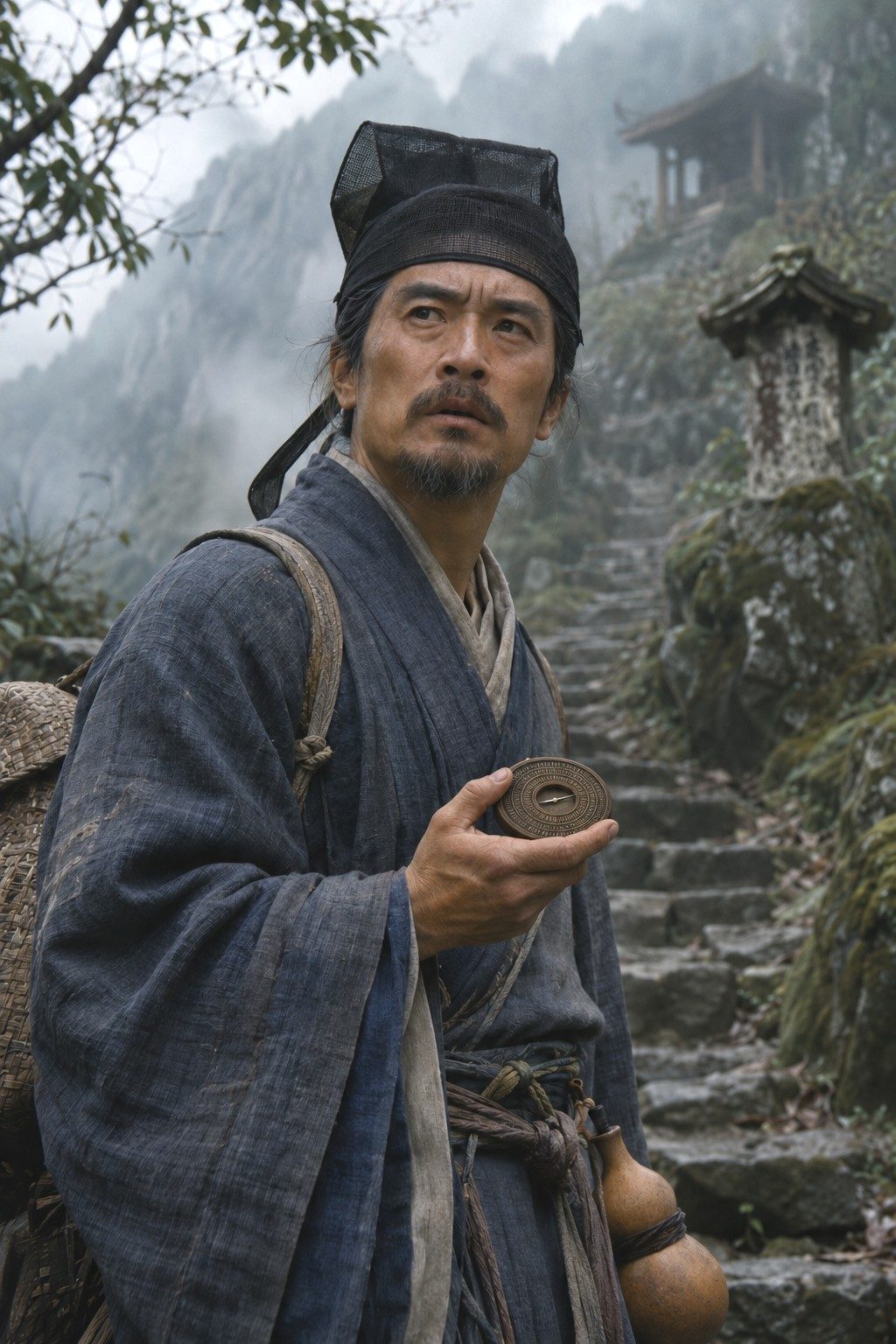
What it is. The mainland empire is a mortal threat (Chapter 8): a war fleet that may come one day, and a court that remembers its claim on the islands. The secret threat is older. The Daqian court keeps Lu Xian's letter (Part 1), and every few generations an emperor reads it and wants what Lu Xian found. The present emperor of Daqian is old, sick, and afraid.
The seeker is Meng Ruiyuan, a Daqian court sorcerer and elixir-maker, sent to the isles three years ago with a forged merchant's pass, a small fortune, and orders to bring back the secret of the immortals or not come back at all. He lives quietly in Umikado among the Daqian merchants, where Gao Hongde arranges his affairs (for a fee, and for reports to the Shikken, and for his own uses). Meng climbs Mount Hōrai every season he can, searching for Lu Xian, and he is close. Chapter 9 gives his statistics.
What it wants. For Meng, Lu Xian himself: his secret, his blood, or his body. For the Daqian court, eternal life for its emperor, and if Tokoyo can be reopened (Part 2), the summit of Hōrai.
How it acts. Meng bribes guides, pilgrims, and the shrine keepers of Hōrai's slopes. He brews elixirs that let him walk where the mountain's kami don't welcome visitors. He doesn't care that he angers them, and he doesn't know what the Eight Kami did to the last mainlander who came for their fruit.
Signs.
- An old man in mainland robes is seen on Hōrai's slopes with a second figure, younger, in mainland dress (Chapter 8).
- Mountain guides from Kasumi turn up rich, and then turn up dead.
- The kami of Hōrai's slopes grow angry, and avalanches and rockfalls close the pilgrim paths.
If no one stops it. Meng captures Lu Xian, or learns how to reopen Tokoyo, and sends word home. The Daqian war fleet sails, not to conquer the isles, but to take Hōrai's summit. The realm faces a foreign invasion in the middle of its civil war, and the Eight Kami, already angry, may not care which side they crush.
Stopping it. Heroes can warn Lu Xian, catch Meng, or bargain with him (he is a scholar, not a monster, and he is as afraid of his emperor as anyone). A Meng who fails can't go home, and he may become a useful, bitter ally. Whatever happens, the heroes learn that Daqian knows the secret of Hōrai, and that the realm's quarrels look very small from across the sea.
Paths for Villains#
Chapter 6 sets these paths aside for the GM's villains. Each is a changed Arcane Background from the Fantasy Companion, with only the changes printed. In every path, pollution replaces Corruption (Chapter 4): wherever the Companion gives Corruption, the villain gains one step of pollution instead, and most villains spend their lives Polluted or worse. A hero who walks one of these paths breaks the law, the precepts, or both.
Curse-Worker#
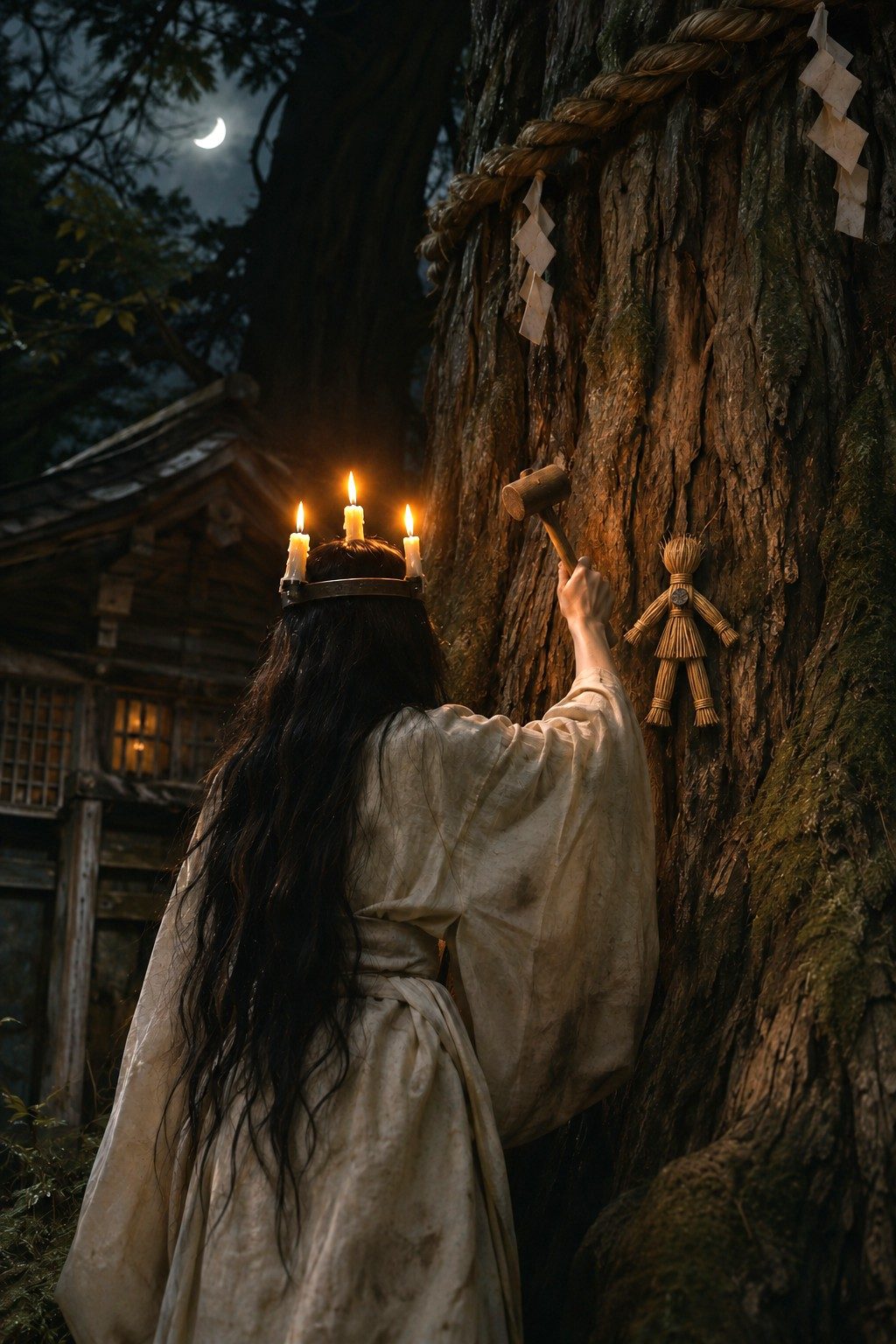
Arcane Background (Warlock/Witch) (FC p. 102), with these changes:
- Who they are. Jealous lovers, ruined rivals, and those who sell curses to them. Most curse-workers lay a curse or two in a lifetime; a few make it a trade.
- Hour of the Ox (curse) is always one of their starting powers. Bad Dreams (nightmares, HC p. 78) joins their available powers.
- No Familiar and no Prepared Powers. In their place, every curse needs a straw effigy of the victim with something of theirs inside (hair, nail parings, or their name in their own hand). Without one, the curse-worker subtracts 2 from the arcane skill roll.
- Seven nights. A curse-worker who visits a shrine tree at the Hour of the Ox for seven nights running, dressed in white with an iron crown of candles, may cast Hour of the Ox with the Strong and Lingering effects of a raise, whatever they roll. But if anyone sees them at the rite, the curse fails and turns back: the curse-worker suffers it instead.
- The Witching Hour Edge (FC p. 103) is renamed Hour of the Ox, and works from 1 to 3 in the morning.
- The curse in Hagane. The curse-worker poisoning the Shogun's dreams (Part 1) is Ishimura Sayo, a lady-in-waiting placed in the Shogun's household from Kanagura. She keeps her effigy under the floor of a disused tea room. Chapter 9 gives her statistics.
Necromancer of the Hungry Dead#
Arcane Background (Necromancer) (FC p. 97), with these changes:
- Who they are. Fallen monks, grave-robbers who learned too much, and those who lost someone and couldn't let them go. They feed the hungry dead, and the dead obey the hand that feeds them.
- Arcane skill: Faith for a fallen gakushō (who still knows the sutras, recited backward); Spellcasting for anyone else.
- Starting powers: Spirit Sight and Veil (detect/conceal arcana), Unbinding (dispel), and Walking Corpse (zombie), plus two powers from their list, which adds Raise the Restless (summon undead, FC p. 141). Resurrection is removed from their list: dead is dead.
- Feeding the dead. Every use of Raise the Restless or Walking Corpse needs an offering of food set out for the dead. A necromancer without one subtracts 2 from the arcane skill roll. A necromancer who stops feeding the dead they've raised is attacked by them.
- Soul Jar (FC p. 98) becomes the Hidden Tablet: the necromancer's soul is hidden in a false ancestor tablet on some family's altar, where nobody thinks to look.
Tengu-Taught Sorcerer#
Arcane Background (Sorcerer) (FC p. 99), with these changes:
- Who they are. The proud and the bitter, taught by a great tengu on a mountain in exchange for something they'll miss: their humility, their family, or their name. The jealous woman of the old tale and Kūzan of the Whetstone both walk this path.
- Available powers add Call the Oni (summon demon, HC p. 82), Call the Yōkai (summon monster, FC p. 140), Return Blow (spite, HC p. 80), and Ride the Wind (fly, FC p. 127).
- Pride. The sorcerer gains the Arrogant Hindrance (SWADE p. 22).
- Critical Failure: the sorcerer is Fatigued and Stunned, gains a step of pollution, and owes their tengu master a service, which the master names at the worst possible moment.
- The master's claim. Once in each Rank, the tengu calls the sorcerer back to the mountain. A sorcerer who doesn't come loses all Power Points until they do.
Dog-Spirit Owner#
Arcane Background (Warlock/Witch) (FC p. 102), with these changes:
- Who they are. Families said to keep a dog spirit (inugami), passed from parent to child, that does their bidding: it bites their enemies, sickens their rivals' children, and steals for them. A word of caution: in the isles, as in the real-world folklore this comes from, the accusation is far more common than the thing. Most families called dog-spirit owners are innocent people hated by their neighbors, and an accusation can ruin them. A GM should treat real dog-spirit owners as rare, and the accusation itself as a cruelty.
- The dog spirit replaces the Familiar (FC p. 36). It is invisible to anyone without Spirit Sight, and it can enter a victim to cast Bad Dreams (nightmares, HC p. 78) or Hour of the Ox (curse) through them, using the owner's Power Points, at any distance.
- No Coven and no Prepared Powers.
- Inheritance. When the owner dies, the dog spirit passes to their eldest child, who may not want it.
Fox-Keeper#
Arcane Background (Warlock/Witch) (FC p. 102), with these changes:
- Who they are. Diviners and petty sorcerers who keep a tiny fox spirit in a bamboo tube, feed it, and send it out to spy, steal, and whisper. Some started as honest fortune-tellers.
- The pipe fox replaces the Familiar (FC p. 36). It can slip into a sleeping person's ear and learn what they know, as Perceive Truth (mind reading), using the keeper's Power Points.
- Available powers add Call the Yōkai (summon monster, FC p. 140), for foxes only.
- No Coven and no Prepared Powers.
- Hunger. The fox must be fed every day. A fox-keeper who misses a day suffers a level of Fatigue as the fox feeds on them instead. A pipe fox that is freed or loses its keeper becomes a wild fox (Chapter 12), and remembers how it was treated.
Notes#
- The demon bound in the northeastern hills and the city's demon gate draw on the demon-gate beliefs in W. G. Aston, Shinto: The Way of the Gods (1905), and on the warrior who fought a demon on a ruined city gate, retold in Helen C. Gunsaulus, Japanese Sword-Mounts (1923).
- The straw figure nailed to a temple-grove tree at the Hour of the Ox follows Lafcadio Hearn, Kwaidan (1904). The crown of candles and the seven nights come from the wider folk tradition.
- The jealous woman taught sorcery by a tengu comes from F. Hadland Davis, Myths and Legends of Japan (1912).
- Dog-spirit and fox-keeping families draw on Percival Lowell, Occult Japan (1894), and on the fox-possession beliefs in Lafcadio Hearn, Glimpses of Unfamiliar Japan (1894).
- The ship ghosts who ask for a ladle follow the funa-yūrei of Shiranui in Chapter 8, from Lafcadio Hearn, Kwaidan (1904).
Part 4: Secrets of the Realm#
This part is the GM's quick reference. It answers every rumor and hook elsewhere in the book that says "Chapter 7 says," shows who knows each great secret, adds the last secret of Ōgiri, and closes with the campaign seeds the secrets open up.
Answers to the Rumors#
| Where | The rumor or hook | The truth | Details |
|---|---|---|---|
| Everywhere | The spirits are waking, and there are more genja than there used to be. | The hakobore: the Great Sword's cut is wearing thin. | Part 1 |
| Seikyō | The Rites of the Year keep the harvest growing and the dead at rest. What do they truly hold back? | They keep the cut sharp under the covenant. Since the Spoiled Tasting of 1256, every rite is weaker. | Part 1 |
| Hagane | "The Shogun talks to people who aren't in the room." (T) | He's an untrained kannagi. The people are real: the first Shogun, his father's dead, and the kami of Hagane. | Part 1 |
| Hagane | Lady Hyoseon needs someone to find out who is poisoning her husband's dreams. | Ishimura Sayo, a curse-worker in his household, paid by the Shikken. | Part 3 |
| Appendix | Someone here has seen the Shogun's secret, and doesn't know what it means. | Choose one: they saw the Shogun bow to an empty room and answer it; they saw Ishimura Sayo leave a disused tea room at the Hour of the Ox; or they carried a sealed chest from Kanagura to her and smelled straw inside. | Parts 1, 3 |
| Kazahaya | "The first Shogun's mound is empty." (T) | His bones lie in a hidden shrine in Hagane Castle, where he is the Shogunate's secret guardian kami. | Part 1 |
| Tatsumi | "The old temples of Furumiya keep the true history of the realm." (T) | The Tatara Record: how Tenzei stole the covenant, and its lost condition, that the gods may set a failed line aside. | Part 1 |
| Tetsugawa | "The ruins of Tatara hold a forge of the gods." (T) | The cold forge of the Smith of Heaven, where he began to reforge the Great Sword and stopped. | Part 1 |
| Tetsugawa | "Master Masuhiro's new blade is cursed." (T) | And it's the Whetstone's experiment, though Masuhiro doesn't know it. | Part 3 |
| Tetsugawa | A great smith is kidnapped on the road, and both blossoms blame each other. | The Whetstone took him. | Part 3 |
| Hōzuki | "A demon is chained beneath the mountain, and the monks' rites keep it there." (T) | The Lord of the Demon Gate, a great oni from Yomi, bound by the Founding Abbot under the eternal lamp. | Part 3 |
| Hōzuki | "The monks are ready to carry the palanquin to Seikyō again." (T) | If every monk leaves the mountain at once, the eternal lamp goes out, and the Lord of the Demon Gate walks. Nobody in the Cloister knows that. | Part 3 |
| Seikyō | "The oni of the Southern Gate took a court noble's son." (T) | The oni is the Lord of the Demon Gate's scout. | Part 3 |
| Kasumi | Strange lights on Mount Hōrai's slopes at night, and an old man in mainland robes. (T) | Lu Xian, undying and bound to the mountain, with his lantern. Lately a second figure follows him: Meng Ruiyuan. | Parts 1, 3 |
| Kasumi | "The Chapter 7 secrets of the mountain lie here." | The Eight Kami, the withered summit groves, Lu Xian, and the place where Tokoyo can return. | Parts 1, 2 |
| Beyond the Isles | "The Daqian court keeps the true record of Lu Xian's voyage." (T) | His one letter home: "eternal life is a cage with no door." | Part 1 |
| Beyond the Isles | "A Daqian sorcerer has come to Mount Hōrai looking for the immortals." (T) He is not the first. | Meng Ruiyuan, the emperor's elixir-maker, living in Umikado. The first was Anshi, in a way, and before him every emperor who read the letter. | Part 3 |
| Beyond the Isles, Umikado, Shiranui | "Zhuo Xianfeng's harbor is protected by the drowned Kamaeda dead." (T) | He holds a monthly court rite for the drowned child-emperor, with offerings stolen from the tribute ships. | Part 3 |
| Shiranui | "The ghost-lights are getting closer to shore every year." (T) | Because the hakobore is widening, and because Zhuo feeds them. | Parts 1, 3 |
| Kagaribi | The oldest shrine in the realm, where all the kami gather once a year. | It guards the great rock that seals the road to Yomi, and the kami meet each Tenth Month to renew the seal. The rock has been cracked since 1256. | Part 2 |
| Hate-no-Kuni | "The kami of the north are older than the Forging Gods." (T) | As old as the undivided world before the cut. They want it undone. | Parts 1, 3 |
| Hate-no-Kuni | "An exiled court noble holds a secret that could bring down the Akebana." (T) | Tachieda Michimaro, a junior ritualist and Tachieda Masunari's nephew, exiled for protesting the Spoiled Tasting. He wrote everything down. | Part 1 |
| Ōgiri | "The companion in the fog valley is a fox." (F) | The Founder of the Circuit. In bad years, something else wears his face (below). | Part 1, below |
| Kurogane | "The flat stone at the shrine is a piece of the gods' sword, and it bleeds before a war." (T) | One of the eight shard stones. It bled last month: a great battle is coming. | Part 1 |
| Chapter 6 | The Undying Orange's seeds, "perhaps a way back to Tokoyo." | They are. Seven years, a Clean kannagi, and a branch carried to Hōrai's summit. | Part 2 |
| Chapter 6 | Tokoyo and Hōrai: the same place? | Yes. Hōrai's summit was the Eternal Land until Lu Xian's theft. | Parts 1, 2 |
Who Knows What#
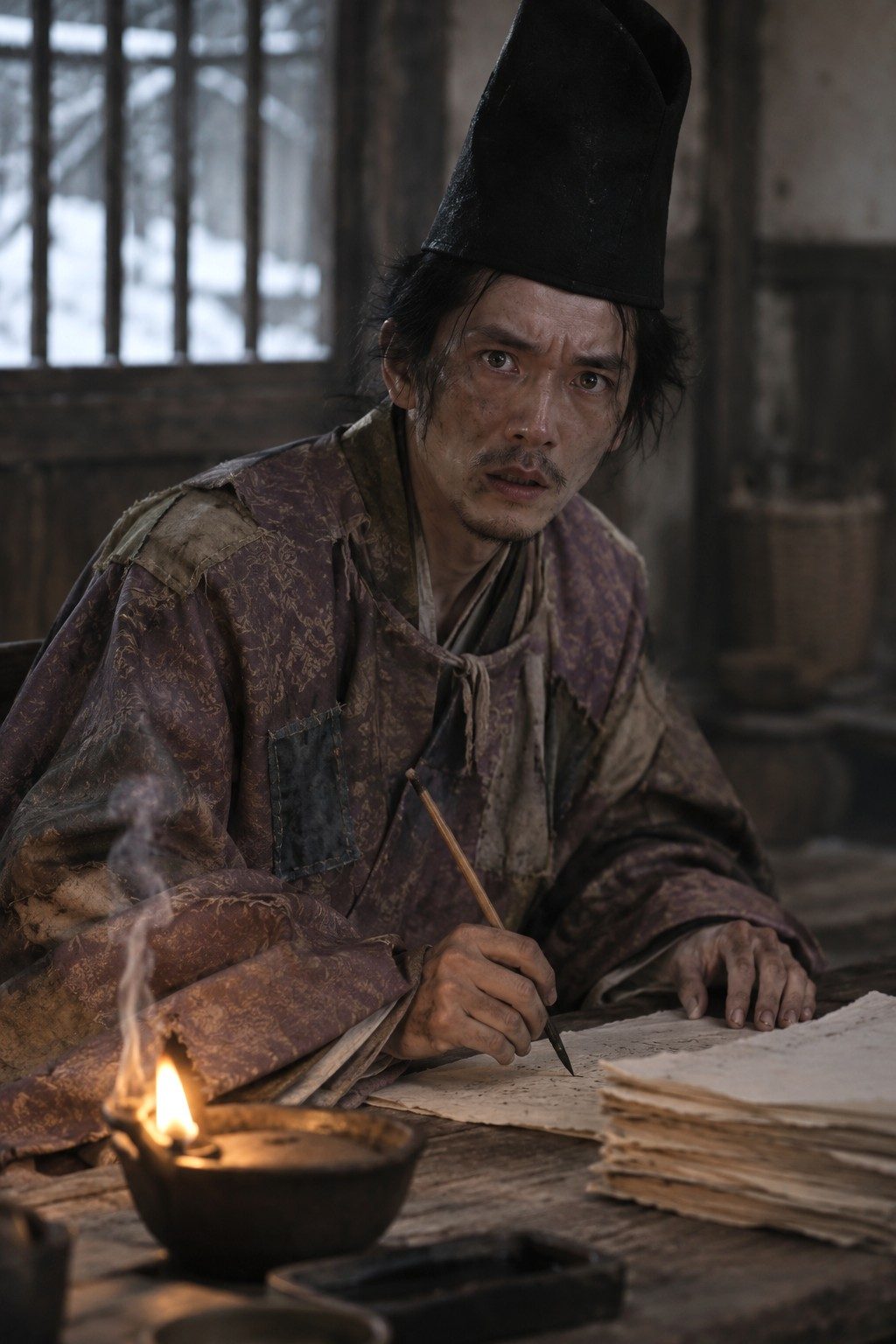
| Secret | Who knows it |
|---|---|
| The hakobore (the cut is thinning) | A few old priests who read the shard stones; Kūzan and the Whetstone; the high priest of Kagaribi; Lu Xian; the Eight Kami. Everyone else blames pollution. |
| The Spoiled Tasting | The Regent Akebana Tsunemaro; Tachieda Masunari; Tachieda Michimaro in exile; the Emperor suspects. The Shikken doesn't know he caused it. The Cloistered Emperor doesn't know at all. |
| The covenant's lost condition | Anyone who can read the Tatara Record (perhaps three scholars in Furumiya, and Kūzan). |
| The shard stones | The priests of the eight shrines, in theory; in practice, perhaps three of the eight chief priests, including old Hiraishi Sanetoki of Kurogane, who is failing and has no one to tell. The Whetstone knows all eight. |
| The first Shogun's hidden shrine | The Shogun, the chief priest of Hagane Castle, and Lady Hyoseon, who followed her husband one night. |
| The Shogun's gift | Nobody, yet. Lady Hyoseon suspects he isn't mad. |
| The curse on the Shogun | Ishimura Sayo, the Shikken, and one of the Shikken's stewards who carries the payments. |
| The Lord of the Demon Gate | The Prince-Abbot of Raihō-ji and the handful of monks who keep the binding hall. The Cloistered Emperor has never been told. |
| Lu Xian lives | Meng Ruiyuan, the Eight Kami, a few shrine keepers on Hōrai's slopes who leave food out for "the old man," and the Daqian court, which suspects. |
| Zhuo's court rite | Zhuo, his crew, and his defrocked priest. The court only knows that tribute ships go missing. |
| The Whetstone | Its members, and nobody else. Thunder Peak knows only that a brilliant monk named Kūzan vanished twenty years ago. |
The Fog Valley of Ōgiri#
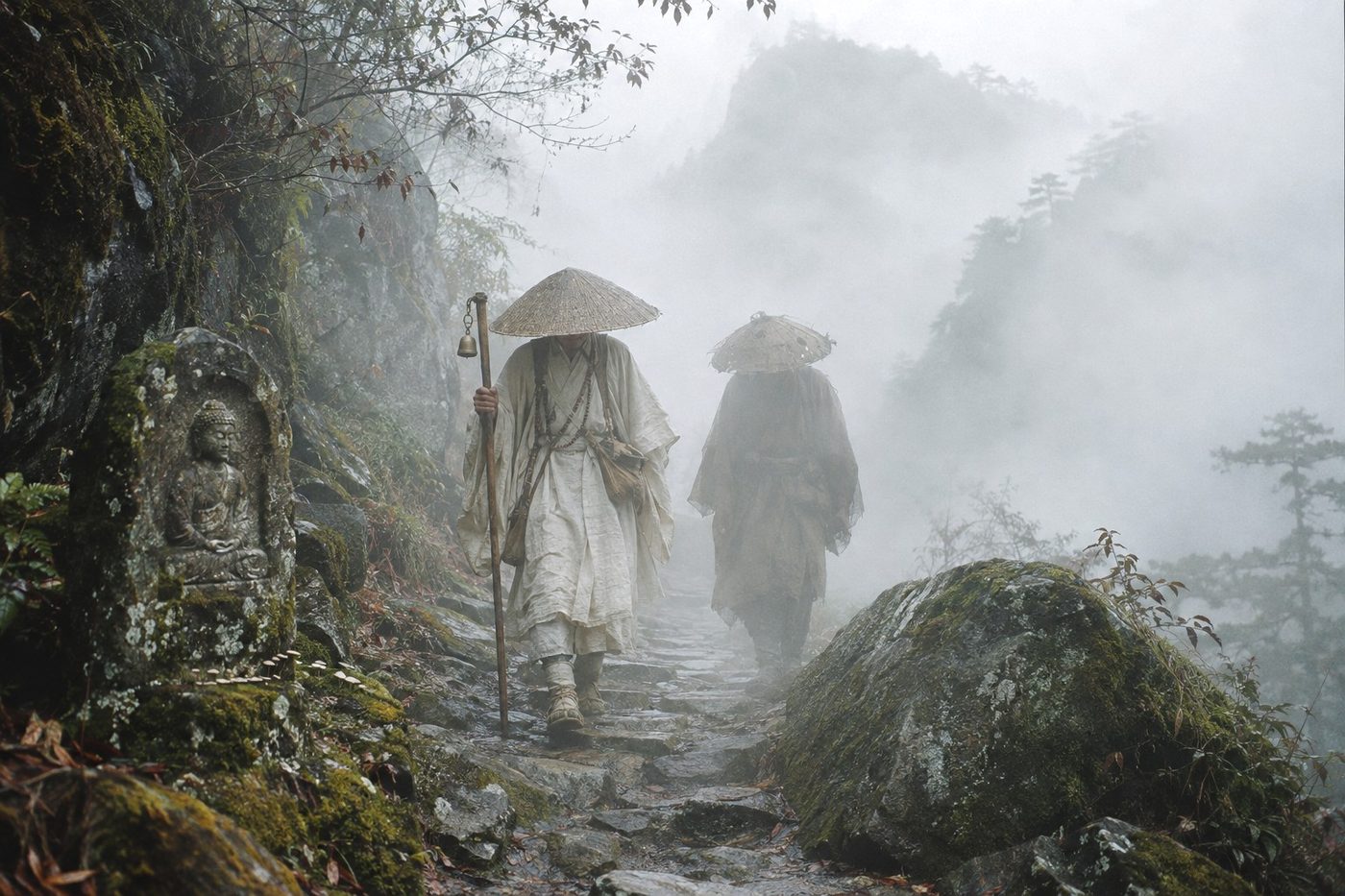
The companion who walks beside lone pilgrims in the fog valley is the Founder of the Circuit (Part 1). He appears as a plain pilgrim in a battered sedge hat, walks on the pilgrim's right, gives good advice in few words, and is gone when the fog thins. He leaves no footprints. He never asks for anything.
But in years when the hakobore runs at Restless or higher, something else walks the fog valley too: a mayoigami (迷い神), a "god of losing the way," one of the hungry spirits of the Hidden World that feed on travelers who stray. It takes the Founder's shape because pilgrims trust it. Its advice sounds wise and leads off the path, into the hidden side of the valley, where the fog never lifts and the lost pilgrims of seven centuries still walk in circles.
Telling them apart:
- The Founder walks on the pilgrim's right. The mayoigami walks on the left.
- The Founder leaves no footprints. The mayoigami leaves footprints, and they face backward.
- The Founder never asks for anything. Sooner or later, the mayoigami asks to see the pilgrim's stamp book, and a pilgrim who hands it over loses the circuit's protection.
A hero who notices one of these signs (a Notice roll at –2 in the fog, or automatically for anyone who knows the signs) can refuse the companion's advice. Naming the mayoigami for what it is, aloud, drives it off for the rest of the day. The Bestiary gives its statistics.
The wish. A pilgrim who completes the circuit is cleansed of all pollution, and the Founder hears one wish (Chapter 8). He grants it as he judges best. A wish for someone else's good is granted fully. A selfish wish is granted in a way that teaches the wisher what it cost. A wish for something no power can do, such as raising the dead, is answered with a dream that shows the wisher why it can't be done, and they wake at peace. A wish to end the hakobore is answered with a vision of the Great Tasting, and the knowledge of how to perform it truly.
Secrets in Kurogane#
The starter province touches the great secrets more than most. A GM beginning in Kurogane has these threads close at hand:
- The Hiraishi stone is a shard stone, and it bled last month. Old Hiraishi Sanetoki knows what that means, and he is dying. The heroes may be the people he finally tells.
- Akahara is one of the realm's polluted fields. Cleansing it (Chapter 6) lowers the hakobore one step (Part 1), clears the drain into Mizunuma Marsh, and gives the League and the Amanuma something they did together.
- The Whetstone knows Kurogane's stone is unguarded except by an old priest and two stone foxes. A fire at the pass shrine "set by passing soldiers" would be just their style.
- Kurogane Pass lies on the road between Sadatsugu's Kasumi and the capital. The battle for the pass, when it comes, is the great battle the stone is bleeding for. Its deadline is dated, an exception to Part 1's "within a season": its dead must be purified by the end of the season in which the battle is fought, or the hakobore rises one step. On the default timeline (Chapter 9, War Clock) the battle comes in summer 1262, so the deadline is the end of summer, and the track reaches 5, Broken, as autumn 1262 begins. If Kurogane's marks bring the march in spring 1262, the deadline moves to the end of spring, and Broken comes as summer begins.
- Mount Hōrai stands just over the border, in Kasumi. Heroes who climb it may meet Lu Xian, Meng Ruiyuan, or the Eight Kami.
The Truth Behind the Relics and Rites#
Chapter 6 gives the relics and great rites as the players may see them. Here is what it leaves out.
- Shiogiri. The rumor that it can claim the throne is false. It claims nothing. It commands the drowned. The pirate Zhuo Xianfeng, who pays the drowned dead, wants it so he can command them instead (Chapter 9).
- Ryōdan. Masuhiro smelted iron sand dug from the field of a thousand graves in Momiji, where the dead of the Minazuki Return still refight their battle, and quenched the blade in water from the same field. The steel took in the dead's fury, and it divides whatever holds it: within a year of a lord or house head taking the blade, a kinsman or chief retainer of that house turns against them (GM's call). If Sadatsugu takes it, the white plum alliance begins to split from within. When the dead of the thousand graves are released (Chapter 6), the fury leaves the steel: Ryōdan becomes a +2 blade with no curse, and Masuhiro, if he still lives, weeps. The heroes may learn the source of the iron sand before the blade is finished, and may stop it, or steal it, or let it be delivered. That the iron sand was the Whetstone's suggestion is in Part 3.
- The Fox's Jewel. In Kurogane, one of the three sisters of the Bamboo Teahouse lost her jewel years ago. She hasn't stopped looking.
- The Tide Jewels. The priestesses of the water dragon of Mizuchi (Chapter 8) guard a riddle about where the jewels lie. The clue: their head, the Dragon's Bride (Chapter 9, Notable Characters), gives the riddle only to a hero who has served the dragon's pool (Chapter 9, Temples and Shrines) or returned a treasure to the dragon king, such as the crystal in The Crystal in the Dragon Palace (Chapter 11). The GM places the two jewels, apart, wherever the campaign needs them, and the riddle names one landmark for each. The dragon king's messenger turtle (Chapter 12) comes once they are woken.
- The Rite at Akahara. When it succeeds, the pollution draining into Mizunuma Marsh stops, though the marsh kami won't be calm until its mirror is returned, and the hakobore falls one step (Part 1). For the first time since the battle, the League and the Amanuma have done something together. Whether that becomes a truce or a betrayal is up to the heroes and the GM (Chapter 8 and Chapter 9).
- The Field of a Thousand Graves. Lord Fujinaga Kagemori knows the old story of the Service ending, and he's tempted.
Campaign Seeds#
The secrets of this chapter open several long campaigns. Each can stand alone or run beside the war of the blossoms, several combine naturally, and any of them could grow into a Plot Point Campaign. This book gives the truth and the stakes, and leaves the endings open.
Mending the Cut. The heroes learn what the hakobore is and set out to mend it: cleanse the great polluted fields, protect the rites, recover the stolen shard stone, and at last bring about a true Great Tasting (Part 1). It is the backbone campaign of Blade and Kami™, and it touches every lord and temple in the realm.
The White Plum Rising. The heroes serve Kagamino Sadatsugu and set out to bring down the Shikken, set aside Shogun Tomoharu, and put the white plum in Hagane. It combines naturally with Mending the Cut, because the realm's secrets are the white plum's best weapons:
- Expose the Shikken. Prove that Ōtaki Kiyoaki refused the Great Tasting's cost and pays the curse-worker poisoning the Shogun's dreams. Either one, made public, turns the court against him.
- Win the Emperor. Only the Emperor can take away a Shogun's commission, name a lord an enemy of the court, or commission a new Shogun (Chapter 8). A true Great Tasting, with the white plum gathering the offerings the Shikken refused, earns the Emperor's gratitude and the gods' favor at once. The Regent, whose secret it exposes, becomes the white plum's enemy or its hostage.
- The first Shogun's wish. What the first Shogun's spirit asks of his house (Part 1) may be the Usurpation set right, with the founder's line restored through Sadamasa's blood. In this campaign, that is the answer, and the founder's spirit becomes the white plum's hidden ally.
- Spare the Shogun. Tomoharu isn't the enemy. Freed from the curse and told what he is, he may lay down the commission himself and become the kannagi he was born to be. A Shogun who abdicates for the gods ends the war with far less blood than a Shogun who must be beaten. Lady Hyoseon, and the Cheongun treaty she embodies, must be won or outmaneuvered.
- The battle for the realm. The war still has to be fought: Kurogane Pass, the fleet at Hagane, the Hostage Ward at Kanagura, and Thunder Peak, which must not be burned, whatever the cost (Part 3). Every battlefield the white plum purifies after the fighting brings the realm closer to healing. Every one it leaves unpurified feeds the threats.
A red plum version works just as well: the heroes break the curse, unmask the Shikken from inside, and save Tomoharu's Shogunate by mending the covenant, while Sadatsugu's war feeds the threats.
The Shogun Who Hears. The heroes are drawn into Hagane Castle by Lady Hyoseon, break the curse on the Shogun, and find him a teacher. Then they learn what the first Shogun's spirit wants from the house of Kagamino, and the answer may decide the war.
The Pilgrimage of Ōgiri. Forty-eight temples, two months on the road, bandits, rival pilgrims, the mayoigami of the fog valley, and a wish at the end that could change the realm. A natural frame for a party that needs to leave the war behind for a while, and a campaign of its own.
The Stones and the Forge. The heroes discover the Whetstone, race it for the shard stones, and follow its trail from Masuhiro's forge to the cold hearth of Tatara, where Kūzan means to reforge the Great Sword.
The Eternal Land. The heroes find the Undying Orange, resist eating it, and spend seven years growing its seed, while Meng Ruiyuan, the Daqian court, and every lord who hears of it try to take it from them. At the end, they climb Hōrai in winter to set Lu Xian free and bring Tokoyo home (Part 2).
The Drowned Emperor. The heroes are sent to stop the raids on the tribute ships and find Zhuo Xianfeng's secret. They may free the drowned court with Shiogiri, or win the court's consent to give a drowned child his funeral at last, which means facing the pride of the Akebana.
GM Glossary#
These terms belong to the Gamemaster's Section, so they appear here instead of in the book's Glossary, which every reader sees.
| Term | Kanji | Meaning |
|---|---|---|
| Amatsu-Hizuchi | 天津火槌 | "Heavenly Fire-Hammer": the Smith of Heaven, one of the three Forging Gods. |
| Hakobore | 刃毀れ | "A chipped edge": a nick in a sword's blade. Among those who know, the wearing-thin of the Great Sword's cut that lets the spirits wake. |
| Homura-no-Kami | 焔 | "Flame": one of the Eight Kami of the Mountain, the fire beneath Mount Hōrai. |
| Itadaki-no-Kami | 頂 | "Summit": the eldest of the Eight Kami of the Mountain. |
| Iwakura-no-Kami | 磐座 | "Rock-Seat": one of the Eight Kami of the Mountain, kami of stone. |
| Kimon-no-Ō | 鬼門の王 | The Lord of the Demon Gate, the great oni bound under Hōzuki (Chapter 12). |
| Kogure-no-Kami | 木暮 | "Dusk Under the Trees": one of the Eight Kami of the Mountain, kami of its forests. |
| Kumowake-no-Kami | 雲分 | "Cloud-Parter": one of the Eight Kami of the Mountain, kami of clouds and rain. |
| Mayoigami | 迷い神 | "A god of losing the way": a hungry spirit that misleads travelers. |
| Mori-no-Okina | 森の翁 | The Elder of the Forest, greatest of the old kami of the north (Chapter 12). |
| Ōfuki-hime | 大吹姫 | "Princess of the Great Blowing": the Wind of the Bellows, one of the three Forging Gods. |
| Shimizu-hime | 清水姫 | "Clear-Spring Princess": one of the Eight Kami of the Mountain, kami of springs and rivers. |
| Teruhi-no-Ōmikami | 照日大神 | "Great Goddess of the Shining Sun": the Sun Goddess, one of the three Forging Gods. |
| Toishi-gumi | 砥石組 | "The Whetstone": a secret society that would reforge the Great Sword. |
| Tokiwa-hime | 常磐姫 | "Evergreen Princess": one of the Eight Kami of the Mountain, keeper of the orange groves. |
| Umi-no-Mikado | 海の帝 | "Emperor of the Sea": the fishermen's name for the drowned child-emperor (Chapter 12). |
| Yamakaze-no-Kami | 山風 | "Mountain Wind": one of the Eight Kami of the Mountain. |
Notes#
- The secrets in this part are invented for Blade and Kami™; their sources are noted in Parts 1 to 3.