Gamemaster's Section · GM only · Chapter 10
Running Blade and Kami™
Part 1: Campaigns#
The Brush and the Blade#
This chapter is for you, the GM. The chapters before it give you a realm at war, the rules that make its honor and pollution matter, and the secrets under its mountains. This one is about turning all of that into a game your group wants to come back to.
Blade and Kami™ has more moving parts than most settings: Honor, Status, on, kegare, duels, contests, houses, domains, armies, and the hakobore. You don't need all of them at once. Start small, with a party, a patron, and a trouble in Kurogane, and add the bigger rules when the story reaches them. Part 4 marks which rules are core and which wait for later.
Most examples in this chapter use Kurogane (Chapter 8) and the archetypes of Chapter 3, so you can see each idea at the table.
Choosing a Campaign#
The first choice is what the heroes are. Chapter 3 suggests five kinds of party, and a sixth comes naturally from the road. Each frame below gives the party's usual patron, the adventures it draws, how Honor, Status, and Duty feel inside it, where it starts in Kurogane, and the rules that matter most. Mixed parties work too: the frame is the group most of the heroes belong to.
Retainers#
Who they are: samurai, foot soldiers, a court poet, a yin-yang master, and perhaps a shinobi the lord never admits to keeping (Chapter 3, Parties). The patron: a lord. In Kurogane, Lord Amanuma Nobutane (red plum) or Lady Kitamori Kaede (white plum). Adventures: carrying letters through enemy land, guarding envoys, hunting spies, settling a haunting on the lord's land, fighting the lord's battles, and choosing between the lord's orders and what is right. Honor, Status, and Duty: all three matter every session. The heroes rise on the clan's ladder from retainer to bannerman to elder, and their Duty in Downtime is real (use Full Duty, Chapter 4). The lord's rewards (Chapter 5) are the campaign's spine. Start: the truce banquet or the haunted guns (Chapter 8, What's Happening Now). Rules that matter: Honor, Status, and on; duels; Patrons and Lords; and, as the campaign grows, Mass Battles and Domains.
The Underworld#
Who they are: gamblers, enforcers, a ronin, a merchant, and a shinobi. The patron: a boss. In Kurogane, Gonzō of the Senomura family, who runs the dice houses of Kayahara. Adventures: collecting debts, guarding a game, running goods past the barrier, defending the town from the lord's tax riders, feuds with rival families, and the jobs no samurai can be seen doing. Honor, Status, and Duty: the family keeps its own accounts (Chapter 4). Status in the family matters more than Honor, but the respectable world still judges the heroes by their Honor, which closes doors. Duty means standing at the boss's side when he calls. Start: the stolen mirror, which turns up at one of Gonzō's dice houses. Rules that matter: Status and on (debts are everything); Gambling and Social Conflict; Chapter 9's underworld families and price tables.
Commoners#
Who they are: a gentry captain, a peasant martial artist, a foot soldier, a sōhei, a shrine maiden, and a sakaibito spirit hunter. The patron: the village itself. In Kurogane, Arasawa and its headman, Arasawa Kyūsuke, who pays two masters. Adventures: defending the harvest from bandits and tax riders, hiring ronin, dealing with the spirits of the fields and woods, choosing sides between lord and League, and surviving when armies march through. Honor, Status, and Duty: the village's ladder has no Trusted rung, so heroes step from Member to Senior with one great deed. Farmers judge heroes by how they treat the village, not by the war tales. Honor matters when the heroes deal with samurai. Start: the tax riders, the night the League's preacher comes. Rules that matter: Status in the village; kegare and the spirits; Mass Battles at the scale of a village fight; and the Upstart Hindrance when a hero rises.
Spirit Hunters#
Who they are: a mountain ascetic, a shrine maiden, a scholar-nun, a wandering monk, and a sakaibito spirit hunter. The patron: a shrine or a temple that sends them where the dead won't rest. In Kurogane, Suzu of Hiraishi Shrine. Adventures: hauntings, curses, possessions, fox tricks, polluted battlefields, and, as the campaign deepens, the shard stones, the Whetstone, and the hakobore itself. Honor, Status, and Duty: each hero answers to their own shrine or temple, so Status is personal and Duty pulls the party apart in Downtime. Kegare matters more than in any other campaign. Start: the thing in the Fourth Gallery or the fox wedding. Rules that matter: kegare; Chapter 6's powers, rites, and talismans; the Worlds Beyond (Chapter 7); and the Hakobore track.
A Temple League#
Who they are: a sōhei, a scholar-nun, a wandering monk, a peasant martial artist, and a mountain ascetic, sworn to one sect. The patron: a temple or a sect league. In Kurogane, the Sekitani League at the Sekitani Midō, or the warrior monks of Tamayama-ji. Adventures: defending the faithful, carrying the head temple's letters, winning converts and debates, guarding pilgrims and tolls, fighting rival sects, and holding the temple's lands against lords who want them. Honor, Status, and Duty: vows and the sect's code decide Honor. The league's council votes, so Status earns a voice more than an order. Start: the tax riders, seen from the League's side, or a spy inside Tamayama-ji (Chapter 8, Ties to Kurogane). Rules that matter: the temple secrets (Chapter 3); Mass Battles and Sieges; the Lay Devotee Edge; and Chapter 9's sects.
The Road Band#
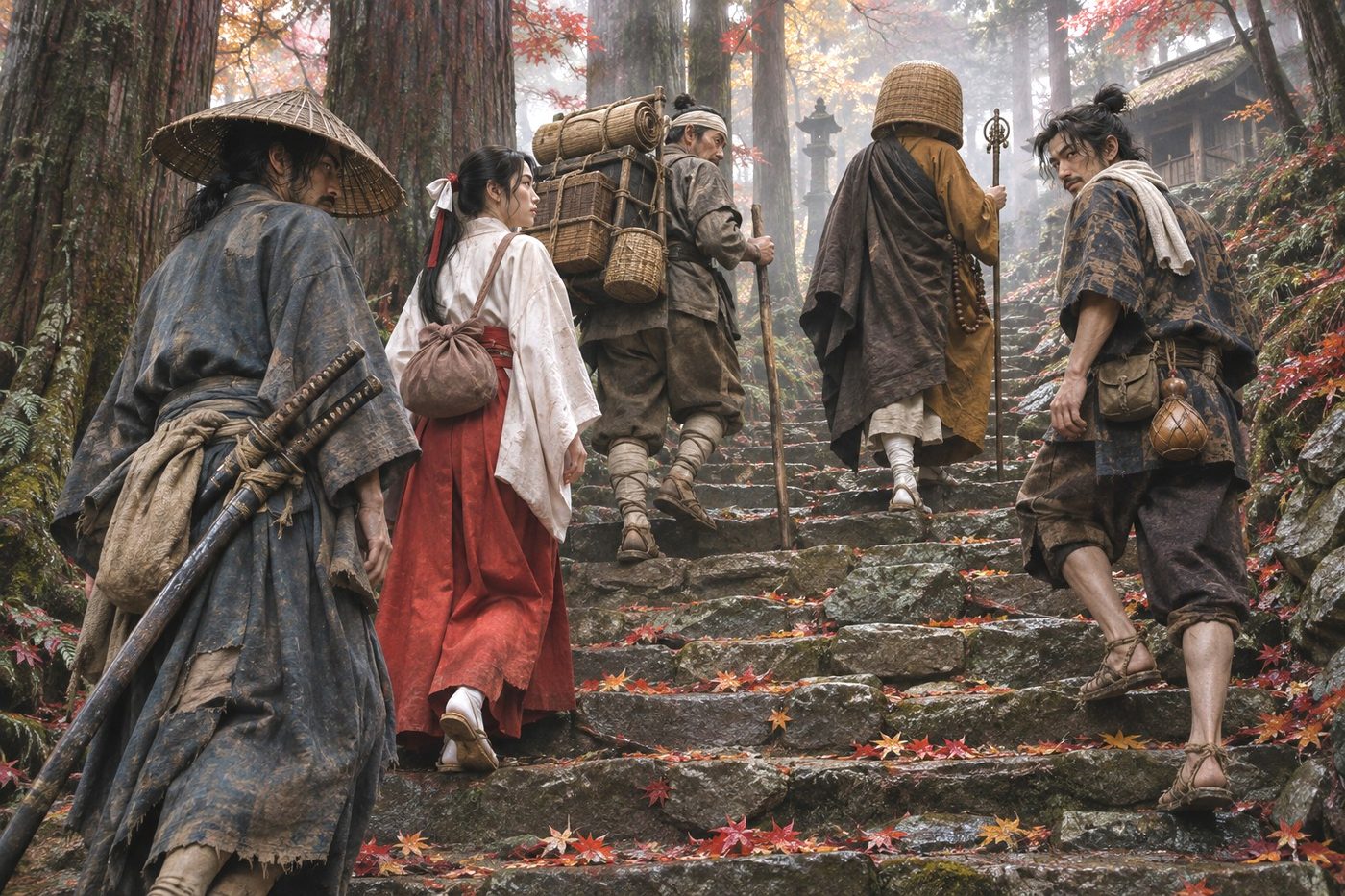
Who they are: anyone. A ronin, a gambler, a shrine maiden, a merchant, and a wandering monk, thrown together by a storm, a debt, or a dying messenger, like the travelers of Chapter 1's opening fiction. The patron: no one at first. The road band takes work where it finds it, and by Seasoned Rank most bands have found a patron, founded a house of their own, or split up. Adventures: a little of everything, which makes it the best frame for trying out the setting. Honor, Status, and Duty: each hero keeps their own group's Status, or none at all. Ronin and wanderers owe no Duty, which is both their freedom and their poverty (Chapter 4). Start: the opening scene at the Teahouse at the Crossroads (Chapter 8). Rules that matter: the Ties to Kurogane table (Chapter 8), on, and The Heroes' House (Chapter 5) once the band wants a name of its own.
From Sword to Banner#
Heroes in Blade and Kami™ can rise very far. A foot soldier can end the campaign as a daimyo, and a gambler as the boss of a city. The table below is a guide, not a rule, to what heroes typically hold at each Rank, so you can pace the rise. Status still rises at most one rung per Rank (Chapter 4), and a great deed can always come early.
Status by Rank#
| Rank | Status | In battle (Chapter 5) |
|---|---|---|
| Novice | Newcomer or Member | Warrior |
| Seasoned | Member or Trusted | Warrior or captain |
| Veteran | Trusted or Senior | Captain |
| Heroic | Senior or Head | Captain or commander |
| Legendary | Head | Commander |
Holdings by Rank#
| Rank | Retainers | Underworld | Commoners | Spirit hunters and temple league |
|---|---|---|---|---|
| Novice | A Member's stipend at the low end, 20 to 50 koku (Chapter 5) | A sworn place in the family and a share of one dice house's take | A family field and the village's trust | A novice's place, a begging bowl, a few talismans |
| Seasoned | A Trusted stipend of 100 koku or more, or a small manor; a house of one's own founded (Chapter 5) | A crew of one's own and a dice house or a stretch of market ground to run | The village's champion; a voice in the elders' council | A hermitage, a wayside shrine, or a sub-temple to keep; a house founded |
| Veteran | A manor of several villages, with soldiers owed | A quarter of a town, and a name every family on the road knows | Headman, or gentry granted two swords and a manor | Elder of a temple or priest of a shrine with lands of its own |
| Heroic | A holding with a hill fort, or a castle to keep for the lord | Boss of one's own family, ruling a town's underworld | Leader of a league of villages, or a lord's retainer with a holding | Abbot or chief priest of a great temple or shrine, with a holding's worth of lands |
| Legendary | A domain: a daimyo of 10,000 koku or more | Boss of bosses, with a city's underworld and friends at court | A province's peasant league, or a daimyo's house founded by an upstart | Head of a sect or a great shrine, with a voice in the realm's rites |
The road band moves into whichever column fits once its heroes find a patron or found a house. Mixed parties use each hero's own column, and the differences make good stories: the samurai holds a manor while the gambler runs its dice house.
The Campaign Dials#
Before play begins, you set the campaign's dials. Each is an optional tool. Leave any of them at its default, which is marked, and the book works as written.
| Dial | Choices | Default | Where |
|---|---|---|---|
| Starting Rank | Novice; or a lords' campaign at Seasoned, with each hero Trusted and holding a small manor or the party sharing one | Novice | Chapters 3 and 5 |
| Starting hakobore | 1 (Stirring: few spirits, war comes first), 2 (Waking), or 3 (Restless: horror from the first session) | 2 | Chapter 7 |
| Gritty or heroic | Gritty Damage and Difficult Healing on or off | Off | Chapter 4 |
| How strict Honor is | Full tables, every deed counted; or only great deeds and great disgraces (changes of 2 or more) | Full | Chapter 4 |
| How rare real power is | Rare (a genja in every province); very rare (only the heroes and the great threats); or more common | Rare | Chapter 6 |
| Advance pace | Every session; every two or three sessions; or one per finished adventure | By campaign length | Part 4 |
| The Hakobore track | Tracked, or kept as story only | Tracked | Chapter 7 |
| The War Clock | Followed, bent, or set aside for your own war | Followed | Chapter 9 |
| Domains and armies | Played in full, played as quick seasons, or kept offstage | When heroes hold land | Chapter 5, Part 3 |
Session Zero (Optional Tools)#
Many groups like to talk before the first session about what kind of game they want. These tools are offered, not required. Use the ones that help your table, and skip the rest.
The game's tone. Blade and Kami™ is PG-13: heroic, mythic, and a little dark, with horror at the edges. Agree how dark your table wants it. A spirit-hunter campaign at hakobore 3 is a ghost story; a retainers' campaign at hakobore 1 is a war tale.
Lines and veils. A line is something that never appears in the game. A veil is something that happens offstage, with the scene cutting away. Ask each player privately or at the table, and respect the answers without asking for reasons.
A safety card. Some groups keep a card on the table that any player can touch to skip or soften a scene, no questions asked. It costs nothing to have and is rarely used.
The hardest material. The book already keeps these offstage and treats them with respect. Talk about them if your group wants to:
- Seppuku and the death of honor. It happens, and it matters, but never on screen (Chapter 4).
- Captives and the captive trade. Shown as the cruelty it is, never played for laughs (Chapters 8 and 9).
- The sakaibito. Real injustice, shown as injustice, with sakaibito as people and heroes (Chapter 2).
- Living faiths. Shinto and Buddhism are changed for play, never mocked (Chapter 1, A Note on Respect).
Why the heroes are together. Settle this before play. Give the party a shared patron, a shared debt, or a shared place. The Ties to Kurogane table (Chapter 8) and the Who Your Hero Is questions (Chapter 3) both help.
Revealing the Secrets#
Chapter 7 holds more truth than any one campaign needs. Let the heroes earn it a piece at a time, so each revelation lands. The table is a pace for a campaign that follows the hakobore, by the Rank the heroes have reached. Faster or slower is fine.
| Rank | What heroes can learn | Typical sources |
|---|---|---|
| Novice | Local mysteries: who poisoned Kurogane's old lord, who stole the Mizunuma mirror, what knocks in the Fourth Gallery. The spirits are waking, and old people say it wasn't always so. | Kurogane's rumors and personalities (Chapters 8 and 9) |
| Seasoned | The shard stones bleed for a reason, and someone is gathering them. The Whetstone exists. The great polluted fields feed the spirits. | Suzu of Hiraishi Shrine, a shard-stone priest, a captured Whetstone agent |
| Veteran | The hakobore: the Great Sword's edge is chipping, and the war dead and a broken rite are why. The Shogun is ill in his spirit, not his body. | A great shrine's high priest, Lady Hyoseon, the Ōgiri pilgrimage |
| Heroic | The Spoiled Tasting of 1256 and who spoiled it. The Shikken pays a curse-worker. The first Shogun watches from Hagane. | Tachieda Masunari's confession, the exile of Hate-no-Kuni, the first Shogun's spirit |
| Legendary | The Covenant of Tatara: a line that fails the gods can be replaced. Tokoyo can be reopened. Only a true Great Tasting can bring the realm back to Quiet. | The Tatara Record at Furumiya, Lu Xian on Hōrai, High Heaven's one oracle |
Three clues for every truth. Any secret the campaign needs should be findable in at least three places: a person who knows, a place that shows it, and a thing that proves it. If the heroes miss one, they find another. Chapter 7's Who Knows What tells you who holds each secret.
Clues for Mending the Cut#
The backbone campaign (Chapter 7, Campaign Seeds) needs five truths. Each has three ways in.
| Truth | A person who knows | A place that shows it | A thing that proves it | Leads to |
|---|---|---|---|---|
| 1. The shard stones bleed, and someone is gathering them | Old Hiraishi Sanetoki, or Suzu after him | The flat stone at Hiraishi Shrine, which bled last month | A captured Whetstone agent's orders, or the empty stone bed if the shrine burns (Chapter 9, War Clock, spring) | Truths 2 and 3; the Whetstone (Chapter 7, Part 3) |
| 2. The great polluted fields feed the spirits | Any shard-stone priest; the League's priest Kaishin, who knows that Akahara's dead were never given their rites | Akahara's two lines of dead, and the blight it drains into Mizunuma Marsh | The marsh clearing, and the spirits quieting, after the Rite at Akahara (Chapter 6) | Truth 3; the other great fields (Chapter 7, Part 1) |
| 3. The hakobore: the Great Sword's cut is wearing thin | The high priest of Kagaribi; Lu Xian on Hōrai; a captured Whetstone agent | The great rock at Kagaribi, cracked since 1256; Shiranui's ghost-lights, closer every year | The Hakobore track made visible: what the heroes have seen change since the campaign began | Truth 4 |
| 4. The Great Tasting of 1256 failed, and who spoiled it | Tachieda Masunari, who can be brought to confess; the Emperor, who suspects | Hate-no-Kuni, where Tachieda Michimaro lives in exile | Michimaro's written account | Truth 5; the Shikken and the Regent (Chapter 9) |
| 5. What a true Great Tasting needs | Tachieda Masunari, once he has confessed, who knows every form of the rite; or one of the three scholars of Furumiya who can read the Tatara Record | Seikyō's palace precinct, where the rite is kept; Furumiya's old temples | Masunari's order of service for the Great Tasting, which lists every offering 1256 left out; the Tatara Record, for the covenant's terms | Mending the Cut's steps 2 to 4 (Chapter 7, Part 1) |
Truth 4 proves that the 1256 rite failed; truth 5 teaches how to perform it again. Masunari is the bridge: the confession that proves truth 4 also opens what he knows for truth 5, so a GM can run truth 5 without Furumiya.
Truths 1 and 2 are Seasoned; 3 is Veteran; 4 is Heroic; 5 is Legendary, following the table above. Kurogane's starters plant truths 1 and 2.
A Campaign Spine: From Kurogane to the Realm#
One page for a GM who wants a road from the first session to the first choice that shapes the realm. Each step names what the heroes can do, and what the War Clock (Chapter 9) does if they don't. The track values printed here are the default trajectory, what happens if the War Clock runs as written. Carry the heroes' results forward: if they cleanse Akahara in winter, every later value is one lower (losing the stone brings the track to 3, not 4, and an unpurified pass to 4, not Broken).
- Autumn 1261 (Novice): the four doors. The Prologue and the four starters in Kurogane (Chapter 11). Track Kurogane's marks toward war and the Carryover Ledger. The banquet's magistrate sees the old lord's poisoning in Teru's; the Fourth Gallery and the mirror point at the marsh and Akahara.
- Winter 1261–62: the old lord's murder. Who Poisoned the Old Lord (Chapter 9) is the province's key. Proof turns Nobutane; no proof leaves him the Shikken's man. The Tasting of the New Rice fails (the hakobore rises to 3). If the League and the Amanuma can stand together, the Rite at Akahara is possible now.
- Spring 1262 (Seasoned): the stone. Hiraishi Sanetoki dies, and his shrine burns unless the heroes guard it. Saving the stone keeps the hakobore at 3, and opens truths 1 and 3. Losing it raises the hakobore to 4 and puts the heroes on the Whetstone's trail.
- Summer 1262: the pass. Sadatsugu marches on Kurogane Pass (a season early, if Kurogane's marks say so). Fight the battle (Chapter 5), make terms, or open the gate. Then purify the dead of the pass by the end of the season of the battle (summer by default, spring if the march came early), or the hakobore rises a step: to Broken on the default trajectory (Chapter 7, Part 4).
- The first realm-level choice. By the end of the first year, the heroes hold secrets no lord has: the old lord's murder, the stones, and what the fields do. What they do with them chooses the campaign: carry them to Sadatsugu (The White Plum Rising), to Hagane (its red plum version), or to the shrines (Mending the Cut), or follow the stones to the forge (The Stones and the Forge). Chapter 7's Campaign Seeds take it from there.
Let the heroes be first. Nobody in the realm has the whole picture. When heroes put the pieces together, they know something no lord, abbot, or Regent knows, and that knowledge is a weapon, a burden, and a reason to keep playing.
Not every campaign needs the hakobore. A retainers' campaign can spend years on the war of the blossoms and touch the secrets only at the edges. The secrets wait.
Part 2: Building Adventures#
Three Questions#
Every adventure in the isles starts with three questions:
- Who wants something? A lord, a boss, a ghost, a village, an abbot. Someone with a name and a reason.
- What stands in the way? A rival, a spirit, an army, a law, a mountain pass in winter.
- What will it cost the heroes? Not only blood and mon, but Honor, an on, a friendship, or their purity.
The third question is what makes an adventure belong to Blade and Kami™. The best ones put the heroes between two things they care about: the lord's order and the village they love, the debt they owe and the oath they swore, the clean path and the one that works. Chapter 1 calls this giri against ninjō. At the table it means giving the heroes a choice that matters, and letting the consequences land.
This part describes six kinds of adventure. Each has a shape (the beats it usually follows), the rules it uses, the pitfalls to watch for, and a d6 table of complications to drop in when the plan goes too smoothly. Most real adventures mix two or three kinds: a mystery that ends in a duel, a journey that becomes a spirit hunt. For a whole adventure built from tables, use the generator in Chapter 11.
Duels#
A duel is the most personal fight in the isles: two people, agreed terms, and everyone watching.
The Shape#
- The challenge. An insult, a school rivalry, a vendetta, or a lord's command. The challenger names the terms, and the challenged accepts, bargains, or refuses at the cost of Honor (Chapter 4).
- The wait. The appointed dawn, the place, the witnesses. This is where friends try to stop it, enemies try to rig it, and the hero writes a letter home.
- The duel. Staredown, draw, and strike (Chapter 4, Iaijutsu Duels), or an ordinary fight under agreed terms.
- The aftermath. Honor won or lost, a school's name defended, a family's grief, and sometimes a new vendetta.
The Rules It Uses#
Iaijutsu Duels and Honor and Duels (Chapter 4), Death and Its Customs (Chapter 4), the martial schools (Chapter 3), and on for a spared opponent.
Death and the Duel#
Duels in Blade and Kami™ are deadly on purpose. There is no Wound Cap, and one clean cut ends a fight. That is the point: a duel to the death should feel like one. A few habits keep it fair to the players:
- Agree the terms on screen. First blood is the usual term. A duel to the death is rare, and both duelists choose it knowingly.
- Always leave a way out. A hero is never forced into a death duel by an Extra with no choice but to fight. Refusing costs Honor, not life. Make that price clear, and let the player decide.
- Remind the players of their tools. Bennies, the staredown's extra cards, surrender (Chapter 4, Combat), and friends who can step in before the draw.
- A death is a story. When a hero dies well, the legacy rules (Chapter 4) give the player a child, sibling, or student who carries the name forward.
- Save it for the climax. A formal duel every session stops feeling special. Let challenges come often and duels come rarely.
Pitfalls#
- The one-player spotlight. A duel is one hero's scene. Give the others jobs during the wait: finding out who bribed the witness, guarding the duelist's sleep, or praying at the shrine for a sign.
- Extras who duel like Wild Cards. Most challengers are Extras. Use Duels With Extras (Chapter 4) and keep it quick.
Complications#
| d6 | Complication |
|---|---|
| 1 | The rigged ground. The challenger chose a dawn duel facing east, and the rising sun is in the hero's eyes (–1 to the staredown) unless someone notices in time. |
| 2 | The stand-in. The challenger's lord forbids him to fight and sends a better swordsman in his place, which is legal and an insult. |
| 3 | The interrupted duel. A magistrate, a priest, or the lord's messenger arrives to forbid it. Obeying looks like fear, and disobeying is a crime. |
| 4 | The beloved. The challenger is someone a hero loves, owes, or once sworn brotherhood with. |
| 5 | The witness who lies. After the duel, a witness swears the hero struck before the signal. |
| 6 | The haunted blade. One duelist carries a sword with a grudge (Chapter 6, Relics). It wants blood, and it isn't particular about whose. |
Intrigue#
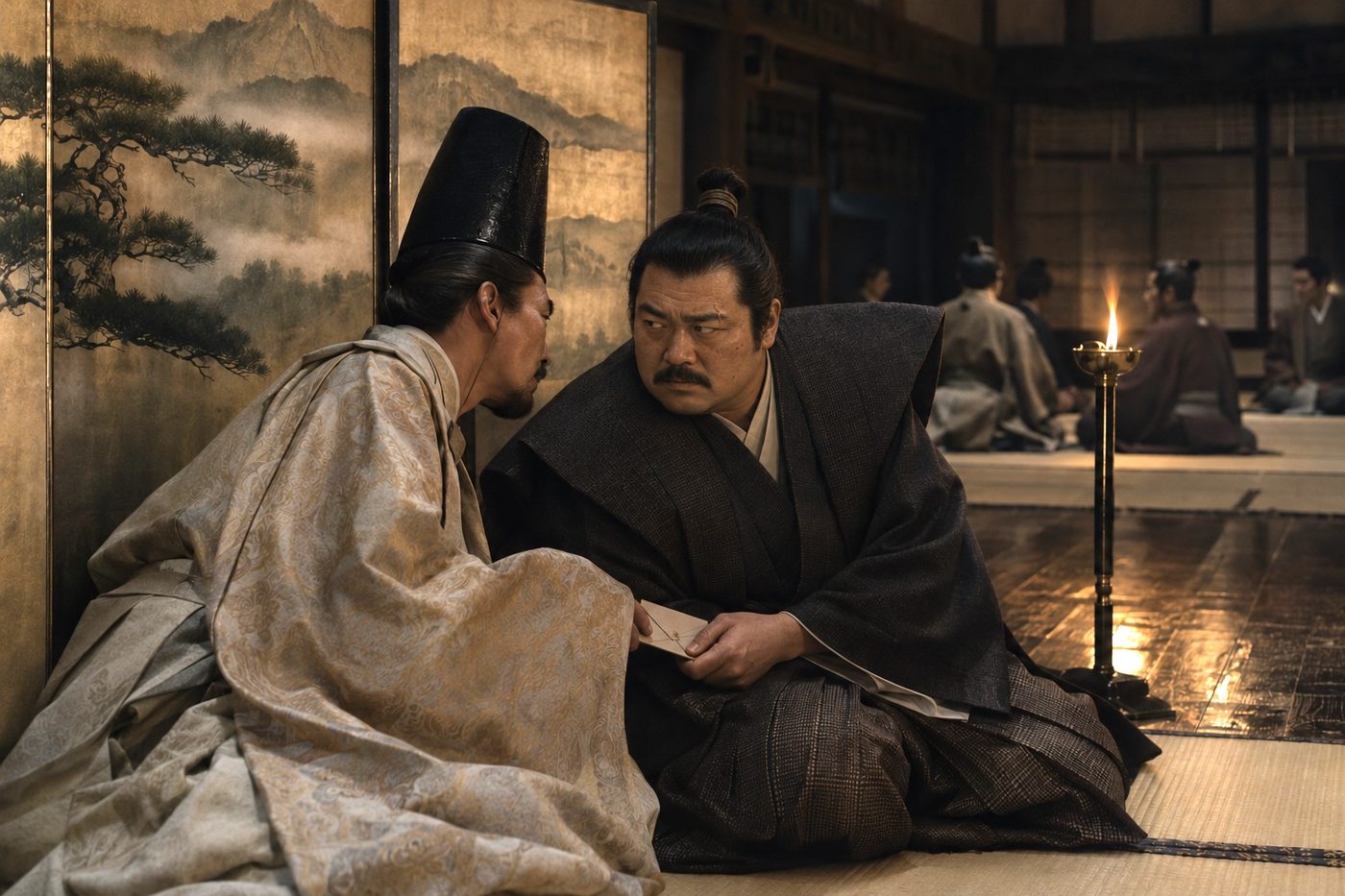
At court, in a castle, or in a temple's council, the weapons are words, gifts, poems, and debts.
The Shape#
- The prize. A title, a marriage, a pardon, a lord's favor, a vote in the league's council, or a single signature.
- The web. The heroes learn who matters, what each wants, and who owes whom.
- The moves. Gifts, visits, contests of refinement, letters, and quiet threats. Rivals make moves of their own.
- The judgment. The lord decides, the court proclaims, or the council votes, and someone loses face.
The Court Web#
Intrigue needs no new rules, only a cast. Before the adventure, sketch three to five figures who matter to the prize. For each, write four things:
- Want: what they hope to gain.
- Fear: what they dread losing.
- Secret: what they hide (Chapter 9's Secrets lines are a ready supply).
- Price: what it takes to win them: a gift, a favor, a poem that moves them, or their secret kept.
Then draw lines between them: who owes whom an on, who hates whom, who is married to whose sister. When the heroes win over one figure, follow the lines and change how the others react. That's the whole engine.
Example: at Kurogane Castle, the heroes want Lord Nobutane to hear a Kitamori envoy. The web holds Nobutane (wants peace without losing face, fears the Shikken), Ōtaki Naomochi at the barrier (wants the toll money, fears exposure), Abbess Shōun (wants her son home, knows everything), and Sainami Takemaro the court poet (wants his dinner, will carry any message for a good gift). Win the poet and he arranges a moon-viewing; win the Abbess and Nobutane listens; cross Naomochi and the Shikken hears of it.
The Rules It Uses#
Social Conflict (SWADE p. 143), Contests of Refinement and Court Intrigue (Chapter 4: etiquette, gifts, insults, and duels of words), on and favors from Status (Chapter 4), Networking (SWADE p. 133), and the court of Seikyō (Chapter 8) for intrigue at its highest.
Pitfalls#
- Talking to the GM instead of to people. Play the figures. Give each a voice, a habit, and a want the heroes can see.
- One roll for everything. Save Social Conflict for the scene where it all comes down to one hearing. Before that, let gifts, contests, and favors earn the bonuses that the Social Conflict will use.
- The fighters get bored. Give them work: guarding the guest house, catching the rival's shinobi on the roof, or a duel of honor that grows out of an insult at the banquet.
Complications#
| d6 | Complication |
|---|---|
| 1 | The wrong gift. The hero's gift is an insult in this house: the crest of the family's old enemy, or a color worn only in mourning. |
| 2 | The poem contest. The lord decides the matter by a contest of refinement, and the rival has hired a famous poet. |
| 3 | The letter. A compromising letter in a hero's hand appears, forged or real. |
| 4 | The hostage. The figure the heroes must win can't act freely, because someone holds their child. |
| 5 | The price is a person. The prize can be had, but only for a marriage, a hostage, or a hero's service to a master they despise. |
| 6 | The palanquin. Warrior monks bring their sacred palanquin to the gate, and no one dares to decide anything until they leave. |
Spirit Hunts#
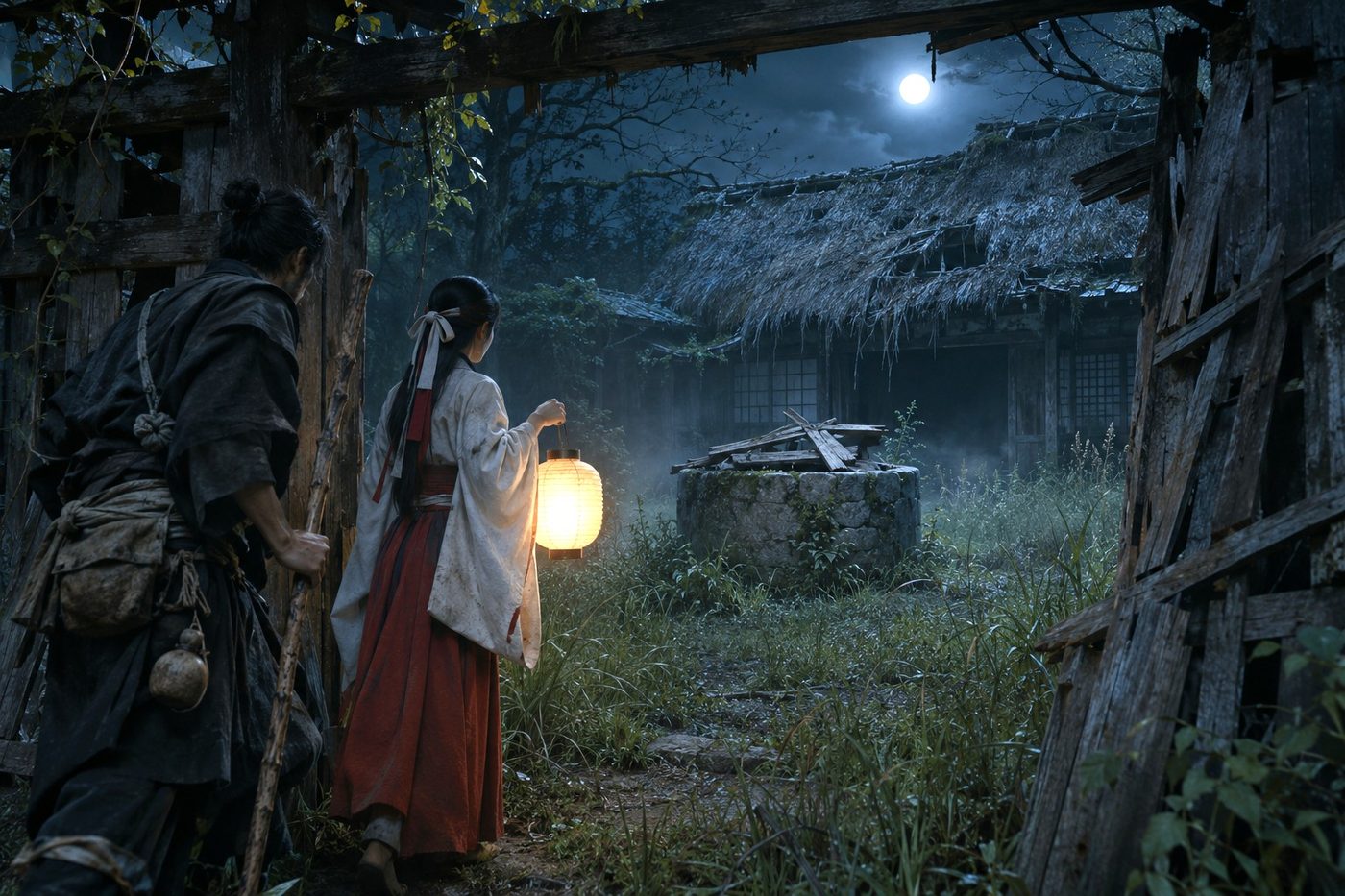
When the dead won't rest or a spirit turns on the living, someone must go into the dark and find out why. The old ghost tales (kaidan) give spirit hunts their shape.
The Shape#
- The wrong. Every haunting begins with something done wrong: a murder, a broken promise, a grave left untended, a shrine polluted, or a god forgotten. The GM decides it first, and the heroes discover it last.
- The sign. Something wrong in the world: a lantern lit by no one, wet footprints in a dry house, a child's song from an empty well.
- The haunting. The spirit grows bolder. People sicken, vanish, or wake somewhere else. The heroes meet it, and it is more than they expected.
- The truth. Through questions, records, dreams, and the dead themselves, the heroes learn the wrong.
- The settling. The heroes choose how it ends:
- Purify the place or the spirit with rites (Chapter 6).
- Appease the spirit with what it wants: a proper burial, a name spoken, a promise kept.
- Avenge the wrong by bringing the living culprit to justice.
- Bind the spirit with a seal or a spirit-bane (Chapter 6), which holds it but doesn't end it.
- Flee, which leaves the haunting to grow.
The best settlings are the ones the heroes earn by learning the truth. A spirit that is only fought usually comes back.
The Rules It Uses#
Kegare and Polluted and Sacred Ground (Chapter 4), Fear (SWADE p. 124), the powers, rites, talismans, and spirit-banes of Chapter 6, the Worlds Beyond (Chapter 7), Research and Occult, and the Bestiary (Chapter 12) for the spirits themselves.
Pitfalls#
- Too much monster, too soon. Fear grows in the gap between the sign and the haunting. Show less. Let the heroes hear it before they see it.
- One answer. Leave room for all five settlings. A party without a priest should still be able to end a haunting by finding the truth.
- Forgetting pollution. Haunted places are usually Polluted Ground, and a spirit hunt should leave the heroes needing a cleansing (Chapter 4). That's what Downtime's Retreat is for.
Why the Dead Won't Rest#
| d6 | The wrong |
|---|---|
| 1 | Murdered and hidden. The body lies under a floor, in a well, or in the river, and no rite was ever spoken. |
| 2 | A promise broken. A lover swore to return, a lord swore to reward, a son swore to come home. They didn't. |
| 3 | The war dead. A battlefield, a burned castle, or a mass grave, unpurified (Chapter 7, the hakobore). |
| 4 | A grave forgotten. No one tends the family's tablets, and the hungry dead come looking for their offerings. |
| 5 | A sacred thing defiled. A shrine's tree was cut, a sacred stone moved, or a god's spring fouled. The angry one is a kami, not a ghost. |
| 6 | A curse laid on purpose. A curse-worker (Chapter 7) made this haunting, and someone paid them. |
What the Spirit Wants#
| d6 | The want |
|---|---|
| 1 | Its name spoken and its death made known. |
| 2 | Its killer punished, by law or by blade. |
| 3 | Its bones laid properly to rest, with rites. |
| 4 | A thing returned: a comb, a letter, a sword, a child's toy. |
| 5 | Its promise kept by someone else. |
| 6 | The living to suffer as it did. This spirit can't be appeased, only purified or bound. |
War#
The war of the two blossoms is the realm's great story. Sooner or later, heroes march.
The Shape: Three Acts#
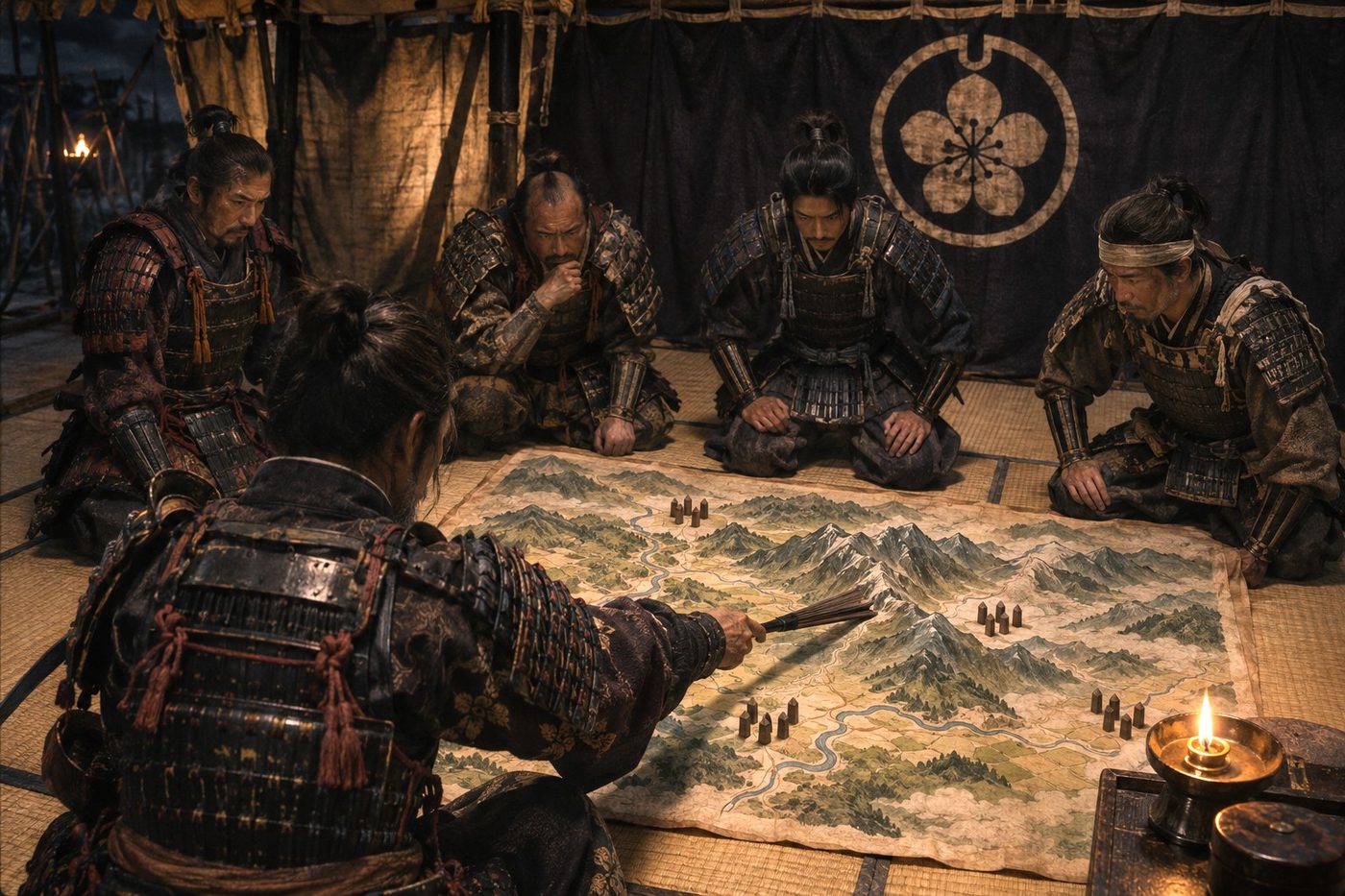
Before the battle. The march, the council of war, the scouts, the spies, the omens, and the night before. Most of the heroes' best work happens here: a spy unmasked can turn a battle, a wavering lord persuaded can bring a thousand spears, and a well read omen can lift an army's spirit. Let what the heroes do before the battle change the battle's odds, as bonuses or Force Tokens (Chapter 5).
The battle. Run it with Chapter 5's Mass Battles, with each hero at their chosen level (warrior, captain, or commander) and their deeds kept short and vivid. Two to four rounds is plenty. If a hero's deed is the turning point, give it a full scene: the duel with the enemy general, the charge at the gate, the rescue of the lord's banner.
After the battle. Heads are taken and shown, rewards given (Chapter 5), captives ransomed or freed (Chapter 4), and the dead counted. Then the dead must be purified within a season, or the battlefield becomes Profane Ground and the hakobore rises (Chapter 7). This is where a war campaign meets the hakobore, and where spirit-hunting heroes earn their place in a samurai party.
The Rules It Uses#
Mass Battles (SWADE p. 131) and Chapter 5's Mass Battles and Sieges (formations, ground and weather, heroes on the battlefield, castles, and sieges), Combat in Blade and Kami™ (Chapter 4: matchlocks, volleys, horse and bow, fire, taking heads, and surrender), the War Rites (Chapter 6), and the War Clock (Chapter 9).
Pitfalls#
- Battles without stakes. A battle the heroes can't affect is a cutscene. Make sure something they did before it matters, and something they do in it can turn it.
- Too many rounds. Keep the Mass Battle short and the heroes' deeds long.
- Forgetting the cost. War burns villages, kills friends, and pollutes the land. Show it, and let the aftermath be as important as the victory.
Complications#
| d6 | Complication |
|---|---|
| 1 | The turncoat. A lord on the heroes' side has secretly agreed to change banners when the battle turns. |
| 2 | Rain. The matchlocks won't fire, the river rises, and the battle the generals planned is gone. |
| 3 | The omen. A white heron, a bleeding stone, or a dead general's ghost appears before the army. How the heroes read it decides the troops' spirit. |
| 4 | The hostage on the wall. The defenders bring a hostage to the wall: a hero's kin, or the attacking lord's son. |
| 5 | The order no one should obey. The commander orders a village burned, or a surrender refused. |
| 6 | The third army. A sect league, a band of sea raiders, or something from the Hidden World arrives on the field and fights both sides. |
Mysteries#
Who poisoned the old lord? Who stole the mirror? A realm of secrets is a realm of mysteries, and magistrates, thief-takers, and curious heroes solve them.
The Shape#
- The crime. A death, a theft, a fire, a forged letter, a vanished bride.
- The questions. Witnesses, suspects, the scene, and the people who don't want the answer found.
- The turn. A second crime, a false confession, or a clue that points somewhere dangerous: up the ladder, into the Hidden World, or at a hero's friend.
- The answer. The heroes name the culprit, and then decide what to do with the truth. In a realm where the guilty may outrank the magistrate, that is the real choice.
Building a Mystery#
Decide the truth first: who did it, why, and how. Then place three clues to it, in three different places (a person who saw something, a place that shows something, and a thing that proves something), as in Revealing the Secrets (Part 1). Add one false trail, preferably laid by the culprit. Then let the heroes investigate however they like. If they miss a clue, the culprit's next move gives them another.
Example: the old lord of Kurogane's poisoning (Chapter 9). A person: the town magistrate, Hirata Mochisuke, who has never stopped wondering about the castle cook. A place: the castle kitchens, where a Kirikubo agent worked for one month four years ago. A thing: the Shikken's sealed commission, which the Kirikubo high masters keep as insurance. The false trail points at Lord Nobutane, who profited, which is exactly what the rumor and Abbess Shōun both believe.
The Rules It Uses#
Notice, Research, Persuasion, and Intimidation; Networking (SWADE p. 133); Interludes (SWADE p. 130) for suspects' stories; Magistrates and the Law (Chapter 9) for what the law allows and what it costs; the Thief-Taker Edge (Chapter 3); and object reading and séance (Chapter 6) for genja, which give clues but rarely proof a magistrate accepts.
Pitfalls#
- The one clue that must be found. Never hang a mystery on a single roll. Three clues, always.
- Magic solves it in one scene. A spirit's word isn't evidence, the dead lie, and the culprit may have used a talisman to hide their trail. Let magic point the way, not end the case.
- The answer is too big. If the culprit is the Shikken, the heroes can't arrest him. Make the answer something they can act on: a go-between to catch, a letter to deliver, a secret to hold over someone.
Complications#
| d6 | Complication |
|---|---|
| 1 | The confession. Someone confesses, and they are lying to protect someone else. |
| 2 | The witness dies. The heroes' best witness is found dead before morning. |
| 3 | Jurisdiction. The culprit fled into a temple's lands, a court noble's house, or another lord's province, where the heroes' authority ends. |
| 4 | The friend. The trail leads to someone a hero owes on. |
| 5 | The spirit witness. The victim's ghost knows who did it, but wants something first. |
| 6 | Ordered to stop. The heroes' patron orders them to drop the case, which tells them how close they are. |
Journeys#
The roads of the isles carry armies, pilgrims, merchants, spies, and ghosts. A journey is an adventure when the road itself is the challenge.
The Shape#
- The reason. A letter to carry, a bride to escort, a pilgrimage to make, a fugitive to catch.
- The road. Barriers and their papers, post stations, mountain passes, rivers and ferries, and the sea roads (Chapters 2 and 8).
- The stops. Two or three encounters along the way, drawn from the land's own troubles.
- The arrival, which is rarely what the heroes expected.
Running the Road#
Travel (SWADE p. 144) handles the days. For a hard stretch, such as a winter pass, a flooded river, or a race to reach the castle before the enemy, use a Dramatic Task (SWADE p. 122), or a Chase (SWADE p. 113) when someone is in pursuit. Barriers are their own small scene: papers, bribes, disguises, or a fight (Chapter 2, Daily Life; Chapter 8). Use Quick Encounters (SWADE p. 134) for stretches where nothing much should happen, and save full scenes for the stops that matter. Each province in Chapter 8 has rumors and hooks to fill a journey's stops, and Kurogane has its own On the Road table.
Pilgrimages. A pilgrimage is a journey with a purpose beyond its end. The great one is Ōgiri's circuit of 48 temples (Chapter 8), which cleanses all pollution and grants one wish, and which Chapter 7 fills with secrets. A pilgrimage can carry a whole campaign: two months on the road, a new temple at every stop, and the same rival pilgrims turning up again and again.
Road Tales (Optional Rule)#
Not every journey needs to be played. When the road matters less than the arrival, let the players tell it. Road Tales work like Interludes (SWADE p. 130), but every player tells one, and together they make the journey.
How it works. Each player draws one card from the Action Deck and tells, in a few sentences, one thing that happened to their hero on the road. The suit sets what kind of tale it is (see below). The player decides what happened, and the GM and the other players may ask a question or add a detail, but the tale is the player's.
The limits. A road tale colors the journey. It never decides the campaign:
- No one dies or is badly hurt, hero or ally. A player can't tell another hero's fate, only their own hero's part in a shared moment ("Jeff's samurai and I argued all night about the bandits").
- No big gains. No relics, no fiefs, no great secrets, no Advances. A road tale can give the hero a small thing: a rumor, a name, a cheap charm, a meal and a bed, or a Minor on, owed or held.
- The GM may veto or soften anything that steps on the adventure ahead, and may ask the player to try another tale.
The reward. A player who tells a tale gets a Benny, as for an Interlude. If a tale moves the GM to tie it to the adventure ahead (the stranger met on the road turns up at the castle; the rumor proves true), the tale becomes a hook, and that is the best reward of all.
| Suit | The tale |
|---|---|
| Spades: the sword | A danger met and passed: a fight with bandits, a proud samurai's challenge, a stretch of road the hero crossed in fear. Nobody dies, and the hero comes away with a story worth telling. |
| Hearts: the people | Someone met along the way: a kindness given or received, an old friend, a lover's letter, a quarrel among the party, a child who followed the band for a day. |
| Diamonds: the road's wealth | Something gained or lost in small: a lucky night at dice, a merchant's bargain, a purse stolen at the inn, a meal earned with a song. Never more than a few hundred mon either way. |
| Clubs: the unseen | A brush with the spirit world: a fox's trick, a dream at a roadside shrine, a ghost who asked a question, an offering left at a jizō. It may leave the hero Touched (Chapter 4), at the player's choice. |
| Joker | The player picks any suit, and the GM quietly ties the tale to the adventure ahead. |
Face cards and aces. When a player draws a Jack or higher, the tale should touch the land the party crosses: a rumor from its rumor table (Chapter 8), one of its places, or one of its people (Chapter 9).
The Rules It Uses#
Travel and Encounters (SWADE p. 144), Dramatic Tasks (SWADE p. 122), Chases (SWADE p. 113), Quick Encounters (SWADE p. 134), Survival and Riding, barriers and travel papers (Chapter 2), the sea roads (Chapter 8), and thin places and the Hidden World (Chapter 7) for roads that go somewhere they shouldn't.
Pitfalls#
- Every day an encounter. Skip the quiet days. A journey is its best two or three stops.
- Nothing on the road connects. Let the stops tie to the reason for the journey: the bride's furious husband, the letter's enemy, the fugitive's friends.
Complications#
| d6 | Complication |
|---|---|
| 1 | The barrier is closed. War, plague, or the Shikken's order. The way around is long, or dangerous, or through someone else's land. |
| 2 | The fellow traveler. A pilgrim, a peddler, or a lone woman asks to walk with the heroes. They are a spy, a fugitive, a fox, or simply lonely. |
| 3 | The storm. Snow closes the pass, or a typhoon holds the ship in port for a week, and the heroes' rivals arrive first. |
| 4 | The road loops. The heroes walk all day and arrive back where they started. Something on the road wants a proper offering (Chapter 7, thin places). |
| 5 | The inn. A post-station inn full of travelers, a locked door, and a death in the night. The journey becomes a mystery. |
| 6 | The pursuers. Someone wants what the heroes carry, and they are a day behind and gaining. |
Notes#
- The spirit hunt's shape, from the quiet wrong detail to the grudge laid to rest, follows the ghost stories collected in Lafcadio Hearn, In Ghostly Japan (1899) and Kwaidan (1904).
- The peach-wood staff of the spirit hunter draws on the myth of the peaches thrown at the pursuers from Yomi, and the custom of driving out evil spirits with peaches that grew from it, in W. G. Aston, Shinto: The Way of the Gods (1905).
Part 3: Clan Play and the Seasons#
Two Speeds#
A Blade and Kami™ campaign runs at two speeds. Adventures run in the foreground, scene by scene, over a few days or weeks of the heroes' lives. Seasons turn in the background, three months at a time, while houses grow, domains are harvested, and the war moves on. The art of clan play is keeping both going without letting either swallow the other.
The rule of thumb: one adventure, one season. Most adventures fit inside a season. When one ends, call for Downtime. When the calendar turns, resolve the War Clock for the season just ended, settle its rites, and update the hakobore (below). Then draw each domain's event using the effects in force for the new season, and play the seasonal turn (Chapter 5) for any house or domain the heroes hold. Tell the players what has changed in the realm, and start the next adventure in the new season. A year of campaign time takes four adventures, which is about right: long enough for the war to move, short enough for the heroes to see it.
Keep the turn short. A full seasonal turn, with an event card, a Domain Action for each officer, and the upkeep or harvest, should take about five minutes per domain. If it takes longer, the table is playing a board game instead of a roleplaying game. Use the quick season (below) or let the deputies handle it (Chapter 5, While the Lord Is Away).
Not every session. If an adventure runs several sessions, the seasons wait. If the heroes go straight from one adventure into the next, play the turn when the calendar turns, at the start of the next session (Chapter 5).
The Quick Season#
Chapter 5 makes the quick season the default: draw the event, roll one rating, and pay upkeep or harvest. Switch to the full turn only when the players want to govern in detail.
Seasons Into Stories#
The best thing a domain can do is give the heroes their next adventure. When a seasonal event is drawn, roll a d4 on its suit's table below, or choose, to turn the event into a hook. The event's own rule still applies (Chapter 5); the hook gives the GM a face, a place, and a reason to ride out.
♠ Spades: War and Danger
| d4 | Hook |
|---|---|
| 1 | The raiders who struck the village wear a neighbor's colors, but they ride like the Yamashiba scouts (Chapter 9). Someone wants the heroes to blame the wrong lord. |
| 2 | A rival's new border fort stands on the hill where the heroes' grandfather is buried. |
| 3 | The lord's call to arms comes with a sealed second letter for the heroes alone. |
| 4 | A ronin band offers to guard the domain for a price, and refusing them may be more dangerous than paying. |
♥ Hearts: The People
| d4 | Hook |
|---|---|
| 1 | The village quarrel is really about a girl who wants to marry across the water line, and both headmen are sure the heroes will see it their way. |
| 2 | A League preacher has been sleeping in the heroes' villages, and the farmers are hiding him. |
| 3 | A hero's own retainer is accused of murder by a merchant who is owed money by half the domain. |
| 4 | The festival goes beautifully, until a stranger in the crowd is recognized as a wanted man the people love. |
♦ Diamonds: Wealth and Trade
| d4 | Hook |
|---|---|
| 1 | The flood uncovered something in the riverbank: old grave goods, a buried storehouse, or a shrine no one remembers. |
| 2 | The merchants from Umikado offer matchlocks, and a barefoot brother of the Black Book travels with them (Chapter 9). |
| 3 | The windfall iron-sand stream runs into a neighbor's land, and their lord has noticed. |
| 4 | The loan came from the Kanehashi family of Kanagura (Chapter 9), and they want a favor instead of the interest. |
♣ Clubs: Spirits and Omens
| d4 | Hook |
|---|---|
| 1 | The curse began the night the domain's surveyors moved a boundary stone. It was holding something down. |
| 2 | The omen points to a child in the heroes' villages who hears the kami. Three temples and a shrine want the child. |
| 3 | The blessing is real, and pilgrims are coming. So are bandits, peddlers, and a fox who is very interested in the healing spring. |
| 4 | The dead of an old battle on the domain's land have begun to walk at night, as the hakobore rises (Chapter 7). |
Many Houses, One Table#
By default the party shares one house and one domain (Chapter 5). A group that lets each hero found a house of their own can end up with five houses and two domains, and that is a lot to run. A few habits help:
- One spotlight each. At each seasonal turn, each player describes one thing their house or office did, in a sentence or two, then rolls. Move on.
- Houses help each other. Sworn friends' houses trade favors as allies do (Chapter 5). Let the players lean on each other's houses in adventures: the temple shelters the samurai's wounded, and the dice house hears what the castle can't.
- Share a domain where you can. A party that holds one domain together, with each hero in an office, runs faster and argues better than five heroes with five fiefs.
- Let the deputies work. A hero who doesn't care about their house this season can leave standing orders and stop thinking about it.
The Campaign Calendar#
The year moves the realm, and the realm moves the heroes. Use the calendar below to place each adventure in a season, and to remember what else is happening when it does. Seasons follow the old reckoning (Chapter 2, Daily Life): spring begins with the New Year in late winter's plum blossoms.
| Month | Season | The court and the faiths | The land and the war |
|---|---|---|---|
| First (Mutsuki) | Spring | New Year; Worship of the Four Directions; the first of the Five Seasonal Festivals | Debts paid and oaths renewed. Lords receive their retainers' New Year visits, and absences are noticed. |
| Second (Kisaragi) | Spring | Prayer for the Year's Harvest | Roads open in the south. Envoys travel, and alliances are made for the year. |
| Third (Yayoi) | Spring | Daughters' festival; cherry blossoms | The campaign season begins in the south and the heartland. |
| Fourth (Uzuki) | Summer | Northern passes open. Armies march. | |
| Fifth (Satsuki) | Summer | Sons' festival | Rice planting. Lords who take farmers to war now go hungry in autumn. |
| Sixth (Minazuki) | Summer | Great Purification; Pacification of Fire | Rains and typhoons. The month shares its name with the Minazuki house, a point of pride for its old retainers (Chapter 2). |
| Seventh (Fumizuki) | Autumn | The lovers' festival; the Festival of the Dead | The ancestors come home, and the restless dead with them. A month for spirit hunts. |
| Eighth (Hazuki) | Autumn | Moon-viewing | The harvest ripens. Raiders and armies aim for the granaries. |
| Ninth (Nagatsuki) | Autumn | Chrysanthemum festival; Offering of First Rice; harvest festivals | Harvest roll (Chapter 5). Taxes are collected, and the tribute rice goes to Seikyō. |
| Tenth (Kannazuki) | Winter | The Month without Gods: the kami gather in council | Shrines stand empty, and lesser spirits grow bold. Harvest festivals end. |
| Eleventh (Shimotsuki) | Winter | Calming of the Soul; Tasting of the New Rice | Snow closes the north. Armies go home, and sieges become starvation. |
| Twelfth (Shiwasu) | Winter | Great Purification; Pacification of Fire | The year's accounts are settled. Plots are laid for spring. |
Using it. Before each adventure, find its month. If a rite falls in it, decide whether anyone means to spoil it (Chapter 8). If a festival falls in it, set a scene there. If it's the campaign season, an army is somewhere nearby.
The War Clock in Play#
Chapter 9's table, If the Heroes Do Nothing, gives the war's first year, season by season. At each seasonal turn:
- Read the season's row of the War Clock.
- Strike out or change anything the heroes have already changed. If the heroes broke Ichizō's raid, the Shikken has no excuse to move the Shogun in spring, and he looks for another.
- Tell the players what they hear, as news and rumor, not as a list. A traveling monk brings word that the Kuzuhara are camped before the snow castle; a merchant curses the price of rice.
- Keep a short log of what the heroes changed. By the third season, your war is no longer the book's, and that is the point.
After the first year, write the next year yourself. Look at what each great faction wants and fears (Chapter 9), where its armies stand, and what the heroes did to it, and give each faction one move per season. Two or three lines a season is enough.
The heroes are not the only movers. Factions react to each other as well as to the heroes. When the heroes win a lord to the white plum, the red plum does something about it. Let the world push back.
The Hakobore in Play#
If you use the Hakobore track (Chapter 7), check it at each seasonal turn, after the War Clock. Did a rite fail? Did a great battle leave its dead unpurified? Did the heroes cleanse a field? Move it as Chapter 7 says, or by judgment.
Show it, don't announce it. The players never need to see a number. They see what the step means:
| Step | What the heroes notice |
|---|---|
| 1, Stirring | Ghost stories at the worst battlefields. An old priest says the rites "answer more readily" than in his youth. |
| 2, Waking | Yōkai on remote roads. The dead rise where they were wronged. More children hear the kami, and the temples argue over them. |
| 3, Restless | Fear grows in ordinary people. Battlefields are shunned. Shrines are full, and every domain's omens turn dark. |
| 4, Torn | At night, in polluted places, the Hidden World shows through. Things cross. Villages bar their doors at dusk and keep fires lit until dawn. |
| 5, Broken | After dark, the two worlds overlap everywhere. The Demon Gate's lord walks. The realm knows its age is ending. |
Let the heroes see the cause. When the hakobore rises, give the players a clue why: the rite that failed, the unpurified field, the stolen stone. When it falls because of something they did, make sure they see that too, in the omens, the people, and the spirits. It is the clearest sign in the game that the heroes are mending the realm.
Allies and Retainers#
As heroes rise, they gather people: a sworn retainer, a band of foot soldiers, a servant, a student, a debtor who owes them their life.
Use SWADE's Allies rules (SWADE p. 111). Retainers, servants, students, and soldiers are Allies. As SWADE intends, the players create, control, and track them, and play them alongside their heroes, in battle and out of it. The GM steps in only when the story needs it, such as when an ally is captured, tempted, or turned. Give each named ally a name, a want, and a reason for their loyalty, which is usually an on (Chapter 4). A retainer whose lord shames them may leave, and a debtor whose debt is paid may stop coming.
Where they come from. Chapter 5's Retainers Upgrade gives a house about 50 armed retainers and two officers. Status gives a Trusted or Senior hero a few Newcomers or a squad for a mission (Chapter 4). A spared enemy may swear service (Chapter 4, Surrender and Ransom). A domain's officers' deputies are Allies too.
Keep them few. In a fight, two or three named Allies per hero is plenty. Large bands fight as Force Tokens in a mass battle (Chapter 5), not as individuals.
Sidekicks, Followers, and Warbands#
At Legendary Rank, three Edges give a hero people of their own: Sidekick and Followers (SWADE p. 53) and Warband (FC p. 41), all used as written (Chapter 3). In the isles, they take these forms:
- The sidekick is a disciple (deshi): a young student who begs to learn the hero's sword style, a page who has followed the hero since boyhood, an apprentice shrine maiden, a novice monk, or a gambler's sworn younger brother. They join the hero's group as a Newcomer, keep their own Honor and Status, and owe the hero a Major on that they spend their life repaying. A sidekick is the natural heir (Generations, below): when the old hero retires or falls, the player may continue with the sidekick as their new hero.
- Followers are sworn retainers who would ride into fire for the hero: a lord's bannermen, a boss's crew, warrior monks of the hero's temple, or a League's spearmen. They want a share of the rewards (Chapter 5), and a lord who doesn't pay them hears about it. Followers who see their lord disgraced may leave, as any retainer might.
- A warband turns five of the hero's followers into hardened champions: the famous captains of the hero's company, known by name and crest across the province, each with a war tale of their own. In a mass battle (Chapter 5), the hero's followers and warband make a natural company for a hero fighting as captain.
A hero's house (Chapter 5) is the natural home for all three: the disciple sleeps in the practice hall, the followers in the barracks, and the warband drills in the yard.
Allies grow. Allies Advance as SWADE describes (SWADE pp. 54 and 112), and a Sidekick advances as a Wild Card (SWADE p. 53). An ally who has followed a hero for years is a fully fleshed-out person, with a history the table remembers. When a hero is away, at court or on a pilgrimage, their player can bring the hero's allies into the party's adventure, and an ally who rises far enough may one day become the player's next hero (Generations, below).
Generations#
A long campaign spans years, and years bring marriages, children, old age, and heirs. These are optional tools for a table that wants a saga, not a single season.
Marriage#
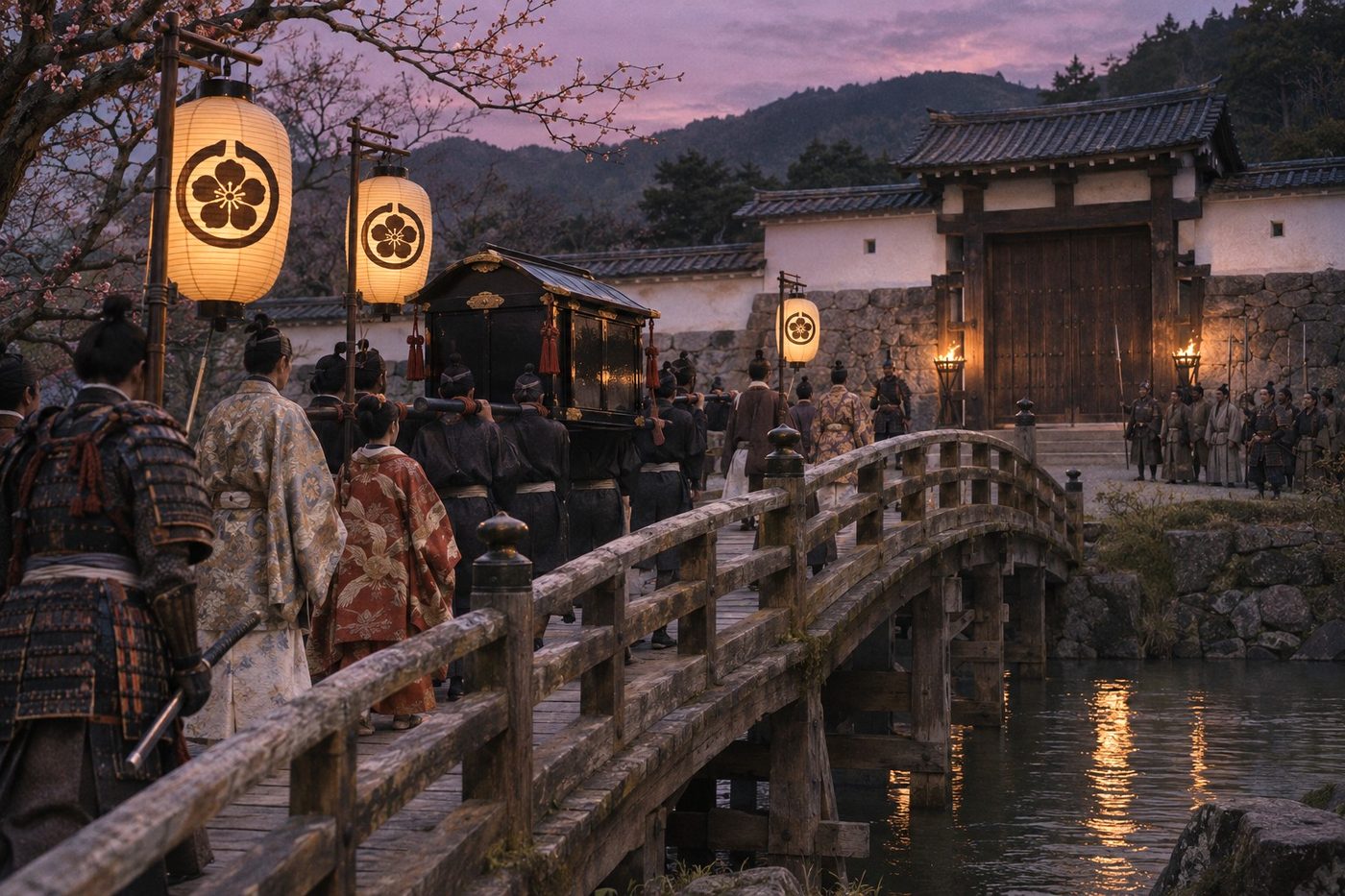
In the isles, a marriage joins two houses, not only two people. Most are arranged by the heads of both families, and a lord arranges his retainers' marriages to bind his clan together (Chapter 5, Serving Well). Love matches happen, and the old tales are full of what they cost.
- A marriage is a story. Play it as an adventure or a court intrigue: the go-between, the gifts, the two families' conditions, the rival suitor, and the wedding.
- A marriage is an alliance. Marrying into a house gives the hero a Minor on with their spouse's family, held both ways. Marrying into a lord's family is a reward for service for the war tales (Chapter 5), and creates a Major on to the lord.
- A marriage refused is remembered. A hero who refuses a marriage their lord arranges may keep their Honor, but loses their lord's favor until they earn it back.
- The spouse is a person, played by the GM as an Ally or a full character, with a want and a voice. A spouse may hold the house while the hero is away (Chapter 5's deputies), run its accounts better than the hero ever could, or have plans of their own.
- Women heads of house marry and keep their houses, as Chapter 2 Society allows. A husband may join his wife's house and take its name, which is common enough when a house has no son.
- Ending a marriage. By the realm's law, a husband may divorce with a short letter; a wife may leave through a convent's sanctuary, serving two years to dissolve the marriage (Chapter 9). Either breaks the alliance, and the families remember.
Children#
- Birth and naming. On the seventh night, a relative gives the child a childhood name (Chapter 2, Names and Language). A child born to a hero's house is a joy, an heir, and a target.
- Children are not combatants. As in Chapter 9, children have no combat statistics. They are people to protect, rescue, or win over. Harm to children stays offstage and only when the story truly needs it (Chapter 1, Tone).
- Hostages. A lord may ask for the hero's child as a hostage (Chapter 5). This is the Hostage Hindrance in the making, and one of the hardest choices in the setting.
- Adoption is common and honorable. A house with no heir adopts a nephew, a son-in-law, or a promising retainer, and a hero may be adopted into a great house as a reward, or adopt a foundling of their own.
- Coming of age. At about 15, a child takes an adult name at the genpuku ceremony and can join the house's service, take vows, or swear the cup oath.
Time Skips#
Between arcs, a campaign may leap ahead a year or more: the winter after a great war, the years an heir needs to grow up, the seven years it takes to grow the Undying Orange's seed (Chapter 7).
- Play the seasons quickly. For each year skipped, play four quick seasons (above) for each domain, or simply decide what happened, with the players' input.
- Each player tells a tale of what their hero did in those years, using the Road Tales limits (Part 2): nothing that decides the campaign, no great gains.
- Each hero gains about one Advance for each full year skipped, as a guide, reflecting training and experience off screen. The GM may allow a hero to swap one Edge for another in the same time.
- Move the War Clock and the hakobore for the years that passed. The realm doesn't wait.
Time-Skip Worksheet. Copy this for each skip.
| Line | Fill in |
|---|---|
| Years skipped | ___ (seasons: four per year) |
| Each domain | ___ quick seasons played, or what happened: ___ |
| Each house | Upgrades gained (one per Advance): ___ |
| Each hero | Their tale: . Advances gained: . Edge swapped: ___ |
| On | Debts called in or forgotten: ___ |
| War Clock | From ___ to ___. Events that fired: ___ |
| Hakobore | From ___ to ___. Why: ___ |
| Kurogane | Marks toward war: ___ |
| The world | Who died, married, was born, or came of age: ___ |
Aging#
Savage Worlds has no aging rules, and Blade and Kami™ adds none. Most heroes are in their twenties or thirties, and a decade passes without any change to their dice. If a campaign runs long enough that a hero grows old, the player may take the Elderly Hindrance (SWADE p. 24) when it fits the story, and earns the usual Bennies for playing it.
The Heir#
When a hero dies, retires, takes holy vows, or hands their house to the next generation, the player may continue with an heir: a child, a younger sibling, a student, or an adopted son or daughter.
- Legacy. A hero who dies well leaves their heir Honor +2 (Chapter 4, A Good Death). A hero who retires with Honor +4 or higher does the same. A stained name passes down as Chapter 4 describes.
- The house passes down. The heir inherits the house and its Upgrades (Chapter 5), and, with the lord's confirmation, the stipend or fief.
- Rank. The heir starts one Rank lower than the old hero, at the start of that Rank (Novice at least), so the new generation has room to grow without starting over.
- The old hero stays. A retired hero becomes an Ally, an elder of the house, a monk or nun at a nearby temple, or a voice of counsel. They can be visited, consulted, and, at the worst moment, kidnapped.
Part 4: Rewards and the Rules#
Advances#
Savage Worlds lets you set the pace of Advances to suit the campaign's length. Choose one of these when you set the campaign dials (Part 1), and tell the players:
| Campaign | Pace | Good for |
|---|---|---|
| Short (about 10 sessions or fewer) | One Advance at the end of every session | A single arc in Kurogane, a pilgrimage, a one-season war |
| Long | One Advance every two or three sessions | Clan campaigns, Mending the Cut, anything meant to reach Heroic Rank |
| By deed | One Advance each time the heroes finish an adventure or reach a major objective | Groups who play irregularly, or adventures of very different lengths |
Long campaigns rise slowly on purpose. A clan campaign spends many sessions at court, on the road, and in the seasonal turn, and it should take years of campaign time to turn a retainer into a lord. A slower pace keeps each Rank's rewards (Part 1, From Sword to Banner) feeling earned.
Time skips give about one Advance per year skipped, as a guide (Part 3).
Bennies in the Isles#
Award Bennies as SWADE describes, for good play, clever ideas, and Hindrances that cause trouble. In Blade and Kami™, these deserve one too:
- Giri against ninjō: a hero chooses duty over desire, or desire over duty, and the player makes the choice hurt.
- Courtesy under insult: a hero keeps perfect manners while being provoked, when a blade would be easier.
- A debt repaid when it costs something (Chapter 4 gives a Benny for repaying on).
- The death poem (Chapter 4), the Road Tale (Part 2), and the Interlude (SWADE p. 130).
- Respect for the unseen: a hero stops to leave an offering, bows to a kami, or speaks a name for the dead, and the moment is played, not just declared.
Honor and Status Pacing#
Honor and Status follow the pace of Advances. Whichever pace you choose above, a hero who acts honorably should rise in reputation at about the same speed they rise in Rank:
| Measure | Guide |
|---|---|
| Honor | About +1 for every two Advances of honorable play, or +2 per Rank. An honorable hero reaches +2 (Trusted) around Seasoned, +4 (Senior) around Veteran, and +6 (Head) around Heroic. |
| Status | At most one rung per Rank (Chapter 4), when the hero has the Honor and a deed to show. |
| Great deeds | A deed for the war tales, or service to the Emperor, can jump ahead of the guide. That is what great deeds are for. |
Keep Honor meaningful.
- Change it only when a deed is known (Chapter 4). Brave acts in an empty forest change nothing.
- Count several small deeds of the same kind as one, and hold each adventure to Chapter 4's limit (+2 from ordinary deeds, plus one great deed), so Honor doesn't race ahead of the heroes' Rank.
- Let losses sting. A hero who loses Honor should feel it in closed doors and cold looks, not only on the sheet.
- Underworld heroes keep their own accounts (Chapter 4). For them, Status in the family follows the same pace, and Honor is what the respectable world thinks.
Rewards by Rank#
Chapters 4 to 6 give many kinds of reward. The table draws them together, so you can see what fits each Rank. Choose one or two per adventure, besides the Advance.
| Rank | Money and land | Standing | Gear and treasure | Edges |
|---|---|---|---|---|
| Novice | 200–500 mon; spending money as a Member (Chapter 5) | A robe or fan with the lord's crest; a Minor on held | Fine ordinary gear; a blessed amulet (Chapter 6) | — |
| Seasoned | 1,000–3,000 mon; a raise of 10–50 koku | A letter of commendation (kanjō); a rung, if earned | A fine sword or horse; a few talismans | The Hermit's Secret (below); a clan secret at Trusted (Chapter 3) |
| Veteran | A raise of 100 koku or more; a manor | The lord's surname or a syllable of his name; a Major on held | A lesser treasure (Chapter 6) | A temple secret, a second martial school |
| Heroic | A holding; a castle to keep | Marriage into the lord's family; a court title (Chapter 8) | A named blade or a relic, once or twice a campaign | — |
| Legendary | A domain of 10,000 koku or more | A seat in the realm's councils; the Emperor's notice | A great relic (Chapter 6) | Sidekick, Followers, Warband (Part 3) |
Every gift is a hook. A gift of land or a famous sword creates a Major on (Chapter 5). The lord who gives it will call it in. A treasure has a lineage, and its last owner's family wants it back (Chapter 6). A title from the court angers someone who wanted it. Let rewards bring their own trouble.
Treasures stay rare. Most heroes see one or two magic treasures in a whole campaign (Chapter 6). A relic should be the reward for an arc, not an adventure.
The Hermit's Secret#
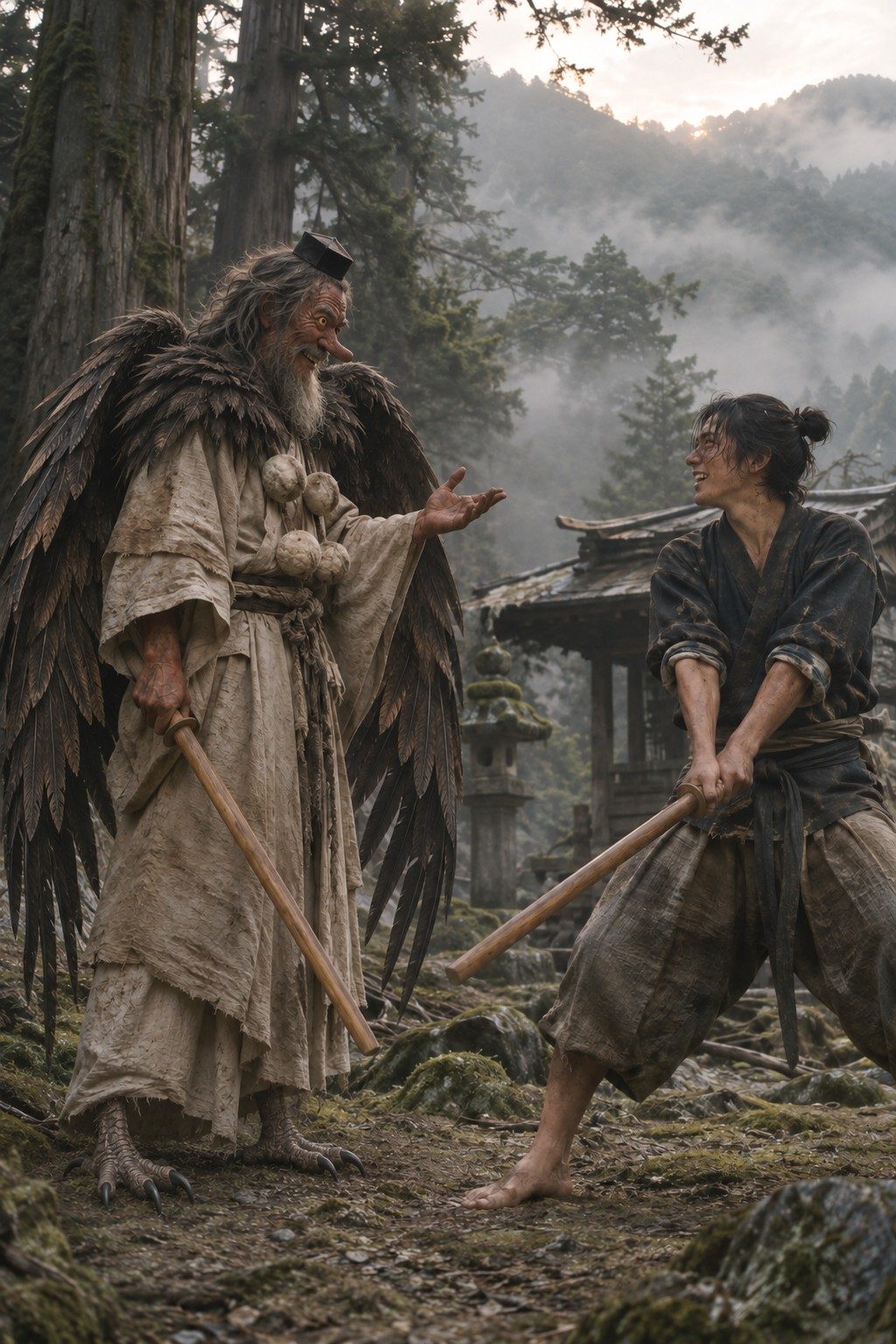
Chapter 3 gives the Hermit's Secret Edge (Seasoned, GM's approval): a technique taught by a wandering master, a hermit, or a tengu, granted only as the reward for an adventure. Each technique is unique in a campaign. A hero may take the Edge more than once, each time for a new technique, but at most once per Rank. Chapter 3 lists the twelve techniques and their requirements so players can see them. Here is how heroes earn one, what each technique does, and the masters who teach them.
Earning the Secret#
A master never comes looking for a student. The hero must earn the lesson in three steps, and each step is part of an adventure:
- Find the master. Rumors, a dream, a dying swordsman's last words, or a Gazetteer rumor (Chapter 8) point the way. The master is somewhere hard to reach: a peak in winter, a ruined gate at midnight, a teahouse where nobody admits to knowing them.
- Pass the test. Every master tests differently: a bout with wooden swords, a night of sitting in the snow, a riddle, a task of humility such as carrying water for a season, or simply catching them. The test should challenge the player as well as the hero. Failing doesn't end the chance, but the master names a harder test next time.
- Pay the price. The hero owes the master a Major on (Chapter 4), and the master names a task, sooner or later: a letter to deliver, an old enemy to face, a grave to tend, a promise to keep. A hero who refuses loses the technique along with the Honor.
When all three are done, the hero takes the Hermit's Secret as their next Advance and learns one of the master's techniques. Each later technique is a new taking of the Edge, with its own Advance, its own master's test, and its own price, and a hero may learn at most one technique per Rank.
Techniques#
Each technique below lists its own requirements in addition to the Edge's. Techniques are situational, as the World Builder guide asks, except the tengu's greatest secret, which is meant to be the stuff of legend.
Cutting the Shadow Requirements: Fighting d8+, Spirit d6+. Master: the ghost of Sogama Okihide. Once per encounter, as a free action, the hero's ordinary weapon cuts the unseen for the rest of the encounter. It counts as a magical weapon against spirits and the dead, so it can harm Ethereal creatures (SWADE p. 176), and against a creature whose weakness is a spirit-bane (Chapter 6), it counts as that bane.
Empty Hands Take the Blade Requirements: Martial Artist, Fighting d8+. Master: Kenzawa Arikazu. Once per round, when an armed foe misses the hero with a melee attack, the hero may immediately try to Disarm them (SWADE p. 100) as a free action, using Fighting. With a raise, the hero takes the weapon into their own hands.
Falling Leaf Requirements: Agility d8+, Athletics d8+. Master: the Grey Abbot. The hero takes no damage from a fall of any height if a wall, tree, cliff face, or rope is within reach to slow them, and lands on their feet, ready to act. Their jumping distances double.
Moon in the Water Requirements: Notice d8+, Fighting d8+. Master: Musada Kozue. The hero watches a foe's movements as the moon's reflection shows the moon. Once per encounter, as an action, the hero makes a Notice roll opposed by one foe's Fighting. With a success, the hero adds +2 to both the Fighting roll and the damage roll of their next attack against that foe, if it comes this encounter. With a raise, the hero has The Drop (SWADE p. 100) for that attack instead. This technique doesn't work during an iaijutsu duel's strike (Chapter 4), where the staredown does the same work.
Reading the Heart Requirements: Notice d8+, Persuasion d6+. Master: Kenzawa Arikazu. After a quiet conversation of a few minutes, the hero makes a Notice roll opposed by the subject's Spirit, or Performance if they are deliberately hiding something. With a success, the GM truthfully answers one question about what the person wants from the hero or the party. The hero may use this once per person per adventure. It doesn't work on spirits, kami, or anyone under a power that hides the mind.
Returning Arrow Requirements: Arrow Cutting (Chapter 3), Athletics d8+. Master: the Grey Abbot. Once per round, when the hero cuts or catches an arrow or thrown weapon with Arrow Cutting, they may send it back as a free action: an Athletics (throwing) attack against the one who shot it, at the missile's own damage and the thrown-weapon ranges of a spear. It never works against a matchlock ball.
The Ghost's Step Requirements: Agility d8+, Stealth d8+. Master: Old Isono. Once per scene, in a crowd of at least a dozen people (a market, a festival, a battle line, a busy street), the hero simply isn't there anymore. They count as having a raise on a Stealth roll against everyone watching, until they attack or draw attention. Used during a Chase (SWADE p. 113) through a crowd, it ends the Chase in the hero's favor.
The Mountain's Breath Requirements: Vigor d8+, Spirit d6+. Master: Nui of the Snows. The hero can go without food or sleep for up to a week with no Fatigue, as long as they have water. They automatically succeed on Vigor rolls to resist heat and cold from the weather, though not from powers or creatures.
The Sleeping Crane Requirements: Notice d6+, Agility d8+. Master: Old Isono. The hero sleeps like a crane on one leg. When danger comes while they sleep, they wake fully alert, with their weapon in hand, and are dealt in normally on the first round of combat. They never count as Unaware because they were asleep. This doesn't help the hero notice a danger they couldn't sense awake, which is still Danger Sense's work.
Snow Without Tracks Requirements: Agility d8+, Stealth d6+. Master: Nui of the Snows. The hero leaves no tracks on snow, sand, mud, or soft ground, so Tracking rolls to follow them suffer –4. They suffer no Stealth penalty for noisy ground, such as gravel, dry leaves, shallow water, or a nightingale floor built to sing under a footstep.
Stone in the River Requirements: Fighting d8+, Vigor d8+. Master: Musada Kozue. When the hero holds a gate, doorway, bridge, stair, or other passage no wider than they can guard (about 1" or 2 yards), no foe may move past them through it unless the foe first Shakes or Wounds the hero, or wins an Athletics roll opposed by the hero's Fighting. Once per round, the hero may make a free Fighting attack against one foe who tries and fails.
Wings of the Tengu Requirements: Heroic, Agility d10+, Fighting d10+. Master: the Grey Abbot. This is the secret the old tales tell of: the boy taught by tengu on the mountain, who leapt among his enemies like a bird among reeds. Once per encounter, as an action, the hero leaps through the fight. They move up to twice their Pace without a running roll, over obstacles and foes up to 2" (4 yards) high and through Difficult Ground, and foes they pass get no free attacks. During the move, the hero makes one Fighting attack against each of up to three different foes they pass adjacent to, each with no Multi-Action penalty and each with the Wild Die, then lands anywhere along the path. The hero can't take any other action that turn, and can't use Frenzy or Sweep with it.
The landing. When the hero lands, they make an Agility roll. On a failure, they are off balance and Vulnerable (SWADE p. 100) until the end of their next turn.
The full secret. A hero who holds Wings of the Tengu may return to the Grey Abbot at Legendary Rank, pass a new test, and learn the full secret: the leap now strikes up to five foes. The full secret is a new taking of the Hermit's Secret, and costs an Advance.
Wings of the Tengu works only in partial or light armor, or none (Chapter 3).
The Masters#
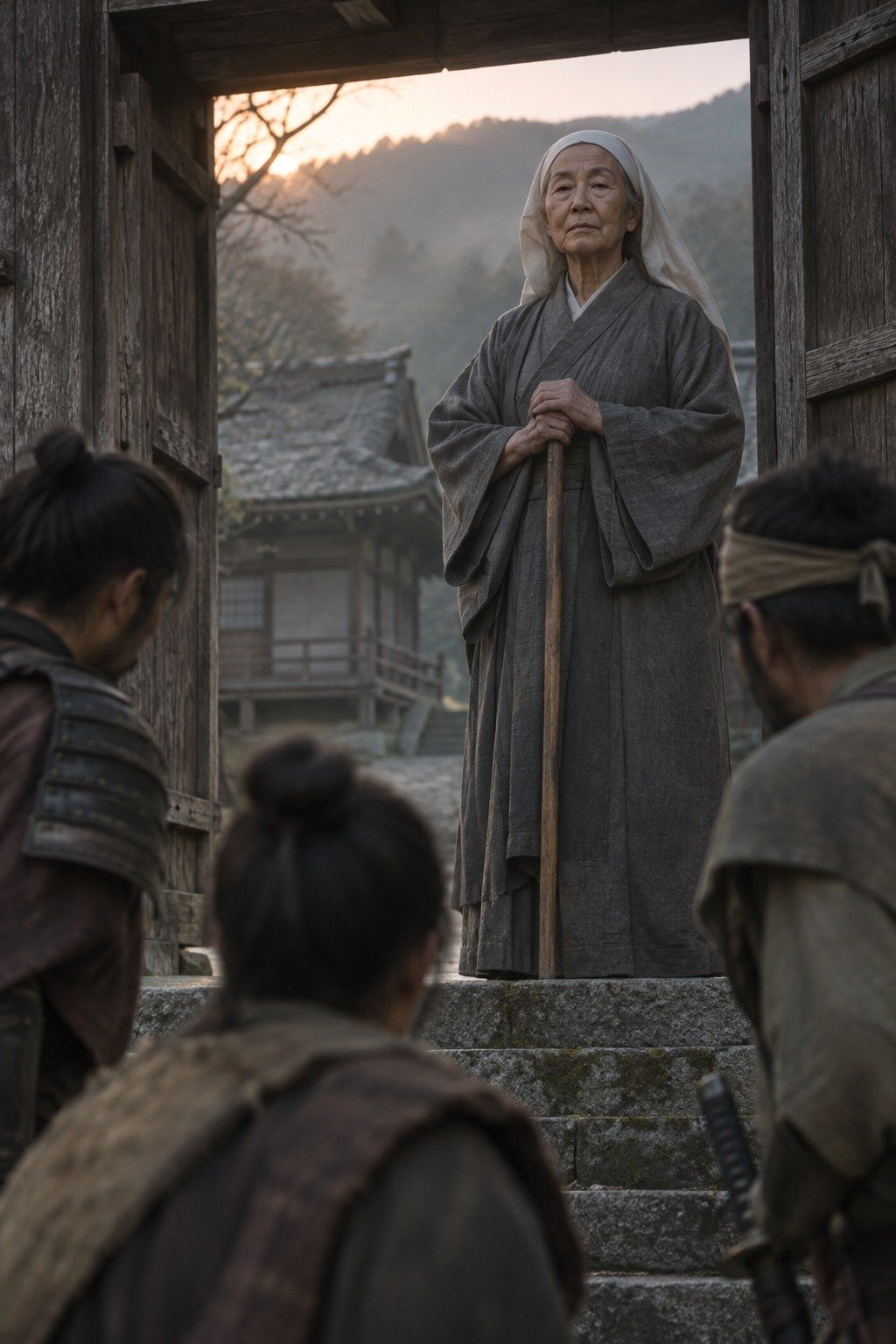
Each master is a person, not a stat block. Heroes learn from them, argue with them, and owe them, but they don't fight them, and a master who must fight is far beyond the heroes' Rank. Place them where the campaign needs them, or where the entries suggest.
The Grey Abbot. The great tengu of Tachiyama in Kurogane (Chapter 8), who stops travelers on the summit path and challenges them to a bout with wooden swords. He wears a mountain ascetic's robes and a face like weathered cedar, and he laughs at the proud and the solemn alike. He has taught swordsmen for five hundred years and remembers all their names. His test is always a bout. Winning is rare; losing with style is enough. He despises the tengu who teach sorcery for the pleasure of watching students fall, and he knows the one who taught Kūzan (Chapter 7). Teaches: Falling Leaf and Returning Arrow; to a student who returns at Heroic Rank, Wings of the Tengu; and at Legendary Rank, its full secret. His price: a task that humbles the student, often in front of people who admire them.
Musada Kozue. An old woman in a lay sister's gray robe who keeps the gate of Matsunoki Convent in Kurogane's castle town (Chapter 8). Forty years ago she was a lord's sword instructor, and twice she held that same gate against husbands who came to drag their wives back out of sanctuary. She has never told anyone why she left the world. Abbess Shōun (Chapter 9) trusts her absolutely. Her test: stand guard beside her at the gate for a season, and do nothing at all unless she says so. Teaches: Moon in the Water and Stone in the River. Her price: the hero must one day protect a woman who comes to the convent for sanctuary, whoever pursues her.
Nui of the Snows. A mountain ascetic who lives alone above the snow line in the tengu peaks of Takane (Chapter 8), in a hut no one else can find twice. She is small, ageless, and very hard to impress, and the hunters of the high valleys leave rice for her at a certain stone. She climbed into the mountains after the death of her husband and both sons in the Cheongun War, and the mountain kept her. Her test: survive a winter night beside her on the bare rock without a fire. Teaches: Snow Without Tracks and The Mountain's Breath. Her price: her husband and sons lie unburied in Cheongun, with thousands of others no lord ever paid to remember. The hero must persuade a temple to hold the rites for them, and pay for it, and have their names read aloud.
Old Isono. The keeper of a small teahouse in Umikado's harbor quarter (Chapter 8), who pours tea for sailors, foreigners, and spies without ever seeming to listen. She was once a middle master of the Tomomura league (Chapter 9), and she left it, which is supposed to be impossible. The Tomomura believe she is dead. Her test: find her at all, then come back the next day and prove it wasn't luck. Teaches: The Ghost's Step and The Sleeping Crane. Her price: silence about who she is, and one day, a warning carried to someone the league means to kill.
Kenzawa Arikazu. A white-haired ferryman on a river crossing of the Ōgiri pilgrimage road (Chapter 8). Pilgrims know him as the old man who won't take money from the poor and won't carry anyone who is rude to the river kami. He was once a famous ronin who disarmed a lord's champion in front of the lord and was driven out of every province for it. He hasn't held a sword in 30 years. His test: cross his river with him a hundred times and tell him something true each time. Teaches: Empty Hands Take the Blade and Reading the Heart. His price: the hero must one day refuse to draw their sword when every reason says to draw it.
The ghost of Sogama Okihide. A temple swordsman of the old capital who died nearly four hundred years ago, in the Minazuki Return (Chapter 2), defending the ruined great south gate of Furumiya (Chapter 8) against soldiers who had come to burn the temples, and who never noticed he was dead. On moonless nights he still stands guard, and he challenges anyone who passes armed after dark. He doesn't know the war ended. His test: a bout with him in the dark, in which the hero must hold out until the first bird sings. Teaches: Cutting the Shadow. His price: find out what became of the woman he was to marry (a question with a sad answer in Furumiya's temple registers), and tell him, so that he can rest. Once he rests, no one else can learn his technique.
Which Rule When#
Blade and Kami™ has many subsystems. Use this table to find the right one, and the tags to decide what to use at all. Core rules carry the setting's themes and come up in most sessions. Recommended rules add depth once the group is comfortable. Optional rules wait until the campaign needs them.
| When this happens | Use | Where | Tag |
|---|---|---|---|
| A deed becomes known | Honor | Chapter 4, Part 1 | Core |
| A hero gives orders, asks a favor, or seeks promotion | Status | Chapter 4, Part 1 | Core |
| Blood, death, or a haunted place touches a hero | Kegare | Chapter 4, Part 2 | Core |
| Two swordsmen agree to a formal duel | Iaijutsu Duels | Chapter 4, Part 3 | Core |
| Someone does a hero a kindness that money can't repay | On | Chapter 4, Part 1 | Recommended |
| A poetry gathering, a tea, or a court quarrel | Contests and Court Intrigue | Chapter 4, Part 4 | Recommended |
| An armored foe, a matchlock, a fire, a surrender | Combat in Blade and Kami™ | Chapter 4, Part 5 | Recommended |
| A hero dies, or chooses death | Death and Its Customs | Chapter 4, Part 6 | Recommended |
| Between adventures | Downtime and Duty | Chapter 4, Part 7 | Recommended |
| A lord rewards, pays, or dismisses a hero | Patrons and Lords | Chapter 5, Part 1 | Recommended |
| The party wants a name of its own | The Heroes' House | Chapter 5, Part 2 | Optional |
| A hero holds land | Domains and the seasonal turn | Chapter 5, Part 3; Part 3 here | Optional |
| Armies meet, or a castle is besieged | Mass Battles and Sieges | Chapter 5, Part 4 | Optional (Core once war comes) |
| A genja calls on their path | Magic, rites, and talismans | Chapter 6 | Core for genja |
| The realm's spirits grow bolder | The Hakobore track | Chapter 7, Part 1; Part 3 here | Optional |
| The war moves without the heroes | The War Clock | Chapter 9, Part 1; Part 3 here | Optional |
| A long trip the table doesn't want to play | Road Tales | Part 2 | Optional |
| Years pass | Time Skips and Generations | Part 3 | Optional |
| The table wants a harsher game | Gritty Damage, Difficult Healing | Chapter 4, Part 7 | Optional |
Turning It Off#
- For a one-shot or a new group, use only the Core rules, and keep Honor to great deeds (the campaign dial in Part 1).
- If a rule slows the table, drop it for the session and pick it up again later. Nothing in the setting breaks if on goes untracked for an evening.
- If the players love a rule, lean into it. A group that loves contests of refinement should have a poetry gathering every few sessions, and a group that loves the seasonal turn should get domain events that matter.
- Ask after each arc what the players enjoyed and what felt like homework. Then adjust.
Sheets and Handouts#
The website and book need these handouts, designed at the publishing stage with the character sheet:
- The character sheet, with boxes for Honor, Status and group, kegare, and on owed and held.
- The domain sheet, with the four ratings, their progress boxes, stores, offices, and deputies (Chapter 5).
- The house sheet, with the house's kind, home, Advantages and Complications, and Upgrades (Chapter 5).
- The campaign calendar (Part 3), with room to mark adventures and the War Clock.
- A one-page GM reference: the Which Rule When table, the Honor tables, the kegare track, the duel steps, and the Hakobore track.
Notes#
- The Grey Abbot and the tengu as sword teachers draw on the legend of the King of the Tengu teaching a young hero swordsmanship in the mountains, told in F. Hadland Davis, Myths and Legends of Japan (1912), and on the long-nosed, winged tengu of William Elliot Griffis, Japanese Fairy World (1880).