Chapter 6
Magic and the Spirit World
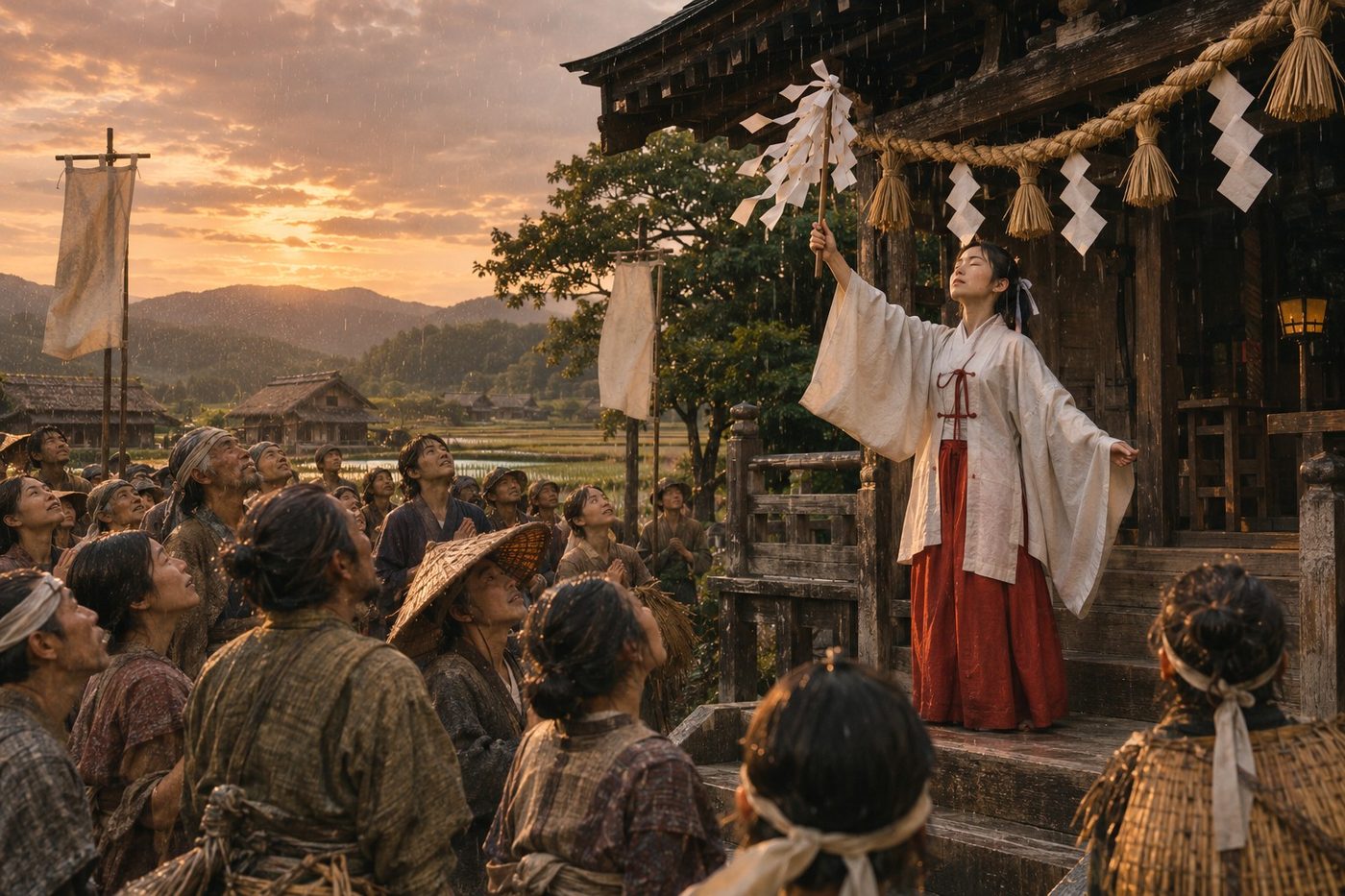
Part 1: How Magic Works#
A Crowded, Watchful World#
In Tsurugishima the spirits are not a matter of belief. A fox really does walk the dike at dusk in a woman's shape. A wronged retainer really does come back to stand at the foot of his murderer's bed. And a few people, a very few, can really make the kami listen.
Most priests, monks, and fortune-tellers have no power at all. They perform the rites correctly, the rites please the kami or comfort the dead, and life goes on. That is worth doing, and nobody thinks less of them for it. But now and then a shrine maiden's prayer brings rain on a cloudless day, a monk's sutra makes a ghost bow and fade, or a court diviner's paper bird flies out the window and comes back with a name. People who can do such things are called genja (験者), "those with proven power." Every village knows the difference between a priest and a genja, even when the priest doesn't.
Words for Power#
Islanders don't have a single word for what a foreign book might call magic. They name it by where it comes from:
- Reigen (霊験), "spirit-proof," is a miracle of the kami: the answered prayer, the healed child, the storm that turns aside. Shrine mediums and mountain ascetics work reigen.
- Hōriki (法力), "power of the Law," is the strength a monk draws from the Buddha's teaching and the guardian kings who protect it. Scholar-monks and warrior monks wield hōriki.
- Jutsu (術), "the art," is the learned craft of the yin-yang masters, built on calendars, directions, talismans, and bound spirits. It is closer to scholarship than to prayer.
- Majinai (呪い) is charm-work and sorcery: the farm wife's cure for warts, the gambler's lucky knot, and also the effigy nailed to a sacred tree at the Hour of the Ox. The word covers both the harmless and the damned, and people use it with a careful tone.
The rules call all of these powers, and every genja has an Arcane Background.
Where Power Comes From#
The kami. A kami grants power to those who are pure, who honor it, and who speak to it in the old words. Each kami has a gentle spirit and a rough spirit, and a genja who calls on one never quite forgets the other. Power from the kami comes most easily on the kami's own ground, and it flows away from anyone stained by death and blood.
The buddhas and their guardians. The buddhas themselves are beyond the world and don't come when called. Their teaching does have power, though, and so do the guardians who protect it: the wrathful kings wreathed in flame, the heavenly generals, and the gate-guardian kings (niō) who stand at every great temple's entrance. A monk who has truly taken the Law into himself can speak with their authority.
The order of the world. The yin-yang masters ask no one's favor. They read the patterns that run through heaven and earth, the balance of in and yō and the turning of the five phases, and they act where those patterns give them leverage, the way a wrestler uses an opponent's weight. When the hour and the direction are right, a small push moves a great deal.
The Five Paths#
Tsurugishima knows five paths to real power. Together they are called the Five Paths. Part 2 gives each one's Arcane Background.
| Path | Who walks it | Source of power | Arcane skill | Usual group |
|---|---|---|---|---|
| Kannagi (巫) | Shrine priests and shrine maidens (kannushi and miko) who can call down the kami | The kami of their shrine | Faith | A shrine |
| Gakushō (学生) | Scholar-monks and scholar-nuns who have mastered the sutras and the secret rites | The Buddha's Law | Faith | A temple or convent |
| Sōhei (僧兵) | Warrior monks who turn faith into battle | The guardian kings | Faith | An armed temple or sect league |
| Yamabushi (山伏) | Mountain ascetics of the Mountain Way (Shugendō), formally called shugenja | The mountain kami and the Immovable King, earned by austerity | Faith | A mountain temple |
| Onmyōji (陰陽師) | Yin-yang masters of the Way of Yin and Yang (Onmyōdō) | The order of in and yō and the five phases | Spellcasting | The court or a lord's household |
At the great armed temples, the scholar-monks and the warrior monks are different people from different backgrounds. The gakushō are ordained and learned, often the younger sons and daughters of good families. The warrior monks come mostly from the hall workers (dōshu), who cook, carry, and guard. The two look down on each other, and the quarrels between them have burned temple halls before now.
In, Yō, and the Five Phases#
Everything in the world is a mix of in (陰), the dark, cool, still, and hidden, and yō (陽), the bright, warm, moving, and open. Night is in and day is yō; water is in and fire is yō; a ghost is very in indeed. Health, luck, and good government come from balance between the two.
The world also turns through five phases (gogyō): wood, fire, earth, metal, and water. Every year, day, hour, direction, color, and season belongs to one of them. The phases follow two cycles that every diviner learns as a child:
- Generating: wood feeds fire, fire makes earth (ash), earth bears metal, metal gathers water (dew), and water nourishes wood.
- Overcoming: wood breaks earth, earth dams water, water quenches fire, fire melts metal, and metal cuts wood.
People use the phases every day without thinking about it. A family checks that a bride's birth phase doesn't overcome the groom's. A carpenter won't start a house on a fire day. A Fire Horse year makes the whole realm nervous.
Lucky and unlucky days. Nobody tracks the phase of every day at the table. When it matters, as when a lord asks for a lucky day to march, a hero with a diviner's almanac (Chapter 3 Gear) makes an Occult roll to name a good one. Onmyōji read the hour before they work, and now and then the stars turn against them (Part 2).
Rare, and Less Rare Every Year#
Real power is rare. Perhaps one priest or monk in ten is a genja, and far fewer in the cities, where rites have become a business. Most villages have never met one, and many people who claim the gift are frauds. An Occult or Notice roll opposed by the fraud's Performance spots a charlatan; a raise spots exactly how the trick is done.
But the old women say there are more genja now than when they were girls, and they're right. Children are born who hear the kami. Rites that were only custom for a hundred years have begun to work again. Many people take it as a sign of the times: a century of war has filled the land with blood and restless dead, the spirits are waking, and the power to answer them is waking too.
Genja and the Law#
The great temples and shrines keep their genja close and lend them out to lords for a price: a rite for victory, a purification after a battle, or an exorcism in the women's quarters. The court's Bureau of Yin and Yang trains and ranks onmyōji, and a diviner without its license is, strictly speaking, a criminal, though few magistrates care in the provinces. Every daimyo of any size keeps at least one diviner to name the lucky days for war.
Sorcery that harms is a grave crime. The old purification prayers list cursing among the offenses against heaven, and every lord's law punishes it with death. Anyone caught at a shrine in the Hour of the Ox with a straw figure and nails is beyond help. The owners of dog-spirits and fox-spirits are shunned by their neighbors even when nothing can be proved, and a marriage broker's first question is whether a family keeps one.
Purity and Power#
The kami turn away from the polluted, and so does the power they grant. Chapter 4's pollution track (kegare) subtracts from Faith rolls at Polluted and Defiled, and that penalty applies to the kannagi, gakushō, sōhei, and yamabushi. Onmyōji don't suffer the Faith penalty on their Spellcasting, because their art doesn't rest on any spirit's favor. They still suffer the Fear penalty like anyone else, and their own weakness is the calendar (Part 2). Onmyōji are often the people sent to an execution ground or a plague village for exactly this reason.
Each faith path also keeps a vow, and breaking it costs a genja their power for a time (Part 2).
What Power Cannot Do#
- The dead stay dead. No rite brings a dead person back to life. The dead go to their ancestors, to rebirth, or to wandering. The best a genja can do is speak with them, feed them, or send them on.
- No buddha comes when called. A monk can call on a guardian's servant, never on a buddha in person.
- The Pure Land and the hells are beyond the reach of any living person. They are for the dead, and the book leaves them to the faith.
- No wish is granted by any power a genja knows. The only wish in the isles is the one said to wait at the end of the 48-temple pilgrimage of Ōgiri (Chapter 8).
The Worlds Beyond#
Islanders speak of three other worlds. What lies behind them belongs to Chapter 7; this is what people know.
- The Hidden World (kakuriyo, 隠世) lies alongside this one, the way the lining lies behind a robe. It is where the kami dwell, where the yōkai go when they vanish, and where the spirits of the honored dead watch over their families. Every shrine gate is a door to it that opens only one way.
- Yomi (黄泉), the Land of the Dead, lies under the earth, dark, polluted, and guarded. In the oldest stories, a god who went there to bring back his dead wife fled for his life, throwing peaches behind him to hold off the hag-armies, and sealed the road with a great rock.
- Tokoyo (常世), the Eternal Land, lies across the sea. The old books say that some who went there never aged, and that an orange tree came from there. Scholars argue whether it is the same as Hōrai, the land's ancient name. If it is, the isles themselves were once the Eternal Land and somehow stopped being so.
A few genja learn to walk into the Hidden World and back (the power called The Hidden Road, Part 3). Nobody living walks into Yomi and comes out unchanged.
Learning the Way#
At creation. A hero takes an Arcane Background Edge at character creation, usually alongside the matching faith profession (Chapter 3), but neither requires the other.
Later. A hero who wants to walk a path later must first find a master and spend two Downtimes in training (Chapter 4), and then take the Arcane Background Edge with an Advance. A path's longer austerities, such as the yamabushi's hundred days, begin in the first Downtime and end in the second, and the days between pass off screen between adventures. What training means depends on the path:
- Kannagi: service at a shrine, purification every dawn, and learning the old words and the sacred dance.
- Gakushō and sōhei: ordination at a temple and the study of the sutras, or for sōhei, the temple's rule and its fighting drills.
- Yamabushi: a hundred days of austerity in the mountains: fasting, cold water, and walking the ridges.
- Onmyōji: a teacher, the books, and the calendar, usually by way of the Bureau of Yin and Yang or a diviner's family.
New powers. A genja learns Novice powers freely when they take the New Powers Edge (SWADE p. 47). Seasoned and higher powers are secret rites: to learn one, a genja also needs a teacher who knows it, a secret scroll that records it, or a revelation from a kami (an adventure reward). A Veteran genja can write a teaching scroll for a power they know, which takes one Downtime and 500 mon (Part 5). Scrolls found as treasure use the Fantasy Companion's rules for scrolls and tomes (Part 5).
Atonement. A genja who has broken their vow (Part 2) can atone in Downtime by copying a sutra by hand (shakyō) or reciting the great purification prayer (norito) at a shrine a thousand times. Either clears the penalty at the end of that Downtime.
New Teachings#
Every sect began with one person who saw something no one else had. A Legendary gakushō, kannagi, or yamabushi with a temple or shrine of their own (Chapter 5, The Heroes' House) may set out to found a new sect. It takes years of play, a body of followers, a written teaching, and the hostility of every established sect that loses patrons to it. The GM handles it as a campaign goal, built on the house rules and the Social Conflict rules (SWADE p. 143). A sect that survives its founder becomes a power in the land, and a target.
Companion Magic Rules in Play#
| Rule | Source | In Blade and Kami™ | Where |
|---|---|---|---|
| Cantrips | FC p. 108 | Yes. Each path has its own. | Part 2 |
| Arcane Devices | FC p. 109 | Yes. These are talismans (ofuda), blessed amulets (omamori), and sutra slips. | Part 4 |
| Battle Magic | FC p. 110 | Yes, as the rites of war, fitted to Chapter 5's Mass Battles. | Part 4 |
| Prepared Powers | FC p. 111 | No. Talismans do this job. | |
| Ritual Magic | FC p. 112 | Yes, with offerings as components. The great rites use it. | Part 4 |
| Domains | FC p. 114 | Yes, as the natures of the kami that kannagi serve. | Part 2 |
| Power Modifiers, Limitations, and Trappings | FC pp. 106–107 | Yes. Every power has an island name and trappings. | Part 3 |
| Stream Template | FC p. 76 | Yes. | |
| Wards and Binds | HC p. 48 | Yes, as sacred ropes and talisman wards. | Part 4 |
| Dynamic Backlash | SWADE p. 138 | No. Each path has its own Critical Failure table. | Part 2 |
| No Power Points | SWADE p. 140 | No. | |
| Corruption | FC p. 28, HC p. 6 | No. Pollution (kegare, Chapter 4) takes its place. |
Notes#
- Magic, charms, curses, and divination, including the effigy curse at the Hour of the Ox, the dog-spirit owners shunned by their neighbors, and cursing among the offenses named in the great purification prayer, follow W. G. Aston, Shinto: The Way of the Gods (1905), and A. B. Mitford, Tales of Old Japan (1871).
- Yomi, Tokoyo, and the peaches follow Aston, Shinto (1905), which also notes that some identified Tokoyo with Hōrai, and the Nihongi (trans. Aston, 1896). The ruler of the unseen world appears in Lafcadio Hearn, Japan: An Attempt at Interpretation (1904).
- Possession, austerities, and the genja's power draw on Percival Lowell, Occult Japan (1894).
Part 2: Arcane Backgrounds#
Walking a Path#
Each of the Five Paths has its own Arcane Background Edge. Four are built on Arcane Backgrounds from the Fantasy Companion (FC) and Horror Companion (HC), and this part prints only what changes. The sōhei's is new and appears in full.
| Arcane Background | Built on | Arcane skill | Starting powers | Power Points |
|---|---|---|---|---|
| Kannagi | Cleric (FC p. 93) | Faith | harai, healing, and three from the kami's nature | 10 |
| Gakushō | Priest (HC p. 64) | Faith | healing, segaki, and three others | 10 |
| Sōhei | New | Faith | smite and one other | 10 |
| Yamabushi | Shaman (FC p. 98) | Faith | arcane protection, relief, and three others | 10 |
| Onmyōji | Wizard (FC p. 104) | Spellcasting | Detect/conceal arcana, dispel, summon ally, and three others | 15 |
Harai, segaki, kami-oroshi, and shōshō are new powers, described in Part 3.
Rules for Every Path#
Arcane Background. Each path is a separate Arcane Background Edge (SWADE p. 37). A hero may hold two with the GM's approval, following the Fantasy Companion's rules for multiple Arcane Backgrounds (FC p. 89). Mountain ascetics, who mix the shrine and the temple, often do.
Miracles and Magic. Kannagi, gakushō, sōhei, and yamabushi may take Edges that require Arcane Background (Miracles). Onmyōji may take Edges that require Arcane Background (Magic).
Pollution. The Faith penalty for pollution (Chapter 4) applies to the kannagi, gakushō, sōhei, and yamabushi. It doesn't apply to an onmyōji's Spellcasting.
Critical Failure. Each path replaces the usual Backlash (FC p. 105) with its own Critical Failure table below. Whatever the result, all the genja's active powers end at once.
Cantrips. Every path uses the Fantasy Companion's cantrips (FC p. 108). The examples under each path show what fits; the GM judges the rest.
Kannagi (shrine mediums, 巫)#
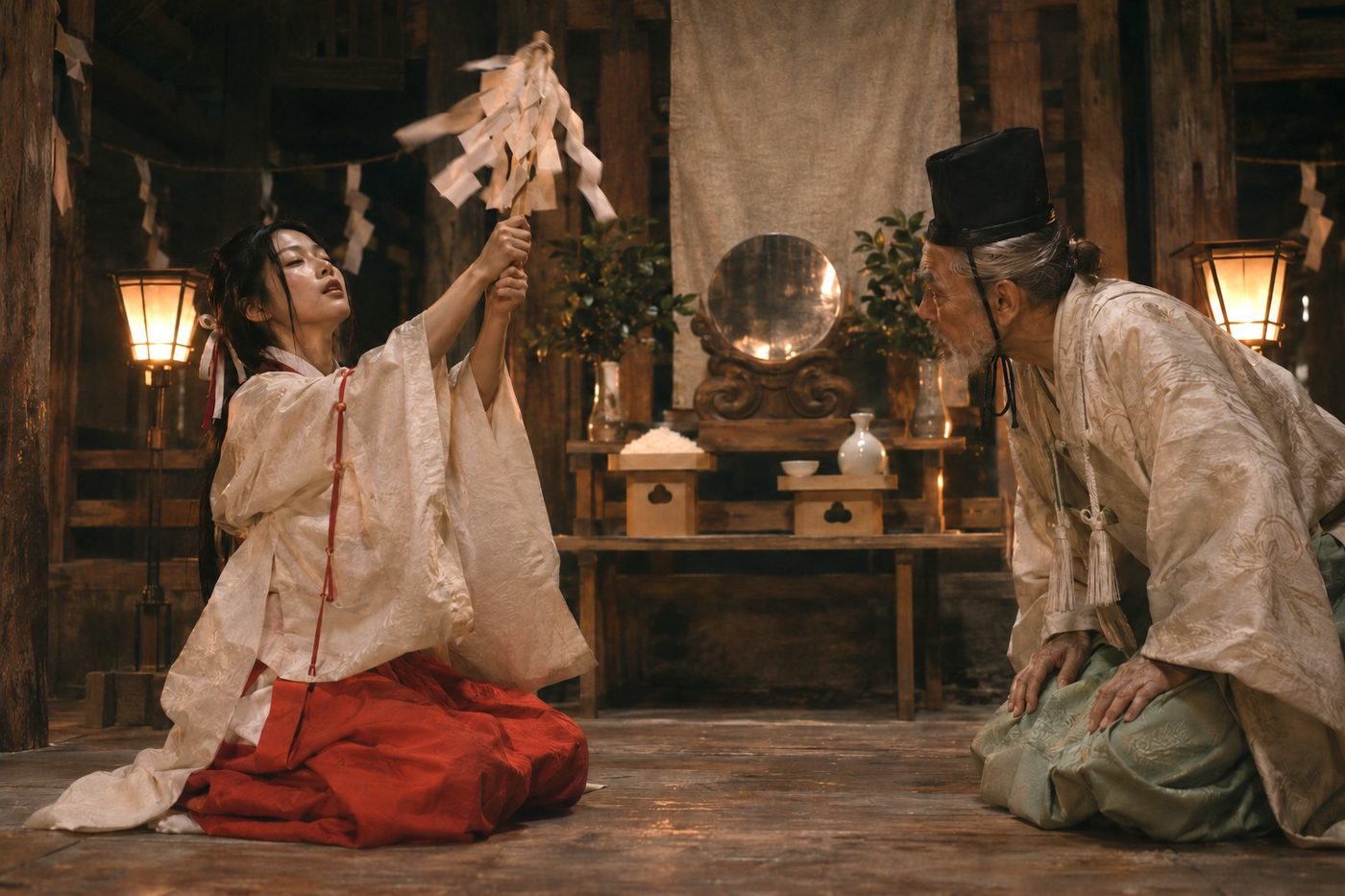
The kannagi is the person a kami speaks through. In the oldest days the word meant a shrine maiden in trance with a paper wand shaking in her hands. Today it covers any shrine priest or shrine maiden whose prayers truly reach the kami of their shrine. Kannagi purify, heal, bless fields and boats, and drive off what the kami despise. Their power is the kami's power, and it depends on purity and the kami's goodwill.
Arcane Background (Kannagi). As Cleric (FC p. 93), with these changes:
- Starting powers: harai, healing, and three powers from the kami's nature.
- Available powers: the powers of the kami's nature (see Kami Natures, below), plus banish, blessing, consecrate ground, divination, exorcism, harai, healing, kami-oroshi, kamigakari, sanctuary, and séance, which every kannagi may learn. Fly, growth/shrink, puppet, and summon monster are struck from every nature. Resurrection is never available (Part 1).
- Holy symbol: the purification wand (ōnusa), a sakaki branch hung with paper, or a cluster of sacred bells, held in one hand.
- Vow: the kannagi's Major Vow is to serve the kami and keep its shrine pure: to make the offerings, purify themselves daily, and never let the dead or blood into the kami's presence.
Cantrips. Waking a dying fire with a single clap, ringing a bell that calms a frightened horse, bringing the scent of sakaki and cedar into a room, telling whether a well's water is clean, making the lantern at a shrine gate flare to welcome a guest.
Critical Failure (d6) | d6 | Result | |---|---| | 1–2 | The kami turns away. The kannagi suffers a level of Fatigue. | | 3 | A stain. The kannagi moves one step down the pollution track. | | 4 | Displeasure. The kannagi subtracts 2 from Faith rolls until they make an offering at a shrine (an hour of prayer and at least 10 mon). | | 5 | The kami speaks. The kami seizes the kannagi's voice. They are Stunned, and they speak a short omen, true but riddling, which the GM supplies. | | 6 | The rough spirit. A gust, a tremor, or a flash of light. Everyone in a Medium Blast Template centered on the kannagi, friend and foe alike, makes a Spirit roll or is Shaken. |
Kami Natures#
A kannagi serves a particular kami, usually the kami of their own shrine, and its nature decides which powers it grants. This uses the Fantasy Companion's domains (FC p. 114). Nine natures use a Companion domain's power list as written; two are new.
| Kami nature | Shrines and examples | Powers |
|---|---|---|
| Mountain and Forest | The kami of a peak, a great cedar, or a sacred grove | Nature domain (FC p. 115) |
| Sea and River | Fishing-village shrines, river crossings, the water dragon of Mizuchi | Sea domain (FC p. 115) |
| Rice and Harvest | Fox-guarded shrines of the rice kami, field and storehouse shrines | Life domain (FC p. 114) |
| Sun | The Forging Gods' great shrines, from whom the Emperor descends | Sun domain (FC p. 115) |
| Moon and Night | Shrines of the moon, of tides and dreams | Moon domain (FC p. 115) |
| War | Shrines of warrior kami, where daimyo pray before battle | War domain (FC p. 115) |
| Learning and Writing | Shrines to scholars who became kami after their deaths | Knowledge domain (FC p. 114) |
| Ancestors and the Dead | Shrines to the honored dead and the angry dead, raised to calm them | Death domain (FC p. 114), but never its summon undead or zombie |
| Snow and Winter | Kami of the northern snows, frozen lakes, and the winter mountains | Cold domain (FC p. 114), but never its zombie |
| Fire and Forge (new) | Smiths' shrines, hearth kami, volcano shrines | Arcane protection, barrier, blast, bolt, boost/lower Trait, burst, damage field, deflection, dispel, divination, elemental manipulation (fire only), environmental protection, fear, healing, light/darkness, protection, smite, warrior's gift |
| Thunder and Storm (new) | Thunder shrines on high peaks, storm kami of the coasts | Arcane protection, barrier, blast, bolt, boost/lower Trait, burst, deflection, dispel, divination, elemental manipulation (air and water only), environmental protection, farsight, fear, havoc, healing, light/darkness, protection, sound/silence, stun |
Wherever a domain list includes resurrection, strike it. Mystic intervention stays, as a Legendary answered prayer.
Gakushō (scholar-monks and scholar-nuns, 学生)#
A gakushō has spent years over the sutras, learned the hand gestures and sacred syllables of the secret rites, and taken the Law so deeply into themselves that it answers. Gakushō calm the restless dead, feed the hungry ghosts, see through illusion and deceit, heal the sick, and call on the guardian kings when demons come. Many are nuns, and the great convents train some of the most respected gakushō in the isles.
Arcane Background (Gakushō). As Priest (HC p. 64), with these changes:
- Starting powers: healing, segaki, and three other powers from the list.
- Available powers: the Priest's list, without beast friend or resurrection, adding blind, corpse sense, grave shroud, mind reading, object reading, segaki, shōshō, and suppress transformation.
- Holy symbol: prayer beads (juzu) worn on the wrist or held, or a sutra scroll.
- Vow: the gakushō's Major Vow is to keep the precepts of their sect and to serve the living and the dead: never to take life except, for some sects, in defense of the Law, and to perform the rites for any who ask.
Cantrips. Making incense smoke rise straight in a draft, quieting a barking dog with a few syllables, keeping ink dry in the rain, making prayer beads glow faintly in the dark, cooling a fevered brow for the night.
Critical Failure (d6) | d6 | Result | |---|---| | 1–2 | Weariness. The gakushō suffers a level of Fatigue. | | 3 | Doubt. The gakushō is Distracted and Vulnerable until the end of their next turn. | | 4 | Attachment. The gakushō can't use that power again until they rest an hour in meditation. | | 5 | Hungry guests. The failed rite draws the hungry dead. Before the next dawn, the GM may bring a minor haunting to wherever the gakushō sleeps. | | 6 | A broken precept. The gakushō suffers the effects of breaking their Vow: –2 to Faith rolls for a week, or until they atone (Part 1). |
Sōhei (warrior monks, 僧兵)#
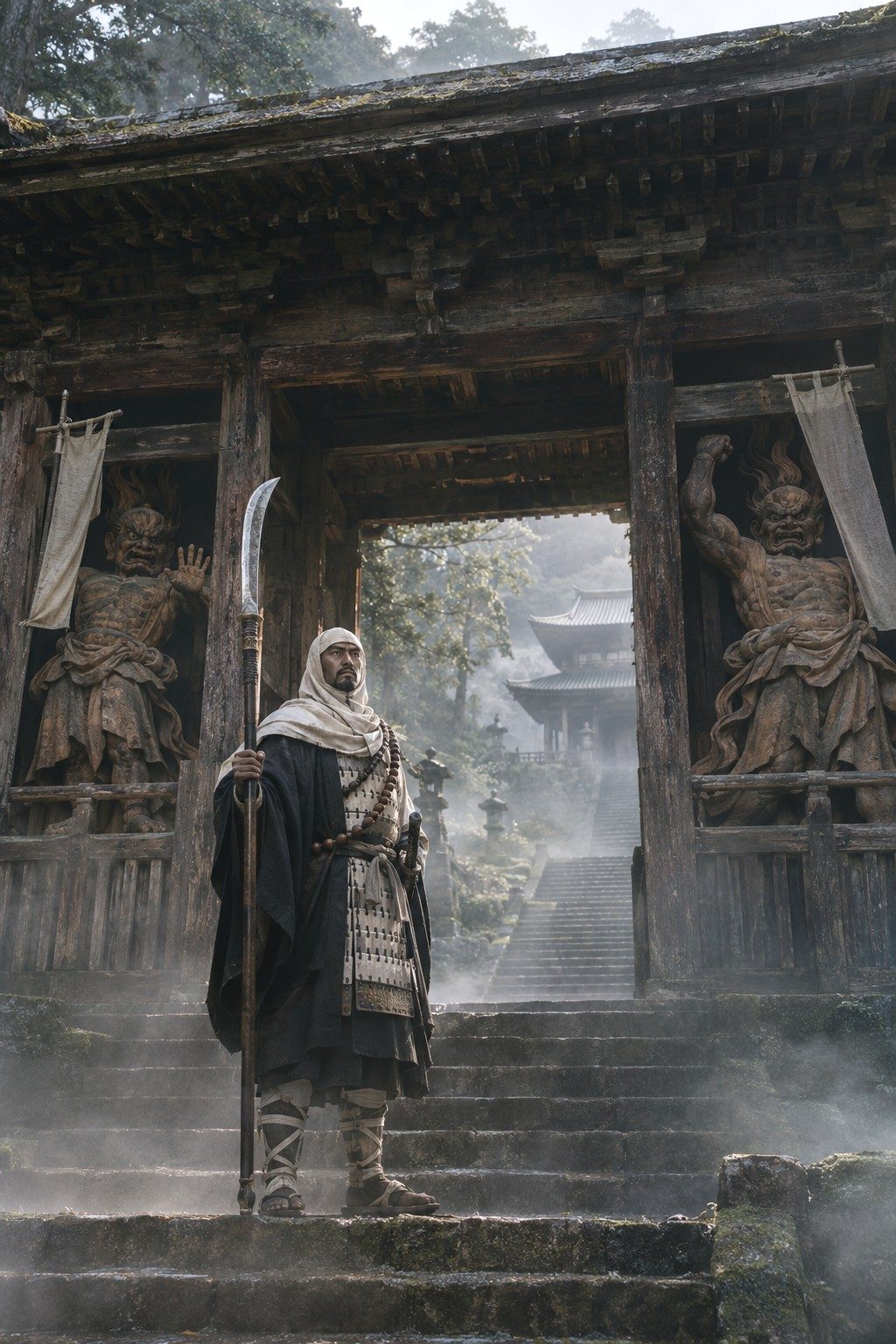
The sōhei doesn't study the secret rites. They take the temple's rule, chant the guardian kings' mantras, and fight. Their power is narrow and hard: a glaive that burns spirits, a war cry that freezes the blood, skin that turns a blade. Most come from the temple's hall workers, and the scholar-monks look down on them. The warrior monks don't much care, since the scholar-monks rely on them to guard the gate.
Arcane Background (Sōhei) Requirements: Novice, Spirit d6+, Fighting d6+ Arcane Skill: Faith (Spirit) Starting Powers: smite and one other power from the list below. Power Points: 10 Available Powers: Arcane protection, banish, barrier, blind, boost/lower Trait, deflection, environmental protection, exorcism, fear, havoc, healing, protection, relief, shōshō, sloth/speed, smite, stun, warrior's gift.
- Miracles: Sōhei may take Edges that require Arcane Background (Miracles).
- Armored faith: Sōhei never suffer Armor Interference, and they may hold a weapon in both hands while activating powers.
- Glaive and prayer: When a sōhei attacks in melee and activates a power with a Range of Self (or targeting only themselves) in the same turn, they reduce the Multi-Action penalty by 2.
- Vow: Sōhei must have a Vow (Minor) to keep their temple's rule and defend it. If they break it, they subtract 2 from Faith rolls for a week.
Cantrips. A jangle of the ringed staff that halts a crowd for a heartbeat, a breath that steams like a temple bell in the cold, a mantra that keeps a march in step, making a torch burn without smoke.
Critical Failure (d6) | d6 | Result | |---|---| | 1–2 | Spent. The sōhei suffers a level of Fatigue. | | 3 | Fury. On their next turn, the sōhei must make a Wild Attack against the nearest foe, or the nearest object if no foe is in reach. | | 4 | Shaken. The sōhei is Shaken. | | 5 | Fumble. The sōhei's weapon flies from their hands and lands 1d4" (2d4 yards) away in a random direction. | | 6 | Rebuke. The sōhei suffers a level of Fatigue and is Shaken. |
Yamabushi (mountain ascetics, 山伏)#
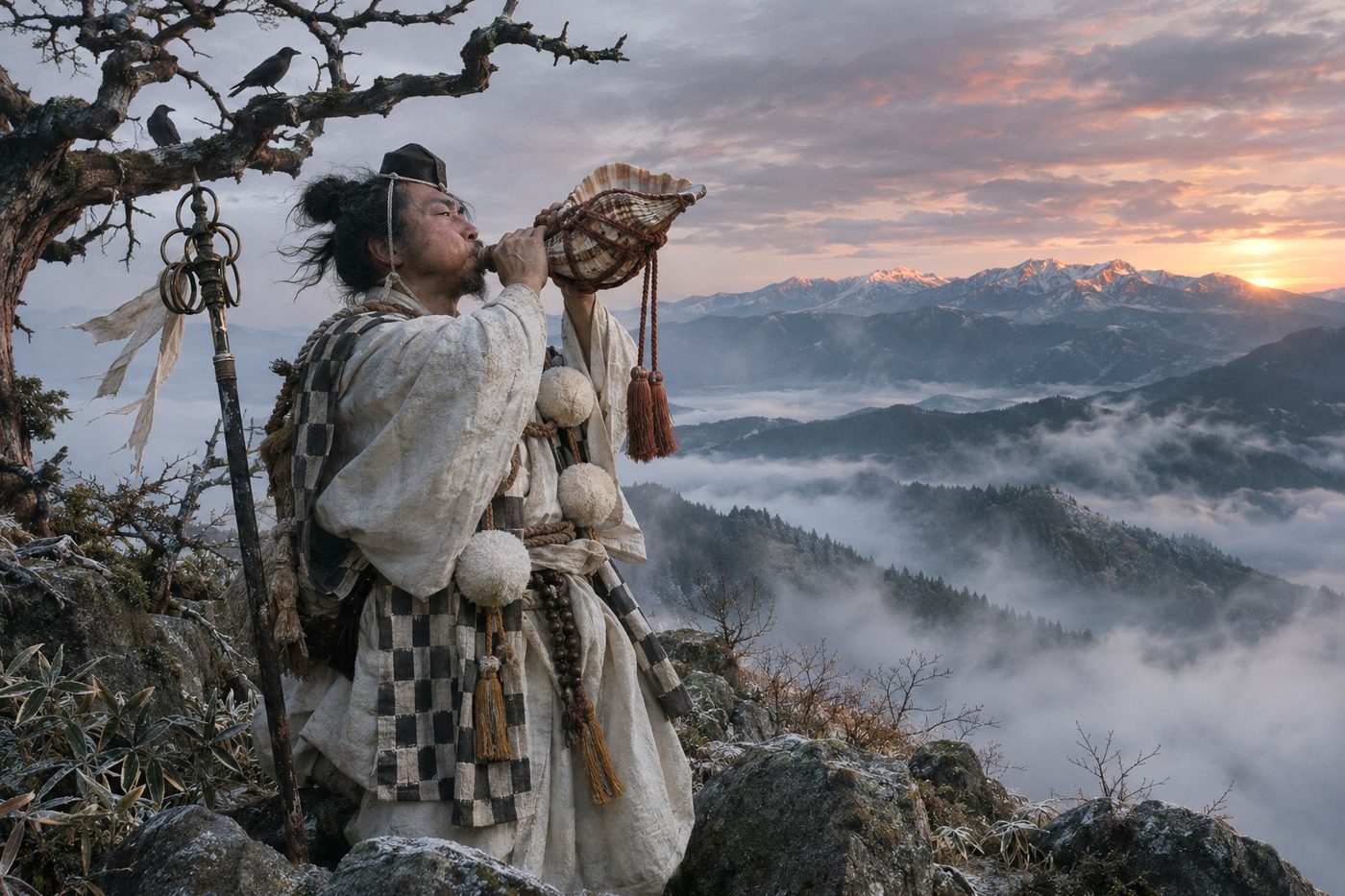
The yamabushi earns power the hard way: fasting, cold water at midnight, a hundred days on the ridges, and nights alone with the tengu. Their formal name, used in temple records, is shugenja, "one who practices the Mountain Way." Yamabushi walk between the shrine and the temple, calling on mountain kami and the Immovable King alike, and the villages below send for them when something stalks the fields. They carry a conch-shell trumpet (horagai) and a ringed staff (shakujō), and few bandits rob them.
Arcane Background (Yamabushi). As Shaman (FC p. 98), with these changes:
- Available powers: the Shaman's list, without burrow, resurrection, or summon monster, adding consecrate ground, exorcism, harai, kami-oroshi, kamigakari, plane shift, shōshō, suppress transformation, and teleport.
- Fetish: the yamabushi's conch-shell trumpet or ringed staff. Without one in hand, they subtract 2 from Faith rolls.
- Quirk: the mountain marks every yamabushi. They have the Quirk (Minor) Hindrance (SWADE p. 26): talking to crows, bathing in icy water every night, refusing to sleep under a roof, or something similar.
- Austerity: Once per session, a yamabushi may take a level of Fatigue from fasting, cold, or chanting to regain 5 Power Points at once. This can't cause Incapacitation.
Cantrips. Lighting a fire with a breath, sending a conch note that carries across a valley, finding the nearest spring, shaking off a light rain, sensing which path a deer took.
Critical Failure (d6) | d6 | Result | |---|---| | 1–2 | The mountain's toll. The yamabushi suffers a level of Fatigue. | | 3 | A heavy toll. The yamabushi suffers two levels of Fatigue. This can't cause Incapacitation; it stops at Exhausted. | | 4 | The tengu laughs. Mocking laughter echoes from the trees. The yamabushi is Distracted for the rest of the encounter, and a small item goes missing. | | 5 | Wild fire. The power's fire, lightning, or cold turns back on the yamabushi for 2d4 damage. | | 6 | Lost on the Way. The yamabushi subtracts 2 from Faith rolls until they spend a night in vigil on a mountain or under a cold waterfall. |
Onmyōji (yin-yang masters, 陰陽師)#
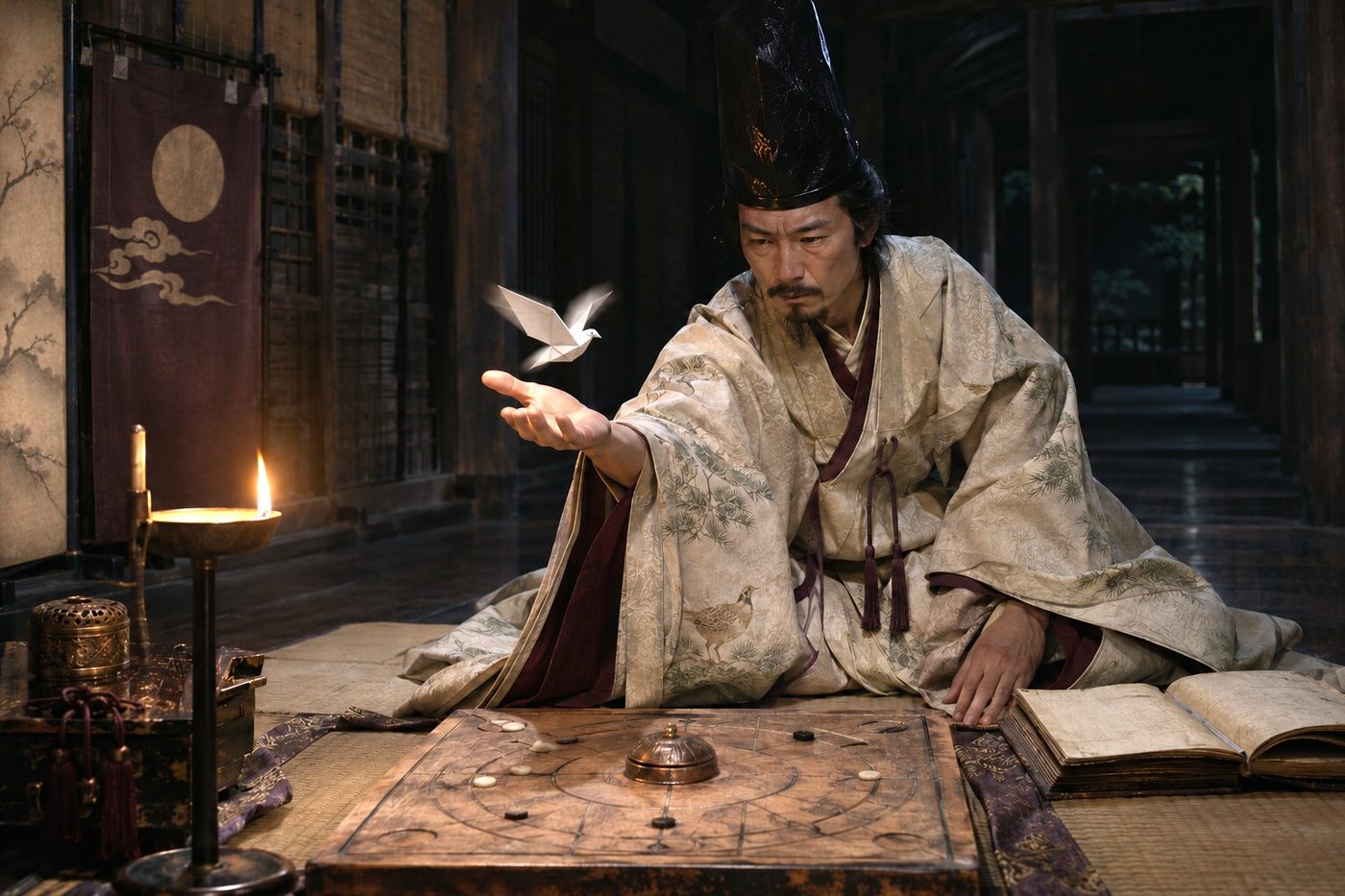
The onmyōji is a scholar first. They read the stars, keep the calendar, name the lucky days and forbidden directions, and know which phase rules each hour. With that knowledge they write paper talismans (ofuda), fold paper servants and bind small spirits to them (shikigami), lay wards, break curses, and, when their masters ask quietly, lay curses of their own. The court's Bureau of Yin and Yang trains the best of them; the rest learn in diviner families or from wandering masters.
Arcane Background (Onmyōji). As Wizard (FC p. 104), with these changes:
- Requirements: Smarts d6+, Academics d6+.
- Starting powers: detect/conceal arcana, dispel, summon ally (a paper servant, see Shikigami, below), and three other powers from the list.
- Available powers: the Wizard's list, without fly, growth/shrink, puppet, time stop, wish, or zombie, adding corpse sense, divination, exorcism, harai, kami-oroshi (the gods of the directions, stars, and calendar only), séance, and suppress transformation.
- Components: the Material Components Hindrance (FC p. 29) means paper, brush, ink, cinnabar, and seals, kept in a writing case.
- Phase: each onmyōji chooses one of the five phases (see The Five Phases, below), which sets the trappings of their attack powers.
- Reading the hour: as an action, the onmyōji consults the almanac and the compass board and makes an Occult roll. Success gives a free reroll on their next Spellcasting roll this encounter. A raise also lowers that power's cost by 1 (minimum 1).
- Ill-starred days: once per session, the GM may declare an ill-starred day, when the phase that overcomes the onmyōji's own rules the heavens. The onmyōji subtracts 2 from Spellcasting rolls for the rest of the scene and gets a Benny.
- Talismans: an onmyōji gains the Artificer Edge (SWADE p. 45, FC p. 36) free on reaching Seasoned. Their arcane devices are paper talismans (Part 4).
Cantrips. Folding a paper bird that flutters a note across a room, telling the hour to the minute, making a brush write in perfect characters, finding north in a windowless room, making a candle flame lean toward a hidden draft.
Critical Failure (d6) | d6 | Result | |---|---| | 1–2 | Strain. The onmyōji suffers a level of Fatigue. | | 3 | Clouded stars. The onmyōji is Shaken and subtracts 2 from Smarts-based rolls until the end of their next turn. | | 4 | An ill-starred hour. The onmyōji subtracts 2 from Spellcasting rolls for the rest of the scene, with no Benny. | | 5 | The servant slips its paper. Any shikigami the onmyōji has summoned vanishes. If none, a minor spirit makes mischief: lamps go out, ink spills, and the onmyōji is Distracted. | | 6 | Rebound. If the power was meant to harm or hinder someone, it strikes the onmyōji instead, who resists it normally. Otherwise, the onmyōji suffers a level of Fatigue. |
The Five Phases#
| Phase | Overcomes | Overcome by | Direction | Trappings |
|---|---|---|---|---|
| Wood | Earth | Metal | East | Thorns, splinters, binding vines, the green smell of spring |
| Fire | Metal | Water | South | Flame, heat shimmer, red sparks, burning paper |
| Earth | Water | Wood | Center | Stone, dust, quaking ground, yellow clay |
| Metal | Wood | Fire | West | Needles, blades of light, the ring of a bell, white frost |
| Water | Fire | Earth | North | Ice, mist, black rain, the roar of a flood |
An onmyōji's attack powers, such as bolt, blast, burst, and barrier, take the trappings of their phase. On an ill-starred day an onmyōji prefers to wait rather than work, which is why lords who depend on them sometimes lose battles.
Shikigami (式神)#
An onmyōji's summon ally calls a shikigami: a paper figure, a carved doll, or a small spirit bound into a folded charm. It takes whatever ally form the power allows, looks like a paper bird, a paper servant, a child in old court dress, or a small beast, and turns back into paper when the power ends. The Shikigami Edge (below) makes one last.
Arcane Edges#
Core and Companion Edges#
The SWADE Power Edges are used as written: Arcane Background (SWADE p. 37), Artificer (SWADE p. 45), Channeling (SWADE p. 46), Concentration (SWADE p. 46), Extra Effort (SWADE p. 46), New Powers (SWADE p. 47), Power Points (SWADE p. 47), Power Surge (SWADE p. 47), and Rapid Recharge and Improved Rapid Recharge (SWADE p. 47). Wizard isn't used (Chapter 3).
Changed Edges
- Holy/Unholy Warrior (SWADE p. 46). Renamed Niō's Wrath, after the gate-guardian kings. It's the warrior monk's signature Edge, and any faith path may take it. Same effect. The unholy version is for villains only.
- Soul Drain (SWADE p. 47). Villains only.
- Battle Magic (FC p. 36). Renamed War Rites. Part 4 fits it to Chapter 5's Mass Battles.
- Blood Magic (FC p. 36). Villains only.
- Familiar (FC p. 36). Renamed Spirit Messenger. A kannagi's or yamabushi's familiar is a kami's messenger: a fox, a crow, a white snake, or a deer. An onmyōji's is a paper bird or a paper doll. Same effect.
- Mystic Powers (FC p. 37). Used with island packages, for warriors who aren't genja: Breath and Bone (the Monk package) for martial artists and wandering monks, Warrior's Ki (the Fighter package) for swordsmen, and Hunter's Spirit (the Ranger package) for mountain hunters. The Barbarian, Paladin, and Rogue packages aren't used; a Rogue package makes shinobi magical.
Used as written: Master Artificer, Epic Mastery, and Transfer (FC pp. 36–38); Favored Power (FC p. 37, HC p. 9); Silent Caster (FC p. 37, HC p. 9).
Companion Edges for each path. Each path uses its base Arcane Background's Edges, renamed: | Path | Edge | Renamed | |---|---|---| | Kannagi | Destroy Undead (FC p. 93) | Severing Rite. It harms the restless dead and other undead spirits. | | Kannagi | Mercy (FC p. 93) | Kami's Mercy | | Gakushō | Aura of Courage (HC p. 64) | Lotus Calm | | Gakushō | Mercy (HC p. 64) | Compassion | | Yamabushi | Primal Magic (FC p. 99) | Mountain Fire | | Yamabushi | Sacred Fetish (FC p. 99) | Consecrated Staff. It applies to the conch or the ringed staff. | | Onmyōji | Spellbooks (FC p. 104) | Secret Scrolls | | Onmyōji | Eldritch Inspiration (FC p. 104) | Reading the Scrolls |
New Arcane Edges#
Conch of the Mountain#
Requirements: Novice, Arcane Background (Yamabushi)
The yamabushi's conch carries across valleys and into the bones of those who hear it. When they blow the conch as the trapping for boost/lower Trait, fear, relief, or sound/silence, the power's Range doubles, and the first two Additional Recipients cost no Power Points.
Fire Offering (Goma, 護摩)#
Requirements: Seasoned, Arcane Background (Gakushō or Yamabushi), Faith d8+
The genja spends ten minutes feeding inscribed prayer sticks into a sacred fire while chanting. The next power they activate within the hour costs 2 fewer Power Points (minimum 1), and they get a free reroll on the Faith roll.
Hand Seals#
Requirements: Seasoned, Arcane Background (Yamabushi or Onmyōji), Spirit d8+
The genja weaves the sacred hand seals and speaks the syllables that go with them, cutting the air like a sword. As a limited free action, they spend 1 Power Point. Until the start of their next turn, they add +2 to rolls to resist powers and to Fear checks caused by spirits, yōkai, and the dead.
Oracle#
Requirements: Seasoned, Arcane Background (Kannagi), Spirit d8+
The kannagi can fall into the old trance and let the kami speak through them. Once per session, after an hour of chanting with a paper wand (gohei) in their hands, the kannagi asks the kami of their shrine, or of the place where they are, one question. The GM answers truthfully but often in riddles. If a companion acts as the questioner (maeza) and succeeds at a Faith or Occult roll, the answer is plain. During the trance, the kannagi is helpless.
Sacred Dance (Kagura, 神楽)#
Requirements: Novice, Arcane Background (Kannagi), Performance d6+
The kannagi dances for the kami, and the kami stays to watch. While the kannagi dances (their action each round, at half Pace), maintaining their powers costs no Power Points, and spirits and yōkai within 5" (10 yards) subtract 1 from Trait rolls.
Shikigami#
Requirements: Seasoned, Arcane Background (Onmyōji), Spellcasting d8+
The onmyōji's paper servants last. Their summon ally has a Duration of one hour. The onmyōji may also bind one shikigami permanently by reducing their maximum Power Points by 2. A bound shikigami serves until it's destroyed; the onmyōji can bind another after a week.
Arcane Hindrances#
- Armor Interference (FC p. 28) comes with the yamabushi (Minor) and onmyōji (Major) Arcane Backgrounds, and any genja may take it.
- Material Components (FC p. 29) is renamed Offerings for the faith paths: salt, sake, rice, sakaki, paper streamers, and incense. Onmyōji take it with their Arcane Background as paper, ink, and seals.
- Talisman (FC p. 29) fits every path: the wand, the beads, the conch, the mirror, or the divining board.
- Corruption (FC p. 28, HC p. 6) isn't used. Pollution (Chapter 4) takes its place.
Paths for Villains#
Not every genja serves the kami or the Law. The curse-worker, the necromancer of the hungry dead, the tengu-taught sorcerer, the dog-spirit owner, and the fox-keeper are paths for the GM's villains, built on the Fantasy Companion's Warlock/Witch, Necromancer, and Sorcerer. They appear in the Gamemaster's Section.
Notes#
- The medium in trance with a paper wand, the questioner (maeza), and the austerities of the mountain ascetics follow Percival Lowell, Occult Japan (1894).
- The jealous woman taught sorcery by a tengu at a mountain shrine comes from F. Hadland Davis, Myths and Legends of Japan (1912).
- The five phases appear in Lowell, Occult Japan (1894), in the five-colored paper wands of the shrines.
Part 3: Powers#
Island Names#
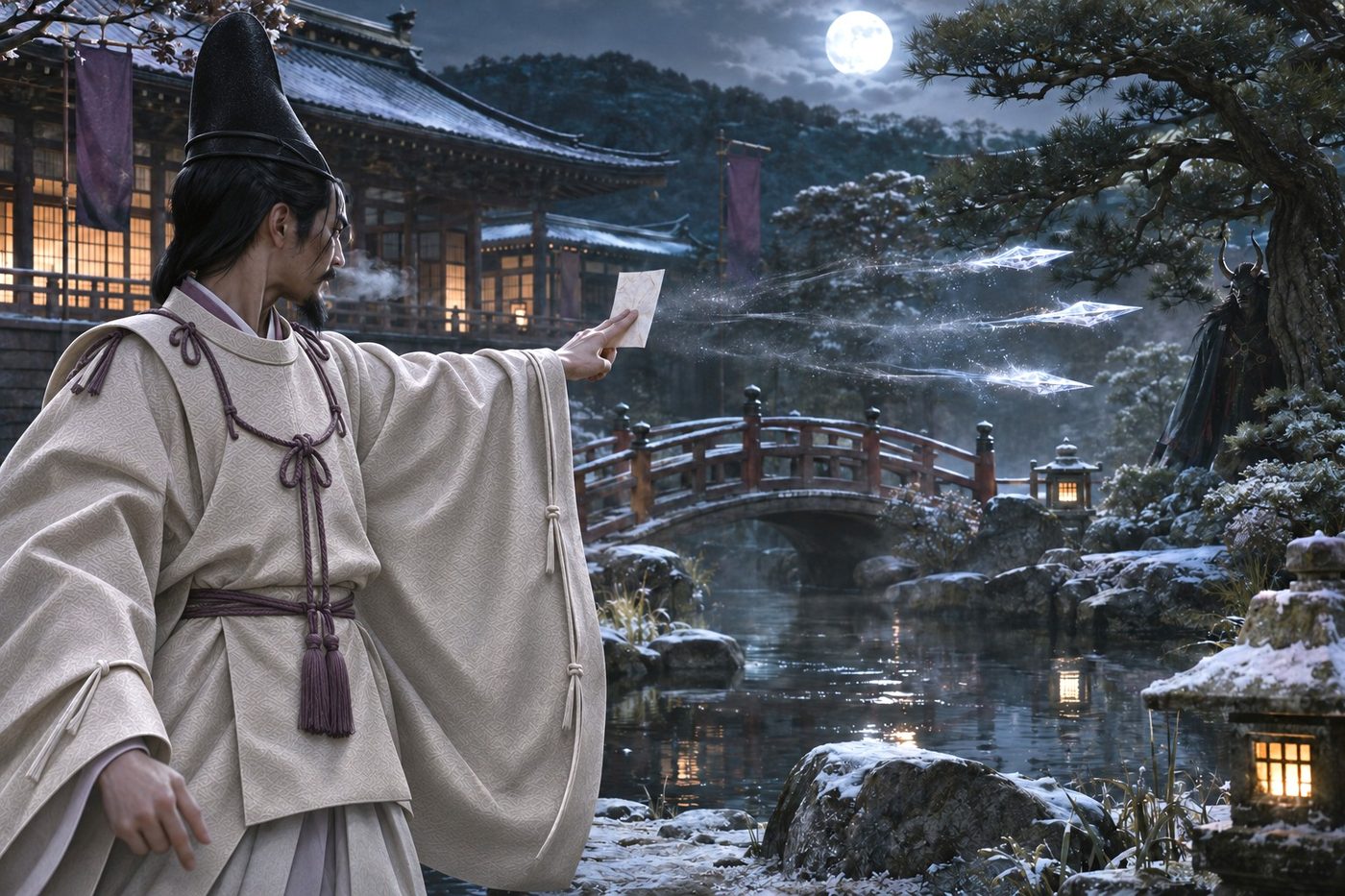
No genja in the isles says "I cast bolt." A yin-yang master looses Arrows of fire or frost, a mountain ascetic calls down Storm, and a scholar-nun lays a Body Ward on a frightened child. Every power in this book has an island name, and the table below gives it first, with the power's game name and page in parentheses. The island name changes nothing about the rules. Arrows (bolt, FC p. 118) is bolt in every way.
Some paths call the same power by their own name, and the table notes those as well. A player who wants a personal name for a power, or a new trapping, may choose one with the GM's approval. A trapping changes how the power looks and sounds, never what it does.
The Fantasy Companion's versions. Where a power appears in both the core rules and the Fantasy Companion, this book uses the Fantasy Companion's updated version (FC p. 116 onward). Powers from the Horror Companion use that book's pages.
Reading the Table#
- Kannagi: "All" means every kannagi may learn the power. Otherwise, only kannagi whose kami has one of the listed natures may learn it (Part 2, Kami Natures). The natures are shortened to their first word: Mountain, Sea, Rice, Sun, Moon, War, Learning, Ancestors, Fire, Thunder, and Snow.
- Gakushō, Sōhei, Yamabushi, Onmyōji: a check mark means the path may learn the power.
- The table is sorted by island name.
The Powers of the Isles#
| Island name (power, source) | Kannagi | Gakushō | Sōhei | Yamabushi | Onmyōji | Trappings and path names |
|---|---|---|---|---|---|---|
| Answered Prayer (mystic intervention, FC p. 131) | All but Fire, Thunder | ✓ | ✓ | Legendary, for kannagi (Part 2). | ||
| Arrows (bolt, FC p. 118) | All but Rice, Learning | ✓ | ✓ | Onmyōji: arrows of their phase. Burning Touch is bolt with the Touch Limitation (FC p. 107): a palm of fire or a hand of frost. | ||
| Beast Form (shape change, FC p. 136) | Mountain, Sea, Moon, Snow | ✓ | ✓ | Yamabushi: the crow and the wolf. Onmyōji: rare, and feared as fox magic. | ||
| Beast Kin (beast friend, FC p. 117) | Mountain, Sea, Rice, Moon, Snow | ✓ | ✓ | Yamabushi: the crows and wolves of the high ridges. | ||
| Bell and Hush (sound/silence, FC p. 137) | All but Sun, War, Fire | ✓ | ✓ | Bell carries sound; Hush steals it. | ||
| Bewilder (confusion, FC p. 120) | Rice, Sun, Moon, Learning, Ancestors | ✓ | ✓ | ✓ | Fox-fire dancing at the edge of sight; the tengu's trick of turning a road around. | |
| Bid the Elements (elemental manipulation, FC p. 124) | Mountain, Sea, Sun, Fire, Thunder, Snow | ✓ | ✓ | Onmyōji: only their own phase. Kannagi: as their kami's nature allows. | ||
| Binding (entangle, FC p. 126) | Mountain, Rice, Ancestors, Snow | ✓ | ✓ | ✓ | Gakushō, sōhei, and yamabushi: the rope of the Immovable King, which binds evil. Onmyōji: vines of Wood, chains of Metal, or mud of Earth. | |
| Binding Seal (planar binding, FC p. 132) | ✓ | A spirit sealed into a paper or a jar; the seal holds as long as the paper does. | ||||
| Blade Gift (warrior's gift, FC p. 143) | Mountain, Rice, War, Ancestors, Fire, Snow | ✓ | ✓ | ✓ | ✓ | |
| Blessing of the Fields (blessing, FC p. 118) | All | ✓ | The spring rice-planting rite and the autumn thanksgiving. A shrine festival can carry it. | |||
| Body Ward (protection, FC p. 134) | All but Moon | ✓ | ✓ | ✓ | ✓ | Goshinpō, the rite of guarding the body, with hand seals traced over the five points of the body. |
| Bone Speech (corpse sense, HC p. 75) | ✓ | ✓ | ||||
| Borrowed Face (disguise, FC p. 122) | Mountain, Rice, Moon, Learning, Ancestors | ✓ | ✓ | The fox's leaf on the brow; a paper mask that becomes a face. | ||
| Burning Steel (smite, FC p. 137) | All but Moon, Learning, Thunder | ✓ | ✓ | ✓ | ✓ | Fire on a sōhei's glaive; the edge of the Immovable King's sword. |
| Call the Beasts (summon animal, FC p. 139) | Mountain, Sea, Rice | ✓ | Kannagi: the kami's messenger beasts, such as foxes, deer, crows, and white snakes. | |||
| Calling Down the Kami (kami-oroshi, new) | All | ✓ | ✓ | Onmyōji call only the gods of the directions, the stars, and the calendar. See New and Changed Powers, below. | ||
| Calling the Dead (séance, HC p. 79) | All | ✓ | Kuchiyose: the medium lends the dead their mouth. | |||
| Calling the Guardians (shōshō, new) | ✓ | ✓ | ✓ | See New and Changed Powers, below. | ||
| Castle (barrier, FC p. 117) | All but Sun, Moon | ✓ | ✓ | ✓ | ✓ | Gakushō and yamabushi: Kekkai, the sacred boundary. Onmyōji: a wall of their phase (thorns, fire, earth, metal, or water). |
| Cliff Walker (wall walker, FC p. 143) | Mountain | ✓ | ✓ | The yamabushi on a sheer rock face; the onmyōji on the ceiling of a palace hall. | ||
| Cloak (deflection, FC p. 121) | All natures | ✓ | ✓ | ✓ | ✓ | A cloak of wind, a blur of mist, or a turning of fate that sends arrows wide. |
| Distant Eye (farsight, FC p. 126) | All but Sun, War, Fire | ✓ | ✓ | ✓ | The hawk's eye of the mountain ascetic; the watchman's gaze of the sea kami. | |
| Dread (fear, FC p. 126) | All but Sea, Rice, Snow | ✓ | ✓ | ✓ | Sōhei: the glare of the gate-guardian kings. Onmyōji: a demon's face in the smoke. | |
| Driving Out (exorcism, HC p. 76) | All | ✓ | ✓ | ✓ | ✓ | Gakushō and yamabushi: chōbuku, the rite of subjugation. Ritual only, as written. |
| Dust in the Eyes (blind, FC p. 118) | Sun, Moon, Learning, Ancestors | ✓ | ✓ | ✓ | ✓ | Gakushō: a flash from the jewel of the Law. Onmyōji: a cloud of ink. |
| Feeding the Hungry Ghosts (segaki, new) | ✓ | See New and Changed Powers, below. | ||||
| Find the Lost (locate, FC p. 130) | ✓ | |||||
| Ghost Body (intangibility, FC p. 128) | Moon, Ancestors | ✓ | ||||
| Heavy Eyes (slumber, FC p. 137) | Rice, Moon, Learning, Ancestors, Snow | ✓ | ✓ | ✓ | A lullaby, a whiff of incense, or the drone of a sutra. | |
| Hidden Form (invisibility, FC p. 129) | Moon, Snow | ✓ | Ongyō, the art of hiding the body. | |||
| The Hidden Road (plane shift, FC p. 133) | ✓ | ✓ | Crossing into the hidden world (kakuriyo), Yomi, or Tokoyo (Part 1). | |||
| Hour of the Ox (curse, FC p. 121) | ✓ | Ushi no toki mairi: a straw effigy nailed to a sacred tree at the second hour after midnight. Illegal, and a capital crime when proven (Part 1). | ||||
| Kami Riding (kamigakari, HC p. 73, changed) | All | ✓ | See New and Changed Powers, below. | |||
| Lantern and Smoke (light/darkness, FC p. 129) | All but Mountain, War | ✓ | ✓ | Lantern brings light; Smoke brings darkness. | ||
| Mantle of Wrath (damage field, FC p. 121) | All but Rice, Moon, Learning, Thunder | ✓ | ✓ | A halo of flame like the Immovable King's, a skin of frost, or a coat of thorns. | ||
| Many Tongues (speak language, FC p. 138) | Rice, Learning | ✓ | ✓ | ✓ | Most often used with the mainland's traders and the Black Book's missionaries. | |
| Mending (healing, FC p. 127) | All | ✓ | ✓ | ✓ | Gakushō and yamabushi: kaji, the empowering prayer laid on the sick. | |
| Mist (illusion, FC p. 128) | Sun, Moon | ✓ | Fox glamour, a mirage over water, a paper scene that seems real. | |||
| Night Eyes (darksight, FC p. 121) | All but Sea, War, Fire, Thunder | ✓ | ✓ | ✓ | The eyes of the owl, the cat, or the fox. | |
| Open Heart (empathy, FC p. 125) | Rice, Moon | ✓ | ✓ | ✓ | ||
| Paper Made Real (conjure item, FC p. 120) | Mountain, Rice, War, Learning | ✓ | A folded paper becomes the thing it shapes, and turns back to paper when the power ends. | |||
| Perceive Truth (mind reading, FC p. 131) | Learning | ✓ | ✓ | |||
| Purification (harai, new) | All | ✓ | ✓ | See New and Changed Powers, below. | ||
| River of Forgetting (mind wipe, FC p. 131) | Learning | ✓ | ||||
| Road and Mire (sloth/speed, FC p. 136) | All but Learning, Fire, Thunder | ✓ | ✓ | ✓ | ✓ | Road speeds; Mire slows. |
| Seal and Open (lock/unlock, FC p. 130) | ✓ | A paper seal (fūin) pasted across a door or a box. | ||||
| Sending Away (banish, FC p. 117) | All | ✓ | ✓ | ✓ | Kannagi: Kami-okuri, the farewell sung to a kami after a festival, turned on unwanted spirits. | |
| Shelter (sanctuary, FC p. 135) | All | ✓ | Kannagi: the shelter of the kami's sleeve. Gakushō: the peace of the Law. | |||
| Shrinking the Earth (teleport, FC p. 142) | Ancestors, Snow | ✓ | ✓ | Shukuchi, the mountain ascetic's art of covering a day's road in a step. | ||
| Soothing (relief, FC p. 134) | Mountain, Sea, Rice, Sun, Moon, War | ✓ | ✓ | ✓ | ||
| Sphere (blast, FC p. 118) | All but Mountain, Rice, Moon, Learning | ✓ | ✓ | Onmyōji: a sphere of their phase. Yamabushi: a ball of mountain fire. | ||
| Spirit Servant (summon ally, FC p. 138) | Sea, Rice, War, Learning, Ancestors, Snow | ✓ | Onmyōji: shikigami (Part 2). | |||
| Spirit Sight and Veil (detect/conceal arcana, FC p. 122) | Rice, Sun, Moon, Learning, Ancestors | ✓ | ✓ | ✓ | Spirit Sight reveals; Veil hides. | |
| Spirit Thief (drain Power Points, FC p. 124) | Moon, Ancestors, Snow | ✓ | ✓ | |||
| Spirit Ward (arcane protection, FC p. 116) | All natures | ✓ | ✓ | ✓ | ✓ | A charm at the throat, a circle of salt, a whispered mantra. |
| Storm (havoc, FC p. 127) | All but Sea, Moon, Fire | ✓ | ✓ | ✓ | ✓ | A gale, a whirl of falling leaves, or the shove of an unseen hand. |
| Straw Rope (consecrate ground, HC p. 75) | All | ✓ | ✓ | Shimenawa: a straw rope strung around the place, hung with zigzag paper. | ||
| Strengthen and Doom (boost/lower Trait, FC p. 119) | All natures | ✓ | ✓ | ✓ | ✓ | Strengthen raises a Trait; Doom lowers it. |
| Sutra Skin (grave shroud, HC p. 77) | ✓ | The sutras brushed over the whole body, which hide the living from the dead. | ||||
| Through the Earth (burrow, FC p. 119) | Mountain, Ancestors | ✓ | Onmyōji of Earth phase only. | |||
| Thunderclap (stun, FC p. 138) | All but Sea, Fire | ✓ | ✓ | ✓ | ✓ | Sōhei: the kiai shout. Kannagi: a single sharp clap of the hands. |
| Torrent (burst, FC p. 120) | All but Mountain, Rice, Moon, Learning | ✓ | ✓ | A spray of flame, freezing water, needles, or thorns. | ||
| Trance (divination, FC p. 123) | All | ✓ | ✓ | ✓ | Kannagi: the oracle (takusen) spoken in trance. Onmyōji: Reading the Signs, by compass board, stars, and the cracks in heated tortoiseshell. Gakushō: Drawing Lots at the altar. | |
| True Form (suppress transformation, HC p. 83) | ✓ | ✓ | ✓ | Forces a fox, a badger, or another shapeshifter back into its own shape, and holds it there. | ||
| Two Hearts (mind link, FC p. 130) | Learning | |||||
| Unbinding (dispel, FC p. 123) | All but Mountain | ✓ | ✓ | ✓ | Gakushō: the sword of wisdom that cuts through delusion. | |
| Unseen Hand (telekinesis, FC p. 142) | ✓ | An invisible shikigami doing the lifting. | ||||
| Voice of Things (object reading, FC p. 132) | Learning, Ancestors | ✓ | ✓ | ✓ | Old things remember. A hundred-year-old object may even answer back (Part 5). | |
| Water Mirror (scrying, FC p. 135) | ✓ | ✓ | A bowl of still water, a bronze mirror, or a pool at a shrine. | |||
| Waterfall Body (environmental protection, FC p. 126) | All but Moon, War, Learning, Ancestors | ✓ | ✓ | ✓ | ✓ | Named for the yamabushi's austerity under icy water. |
New and Changed Powers#
Purification (Harai, 祓)#
Rank: Novice Power Points: 2 Range: Smarts Duration: Instant Trappings: The purification wand swept left, right, and left; a handful of salt; water flicked from a sakaki branch; the words of the great purification.
Harai is the oldest rite of the shrines, the cleansing every child sees at every festival. In the hands of a genja it works at once, in the middle of a fight. When activating the power, the caster chooses one of these effects:
- Cleanse: With success, the target moves two steps toward Clean on the pollution track (Chapter 4). With a raise, the target becomes Clean. A Defiled hero's Fatigue from pollution lifts as soon as they're Polluted or better.
- Drive back: The target must be one of the restless dead, a demon (oni), or another supernatural evil being (HC p. 74). It makes a Spirit roll, at –2 if the caster got a raise. If it fails, it's Shaken and can't move closer to the caster on its next turn.
Harai cleanses people, not places. Cleansing profane ground takes a full rite (Part 4). The simple harai in Chapter 4, a Faith roll anyone with Faith can make over a few minutes, remains available and costs no Power Points.
Modifiers
- Additional Recipients (+1): The power affects one more target for each additional Power Point.
- Area Effect (+2/+3): The power affects everyone in a Medium Blast Template for +2, or a Large Blast Template for +3. Cleanse affects only those the caster chooses; Drive back affects only evil beings.
- Clean Hands (+1): Each cleansed target ignores the next step of pollution they gain within the hour.
Feeding the Hungry Ghosts (Segaki, 施餓鬼)#
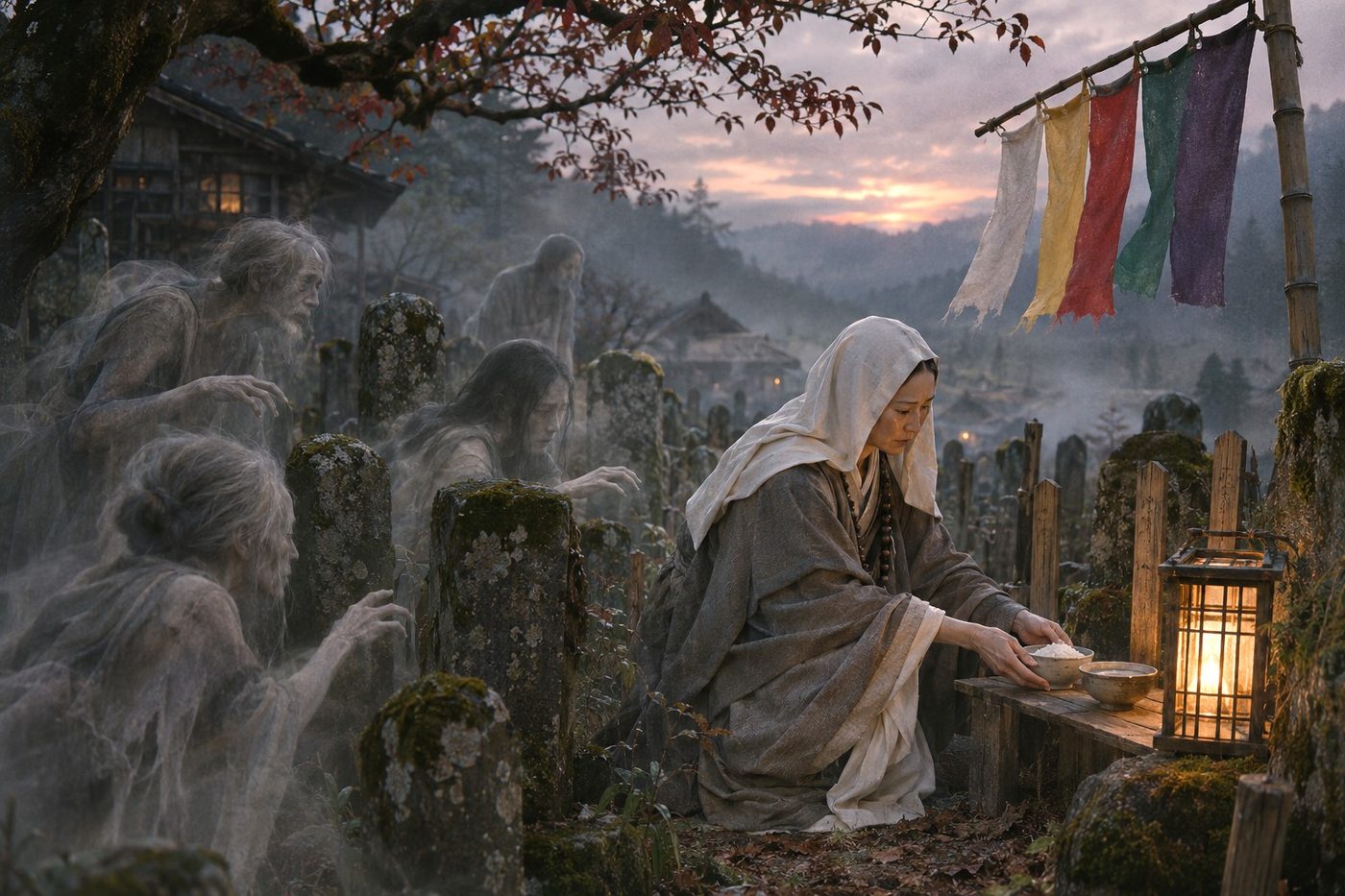
Rank: Novice Power Points: 3 Range: Smarts Duration: Instant (see below) Trappings: Rice and water set on a shelf for the dead, a banner of five colors, a sutra chanted aloud, water sprinkled from a pine sprig.
The gakushō offers food and the teaching to the hungry dead. Many of the restless dead are trapped by hunger, for food, for revenge, or for the rites no one performed, and a little of what they crave quiets them.
The target must be one of the restless dead. It makes a Spirit roll, at –2 if the caster got a raise. Hungry ghosts (gaki) and corpse-eaters (jikininki) subtract another 2. If an Extra fails, it's pacified for the rest of the scene: it stops attacking, drifts away from the living, and doesn't return unless it or one of its kind is attacked. If a Wild Card fails, it's Shaken and can't attack the caster on its next turn.
Segaki doesn't affect the living, demons, or yōkai that were never human.
Modifiers
- Additional Recipients (+1): The power affects one more target for each additional Power Point.
- Area Effect (+2/+3): The power affects all the restless dead in a Medium Blast Template for +2, or a Large Blast Template for +3.
- Release (+2): This modifier needs an hour-long rite with food and water offered (Ritual Magic, FC p. 112). An Extra that fails its roll passes on to its next life and never returns. A Wild Card is released only if what holds it in this world is put right first (GM's call). The great rites for whole fields of the dead are in Part 4.
Calling Down the Kami (Kami-oroshi, 神降ろし)#
Rank: Novice, Seasoned, or Veteran (see below) Power Points: 3, 5, or 10 (see below) Range: Smarts Duration: One scene Trappings: A sacred dance with a cluster of bells, a sakaki branch held high, the wand shaken over an altar, three blasts on a conch, a written invitation burned on a brazier.
The caster invites a kami, or its messenger, to come and listen. Nothing binds it. A kami comes as an honored guest, hears what the caster asks, and leaves when it chooses. A Touched or worse caster can't use this power at all (Chapter 4).
| Rank | Cost | Who comes |
|---|---|---|
| Novice | 3 | A messenger: one of a kami's sacred beasts, such as a fox, a crow, a deer, or a white snake. It carries one message to a kami or a shrine within a day's walk, answers one simple question about the place where it lives, or leads the caster there. |
| Seasoned | 5 | The kami of this place: the kami of a spring, a grove, a crossroads, a well, a rock, or a village. It knows what has happened there and may help in the ways its nature allows. |
| Veteran | 10 | A great kami: the kami of a mountain, a great river, a stretch of sea, or a province. It comes only at its own shrine, on its festival day, or where its power is strongest (GM's call). |
The bargain. Once the kami arrives, the caster makes their request and rolls Persuasion or their arcane skill, whichever is higher.
- Modifiers: +1 for a good offering (sake, rice, or cloth worth at least 50 mon), +2 for a lavish one (500 mon or more, a fine sword, or a horse). –2 if the request goes against the kami's nature, and –2 if the caster or their companions have offended this kami before.
- Failure: The kami declines and departs.
- Success: The kami grants one favor, and names its price: an offering, a festival, a shrine repaired, a task done, or a Minor Vow kept for a season.
- Raise: As success, but the price is small, or the kami asks nothing.
Favors. A kami may answer one question truthfully (as divination), activate one power from its nature for the caster at no Power Point cost (Seasoned and Veteran only, using the caster's Rank), calm or stir the weather over its own ground for the scene, reveal something hidden in its place, or add +2 to one roll the caster makes there. A great kami may do more, as the GM allows.
An unpaid price. A kami that isn't paid is angry. The caster suffers the Bad Luck Hindrance (SWADE p. 22) until they make amends, and the GM may add a curse of the kami's choosing (curse, FC p. 121) on its own ground.
Critical Failure. The caster rolls on their path's Critical Failure table, and the kami's rough spirit (aramitama) wakes: the kami is offended, as above.
Paths. Kannagi and yamabushi call any kami. An onmyōji calls only the gods of the directions, the stars, and the calendar, the powers their almanacs track: the god who wanders the eight directions and must not be faced, the general of the year's unlucky quarter, and the stars of fate. These gods answer an onmyōji's invitation, written on paper and burned. They grant favors of fortune, direction, and timing, and they don't bless fields or calm the sea. Gakushō, sōhei, and the yamabushi's Buddhist side use Calling the Guardians instead.
Calling the Guardians (Shōshō, 召請)#
Rank: Novice, Seasoned, or Veteran (see below) Power Points: 3, 5, or 10 (see below) Range: Smarts Duration: One scene Trappings: A mantra repeated on prayer beads, a hand seal for each guardian, incense lit before an image, a fire of prayer sticks, a sutra scroll unrolled toward the danger.
The buddhas are beyond the world and don't come when called (Part 1). Their guardians do. A monk who has taken the Law into themselves invites a guardian to the place of the rite, and the guardian answers out of compassion, not for payment. A Touched or worse caster can't use this power (Chapter 4).
| Rank | Cost | Who answers |
|---|---|---|
| Novice | 3 | An attendant: one of the boy attendants (dōji) who serve the wrathful kings, or a lesser guardian spirit of the temple. It acts as a Spirit Servant (summon ally, FC p. 138) of the caster's Rank for the scene, carries a message to a temple within a day's walk, or guides the caster. |
| Seasoned | 5 | A guardian's presence: a heavenly general or one of the protectors of the Law, felt more than seen. It answers one question truthfully (as divination), or activates one power from the caster's list for them at no Power Point cost, using the caster's Rank. |
| Veteran | 10 | A wrathful king's shadow: the Immovable King or one of his fellow wisdom kings appears in flame for a moment. Every demon, restless dead, and evil yōkai in a Large Blast Template centered on the caster makes a Spirit roll or flees for the rest of the scene. Wild Cards that fail are Shaken instead. The guardian may do more in dire need, as the GM allows. Only before the guardian's image in a hall, at a sacred fire, or when innocent lives are at stake. |
The request. The caster asks, and rolls their arcane skill.
- Modifiers: +1 if the request protects the helpless or the Law, and –2 if it serves the caster's own gain. A request to harm the innocent always fails.
- Failure: No one answers.
- Success: The guardian helps as above.
- Raise: As success, and the guardian stays an extra scene, or the next use of this power before the next dawn costs 2 fewer Power Points.
Thanks. Guardians don't bargain, but they expect thanks. Within a day, the caster spends an hour reciting sutras or copying one in thanks. If they don't, they subtract 2 from rolls for this power until they do.
Critical Failure. The caster rolls on their path's Critical Failure table, and the guardians turn away: the caster can't use this power again until they atone by copying a sutra in Downtime (Part 1).
Kami Riding (Kamigakari, 神懸かり)#
As Aspect of the Rada Loa (HC p. 73), with these changes:
- Who rides: a kannagi's own kami, or for a yamabushi, the kami of the mountain where they trained (choose Mountain and Forest, Thunder and Storm, or Fire and Forge). Only one kami rides the caster at a time.
- Effects: use the kami's nature from the table below instead of the loa. As in the original, every benefit gains +1 if the caster got a raise.
- Manner: while ridden, the caster speaks in the kami's voice and takes on its temper. Anyone who sees it knows a kami is present.
- Pollution: a Touched or worse caster can't be ridden.
| Kami nature | Benefit |
|---|---|
| Mountain and Forest | Free reroll on Athletics and Survival rolls. Ordinary animals won't attack the caster unless harmed. |
| Sea and River | As Agwé: mastery of the water (HC p. 73). |
| Rice and Harvest | As Damballa: free reroll on Vigor rolls, and on Wealth or haggling rolls (HC p. 73). |
| Sun | Free reroll on Spirit rolls, including Fear checks. The caster sheds light like a lantern out to a Medium Blast Template. |
| Moon and Night | The caster ignores Illumination penalties, and has a free reroll on Notice and Stealth rolls. |
| War | Free reroll on Fighting and Intimidation rolls. |
| Learning and Writing | Free reroll on Academics, Occult, and Persuasion rolls. |
| Ancestors and the Dead | As Baron Samedi: one of the restless dead that moves adjacent to the caster makes a Vigor roll or is Stunned (HC p. 73). |
| Fire and Forge | The caster takes no damage from ordinary fire and heat, and has a free reroll on Repair rolls. |
| Thunder and Storm | Free reroll on Athletics and Intimidation rolls. The caster's voice carries like thunder for a mile. |
| Snow and Winter | The caster takes no damage or Fatigue from cold, and has a free reroll on Survival and Stealth rolls. |
Powers for Villains#
These powers exist in the isles, but only villains use them. A hero who learns one breaks the law, the precepts, or both. Each still gets an island name, for the GM's use.
| Island name (power, source) | Who uses it |
|---|---|
| Call the Oni (summon demon, HC p. 82) | Tengu-taught sorcerers and fallen monks |
| Call the Yōkai (summon monster, FC p. 140) | Tengu-taught sorcerers, witches with familiar spirits |
| Bad Dreams (nightmares, HC p. 78) | Rogue onmyōji, curse-sellers |
| Raise the Restless (summon undead, FC p. 141) | Necromancers, the angry dead themselves |
| Return Blow (spite, HC p. 80) | Sorcerers and demon-pact warriors |
| Ride the Wind (fly, FC p. 127) | Tengu and those they teach |
| Possession (puppet, FC p. 134) | Foxes and other possessing spirits, as the GM's creatures only (Chapter 12). No hero or villain path learns it. |
| Walking Corpse (zombie, FC p. 145) | Necromancers |
Hour of the Ox (curse) is on the onmyōji's list, since a master must understand a curse to break one. Using it is a capital crime (Part 1).
Powers Not Used#
Resurrection (dead is dead), time stop, wish, and growth/shrink don't appear in the isles. Puppet appears only as Possession, a power of foxes and other possessing spirits (above), which no hero can learn. Neither does Fury of the Petro Loa (HC p. 76), and Aspect of the Rada Loa appears only as Kami Riding.
Notes#
- Purification with wand, salt, and water, and the great purification of the Sixth and Twelfth Months, follow W. G. Aston, Shinto: The Way of the Gods (1905), and Ernest Satow, "Ancient Japanese Rituals," Transactions of the Asiatic Society of Japan (1879–1881).
- Feeding the hungry ghosts draws on Lafcadio Hearn, "Jikininki," in Kwaidan (1904), and the Bon customs in F. Hadland Davis, Myths and Legends of Japan (1912).
- Sutra Skin follows Hearn's "The Story of Mimi-Nashi-Hoichi," also in Kwaidan.
- Kami Riding and Calling Down the Kami draw on Percival Lowell, Occult Japan (1894), which describes trance possession by a kami, the questioner and the medium, and the paper wand.
- Hour of the Ox and the straw rope follow Aston, Shinto, and A. B. Mitford, Tales of Old Japan (1871).
- True Form draws on M. W. de Visser, "The Fox and the Badger in Japanese Folklore," Transactions of the Asiatic Society of Japan (1908), and Hearn, "Of Kitsune," in Glimpses of Unfamiliar Japan (1894).
Part 4: Rites, Talismans, and Spirit-Banes#
Paper, Rope, and Salt#
Most people in the isles never see a genja work a wonder. They see the wonder's leftovers: a charm ticket pasted over a farmhouse door, a brocade amulet hanging from a merchant's sash, a straw rope around a great cedar, a line of salt across a threshold after a funeral. Most of these are custom and hope. Some are real. This part gives the rules for the real ones, and for the great rites that only the strongest genja attempt.
Prices. Prices are in mon. Where this part uses a Fantasy Companion price, it converts at 20 mon to the gold piece, as Chapter 3 does.
Talismans#
A talisman is a power held in an object until someone sets it free. It uses the Fantasy Companion's Arcane Devices rules (FC p. 109) as written: the maker needs the Artificer Edge, spends an hour per power, and invests their own Power Points, which return when the talisman is used or after 48 hours. Anyone may use a talisman. Its user rolls the maker's arcane skill, or a skill that fits its form, such as Athletics for a paper charm thrown at a foe.
Each path makes talismans in its own style:
| Path | Talismans |
|---|---|
| Kannagi | Blessed amulets in brocade bags (omamori), sakaki sprigs, paper streamers cut and blessed at the altar, a bell from the shrine's cluster |
| Gakushō | Sutra slips, prayer beads, small images of a guardian king, a sacred syllable brushed on a wooden tablet |
| Sōhei | A blessed glaive cord, a guardian's name written inside a helmet, a sutra sewn into a sleeve |
| Yamabushi | Prayer sticks from the sacred fire, a knotted cord, a talisman of the mountain's tengu, a pine sprig from the high ridge |
| Onmyōji | Paper talismans (ofuda) brushed with seals and the five-pointed star, paper dolls, a slip pasted to a door or a blade |
Fresh talismans. Because a talisman's power fades after two days, a talisman is a gift, a fee, or a favor, never a shelf good. A shrine or temple with a genja in residence makes one to order for 100 mon per Power Point it holds, if the heroes are on good terms with it. Foxes, tengu, and other spirits who know talismans' worth trade for fresh ones too.
Blessed Amulets#
Most shrine amulets (Chapter 3, 5 mon) are hope and custom. A blessed amulet is made by a kannagi or gakushō who truly reaches the kami or the Law, and it has a small real power. It isn't an arcane device and needs no Artificer Edge, only a genja's prayers over it at the New Year.
Blessed amulet (omamori), 100 mon. Each amulet serves one purpose, chosen when it's bought: safe travel (Riding or Boating), good health (Vigor rolls against disease and poison), success in study (Academics), victory (Fighting in a duel), safe childbirth, or protection from fire. Once per session, its owner adds +1 to one roll of that kind after rolling. Only one blessed amulet works for a hero at a time. It stops working when the owner is Defiled (Chapter 4), and it's returned to the shrine to be burned at the New Year.
Permanent Talismans#
A genja with the Artificer Edge can make a permanent talisman, one that doesn't fade and doesn't hold their own Power Points, using the Fantasy Companion's Crafting Magic Items rules (FC p. 169). Use its costs at 20 mon to the gold piece. The workshop is a Talisman Workshop (see The House, below), a great shrine's office, or a temple's sutra hall. Permanent talismans are rare and valuable, and most of them become heirlooms (Part 5).
Spirit-Banes and Seals#
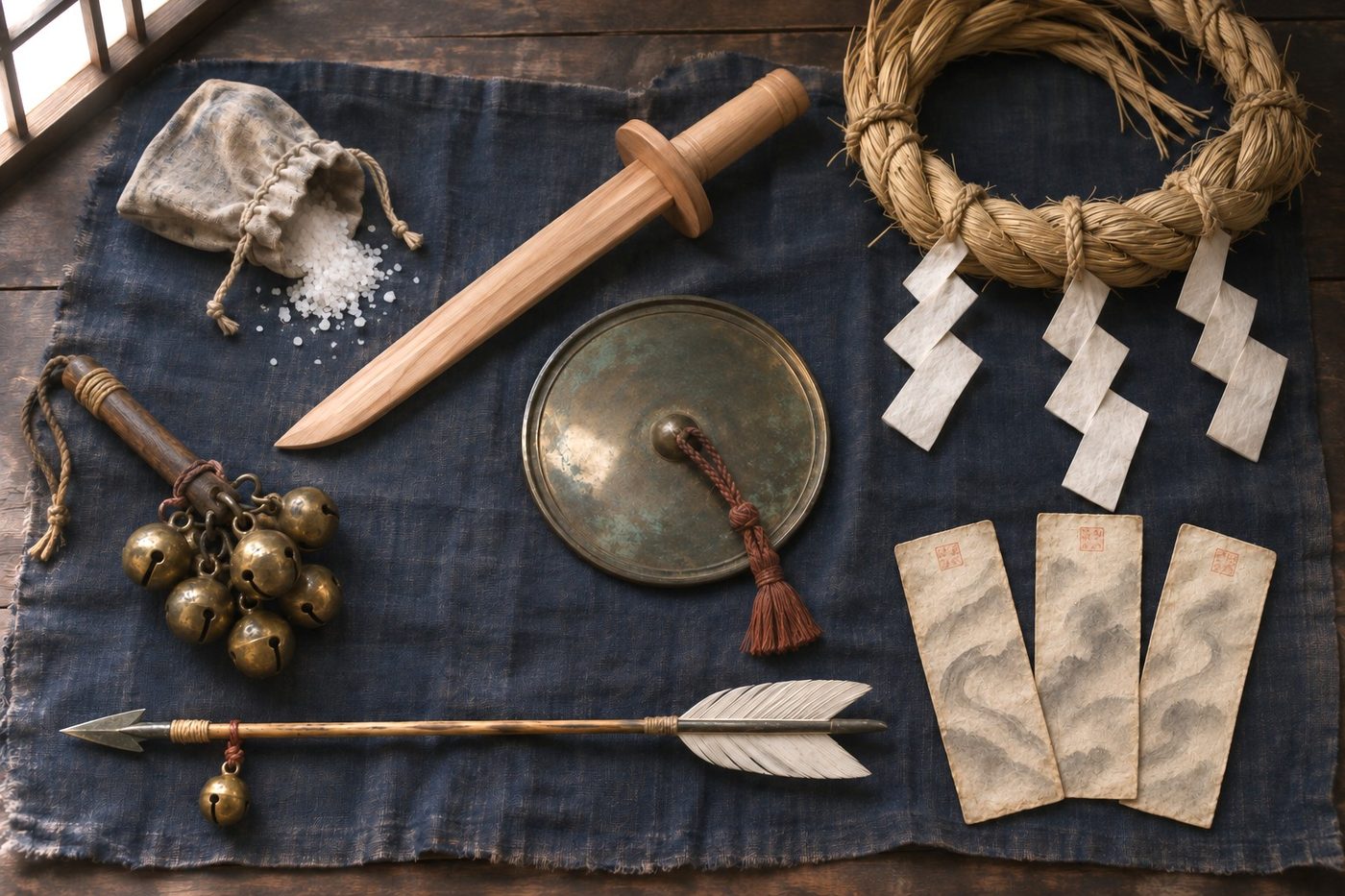
The isles have their own spirit-banes. Silver, cold iron, and holy water aren't known here. Where a creature's weakness names one of those, the Bestiary gives an island bane instead.
Wards#
Spirit-banes use the Horror Companion's Wards rules (HC p. 48). A spirit that wants to attack someone holding the right ward, or to cross a threshold protected by it, makes a Spirit roll at –4. Anyone with Occult may roll to recall the ward for a common creature.
| Spirit-bane | Wards against | Price |
|---|---|---|
| Salt | The restless dead and impure spirits. A line of salt guards a threshold after a funeral. | 5 mon a pouch |
| Peach wood | Demons (oni) and the dead of Yomi, whom the first god drove back with peaches. A peach-wood charm, a peach-wood sword, or the fruit itself. | 50 mon a charm or sword |
| A bronze mirror | Shapeshifters. A fox, a badger, or any spirit in borrowed shape shows its true form in the mirror's face, and it makes the Spirit roll to come near one held toward it. | 200 mon |
| A demon-breaking arrow (hamaya) or a twanged bowstring | Evil spirits and the demons of sickness. Arrows are sold at shrines at the New Year; palace guards twang their bowstrings at night. | 20 mon an arrow |
| Iris and mugwort | Evil spirits entering a house, when hung at the eaves in the Fifth Month. | 2 mon a bundle |
| Bells | Wandering spirits and the restless dead. The sound calls the kami and sends lesser spirits away. | 30 mon a cluster |
| A sacred rope (shimenawa) | Anything polluted or impure crossing into the space it bounds. | 20 mon a length |
| Sacred spring water | Demons and impure yōkai. It takes the place of holy water wherever a creature's weakness names holy water. | 10 mon a flask, from a shrine's sacred spring |
| Sutras written on paper or skin | The restless dead. See also Sutra Skin (grave shroud, Part 3). | Only from a gakushō |
Seals#
To trap a spirit, the isles use seals instead of binding circles, with the Horror Companion's Binds rules (HC p. 49) and one change: in the isles, seals hold ghosts, spirits, and yōkai as well as demons, unless the GM decides a particular being is too great. The four kinds of binding circle become:
| Seal | Made with |
|---|---|
| Hasty | A line of salt, or a slip of paper pasted on a doorway |
| Standard | A sacred rope hung with paper streamers |
| Elaborate | A rope, four paper talismans at the corners, and a sutra or prayer read over it |
| Custom | A seal written with the spirit's true name, or with something it owned in life |
Breaking a seal is easy for anyone outside it: cutting the rope, tearing the paper, or sweeping the salt away. Many a ghost story starts with a curious servant who peeled off an old talisman.
The Great Rites#
The greatest works of the genja are rites, not powers. They take hours, cost a fortune in offerings, and often need many hands.
Ritual Magic#
Great rites use the Fantasy Companion's Ritual Magic rules (FC p. 112), with these changes:
- Offerings are the components. The components are sake, rice, cloth, paper, incense, and the fees of the priests, musicians, and dancers who assist: 2,000 mon per Power Point for a power the leader knows, or 3,000 mon per Power Point for one they've learned only from a ritual scroll. A lord, a village, or a temple often pays.
- The leader's arcane skill. A genja leads the rite with their arcane skill if the power is on their path's list, whether they know it or not, as the Companion allows. Anyone else uses Occult.
- Assistants. Up to four others may help the leader with Support rolls each round (SWADE p. 106): priests chanting, a shrine maiden dancing, a drummer, or a lord making the offerings in person.
- Shrine Favor. A great rite performed for a domain, successful or not, counts as the Honor the Kami action for that season (Chapter 5).
Cleansing a Place#
Profane ground (Chapter 4) can be cleansed only by a rite. The Rite of Cleansing a Place is a ritual of harai with the area enhancement (Ritual Magic, FC p. 112): a radius of 50 yards for +3, or 100 yards for +5, or a building, a ship, or a village street of about that size.
- Success: the place is no longer Profane Ground. It's ordinary ground again.
- Raise: as success, and the place counts as Consecrated Ground (HC p. 41) for a year and a day.
- The restless dead first. If restless dead haunt the place, the rite fails until they're released (segaki with Release, Part 3) or their grievance is settled.
- Failure or Critical Failure: the offerings are spent, and the restless dead, if any, attack the rite.
The Rite at Akahara#
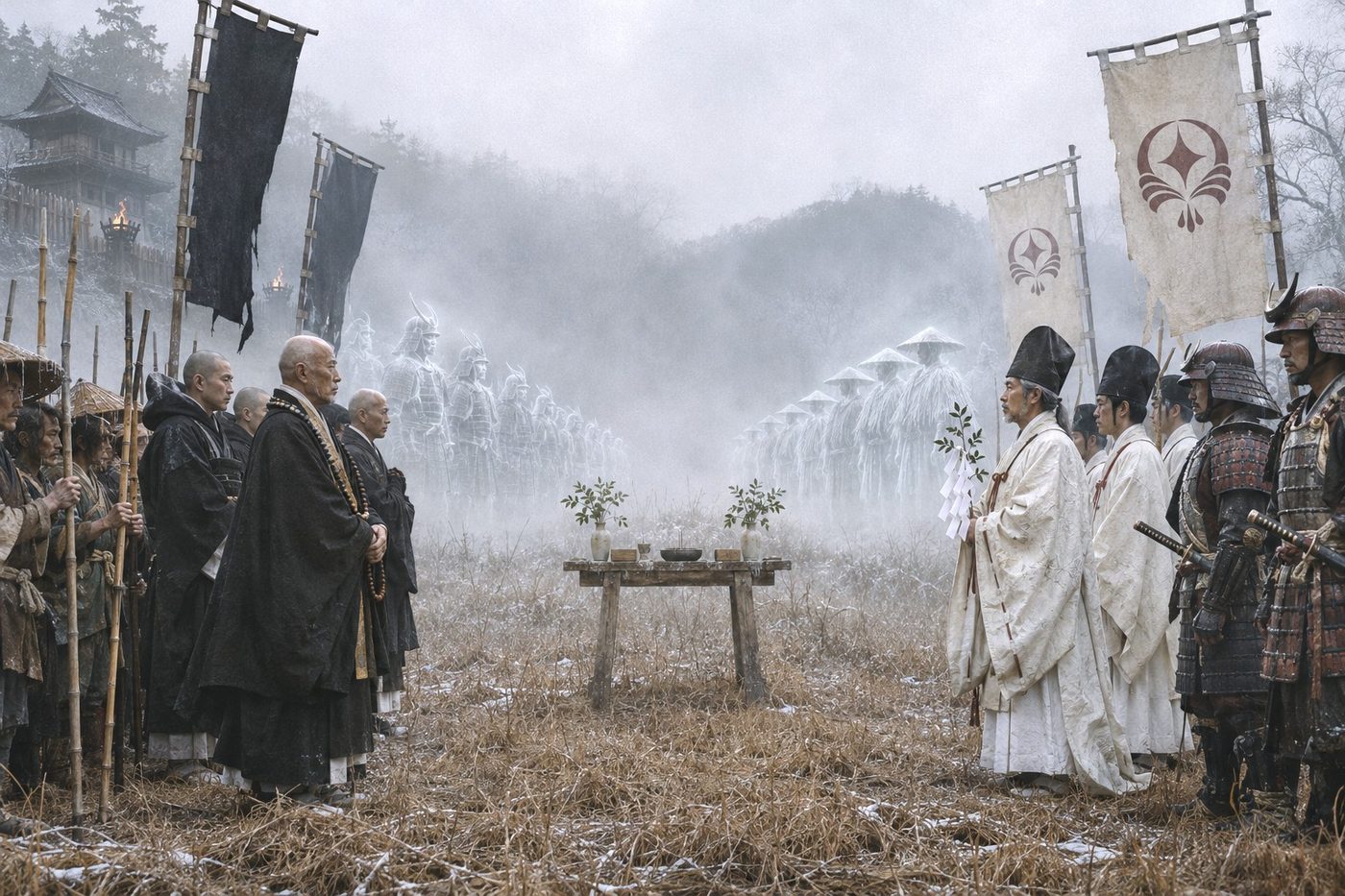
Akahara's dead (Chapter 8) were never purified, and they stand in two lines in the fog, the League's dead on one side and the Amanuma dead on the other. They're bound by hatred as well as by neglect. Each side's dead accept offerings only from their own people. To release them, the heroes must cleanse Akahara with both sides present:
- Two leaders of the rite. One genja leads for each side, perhaps a gakushō of the League's temple and a kannagi of the Amanuma castle shrine. They take turns rolling for the rite's Dramatic Task, and each round's roll counts only if both sides' offerings are on the altar.
- The dead must be seen. A representative of each side, someone of rank, must speak the names of the dead their side left behind. The League keeps the names in its temple's book of the dead. The Amanuma never wrote theirs down, and recovering them from the castle records, the old soldiers, and the widows is an adventure.
- If one side is missing, the dead of the absent side attack the rite at the end of each round, and the rite can't succeed.
- If the rite succeeds, the fog lifts, the two lines of the dead bow to each other and fade, and Akahara becomes ordinary ground. The GM's Section tells what else follows.
The Field of a Thousand Graves#
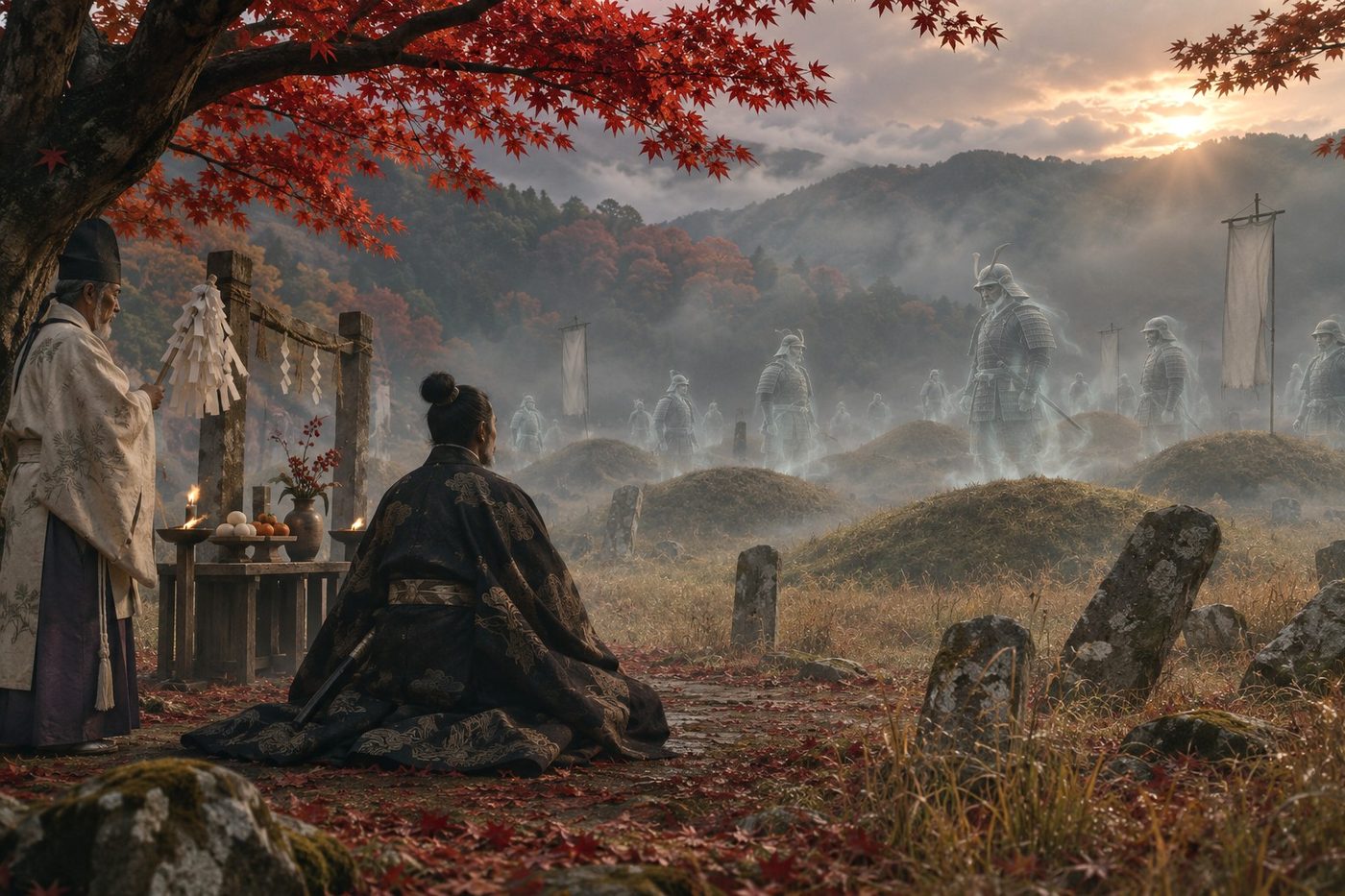
In the hills of Momiji (Chapter 8), the dead of the Minazuki Return refight their battle every autumn night. They're warriors, and the rumor is true: they fight for whoever cleanses their field. Whoever leads the rite chooses one of two endings before it begins.
- Release. The rite is a great segaki with Release (Part 3) followed by the Rite of Cleansing a Place, using the 100-yard enhancement, with one rite for each part of the valley. When it succeeds, the dead pass on. The field becomes ordinary ground, the domain marks a Shrine Favor box, and every hero who took part gains 1 Honor for an act of piety.
- Service. The rite feeds the dead but doesn't release them, and the leader asks them to fight once more. In the next battle fought on or within sight of the field, the army that holds their oath adds 2 Force Tokens of ghostly warriors (Mass Battles, Chapter 5), and the enemy subtracts 1 from its Morale rolls as the dead rise from the mounds. After that battle, the dead must be released within a season, or they turn on the lord who bound them: every Clubs event in that domain is a Curse (Chapter 5) until they're released, and the lord gains the Haunted Hindrance.
The Rites of War#
Lords take genja to war. Shrine priests pray for victory before the march, warrior monks chant at the front, and onmyōji choose the hour of the attack. Chapter 5's Mass Battles use these rules.
Before the battle. A genja may lead a prayer for victory before the first round: an hour of rites and offerings worth at least 500 mon. They roll their arcane skill. On a success, the commander adds +1 to the first Battle roll (+2 on a raise). On a Critical Failure, the omens are bad, and the army subtracts 1 from its first Morale roll. An onmyōji who reads the hour for the attack (Part 2) instead lets the commander reroll the first Battle roll.
During the battle: as a warrior. Any genja may make a Support roll with their arcane skill, chanting, praying, or burning talismans at the front, as the core rules describe (SWADE p. 132).
During the battle: War Rites. A genja with the War Rites Edge (Battle Magic, FC p. 110) may instead work a power over a whole company, using the Companion's Battle Magic rules (+5 Power Points, a Range of 100 yards, and a penalty for the number affected: –2 for a band of up to 50, –4 for a company of up to 250, –6 for up to 500). In Chapter 5's terms:
- Powers that strengthen (boost Trait, deflection, protection, smite, warrior's gift, and others the GM allows): on a success, the commander adds +1 to this round's Battle roll, +2 on a raise.
- Powers that harm or hinder (blast, bolt, burst, fear, havoc, stun, and others the GM allows): on a success, the enemy subtracts 1 from this round's Battle total, 2 on a raise.
- Unbinding (dispel): a genja may oppose an enemy genja's War Rite this round. Make opposed arcane skill rolls. If the defender wins, the enemy's War Rite has no effect.
- Critical Failure: the genja rolls on their path's Critical Failure table, and their army loses its bonus from rites for the rest of the battle.
A battle is a bloody fight for genja too. Every genja who fights in one gains a step of pollution as Chapter 5 describes, and kannagi feel it most.
The House: Talisman Workshop and Diviner's Hall#
The Heroes' House (Chapter 5) left two upgrades for this chapter.
- Talisman Workshop (Magical Workshop): a room with brushes, cinnabar, a writing altar, and a small shrine. It counts as a Standard workshop for making permanent talismans (FC p. 169), with no weekly fee for the house's founder. Taken a second time, it counts as a Grand workshop (+2).
- Diviner's Hall (Wizard's Tower): requires the Scroll Archive. A diviner joins the house, an onmyōji, an old kannagi, or a temple's master of lots, who keeps the calendar, warns of ill-starred days, and helps protect the house. Once per adventure, the house's founder may ask the diviner one question as though by divination. A hero who Trains an arcane skill here gains the Companion's bonus for the Wizard's Tower, for any path.
Downtime#
Chapter 4 left two Downtime activities for this chapter.
- Enchant (FC p. 78). Used as written: Crafting permanent talismans at a workshop (FC p. 169).
- Research (FC p. 78, HC p. 40). The powers part is used as written. A genja who spends a Downtime in a temple library, a shrine's archive, or a master's scroll room may use any power from their path's list of their Rank or lower for one encounter, or change a power's trapping for one encounter.
Notes#
- Peaches against the dead of Yomi, the straw rope, salt, and the demon-breaking bow follow W. G. Aston, Shinto: The Way of the Gods (1905).
- The Three Great Rites (boiling water, walking on fire, and the ladder of sword blades) follow Percival Lowell, Occult Japan (1894).
- Sacred mirrors draw on F. Hadland Davis, Myths and Legends of Japan (1912).
- Sutras written on the body follow Lafcadio Hearn, "The Story of Mimi-Nashi-Hoichi," in Kwaidan (1904).
Part 5: Relics and Treasures#
Heirlooms, Not Loot#
In Tsurugishima, a magic sword isn't something found in a dragon's hoard and sold at the next town. It has a name, a smith, a lineage of owners, and usually a grudge. A family that owns one keeps it in a lacquered box in the fireproof storehouse, brings it out at the New Year, and values it above a castle. Giving one away is a gift a lord remembers for generations. Stealing one starts a feud.
Rarity. Magic treasures are rare. Most heroes see one or two in a whole campaign. The GM uses the Fantasy Companion's treasure rules (FC pp. 149–169) sparingly, and gives treasures names and histories.
Prices. Treasures are almost never for sale, but the GM may need their value for gifts, ransoms, and rewards. Use the Fantasy Companion's prices at 20 mon to the gold piece (Chapter 3). A blade with +2 Fighting (FC p. 152) is worth 160,000 mon, the yield of a manor of 160 koku, which is about right: such blades are traded for fiefs.
Cursed treasures. Cursed items follow the Fantasy Companion (FC p. 150): only Unbinding (dispel) with the Disenchant modifier removes one, with one try per caster per item.
Companion Treasures in Island Dress#
When the GM rolls on the Fantasy Companion's Magic Items table (FC p. 151), use these island forms:
| FC result | In the isles |
|---|---|
| Exploding Stone | Thunder pebble, a black stone from a lightning-struck peak |
| Luck Stone | Lucky coin, an old coin with a square hole, worn smooth |
| Power Stone | Spirit jewel, a comma-shaped bead of jade or agate |
| Table A: Armor | Lacquered armor: a corselet, a full suit, or a helmet with a famous crest |
| Table B: Shield | Blessed shoulder guards (sode), the broad plates that served samurai as shields, giving the same Parry bonus |
| Table C: Melee Weapon | Roll the weapon type from Chapter 3's weapons instead: a long sword, short sword, glaive, spear, or great sword |
| Table D: Ranged Weapon | A bow, or rarely a matchlock. No crossbows. |
| Table E: Arrows | Arrows from a shrine or a famous fletcher |
| Table F: Jewelry | A hairpin, a comb, prayer beads, a sword guard, or a carved toggle (hyōtan or magatama shape) |
| Table G: Potions | Medicines: pills, powders, and decoctions from a temple dispensary or a mountain ascetic |
| Table H: Scrolls | Ritual scrolls or a sheaf of talismans |
| Table I: Tomes | Teaching scrolls (see Secret Scrolls, below) |
| Table J: Wondrous Item | Roll on Lesser Treasures of the Isles, below, on a 1–3 on a d6; otherwise use the Companion's table in island dress |
Lesser Treasures of the Isles#
These are the small wonders of folk tales. Each uses the Fantasy Companion's rules for items that grant powers (FC p. 150): activation is an action with no Trait roll, a minor power gives a success, and a major power gives a raise.
| d12 | Treasure | Effect | Value |
|---|---|---|---|
| 1 | Straw rain cape of hiding (kakuremino) | Hidden Form (invisibility), minor power, once per day | 30,000 mon |
| 2 | Lucky mallet | Struck on the ground once a year at the New Year, it brings forth rice, cloth, and coins worth 1d10 × 100 mon. Struck at any other time, it brings forth nothing but bad luck: the striker gains the Bad Luck Hindrance for a month. | 40,000 mon |
| 3 | Kappa's ointment | A clamshell of salve, three uses. Each use heals one Wound, as Mending (healing), and sets a broken bone overnight. A kappa who gave it in thanks may give more. | 3,000 mon |
| 4 | Ever-full sake gourd | Fills with good sake each dawn, enough for a feast of ten. Kami and tengu like being offered it (+1 to the bargain in Calling Down the Kami). | 10,000 mon |
| 5 | Oiled-paper umbrella of turning | Opened, it acts as Cloak (deflection), minor power, once per day | 20,000 mon |
| 6 | Pilgrim's straw sandals | Never wear out; their wearer moves as Road (speed), minor power, once per day, and never tires on a pilgrimage road | 15,000 mon |
| 7 | Flute of the wild | Played, it acts as Beast Kin (beast friend), minor power, once per day | 15,000 mon |
| 8 | Bell of waking | Rung, it ends slumber, fox glamour, and trances within 5" (10 yards), as Unbinding (dispel) against those powers only | 25,000 mon |
| 9 | Incense of remembrance | Three sticks. Burning one with the dead person's name acts as Calling the Dead (séance), minor power | 9,000 mon |
| 10 | Mountain conch | Blown in a battle, it gives +1 to Rally the Ranks (Chapter 5). Blown in the mountains, every yamabushi within a day's walk knows where it sounded. | 10,000 mon |
| 11 | Tengu feather fan | Fanned, it acts as Storm (havoc), minor power, once per day. Tengu want it back. | 30,000 mon |
| 12 | Bronze mirror of truth | A spirit-bane against shapeshifters (Part 4). Once per day, as True Form (suppress transformation), minor power, on one creature it reflects | 40,000 mon |
The Smith Lines#
Swords in the isles are made by families of smiths who pass their names, their secrets, and their tempering methods down for generations. A sword's tang carries the smith's signature, and a connoisseur can name the line from the grain of the steel and the shape of the temper line alone (an Academics or Repair roll). Masterwork blades (Chapter 3) come from these lines, and so do most named blades.
| Line | Home | Known for |
|---|---|---|
| The Masuhiro line | The smiths' valley, Tetsugawa | Bright, hard steel and a straight temper line. Masters of the line take the name Masuhiro. The present master is the greatest smith of the age, and the proudest. |
| The Kiyozumi line | Temple forges below Thunder Peak | Glaive blades and spearheads for warrior monks, forged after fasting and prayer. The smiths are lay brothers of the temple. |
| The Kazunaga line | The northern provinces | Heavy great swords and field swords, made for the Kanemori school and the border wars. Plain to look at and almost impossible to break. |
| The Tsunesane line | Seikyō | Elegant, curved court swords for the old families, mounted in gold and lacquer. Old blades of this line are the finest gifts at court. |
| The Hidetane line | Once Kissaki-jima; ended | The Kamaeda clan's smiths. The line died with the Kamaeda at sea, and its blades are rare and haunted. |
Named Relics#
Named relics come in two kinds:
- Heirlooms are permanent magic items, built with the Fantasy Companion's item rules.
- Great relics use the Fantasy Companion's Relics rules (FC p. 168): finding one is a quest, its power is awakened by a rite resolved as a Dramatic Task at a sacred place, and after it acts it goes dormant or vanishes.
Shiogiri, the Drowned Emperor's Sword#
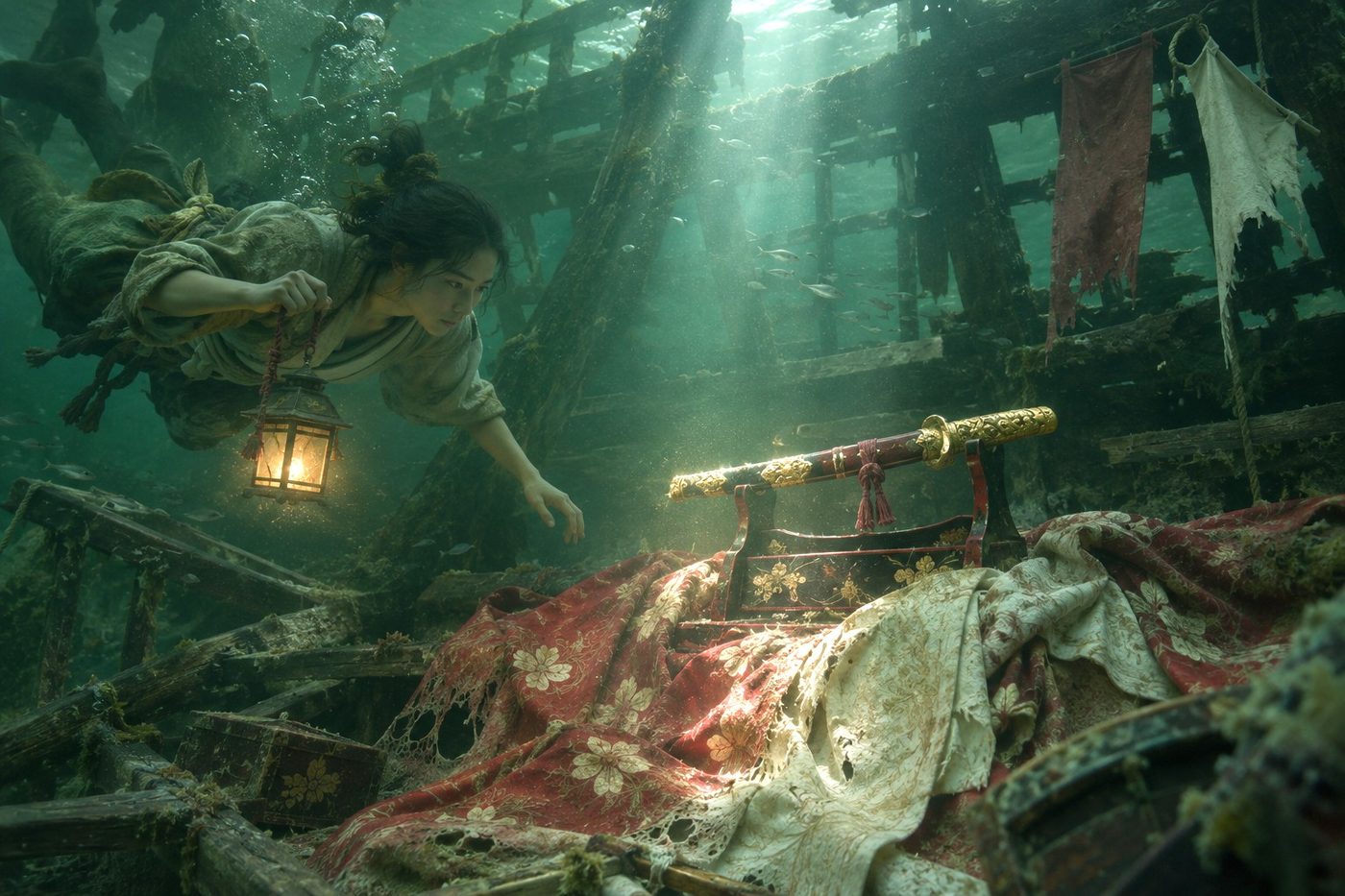
Heirloom and great relic. Long sword of the Hidetane line.
The last child-emperor of the Kamaeda wore Shiogiri ("Tide-Cutter") at his belt when his grandmother took him into the sea at the end of the Minazuki Return. It lies with his bones in the wreck of the Kamaeda flagship, off the bay of the drowned court in Shiranui (Chapter 8). Rumor says that whoever holds it can claim the throne.
- As a blade: +2 Fighting (FC p. 152). Its steel never rusts, though it has lain in salt water for four centuries.
- Among the dead: the drowned dead of Shiranui never harm its bearer or a boat that carries it, and they obey the bearer's simple commands at sea.
- As a great relic: awakened by a rite at the lantern-keepers' hall, the sword does one of two things. It can release the drowned court: every drowned ghost of the Kamaeda passes on, the ghost-lights go out forever, and the bay becomes ordinary sea. Or it can call them to war: once, in a battle at sea within sight of Shiranui's coast, the drowned rise against the bearer's enemies, who lose 3 Force Tokens at once. After either, the sword is only a fine blade.
- Who wants it: the court, which wants it buried with honor, and every red and white lord who believes the rumor. The GM's Section says who else.
Ryōdan, Master Masuhiro's Blade#
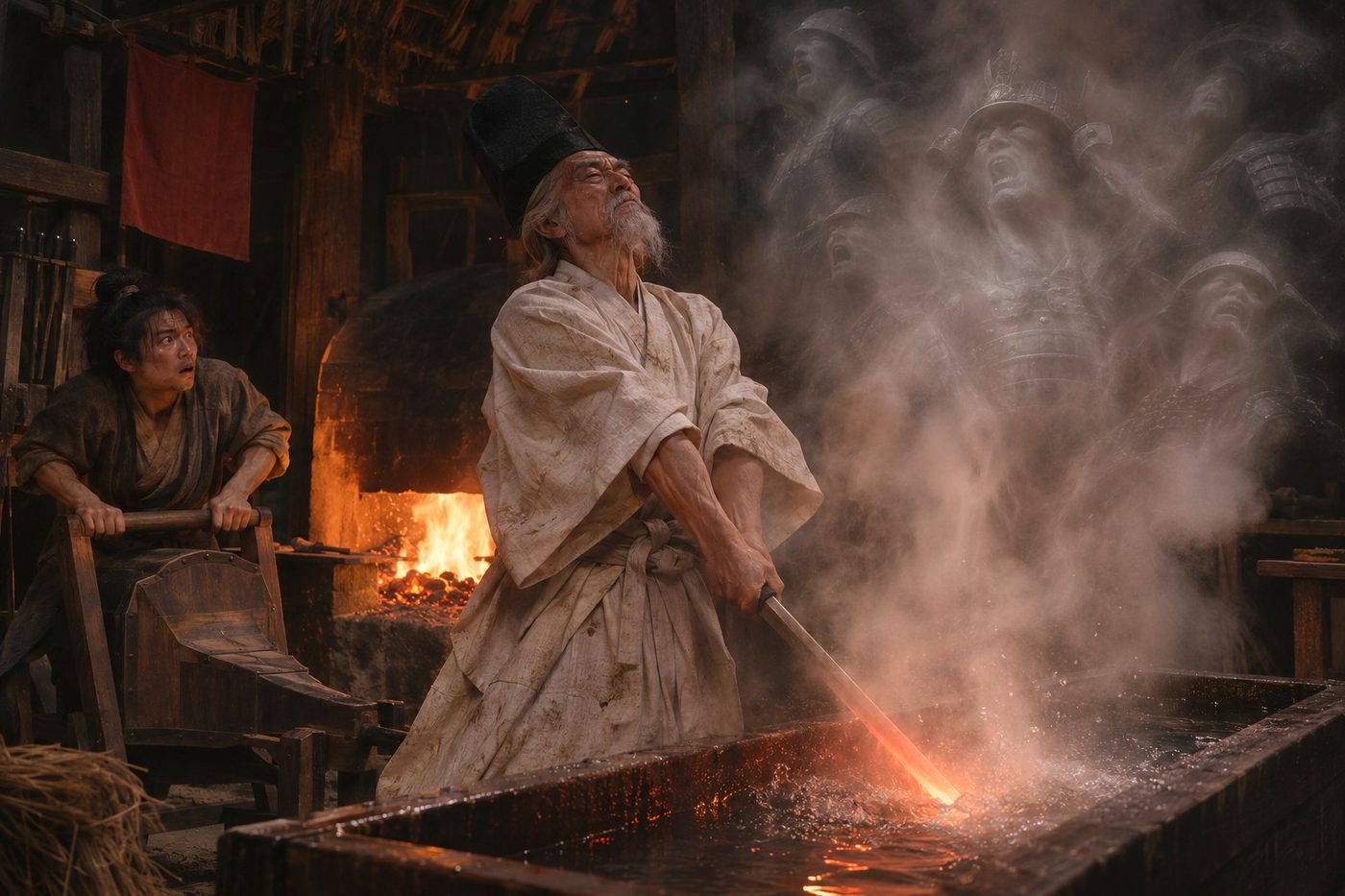
Cursed heirloom. Long sword of the Masuhiro line.
Master Masuhiro boasted that he was forging Kagamino Sadatsugu a blade to cut the Shogunate in two, and pride drove him to keep his word. Ryōdan ("Cut in Two") will be the finest sword of the age, and the smiths of Tetsugawa whisper that it is cursed.
- As a blade: +2 Fighting, and its damage die increases one step (FC p. 152).
- Cursed: once its owner has drawn it in anger, they can't part with it except by Unbinding with Disenchant (FC p. 150). While they carry it, they have the Bloodthirsty Hindrance (SWADE p. 23), and each time it draws blood they gain a step of pollution (Chapter 4), in addition to any other.
- Where it stands: when the campaign begins, Masuhiro is still forging it. The GM's Section tells what the curse is, and how it can be lifted.
The Mirror of Mizunuma#
Heirloom. A bronze mirror, a hand-span across.
The sacred mirror of the old river kami of Mizunuma Marsh (Chapter 8), stolen this spring from its island shrine. While it's gone, the blight on the marsh spreads. Who took it is answered in Chapter 9.
- A spirit-bane against shapeshifters (Part 4), at its strongest: a shapeshifter makes its Spirit roll at –6 to come near it.
- Once per day, as True Form (suppress transformation), major power, on one creature it reflects.
- Returned to its shrine, it calms the river kami; with Akahara cleansed (Part 4), the marsh clears within a season and the kappa become polite again.
The Red-Laced Armor of Minazuki#
Heirloom. A great armor laced in red silk.
The armor Minazuki Tsunetomo, the first Shogun, wore through the Minazuki Return. The Kagamino keep it at Hagane and display it at the New Year. Its loss shames the Shogunate.
- Armor +2 (FC p. 152), and its Minimum Strength is one die type lower.
- The great banner's shadow: when its wearer is the commander in a Mass Battle, the army adds +1 to its Morale rolls.
- Honor: a hero who wears it without the Shogun's leave loses 2 Honor, and every red group's Attitude toward them drops one step (SWADE p. 33).
Night Rain, the Tea Bowl#
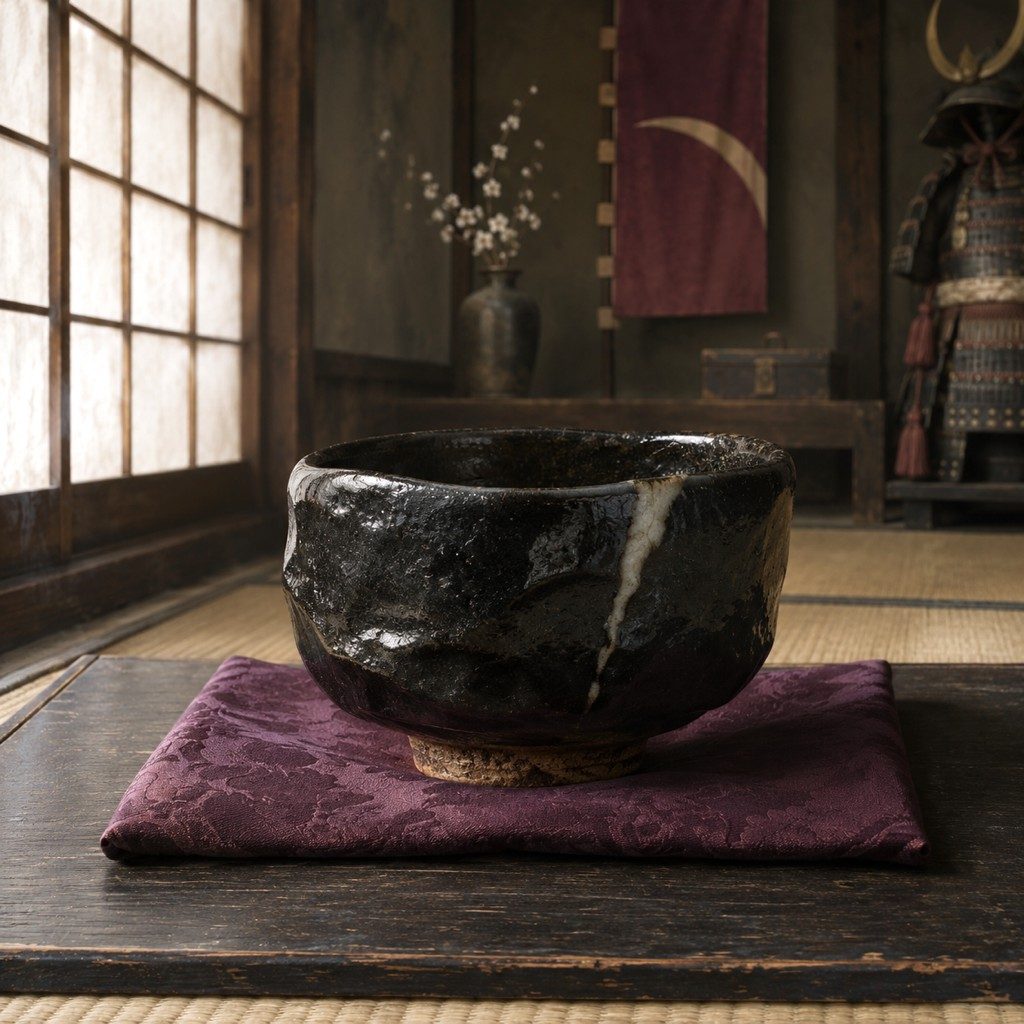
Treasure. A black tea bowl with a pale streak like rain.
A tea bowl from the mainland, crude and lopsided, that tea masters say is the most beautiful object in the realm. It isn't magical, but it's worth more than a castle.
- At a tea gathering, its owner adds +2 to Persuasion rolls with every guest who understands tea.
- As a gift, it counts as the highest reward a lord can give (Chapter 5), and the lord who receives it owes the giver a favor as large as a fief.
The Fox's Jewel#
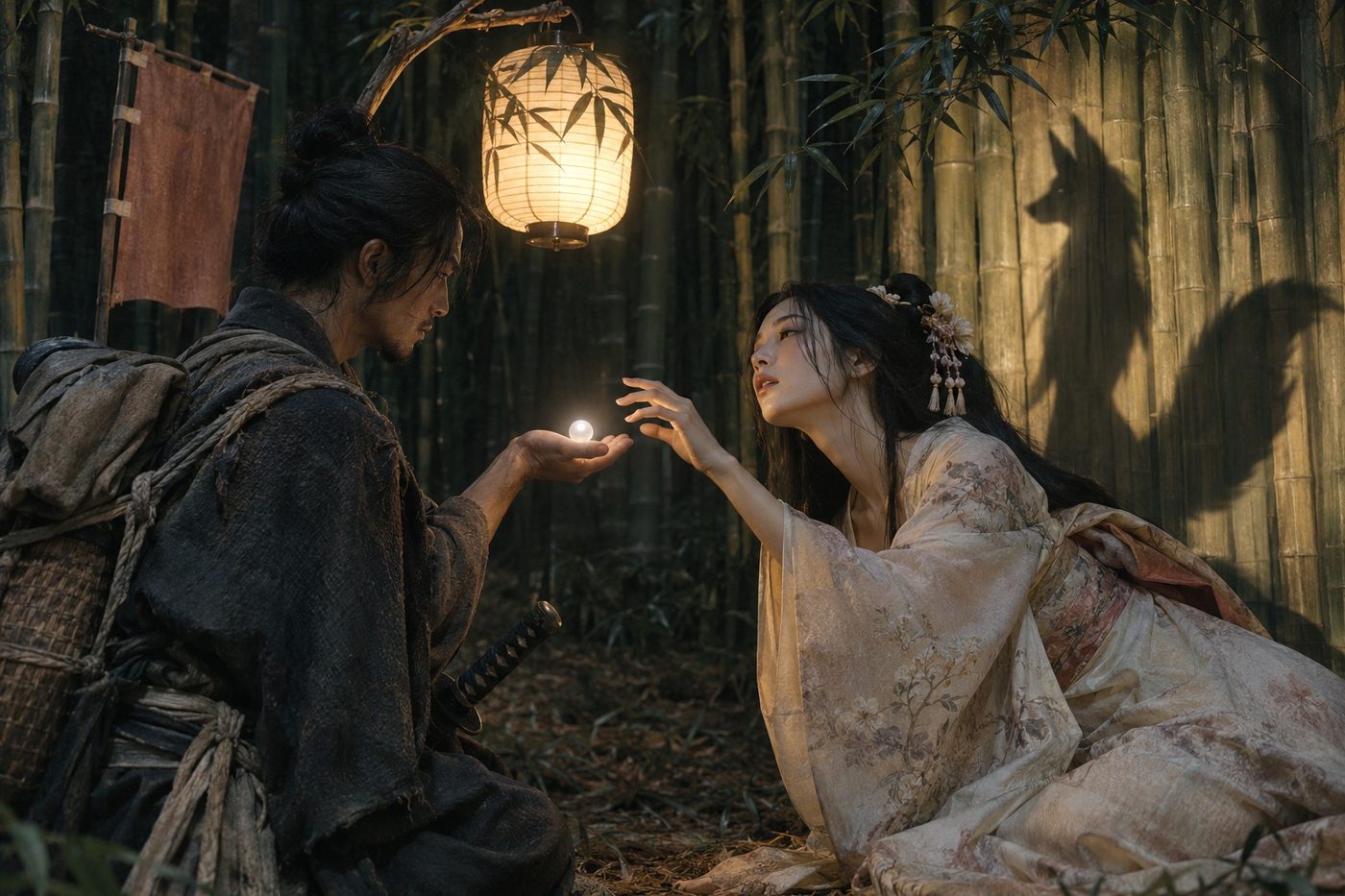
Heirloom. A white pearl that glows faintly, like a star.
Every old fox keeps its soul in a jewel (hoshi no tama). Whoever holds a fox's jewel holds the fox.
- The holder may demand one service of the fox each season, and it must obey. The fox does anything else to get its jewel back: bargain, steal, bewitch, or kill.
- Returning it freely makes the fox a grateful ally for life (and foxes live a long time).
The Thunder Peak Glaive#
Heirloom. Glaive of the Kiyozumi line.
Forged by a lay brother after a hundred days of fasting, and consecrated before the temple's guardian kings. Thunder Peak's warrior monks carry it before the sacred palanquin when they march on the capital.
- As a blade: +1 Fighting (FC p. 152).
- Burning Steel (smite), minor power, three times per day.
- Against demons, it counts as peach wood (Part 4) and adds +2 damage.
The Begging Bowl of the Wandering Saint#
Heirloom. A plain black lacquered bowl.
A saint who wandered the isles three hundred years ago carried this bowl, and fed the hungry dead from it wherever he went.
- Feeding the Hungry Ghosts (segaki) cast with the bowl gets +2 to the arcane skill roll.
- A great segaki rite using the bowl costs half the usual offerings (Part 4).
The Dragon's Rice Bale#
Heirloom. A straw bale of rice tied with a red cord.
The dragon of a great bridge gave this bale to a hero who killed the centipede that preyed on its children. The rice inside never runs out.
- Feeds a hundred people a day, forever.
- In a domain, it adds one store to every harvest (Chapter 5). Villages have fought wars over it.
The Tide Jewels#
Great relic. Two jewels, one white and one blue-green.
The ebbing jewel and the flowing jewel of the dragon king under the sea, lent to a hero of the oldest days and never returned. They lie hidden, apart, and no one living is known to know where.
- Awakened together by a rite at the water's edge, they raise the sea or draw it back for an hour: enough to drain a strait so an army can cross, or to flood one under an enemy fleet. In a Mass Battle at sea or on the shore, the enemy loses 4 Force Tokens.
- Afterward, the dragon king sends for them. Whoever used them can expect a visitor from under the sea.
- Daqian's war fleet (Chapter 8) is reason enough for the Shogun and the court to want them found.
The Undying Orange#
Great relic. A golden citrus fruit on a single leafy twig.
Fruit from the orange trees of Tokoyo, the Eternal Land (Part 1), brought back by a voyager who returned after ten years to find his emperor dead. It hasn't withered since.
- Eaten, it cures any disease, poison, or curse, ends any haunting of the eater, and cleanses them to Clean. The eater ages no further for one year.
- It doesn't raise the dead. Dead is dead.
- Its seeds, if planted at a great shrine and tended for seven years by a kannagi, might grow a tree. That's a campaign of its own, and perhaps a way back to Tokoyo (Chapter 7).
The Book of the Dead of Sekitani#
Treasure. A temple register, bound in plain paper.
The Sekitani League's temple keeps the names of every believer who died at Akahara. It has no power of its own, but the rite at Akahara (Part 4) can't succeed without it, and the League's council won't lend it to anyone it doesn't trust.
Tools That Come to Life#
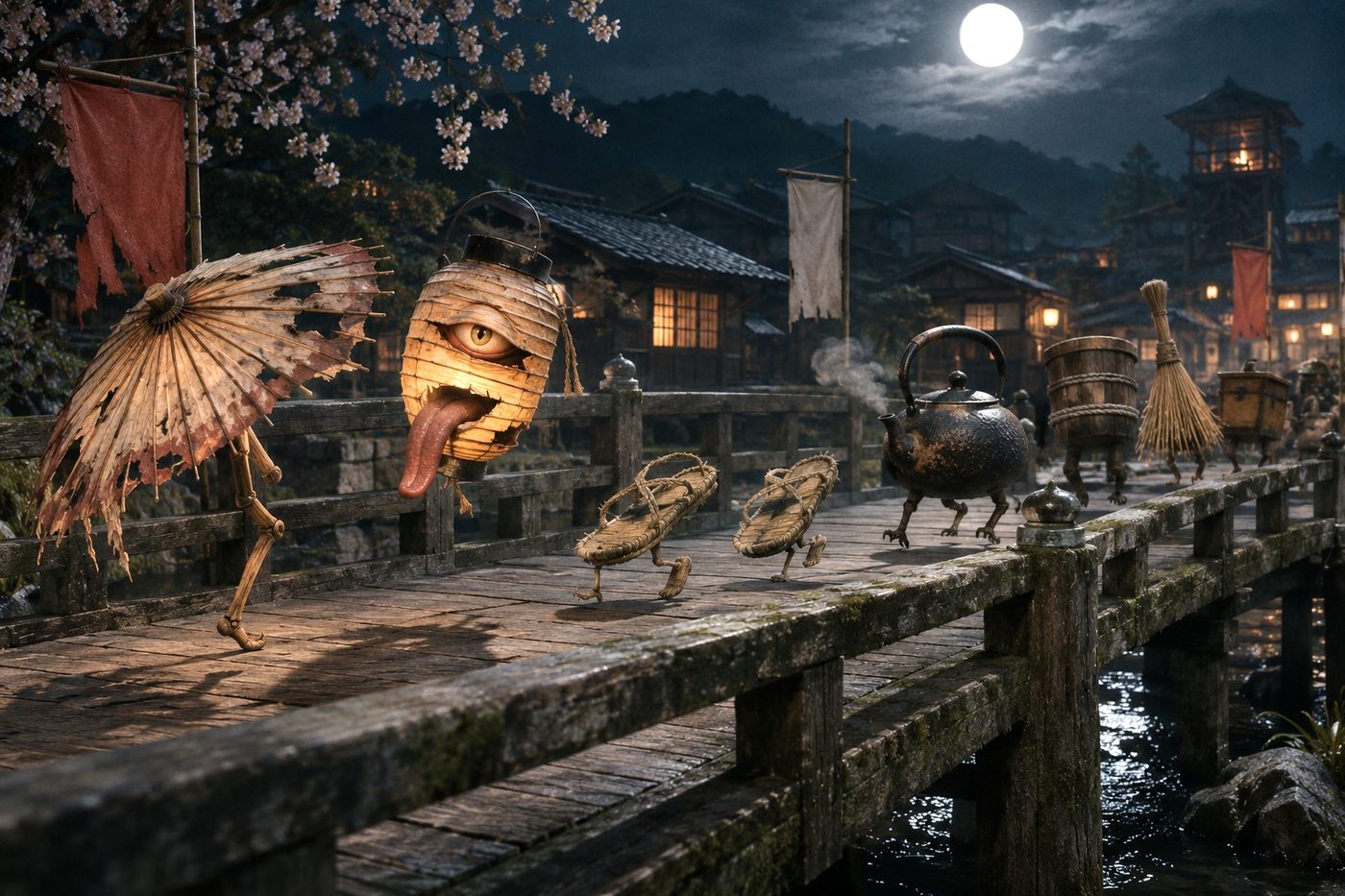
An object that reaches a hundred years becomes a tsukumogami, a thing with a spirit of its own. What kind of spirit depends on how it was treated.
- Cared for: a sword kept oiled and honored, a tea bowl used with respect, a family's armor aired and repaired every year. When such a thing passes a hundred years, a kannagi or gakushō may hold a rite for it (an hour, an offering of 500 mon, and an arcane skill roll). On a success, the object awakens, and it gains one Novice power from the genja's list as a minor power, usable once per day. Its spirit is loyal to the family.
- Neglected or thrown away: an old umbrella, a cracked lantern, worn sandals, a broken pot left in a corner. These awaken angry and become yōkai (Chapter 12). They wander at night in processions, playing tricks and taking revenge on careless owners.
Voice of Things (object reading, Part 3) used on a hundred-year-old object may get an answer from the object itself.
Secret Scrolls#
Powers of Seasoned Rank and higher are secret rites (Part 1), learned only from a teacher, a revelation, or a secret scroll.
- Teaching scrolls (Companion Tomes, Table I) hold one power each. A genja whose path has the power on its list learns it when they next take the New Powers Edge, even without a teacher. A sect, a school, or a diviner family guards its scrolls, and it treats a stolen one as a grave crime.
- Ritual scrolls (Companion Scrolls, Table H) hold a single great rite. Anyone may use one for Ritual Magic (Part 4), and it's consumed.
- Writing scrolls. A Veteran genja may write a teaching scroll for a power they know: one Downtime and 500 mon in paper, ink, and fees. Selling or giving one outside the genja's own sect is a breach of their Vow.
Notes#
- The drowned child-emperor and the haunted sea follow Lafcadio Hearn, "The Story of Mimi-Nashi-Hoichi," in Kwaidan (1904).
- The fox's jewel draws on M. W. de Visser, "The Fox and the Badger in Japanese Folklore," Transactions of the Asiatic Society of Japan (1908).
- The dragon's rice bale, the centipede, the lucky mallet, and the tide jewels of the sea dragon king follow F. Hadland Davis, Myths and Legends of Japan (1912).
- The orange of Tokoyo follows W. G. Aston, Shinto: The Way of the Gods (1905).
- The coat of invisibility and the lucky mallet also appear in William Elliot Griffis, Japanese Fairy World (1880).
- Sword fittings and the smiths' families draw on Helen C. Gunsaulus, Japanese Sword-Mounts (1923).
Part 6: The Mystic Archetypes#
One for Each Path#
The five mystic archetypes, one for each of the Five Paths (the shrine maiden, scholar-nun, sōhei, mountain ascetic, and yin-yang master), are printed once, with the other archetypes, in Chapter 3 (Archetypes). Each is a complete Novice genja built with Chapter 3's rules, who spends their free Edge on their Arcane Background. Their powers use the island names of Part 3, and Chapter 3's Parties table suggests where each fits.