Gamemaster's Section · GM only · Chapter 8
Gazetteer
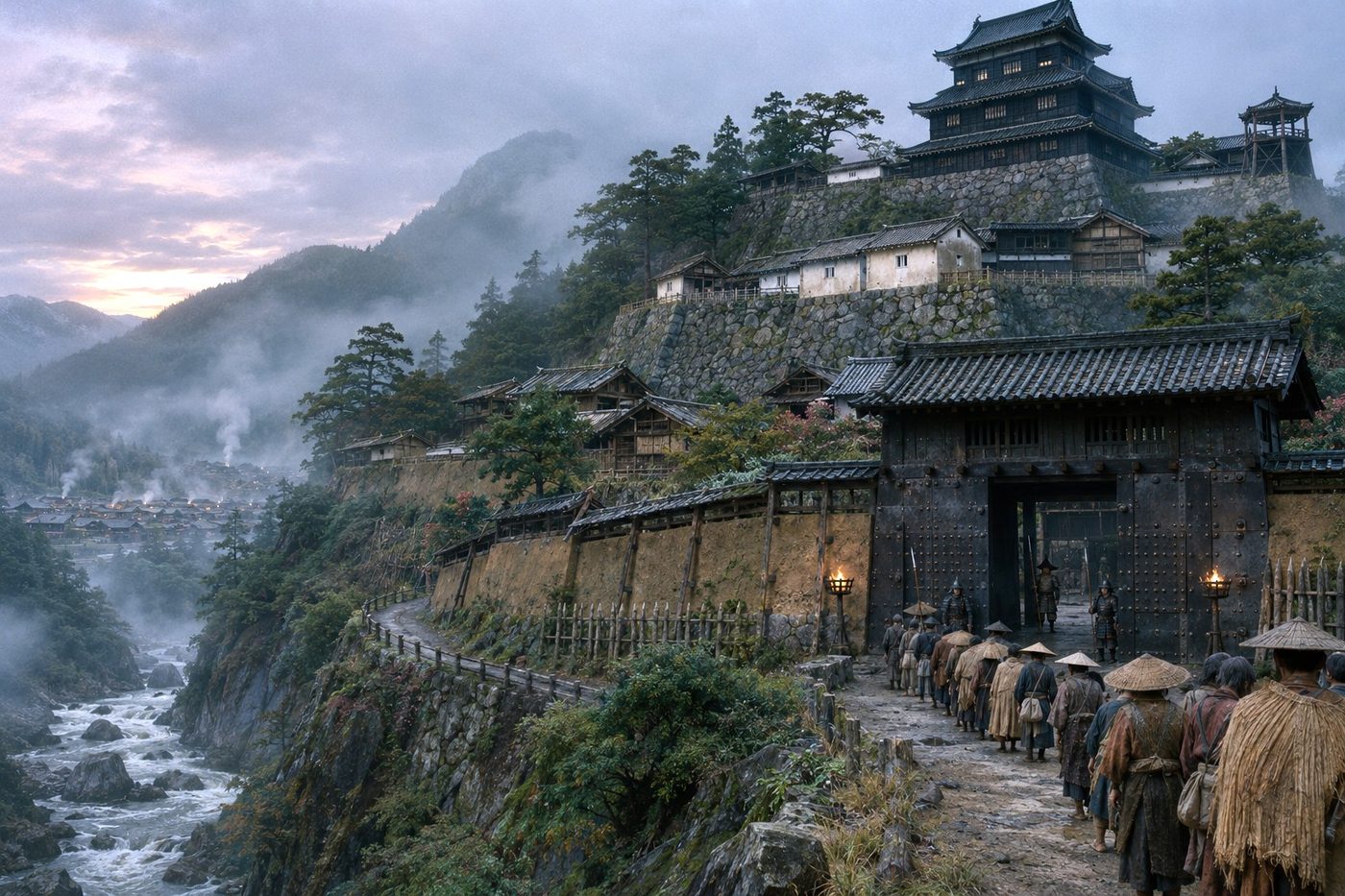
Part 1: Kurogane, the Starter Province#
The Iron Gate#
Every army that marches from the Pure Capital to the eastern plains, and every army that marches back, must pass through Kurogane. The province is a fist of black mountains between the Inner Provinces and the east, and the only good road through it climbs to Kurogane Pass. Whoever holds the pass can tax the realm's trade, close the road to the Shogun's messengers, or open it to a rebel army. Whoever holds the mines in the northern valleys can arm that army.
Three powers hold Kurogane, and none of them can drive out the other two. The Amanuma clan of the red plum holds the castle and the pass. The Kitamori clan of the white plum, a branch of the same family, holds the iron mines. The Sekitani League of Western Light farmers holds the rice valley in the Buddha's name. Around them, temples, shrines, schools, merchants, gamblers, and shinobi all play their own games, and the kami of the mountains watch and grow restless.
Kurogane is built to start a campaign. Every kind of group in Chapter 2 has a home here, every kind of hero has a reason to be here, and every power needs capable people it can't get from its own ranks. A party can serve one power, play all three, or try to break the stalemate. Whatever they do, the rest of the realm will notice, because when Kurogane falls to one side, the war of the two blossoms begins.
Using This Part#
- Kurogane at a Glance and The Lay of the Land give the province in brief.
- The Three Powers and The Other Groups describe who holds what, with a domain sheet for each power (Chapter 5).
- A Tour of Kurogane keys 20 places for the province map.
- Personalities names the people heroes meet first. Their stat blocks are in Chapter 9, and the spirits are in the Bestiary (Chapter 12).
- Running Kurogane gives ties for new heroes, the current troubles, road encounters, rumors, and an opening scene. The starter adventures in Chapter 11 begin here.
Kurogane at a Glance#
| Region | Yamaji, the Mountain Road, on Shinogi-jima |
| Neighbors | Asagiri to the west, Hōzuki to the northwest, Takane to the north, Kasumi to the east, Inazuma to the southeast, and Tatsumi to the south |
| Size | About 180,000 koku in all: Amanuma 80,000, the Sekitani League 60,000, and Kitamori 40,000 (most of it in iron, not rice) |
| Extent | About two days across on foot, from the southern border to the summit of the pass |
| Forces | About 3,600 in all, never under one banner: the Amanuma 1,600 (with a company of matchlock gunners), the Sekitani League 1,200 sworn spearmen and archers (and thousands of farmers more when the temple drum sounds), and the Kitamori 800 (plus miners who fight when they must) |
| Seat | Kurogane Castle and its castle town, in the Kusugawa basin |
| The great road | The Yamaji Road, from Seikyō east over Kurogane Pass to Kasumi and the eastern plains |
| First shrine | Hiraishi Shrine, at the summit of the pass |
| Allegiance | Split: red plum (Amanuma), white plum (Kitamori), and the third power (Sekitani League) |
| Known for | Iron, the pass toll, the draw-cut sword, and fog |
Travel times on foot: three days from Seikyō to the castle town, one day from the castle town to the pass, and about five days from the pass to Hagane.
The Lay of the Land#
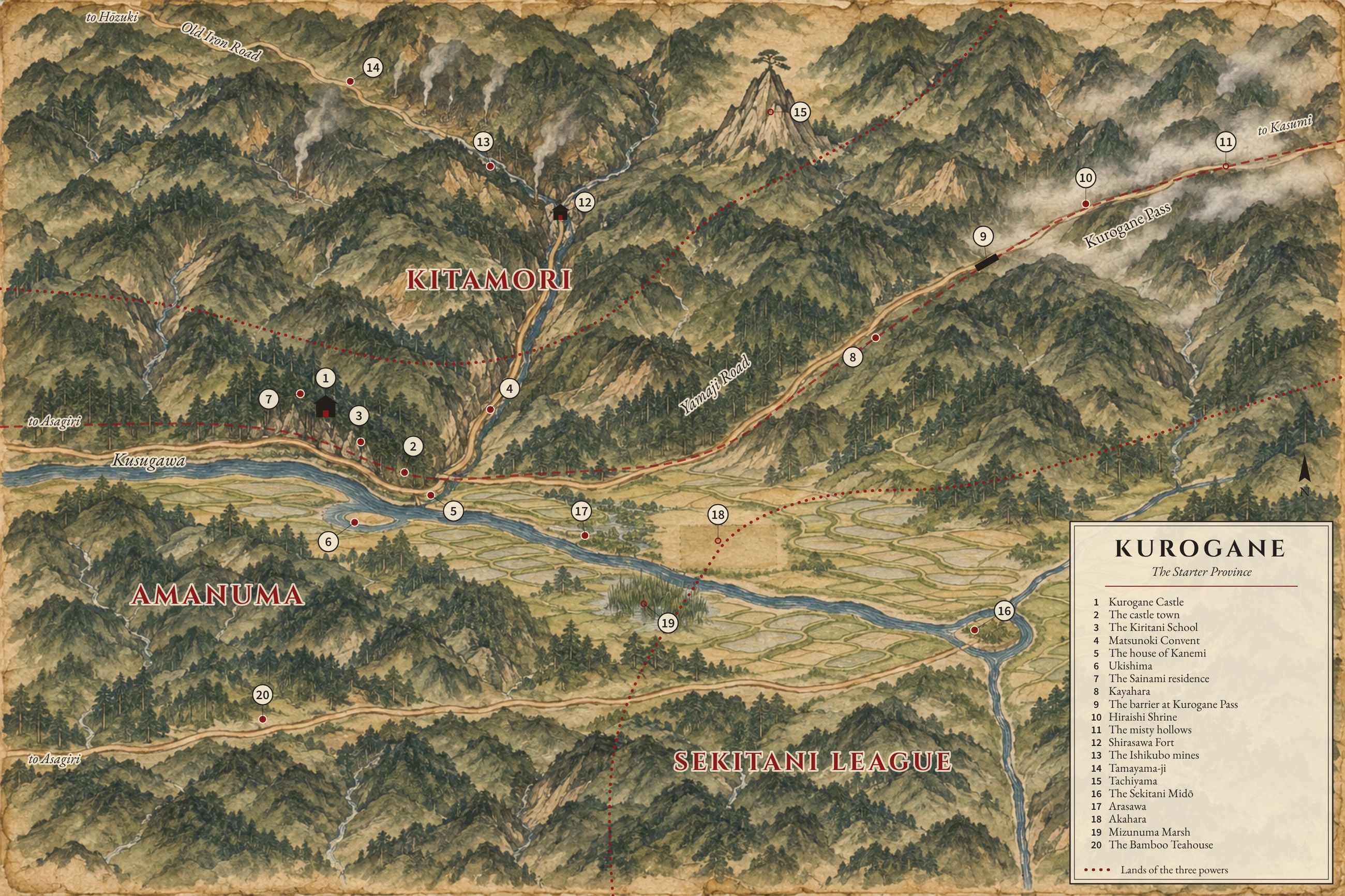
Kurogane has three parts, and each belongs to one of the three powers.
The Kusugawa basin is the heart of the province: a long valley of rice terraces along the Kusugawa river, ringed by cedar-dark mountains. The Yamaji Road follows the river east from Asagiri, past the castle town, toward the pass. The lower basin, around the castle, is Amanuma land. The upper basin, where the valley widens into the best rice land in the province, belongs to the Sekitani League.
The northern valleys climb from the basin into steep, narrow hollows where the rivers run black with iron sand and the hills are honeycombed with mine shafts. Charcoal smoke never leaves the sky there. These valleys are Kitamori land. The old iron road, older than the Yamaji Road, winds northwest from the mines over the mountains toward Hōzuki and the Thunder Peak temples.
The pass country rises in the east, where the Yamaji Road climbs out of the basin through a gorge to Kurogane Pass, on the border with Kasumi. From the summit on a clear day, a traveler can see the white cone of Mount Hōrai far to the southeast. Clear days are rare. Fog fills the gorges most mornings and many afternoons, and in the misty hollows above the pass, people say, live folk who are not quite farmers.
Climate. Kurogane is cold for its latitude. Snow closes the pass for a month or two most winters, and the rains of the early summer turn the pass road to red mud. Autumn is the season for war, because the harvest is in and the road is dry.
The Three Powers#
The Amanuma Clan (Red Plum)#
The Amanuma have ruled Kurogane from its castle for nine generations. They grew rich on the pass toll and loyal to the Kagamino shoguns who let them keep it. When the realm split, they took the red plum without hesitation.
The present lord, Amanuma Nobutane, did not expect to rule. His elder brother, the last lord, died four years ago of what his physicians called a fever, and left a son, Botanmaru, who is now 10. Nobutane became lord as the boy's guardian, then sent the boy to Kanagura "for his education," where the Shikken keeps him as an honored hostage. Nobutane says the boy will rule when he comes of age. Few believe it, and the dead lord's widow least of all. She shaved her head and became abbess of Matsunoki Convent, and she has not spoken to her brother-in-law since.
Nobutane is a capable, anxious man who feels the pass slipping through his fingers. The Shikken now takes a share of the toll through his own agent at the barrier, the League has taken the upper basin, and his cousins hold the mines. He needs soldiers he can trust and victories he can show the Shikken, and he will reward anyone who brings him either.
Holdings: Kurogane Castle, the castle town, the lower basin, the pass and its barrier, and the post town of Kayahara. Soldiers: about 1,600, with a strong company of matchlock gunners bought from Umikado. Wants: the mines back, the League broken, and his nephew kept far away.
| Domain | Size | Harvest | Defense | Loyalty | Shrine Favor |
|---|---|---|---|---|---|
| Amanuma | 80,000 koku | d6 | d8 | d4 | d6 |
The Kitamori Clan (White Plum)#
Two generations ago, a younger son of the Amanuma received the northern valleys as his fief, built a fort there, and took a new name from the forest behind it: Kitamori. He was the father of the present head's late husband. As the mines grew, so did the branch house, until it was richer than the main line in everything but rice. When the last Amanuma lord died and Nobutane took the seat, the Kitamori refused to swear to him. They stopped sending iron to the castle and began selling it on the old iron road to Sadatsugu's smiths instead. They now wear the white plum.
The head of the house is Kitamori Kaede, a sharp, widowed woman of 50 who ran the mines for her husband for 20 years before she ran them for herself. She considers Nobutane a usurper and Botanmaru the rightful lord, and she would happily rule Kurogane as the boy's regent. Her son, Kitamori Kagetsuna, commands the mine guards and studies the draw-cut at the Kiritani School, where he duels the Amanuma retainers in the yard and has fallen in love with one of them.
Holdings: Shirasawa Fort, the Ishikubo mines, the northern valleys, and the old iron road as far as Tamayama-ji. Soldiers: about 800, plus miners who fight with picks and hammers when they must. Wants: Botanmaru brought home and put on the seat, with Kaede as his regent, and a white plum army through the pass.
| Domain | Size | Harvest | Defense | Loyalty | Shrine Favor |
|---|---|---|---|---|---|
| Kitamori | 40,000 koku | d8 | d6 | d6 | d4 |
The low Shrine Favor is the price of the mines. The miners dig into places the mountain kami didn't give them, and the shafts have begun to find things that should have stayed buried.
The Sekitani League (Third Power)#
Three years ago, in the autumn of Kenreki 1258, the Amanuma doubled the rice tax in the upper basin to pay the Shikken. The farmers of the valley, most of them Western Light faithful, met at their temple at Sekitani, swore an oath before the Buddha of Boundless Light, and drove the tax collectors out with bamboo spears. That winter the Amanuma came to punish them. The League met them in the snow at Akahara, and by morning hundreds on both sides lay dead in the frozen fields. Neither side won, but the Amanuma never came back.
Since then the upper basin has been a republic of farmers and rural gentry, governed by a council of league elders that meets at the Sekitani Midō, the fortified Western Light temple at the head of the valley. The council answers only to letters from the sect's distant head temple. The League pays no tax to any lord, feeds its own spearmen, and takes in runaway farmers from every neighboring province. Every daimyo in the region fears it will spread.
The League's leaders are Kaishin, the soft-spoken priest of the Midō, who preaches that the Buddha's mercy needs no lords, and Tora of the Spears, a gentry widow who led the line at Akahara and now captains the League's fighters. They do not always agree. Kaishin wants peace with anyone who leaves the valley alone. Tora wants the lower basin.
Holdings: the upper basin, the Sekitani Midō, and a dozen villages, with secret members in many more, including Amanuma villages such as Arasawa. Soldiers: about 1,200 sworn spearmen and archers, and several thousand more farmers who come when the temple drum sounds. Wants: to be left alone, or, if Tora has her way, the whole basin.
| Domain | Size | Harvest | Defense | Loyalty | Shrine Favor |
|---|---|---|---|---|---|
| Sekitani League | 60,000 koku | d8 | d6 | d10 | d6 |
The Stalemate#
Each power is strong enough to hurt the others and too weak to finish them. The Amanuma can't take the mines without leaving the basin open to the League, and can't crush the League without leaving the castle to the Kitamori. The Kitamori can't hold the pass without the castle. The League can't take the castle at all. All three know that outside help would break the deadlock, and all three are looking for it: the Amanuma from the Shikken, the Kitamori from Sadatsugu, and the League from the Western Light leagues of Hotaru and from the farmers of every valley in reach.
That is where heroes come in. Each power needs people who aren't bound by its own ranks, people who can carry a message through enemy land, guard a shipment, settle a haunting, win a duel, or do something no one admits to ordering.
The Other Groups#
Kurogane holds a model of every kind of group in Chapter 2 Society. Each can be a hero's group from the start (Chapter 3).
| Kind of group | In Kurogane | Sketch |
|---|---|---|
| Samurai clan (red plum) | The Amanuma clan | Lords of Kurogane Castle and the toll on the pass, loyal to the Shogun, and taxed by the Shikken |
| Samurai clan (white plum) | The Kitamori clan | The branch house that holds the northern iron mines and sells the iron to Sadatsugu's smiths |
| Sect league (ikki) | The Sekitani League | Western Light farmers and gentry who drove out their lord's tax collectors, and now answer only to their temple |
| Temple | Tamayama-ji | A Thunder Peak temple on the old iron road, whose warrior monks guard pilgrims and charge their own tolls |
| Convent | Matsunoki Convent | A Still Mind convent in the castle town, where wives fleeing their marriages find sanctuary. Its abbess is the widow of the last Amanuma lord. |
| Shrine | Hiraishi Shrine | The shrine of the pass, guarded by two stone foxes, whose priestly family has kept the pass's kami content for 600 years |
| Martial school | The Kiritani School | The draw-cut school, whose hall stands in the castle town. Both clans send their sons and daughters to it, and they duel each other in its yard. |
| Merchant house and guild | The house of Kanemi and the Iron Guild | The greatest iron merchants of the province, who buy from both clans and lend to both |
| Underworld family | The Senomura family | Gamblers who run the dice houses of Kayahara, the post town below the pass |
| Shinobi league | The Kirikubo league | A hidden league in the misty hollows above the pass. Everyone in Kurogane has heard of them, and no one admits to hiring them. |
| Village | Arasawa | A farming village in the Amanuma lands whose gentry headman secretly pays the Sekitani League as well |
| Sakaibito hamlet | Ukishima | A riverside hamlet below the castle, whose tanners lace the armor of both clans |
| Court family | The Sainami family | Minor court nobles who fled Seikyō to live as the Amanuma lord's guests, teaching poetry and lending his house the court's glamour |
A Tour of Kurogane#
The numbers key each place to the Kurogane map.
The Castle and Its Town#
1. Kurogane Castle. The Amanuma castle crowns a steep spur above the Kusugawa, where the valley narrows and the Yamaji Road must pass beneath its walls. It is a castle of three rings (Chapter 5): the outer ring of earth walls and retainers' houses, the second ring of stone with the storehouses and the training ground, and the inner ring with the lord's hall and a three-story keep of black-lacquered wood. Iron plates sheathe its gates, which is either a boast or a warning. The lord holds court in the great hall every month, and petitioners line up at the outer gate before dawn. The dead lord's rooms are kept closed. Servants say his footsteps still cross them at night.
2. The castle town. About 8,000 people live in the town below the castle: retainers in the streets nearest the walls, then merchants, smiths, and artisans along the road, with temples on the edges and the pleasure quarter by the river. Iron is everywhere. Sword-polishers, armorers, and pot-makers fill whole streets, and the clang of hammers starts at dawn. The town has two inns for samurai, a dozen for commoners, a public bathhouse, and a constable's post that answers to the castle.
3. The Kiritani School. A long hall of polished cedar near the castle's outer gate, with a sanded yard in front and the school's rules hung on the wall in the headmaster's own brush. The Kiritani School teaches the draw-cut (Chapter 3), and its students fill Kurogane's duels. By old custom, the yard is neutral ground: Amanuma and Kitamori students train side by side, bow to each other, and settle their quarrels there with wooden swords, under the headmaster's eye. Lately they have been settling them with steel. The headmaster, Kiritani Hisamura, has told both lords that the next student who draws a live blade in his yard will be expelled, and both lords have told him privately that they would take it as a favor if he expelled the other side's.
4. Matsunoki Convent. A walled Still Mind convent of moss gardens and pine trees on the hill east of the town. Women fleeing their marriages run to its gate, and a woman who touches the gatepost is under the abbess's protection. Abbess Shōun, once the wife of the last Amanuma lord, rules it with quiet authority and an excellent memory. She corresponds with her son in Kanagura, with Kitamori Kaede, and with the Sainami family, and she knows more about the castle than anyone outside it. An old lay sister, Musada Kozue, keeps the convent's gate (Chapter 10).
5. The house of Kanemi. The greatest merchant house in Kurogane, a long shopfront under an indigo curtain that bears the shop name. Its master, Yoemon, heads the Iron Guild, which buys iron from the Kitamori, rice from the League, and protection from the Amanuma, and lends money to all three. Yoemon is cheerful, generous, and utterly neutral, because the stalemate is the best thing that ever happened to his profits. His storehouses hold more coin than the castle's.
6. Ukishima. A sakaibito hamlet on a sandbar island below the castle, linked to the town by a single plank bridge that is drawn up at night. Its people tan hides, make drums and sandals, and lace the armor of both clans. Their headman, Rokuzaemon, knows every suit of armor in Kurogane and where its weak lacing lies, which makes him useful to anyone planning to kill its wearer. The hamlet's people are Western Light faithful, and many quietly hope the League wins. Rokuzaemon's niece is the finest armor lacer in the province, and what she wants has nothing to do with the dead: she wants the Iron Guild to sell Ukishima's lacing under Ukishima's own name, not a castle armorer's.
7. The Sainami residence. A small court-style mansion with a pond garden, inside the castle's outer ring, where the Sainami family lives as the lord's guests. Sainami Takemaro teaches the Amanuma retainers poetry, calligraphy, and the tea ceremony, and lends the lord's banquets the glamour of Seikyō. He is threadbare, gracious, and in debt to the house of Kanemi for everything he owns. His daughter writes letters to the capital that the lord never sees.
The Road to the Pass#
8. Kayahara. The post town at the foot of the pass, where the Yamaji Road leaves the basin and begins to climb. Kayahara has 200 houses strung along the road: inns, teahouses, stables, porters' lodgings, and dice houses. Travelers waiting for the pass to clear, the barrier to open, or the rain to stop fill it all year. Kayahara is the Senomura family's town. Their boss, Gonzō, runs the dice houses, takes a cut of every inn, and keeps the peace better than the castle's constables. A traveler who wins too much at the dice may find the road ahead suddenly dangerous. The Teahouse at the Crossroads, at the town's eastern end where a mountain path meets the road, is the best place in Kurogane to hear news, and the worst place to say anything secret.
9. The barrier at Kurogane Pass. Halfway up the pass, where the road runs between a cliff and a gorge, the Amanuma barrier closes it with a timber gate, a guardhouse, and a palisade. Every traveler shows a pass and pays the toll: 30 mon a person, 100 mon a horse, and a tenth of all goods carried for sale. The barrier captain, Kuroe Sanemitsu, is an Amanuma bannerman, an honest man doing a job he hates. Beside him sits Ōtaki Naomochi, a minor kinsman of the Shikken, who collects a second toll for Kanagura and records every traveler in a ledger that goes to the Shikken each month. The two men loathe each other. Ronin back from Cheongun refuse the Shikken's toll on principle, and the barrier has seen more than one fight.
10. Hiraishi Shrine. The first shrine of Kurogane stands at the summit of the pass, in a grove of great cedars hung with sacred ropes. Its kami is the spirit of the pass itself, which lives in the flat stone, a great slab of black rock beside the road that, the priests say, is a shard of the Great Sword. Two stone foxes guard the gate. Travelers rinse at the basin and pray for a safe crossing, and those who skip the prayer tend not to have one. The Hiraishi family has kept the shrine for 600 years. The chief priest, Hiraishi Sanetoki, is old and failing, and the shrine maiden who speaks for the kami, his granddaughter Suzu, has lately been saying things in trance that frighten him: that the kami of the pass is angry, that blood is coming, and that the foxes are tired of waiting.
11. The misty hollows. Above the pass, on the Kasumi side, a maze of hanging valleys is filled with fog most of the year. A few poor hamlets cling there, growing millet and buckwheat and burning charcoal. Their people seem to be ordinary hill farmers. They are the Kirikubo league, and the hollows are their home and their fortress. No outsider finds a way in without a guide, and no guide has ever taken one. A message left in the hollow tree at the shrine's back fence reaches them in a day. The price comes back by the same tree.
The Northern Valleys#
12. Shirasawa Fort. The Kitamori seat stands on a crag above a white marsh where three mine valleys meet. It is a rough mountain fort of earth and timber, with a single stone tower, and it has never been taken. Its walls are hung with the white plum now. Smoke from the charcoal kilns below hides it half the day.
13. The Ishikubo mines. Five valleys of shafts, spoil heaps, smelting furnaces, and miners' barracks, with about 3,000 people living in the smoke. The miners are hard, superstitious, and loyal to whoever pays them on time, which lately has been the Kitamori. Mine guards in iron headbands watch the roads. The deepest shaft, the Fourth Gallery, broke into an old cavern last spring, and the Kitamori sealed it after the first crew didn't come back. The miners won't go near it. At night, something in it knocks.
14. Tamayama-ji. A Thunder Peak temple of 40 halls on a forested ridge along the old iron road, a day's walk north of the mines. Its warrior monks guard pilgrims and iron caravans on the road to Hōzuki and collect their own toll for the privilege, which neither clan dares challenge. The abbot, Genzan, is a scholar of the secret rites and an old soldier, and takes orders from Raihō-ji and no one else. Thunder Peak hates the Western Light leagues, and Tamayama-ji's monks would happily help any lord who promised to burn the Sekitani Midō.
15. Tachiyama. A sharp, bare peak above the northern valleys, its summit crowned by a stunted pine. Mountain ascetics climb it to fast and pray, and some don't come down. Hunters say a great tengu lives on the summit, a sword-master who stops travelers on the path and challenges them to a bout with wooden swords. Those who lose are mocked and sent home. Those who win, or lose with style, are sometimes taught. Chapter 10 tells more of him, the Grey Abbot.
The Upper Basin#
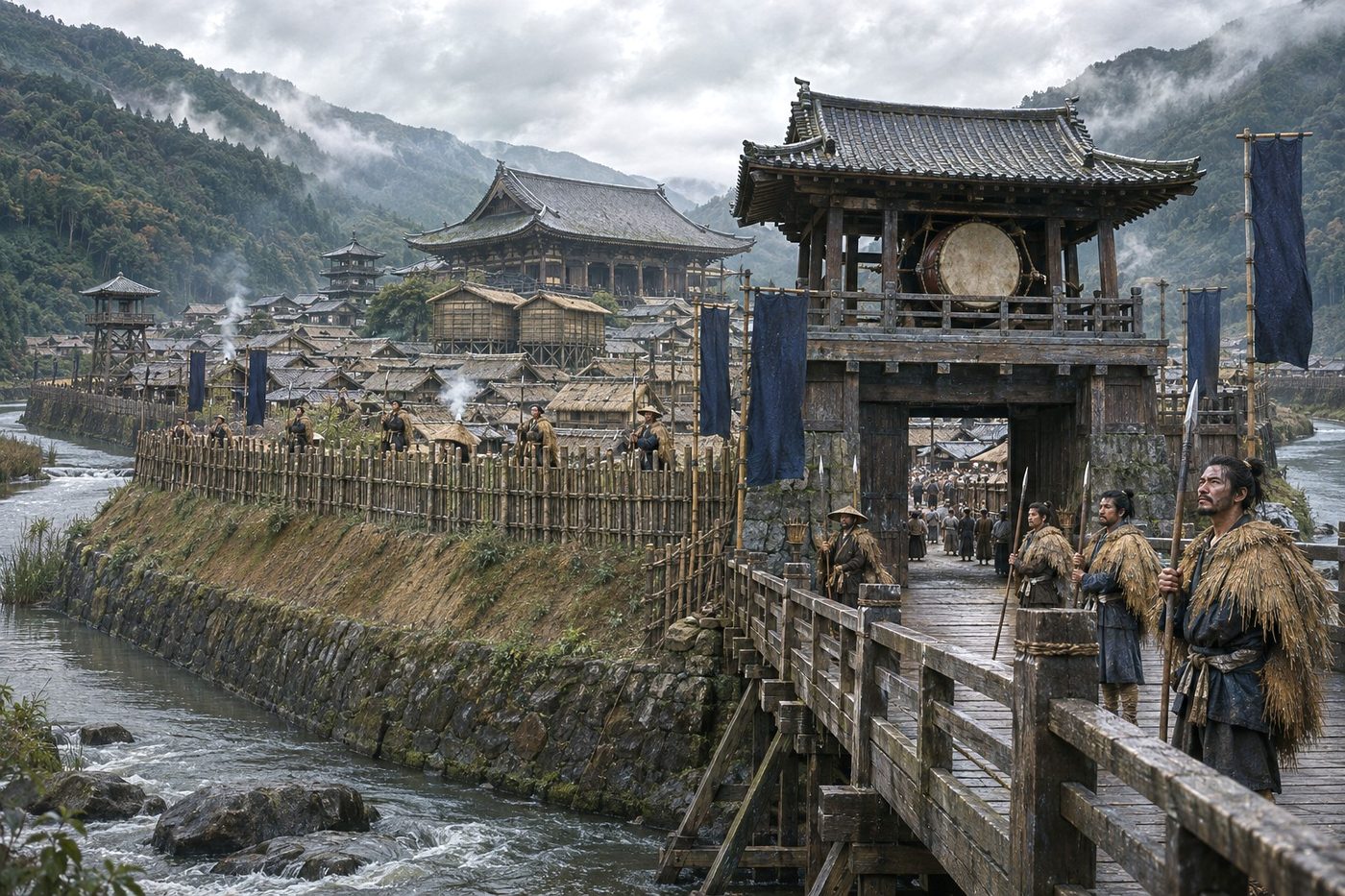
16. The Sekitani Midō. The League's temple stands at the head of the valley on an island between two rivers, ringed by moats, earth walls, and bamboo palisades. It is less a temple than a fortified town, with a great hall for the Buddha of Boundless Light, the council's meeting house, granaries, an armory, and the houses of 1,000 believers. A great drum hangs in its gate tower. When it sounds, every League village in the basin sends its spearmen. Outsiders may visit the great hall to pray. Armed samurai may not cross the bridge.
17. Arasawa. A farming village of 40 houses at the edge of the lower basin, in Amanuma land, with a shrine to the rice kami, a single sake brewer, and a jizō at the crossroads. Its headman, Arasawa Kyūsuke, is a gentry farmer who keeps a spear and armor in his storehouse, pays his tax to the castle, and secretly pays the League as well so that its spearmen leave his village alone. If either side finds out, Arasawa burns. Half the villagers are League members, and the other half know it. Arasawa is the model village for a commoner party.
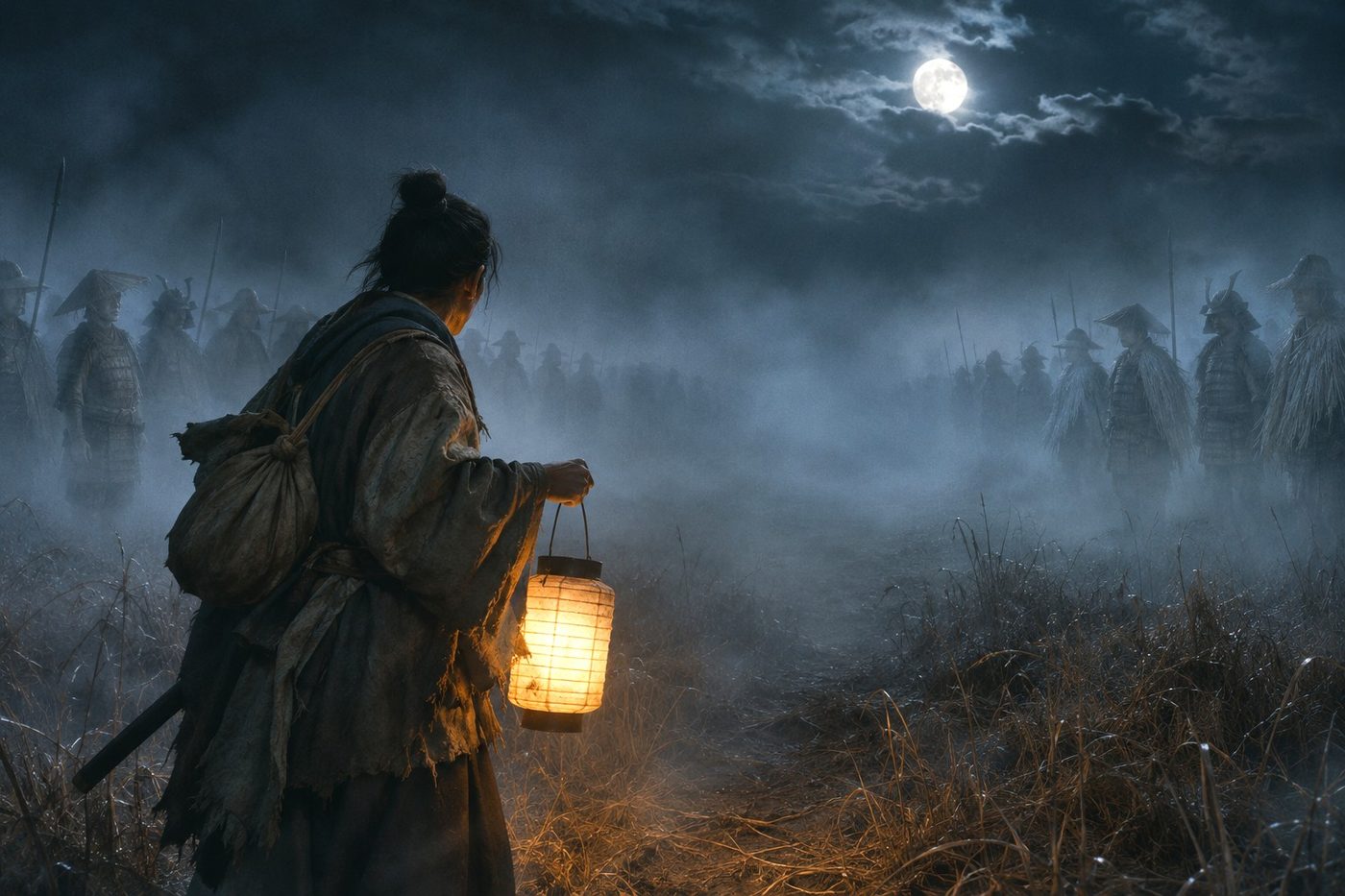
18. Akahara. The battlefield of the League's founding winter, a long, flat stretch of fields between the lower and upper basin that no one farms anymore. Fog lies on it even at noon. Akahara is Profane Ground (Chapter 4). At night, shapes in armor and straw rain capes stand in the fog in two lines, and anyone who walks between them wearing either side's colors is attacked. The dead were never purified, and the League and the Amanuma blame each other. A rite to cleanse Akahara (Chapter 6) would need the help of both sides, and that alone might break the stalemate, for good or ill.
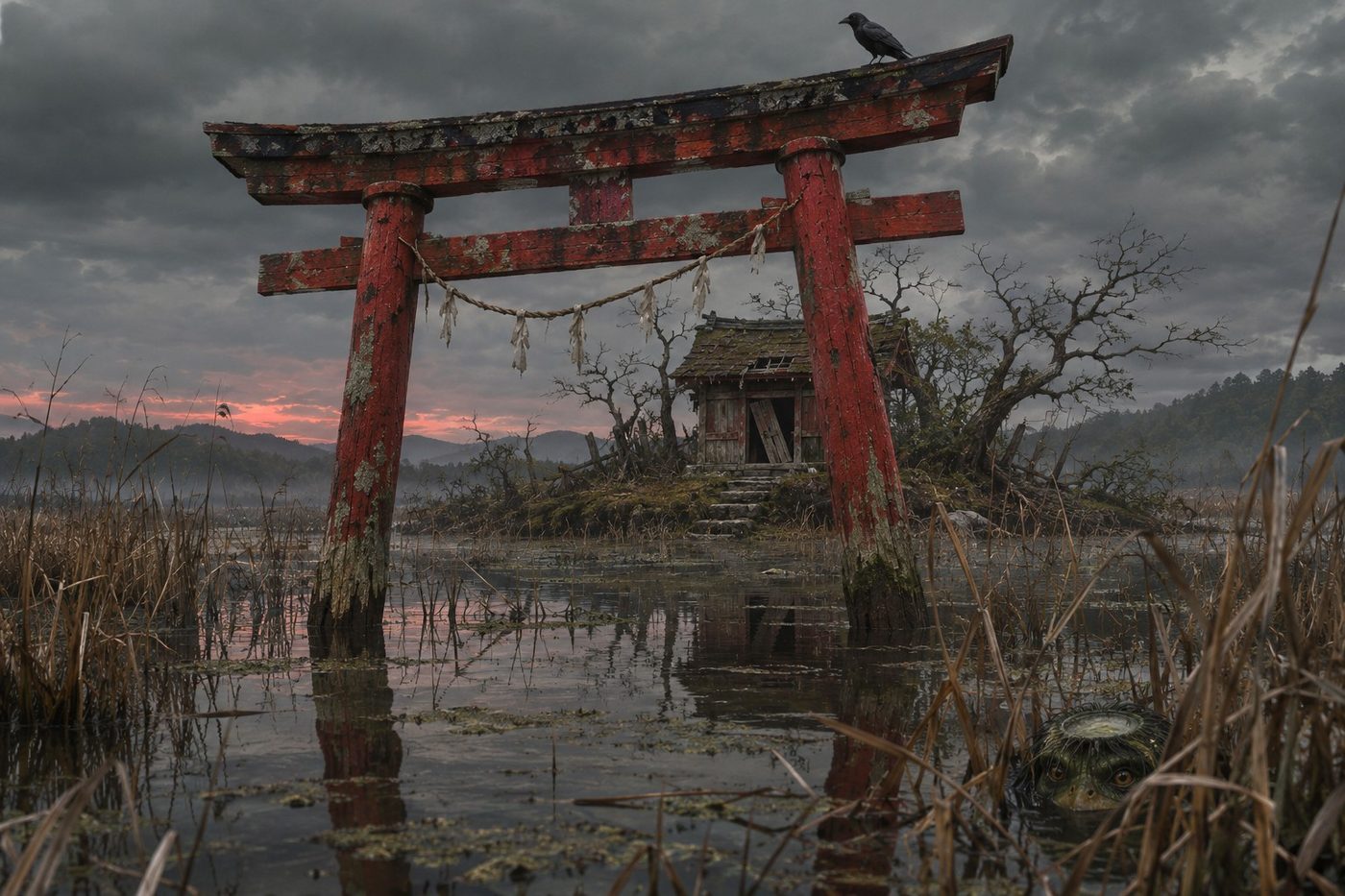
19. Mizunuma Marsh. A reedy marsh below Akahara, where a stream from the battlefield feeds the Kusugawa. A vermilion shrine gate stands half sunk in its black water, marking the home of an old river kami. After Akahara, soldiers of both sides threw their dead into the marsh rather than carry them home, and the water turned dark with pollution. The marsh's kappa, once polite and easily bowed to, now drag down anyone who comes near. Then, this spring, someone stole the river kami's sacred bronze mirror from its little shrine on the island, and the blight on the water began to spread to the rice fields downstream.
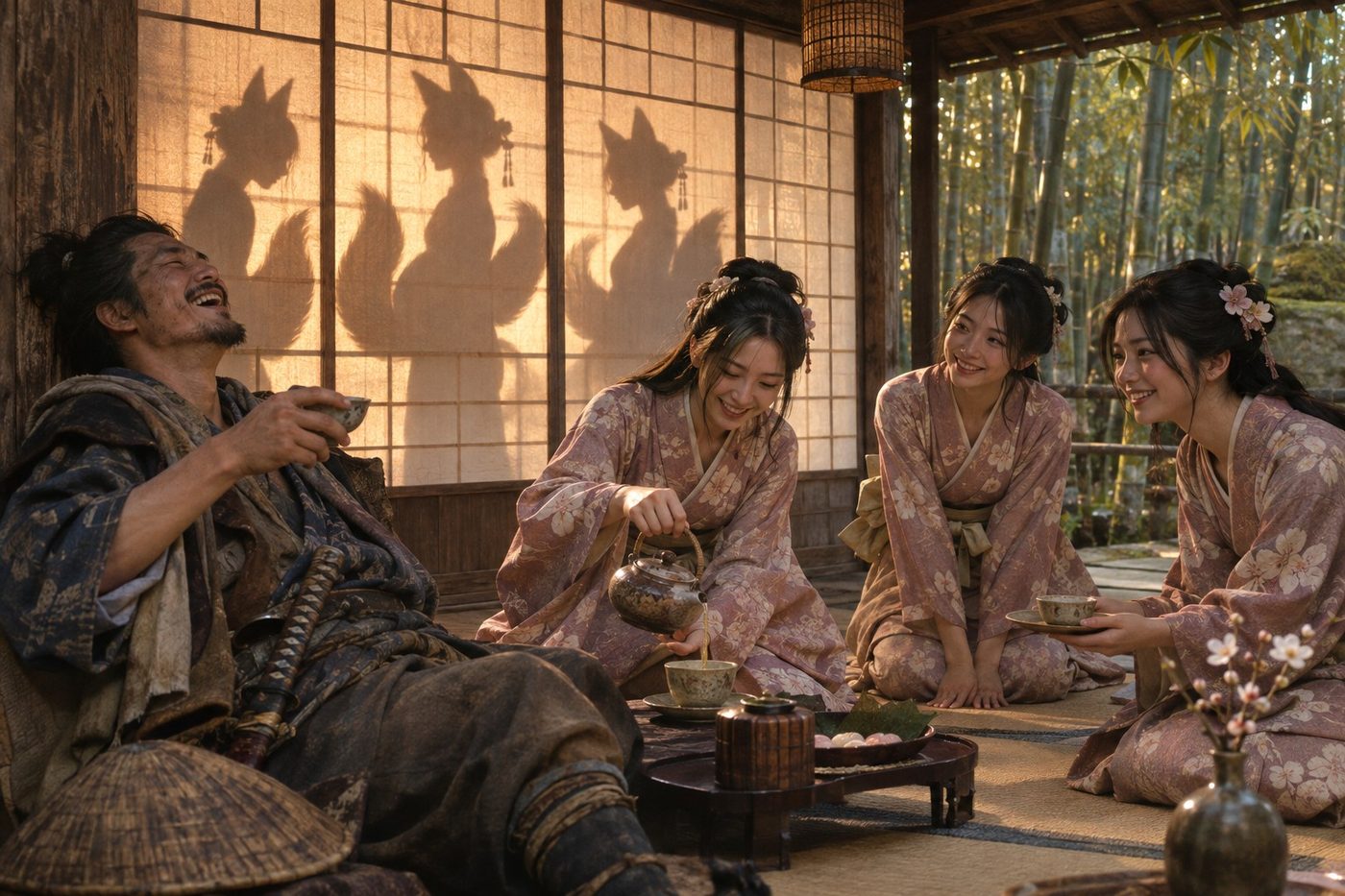
20. The Bamboo Teahouse. A pretty teahouse in a bamboo grove where a side path from the upper basin meets the border road to Asagiri, run by three beautiful sisters who serve the finest tea in the province. Officers of every side stop there, and every side's secrets leak out over the cups. The sisters are foxes (kitsune). They sell what they hear to anyone who pays in fine sake or fresh talismans, and they amuse themselves by leading proud samurai astray in illusions. They have never been caught, because no one who has seen through them has been believed.
Beyond the Tour#
A few places lie off the keyed map, for the GM to place as needed: the Old Kings' Mound, a great tree-covered burial mound from the Age of Seven Kingdoms on the southern border with Tatsumi, which no one digs into; the hot springs of the gorge below the pass, where wounded soldiers of every side bathe together under a truce older than the clans; and the charcoal burners' huts scattered through every forest, where travelers can shelter for a night and hear the ghost stories of the hills.
Personalities#
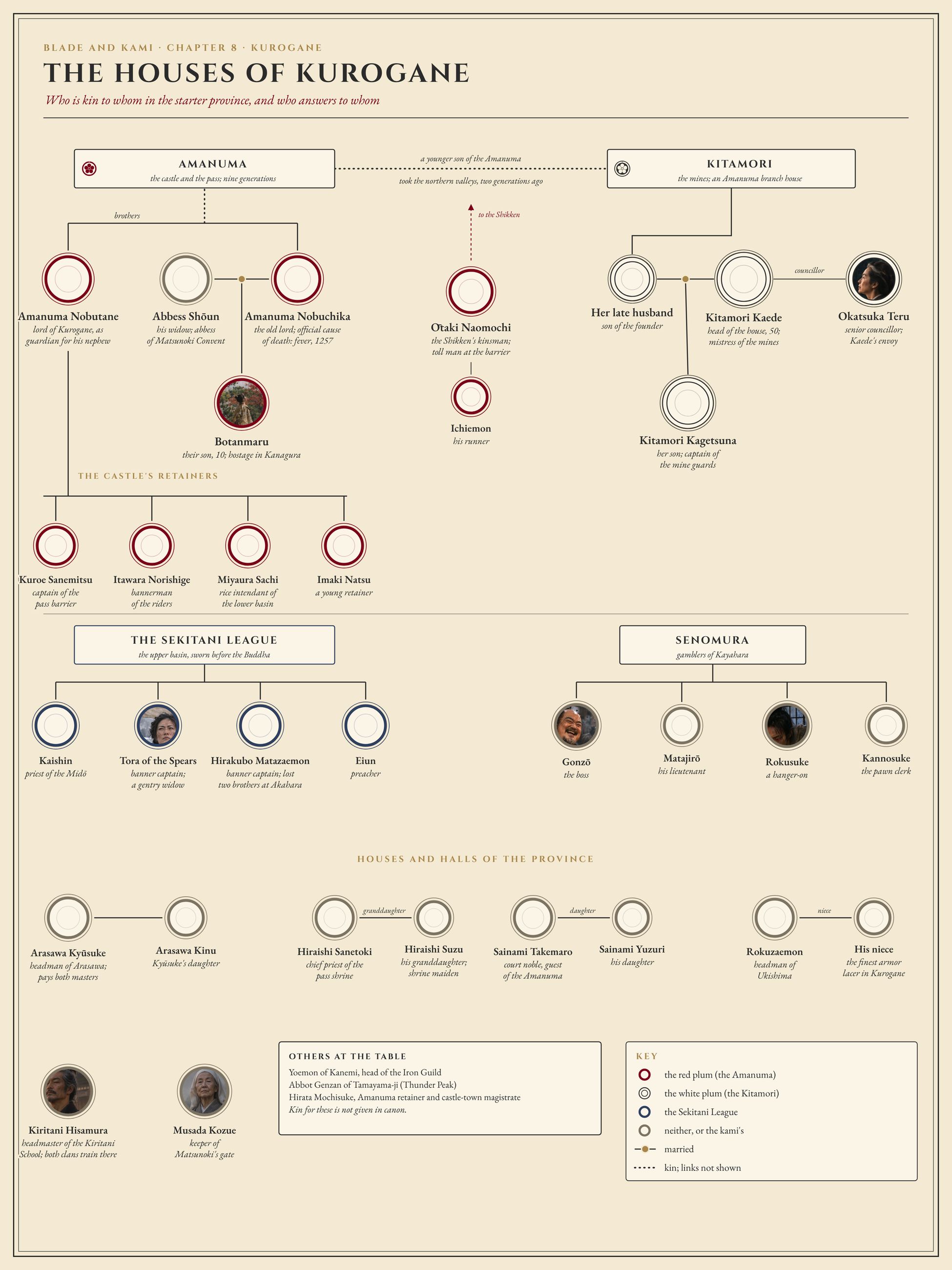
These are the people heroes meet first. Chapter 9 gives their stat blocks.
| Name | Who they are | Side |
|---|---|---|
| Amanuma Nobutane | Lord of Kurogane Castle, anxious and capable, who rules as guardian for a nephew he keeps far away | Red |
| Botanmaru | The dead lord's son, 10 years old, the Shikken's honored hostage in Kanagura | Unwilling |
| Abbess Shōun | The dead lord's widow, abbess of Matsunoki Convent, who knows everything | Her son's |
| Kuroe Sanemitsu | Captain of the pass barrier, an honest bannerman | Red |
| Ōtaki Naomochi | The Shikken's kinsman and toll collector at the barrier | Red (the Shikken's) |
| Kitamori Kaede | Head of the Kitamori, mistress of the mines | White |
| Kitamori Kagetsuna | Her son, captain of the mine guards, a Kiritani student in love with an Amanuma retainer | White |
| Kaishin | Priest of the Sekitani Midō, who preaches mercy without lords | League |
| Tora of the Spears | Banner captain of the League, hero of Akahara | League |
| Abbot Genzan | Abbot of Tamayama-ji, scholar and old soldier | Thunder Peak |
| Hiraishi Sanetoki | Chief priest of the pass shrine, old and failing | The kami's |
| Suzu | His granddaughter, the shrine maiden who speaks for the angry kami | The kami's |
| Kiritani Hisamura | Headmaster of the Kiritani School, trying to keep his yard neutral | Neutral |
| Yoemon of Kanemi | Master of the house of Kanemi and head of the Iron Guild | His own |
| Gonzō | Boss of the Senomura family in Kayahara | His own |
| Arasawa Kyūsuke | Headman of Arasawa, who pays two masters | Both |
| Rokuzaemon | Headman of Ukishima, who knows every suit of armor in the province | League, quietly |
| Sainami Takemaro | A court noble in exile, poet to the Amanuma | Red, for his dinner |
Running Kurogane#
Ties to Kurogane#
At the start of a campaign, each player may roll a d6 or choose a tie that binds their hero to the province. Each one begins as a debt of on (Chapter 4).
| d6 | Tie |
|---|---|
| 1 | A debt of steel (Major, owed by the hero). An Amanuma bannerman pulled the hero from a burning house last winter. Now he asks the hero to escort his sister to Matsunoki Convent, past her furious husband. |
| 2 | The merchant's favor (Minor, owed to the hero). The hero saved a Kanemi clerk from river bandits. The house of Kanemi owes the hero one service: safe passage, a forged travel pass, or a loan. |
| 3 | The ascetic's cure (Major, owed by the hero). A mountain ascetic from Tachiyama cleansed the hero of deep pollution. In return, the hero swore to bring back a sutra scroll that thieves carried into a haunted ruin. |
| 4 | The village's shelter (Minor, owed to the hero). The hero drove raiders away from Arasawa. The village will hide the hero, feed them, and ask no questions. |
| 5 | The dead man's sword (Major, owed by the hero). A dying soldier at Akahara gave the hero his short sword and made them swear to return it to his family shrine. Until the oath is kept, he visits the hero's dreams. |
| 6 | The temple's refuge (Minor, owed by the hero). The monks of Tamayama-ji hid the hero from a lord's hunters. Now they want the hero to find a spy inside their own walls. |
What's Happening Now#
When the campaign begins, roll a d6 or choose the trouble that comes first. The others are brewing in the background.
| d6 | Trouble |
|---|---|
| 1 | The haunted guns. An Amanuma caravan carrying 50 new matchlocks from Umikado vanished in the fog at Akahara. Now shots ring out from the fog at night, and the guns fire on anyone who comes near, with no hands on them. |
| 2 | The tax riders. Amanuma tax collectors seized Arasawa's winter rice. A League preacher arrives tonight to raise the village before dawn, and the castle's riders are a day behind him. |
| 3 | The stolen mirror. The river kami's mirror is gone from Mizunuma Marsh, and the blight is spreading downstream. Each side blames the other, and someone is selling the mirror in Kayahara. |
| 4 | The truce banquet. Lord Nobutane invites Kitamori envoys and League elders to a feast at the castle to talk peace. Someone means to murder an envoy and blame the heroes, who were hired as neutral guards. |
| 5 | The thing in the Fourth Gallery. The knocking in the sealed gallery has stopped. Three miners vanished last night, and a demon's voice from the shaft offers Kitamori Kaede all the iron she wants, for a price. |
| 6 | The fox wedding. A noble bride's procession of lanterns crosses the pass at dusk while the sun shines through the rain. Anyone who watches it without a protective talisman is cursed with a wasting sickness, and a Kitamori retainer watched. |
On the Road#
When heroes travel in Kurogane, the GM draws an encounter card as usual, or rolls a d6 here.
| d6 | Encounter |
|---|---|
| 1 | Deserters. Four to eight foot soldiers who fled the Akahara winter have turned bandit, led by a starving ronin back from Cheongun. |
| 2 | The flute player. A wandering monk in a basket hat plays the flute at the roadside. He is a Kirikubo agent gathering news, or a diviner hunting the Bamboo Teahouse's foxes, or simply a monk. |
| 3 | The roadside jizō. A stone jizō in a red bib. A hero who stops to leave food or incense and say a prayer is cleansed of one step of pollution (Chapter 4), once per journey. |
| 4 | The bridge kappa. A kappa blocks a plank bridge and demands a cucumber, or a proper bow. A kappa from Mizunuma doesn't bow back. |
| 5 | The challenger. A proud young samurai, a Kiritani student, challenges the best-armed hero to a formal duel to first blood (Chapter 4) for the honor of the school. |
| 6 | Fox mist. The road loops back on itself in the fog for hours, until someone notices the little fox shrine hidden in the trees and leaves an offering there (Notice at –2, or Occult). |
Rumors#
When heroes listen at the Teahouse at the Crossroads, roll a d6 or choose. True rumors are marked (T) and false ones (F), for the GM's eyes only.
| d6 | Rumor |
|---|---|
| 1 | "The old lord didn't die of fever. His brother poisoned him." (F) Lord Nobutane's guilt is that he profited, not that he killed. Someone else did the poisoning, and Chapter 9 says who. |
| 2 | "Lady Kaede means to bring the boy home and rule as his regent." (T) |
| 3 | "The Shikken's man at the barrier sends every traveler's name to Kanagura." (T) |
| 4 | "The League's priest talks to the Buddha, and the Buddha talks back." (F) Kaishin is sincere but has no powers. Tora's banner, though, has turned aside more arrows than any cloth should. |
| 5 | "The flat stone at the shrine is a piece of the gods' sword, and it bleeds before a war." (T) It bled last month. |
| 6 | "The Kirikubo are just a ghost story to frighten children." (F) |
Savage Tale Hooks#
Chapter 11's four starter adventures begin in Kurogane, one for each kind of party. The haunted guns and the fox wedding are seeds for the GM to build on (Chapter 11, Savage Tales of the Isles, has The Guns in the Fog); Chapter 11's Using the Savage Tales gives the table of which starter suits which party.
- A samurai party serves Lord Nobutane (or Lady Kaede) and starts with the truce banquet.
- An underworld party works for Gonzō of the Senomura family and starts with the stolen mirror, which turns up at one of his dice houses.
- A commoner party belongs to Arasawa and starts with the tax riders.
- A spirit-hunter party answers Suzu's call at Hiraishi Shrine and starts with the thing in the Fourth Gallery.
An Opening Scene#
For a quick start, open in the Teahouse at the Crossroads in Kayahara on a night of pouring rain (Chapter 11 writes this out as The Road Band's Prologue), with the heroes sheltering together for whatever reasons their ties give them. A wounded Kitamori messenger stumbles in, clutching a sealed letter, and begs for help. Moments later, a squad of Amanuma matchlock gunners arrives outside, demanding the messenger before their slow-matches burn down in the rain. Gonzō's men watch from the dice room and wait to see who will pay them more. And the paper lantern by the door, which nobody lit, begins to glow with a pair of eyes, feeding on the rising anger in the room.
Notes#
- The fox sisters of the Bamboo Teahouse draw on the fox legends in F. Hadland Davis, Myths and Legends of Japan (1912), chapter 5.
- The kappa of Mizunuma follow the river goblins of Davis, Myths and Legends of Japan, and of R. Gordon Smith, Ancient Tales and Folklore of Japan (1908).
Part 2: Seats of Power#
Four Cities, Four Masters#
Power in Tsurugishima has four homes, and no two agree on who rules the realm.
- Seikyō, the Pure Capital, is where the Emperor reigns. It grants the titles that make power lawful.
- Hagane, the Shogun's fortress-port, is where the realm is supposed to be governed. It holds the Shogunate's offices and its fleet.
- Kanagura, the Shikken's castle-port, is where the realm is actually governed. It holds the money.
- Umikado, the Sea Gate, is where the world comes in. It holds the guns.
Each city entry gives the city at a glance, its districts with keyed places for a city map, the people who matter, a d6 rumor table, and Savage Tale hooks. True rumors are marked (T) and false ones (F), for the GM's eyes only. Personalities' stat blocks are in Chapter 9.
Seikyō, the Pure Capital#
| Province | Miyabi, in Uchikuni (the Inner Provinces) |
| People | About 120,000, down from twice that in its glory |
| Extent | About an hour's walk across the old grid, and less across the part still lived in |
| Forces | The Shogun's Deputy's few hundred soldiers and an elderly palace guard. Thunder Peak's warrior monks can come down from Hōzuki in a day. |
| Ruled by | The Emperor reigns. The court governs the palace and little else. The Shogun's Deputy keeps order in the streets. |
| Allegiance | The court favors no blossom openly, and sells its blessings to both |
| Known for | The Emperor, the court, poetry, ritual, temples, and genteel poverty |
Seikyō lies in a basin ringed by wooded hills, laid out as a grid of broad avenues around the Imperial palace, with the Matsugawa river along its eastern side. For 767 years it has been the Emperor's city. It was built for 250,000 people, and half of it is now gardens, ruins, and fields of autumn grass inside the old walls. Its avenues are lined with willows, its walls are faded vermilion, and its temples are the oldest and most beautiful in the isles. Everyone in Seikyō is either very old money or very new ambition, and both are dressed in silk they can't afford.
Seikyō has no castle and no army. Its protection is its holiness: no lord has ever dared to burn the Emperor's city, and every lord who has thought about it has found the rest of the realm against him. That holiness is wearing thin.
Districts and Places#
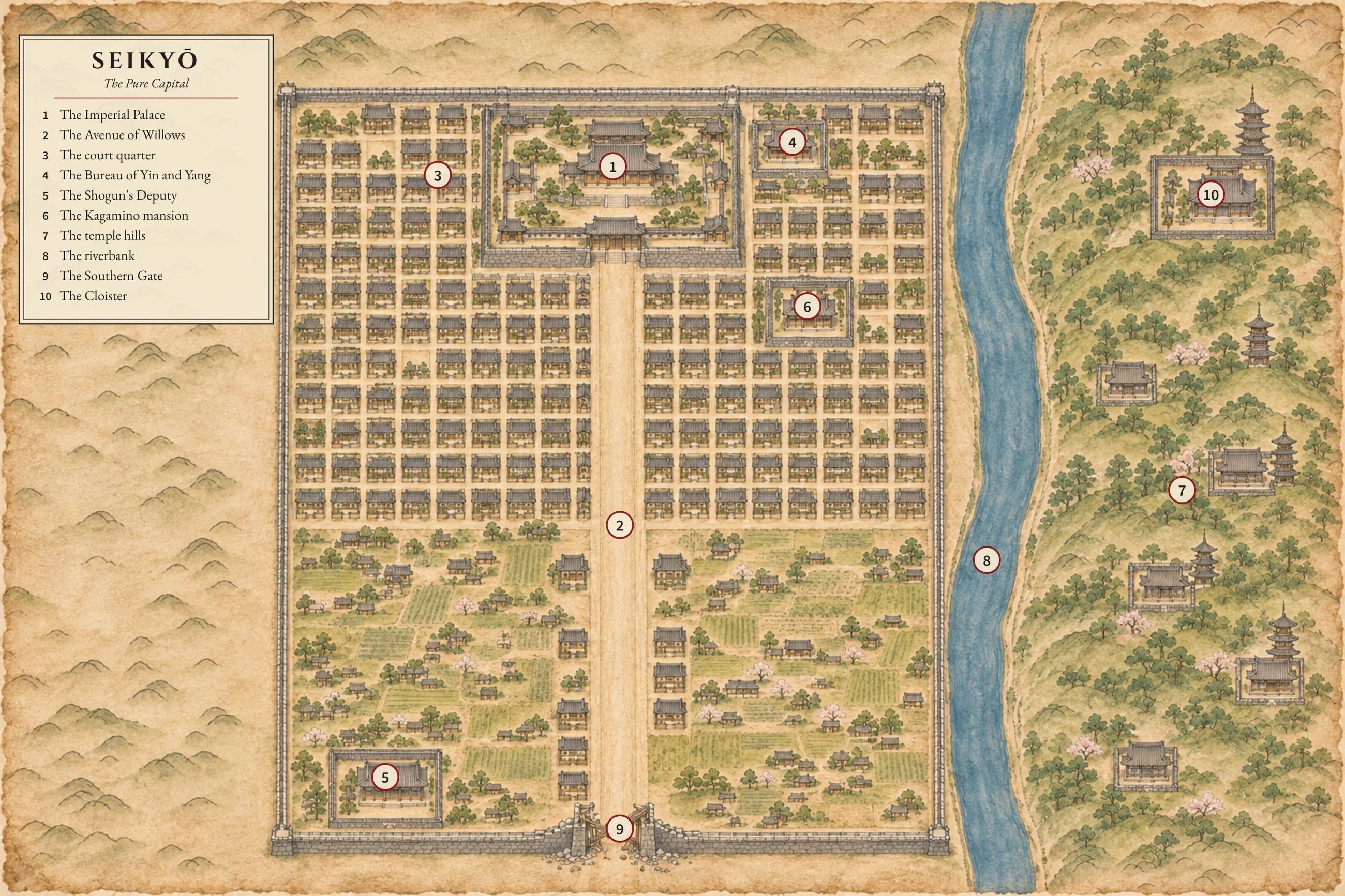
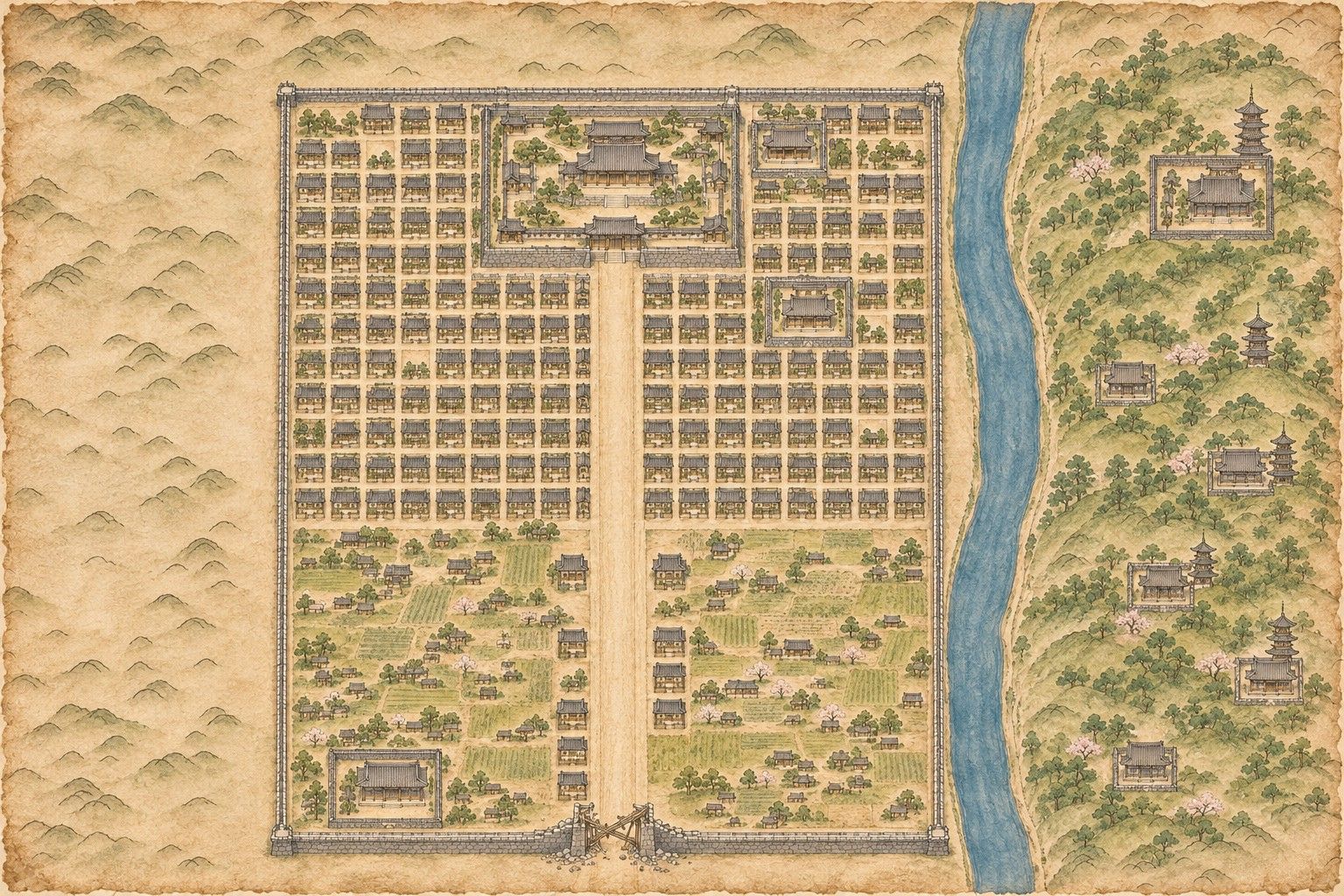
1. The Imperial Palace. A walled enclosure of halls, galleries, and gardens at the north end of the great avenue. The Emperor lives within it, performs the rites of the year, and almost never leaves. The walls need replastering, the gardens need weeding, and the gate guards are elderly. Inside, the court's ceremonies go on exactly as they did eight centuries ago, every gesture, robe color, and bow governed by precedent. A samurai who wants an audience needs a court rank, a sponsor, an auspicious day, and a very large gift.
2. The Avenue of Willows. The great avenue runs south from the palace gate to the ruined Southern Gate, so broad that a festival procession of a thousand fills only half of it. Court nobles' ox-carriages, monks, merchants, and pilgrims share it by day. By night it is empty and dark, and wise people don't walk it alone.
3. The court quarter. The mansions of the court families crowd the streets around the palace, each behind a mud wall with a tiled cap. The greatest is the mansion of the Akebana, the regents' family, whose gardens are kept perfect even when its roof leaks. Smaller mansions are rented out, mortgaged, or quietly sold to provincial lords who want a Seikyō address. In the court quarter, introductions are the currency. A court noble will introduce a hero to anyone, for a price, and the introduction is usually genuine.
4. The Bureau of Yin and Yang. A cluster of old halls near the palace, with an observatory tower, where the court's yin-yang masters (onmyōji) keep the calendar, read the stars, name lucky and unlucky days, and guard the city's demon gate in the northeast. The head of the Bureau, Watanaga Narimaro, is a dry, precise scholar who knows exactly how many curses are being laid in Seikyō each month, and by whom. Lords who need a curse lifted, a day chosen, or an omen explained come here, and pay well.
5. The Shogun's Deputy. On the southern edge of the city, the Shogunate keeps a walled compound where the Shogun's Deputy at Seikyō (Seikyō tandai) and his few hundred soldiers keep the peace, watch the court, and arrest troublemakers. The Deputy, Uchimori Shigetane, is red plum and loyal to the Shikken. His soldiers are spread thin, his budget has been cut, and the city's gangs know it.
6. The Kagamino mansion. The Shogun's family keeps a great residence in Seikyō for visits to the court. Its only full-time resident is the Shogun's uncle, Kagamino Tomokiyo, the former guardian whom the Shikken pushed aside. He spends his days writing poetry, attending court, and cultivating every noble who resents the Shikken, which is most of them. Tomokiyo is still red plum, for now.
7. The temple hills. The eastern hills are covered with temples of the older scholarly sects and the great Thunder Peak branch temples, their pagodas rising above the cedars. Pilgrims climb to them by the thousand, and their storehouses hold the realm's oldest sutras, relics, and treasures. Thunder Peak's monks in Seikyō answer to Raihō-ji in nearby Hōzuki, which is why the court fears them.
8. The riverbank. The dry bed and banks of the Matsugawa are a world outside the city's order: sakaibito laborers, street performers, puppeteers, executioners, fortune-tellers, and outcasts of every kind live there, along with markets, gambling dens, and the city's execution ground. The riverbank's people answer to their own headmen, and the Deputy's soldiers go there only in force.
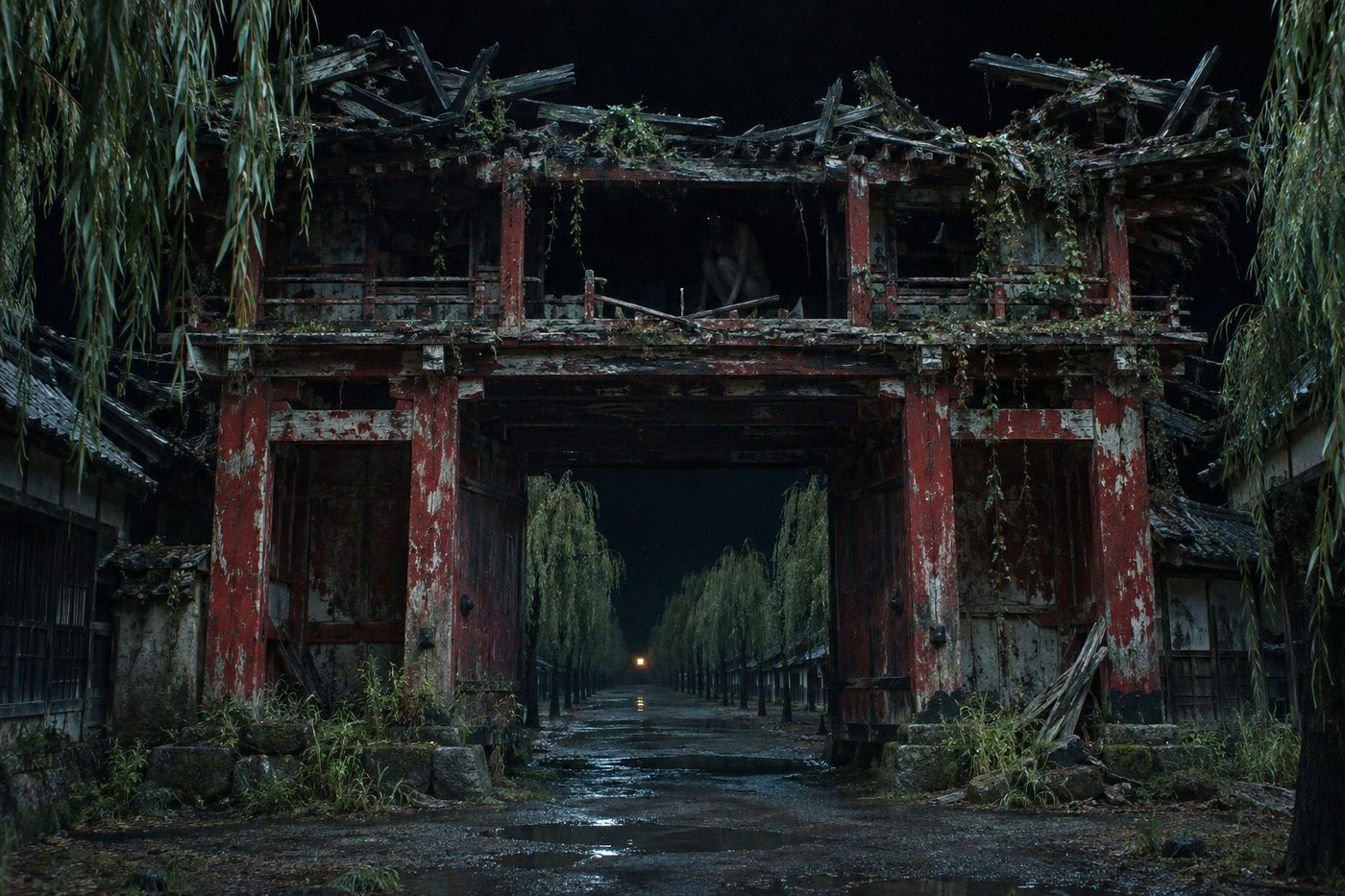
9. The Southern Gate. The great gate at the south end of the Avenue of Willows has been a ruin for a century. Its roof has fallen, its upper story is open to the sky, and it is a dumping ground for the unclaimed dead. Everyone in Seikyō knows that something lives in its upper story, and that it comes down on moonless nights.
10. The Cloister. High in the temple hills, behind a plain gate and a long wall of white plaster, stands the residence of the Cloistered Emperor, the retired sovereign who took vows and left the throne to his son. Its halls are modest and its gardens are famous, and more decisions are made in them than in the palace. Warrior monks guard its gate, and a steady stream of nobles, abbots, and provincial envoys climbs the hill to see its steward.
The Rites of the Year#
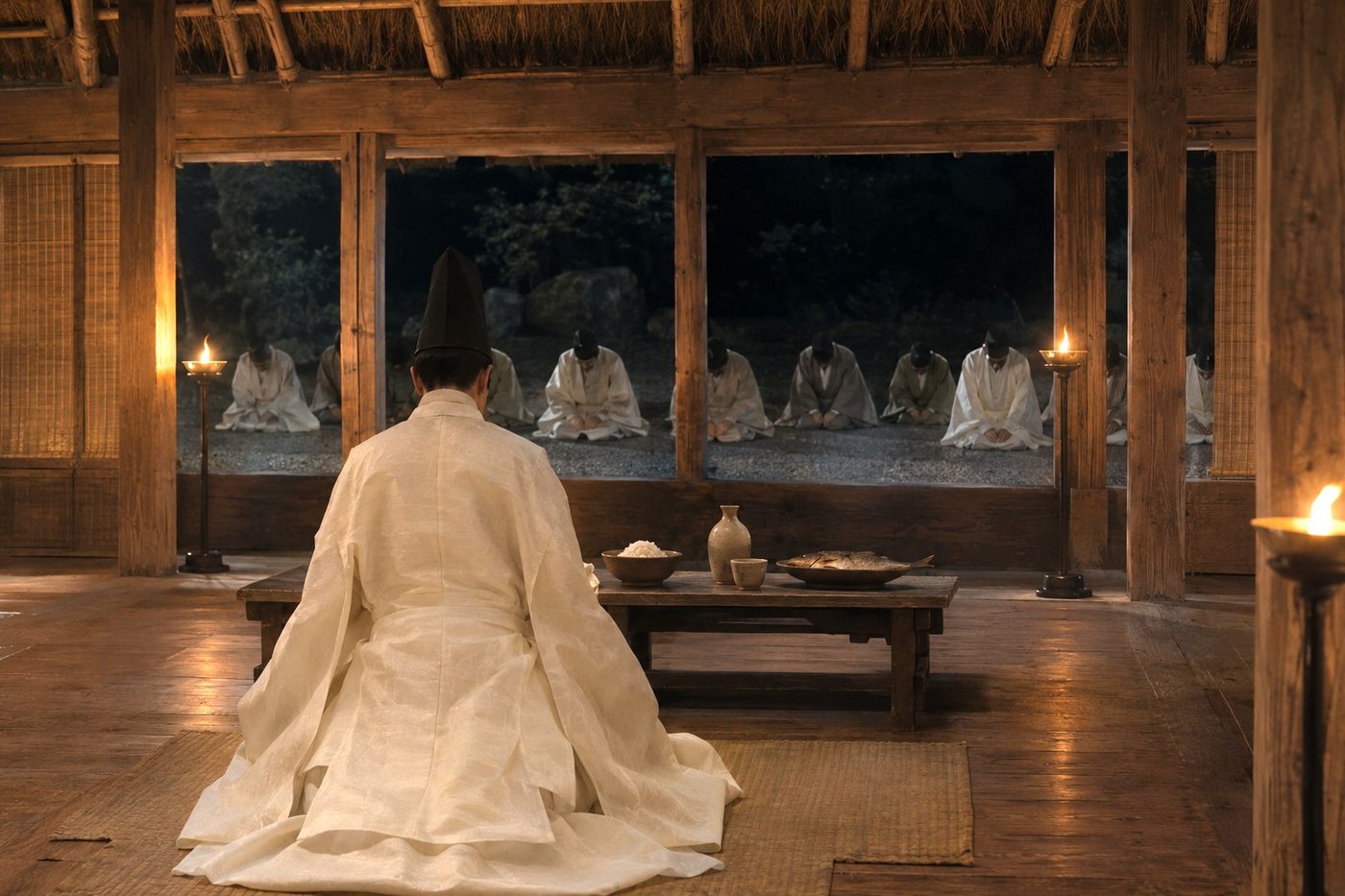
The Emperor's first duty is not to govern. It is to keep faith with the gods. Through the year he performs a cycle of great rites, each on a day the Bureau of Yin and Yang chooses, each in a precinct kept perfectly pure, and each with offerings that the provinces are bound to send. Everyone in Tsurugishima believes that these rites keep the harvest growing, the fires banked, and the angry dead at rest. In Blade and Kami™, they do.
| Month | Rite | What it keeps |
|---|---|---|
| First, at dawn of the new year | Worship of the Four Directions (shihōhai): the Emperor bows to heaven, earth, the four quarters, and the tombs of his ancestors | The realm safe from great disasters for the year |
| Second | Prayer for the Year's Harvest (kinensai): offerings sent from the palace to every first shrine in the realm | The rice planting and the rains |
| Sixth and Twelfth | Great Purification (ōharae): the court and the city are cleansed of the half-year's pollution, carried away on the river | The land's pollution from building up |
| Sixth and Twelfth | Pacification of Fire (chinkasai): the kami of fire are fed and calmed at the four corners of the palace | The cities from great fires |
| Ninth | Offering of First Rice (kannamesai): an Imperial envoy carries the first rice of the year to the great shrine of the Forging Gods | The gods' favor toward the Imperial line |
| Eleventh | Calming of the Soul (chinkonsai): the Emperor's own spirit is renewed so that it can bear the realm through winter | The Emperor's health, and the realm's |
| Eleventh | Tasting of the New Rice (niinamesai): the Emperor offers the new harvest to the gods and eats it with them, alone, through the night | The bond between the gods, the Emperor, and the land. The greatest rite of the year. |
Smaller offerings are made every month, and once in each reign a new Emperor performs the Great Tasting, a vast version of the New Rice rite that seals his reign. Until it is done, he is not fully Emperor in the eyes of the gods.
What can go wrong. A rite fails when it is performed on the wrong day, in a polluted precinct, by a polluted priest, without its offerings, or not at all. Death, blood, or violence inside the palace walls pollutes it. A curse can mar it. So can poverty: the offerings come from the provinces as tribute, and in the warring years many lords have stopped sending them. The court quietly lets a rich lord pay for a rite that his neighbors neglected, and remembers his generosity. Lords who want to hurt the throne, or a rival who depends on it, have learned that a rite can be spoiled without ever touching the Emperor.
When a rite fails. Word spreads within a season, through omens nobody can ignore. For the season that follows (a year, for the New Rice, the Great Purification, or the Four Directions):
- Every domain in the realm draws two cards for each Clubs event and keeps the lower (Chapter 5).
- The rite's own harm falls. A failed Pacification of Fire brings a great fire in a city of the GM's choice. A failed Purification lets pollution gather: rinsing and salt can't cleanse a hero below Touched, and only a priest's rite can (Chapter 4). A failed Calming of the Soul makes the Emperor ill. A failed New Rice rite puts one province, chosen by the GM or by divination, into a Shrine Favor crisis (Chapter 5).
- The spirits wake further. The yōkai, the restless dead, and the rough spirits of the kami grow bolder everywhere. Fear checks they cause are made at a further –1 until the next rite of the same kind succeeds. This stacks with the Hakobore track's Fear penalty (Chapter 7), to no worse than –3 in all.
Guarding a rite, finding the stolen offering, cleansing a polluted precinct in the night before the dawn, or catching the diviner who chose a false day all make fine Savage Tales. Chapter 7 says what the rites truly hold back.
The Cloistered Emperor#
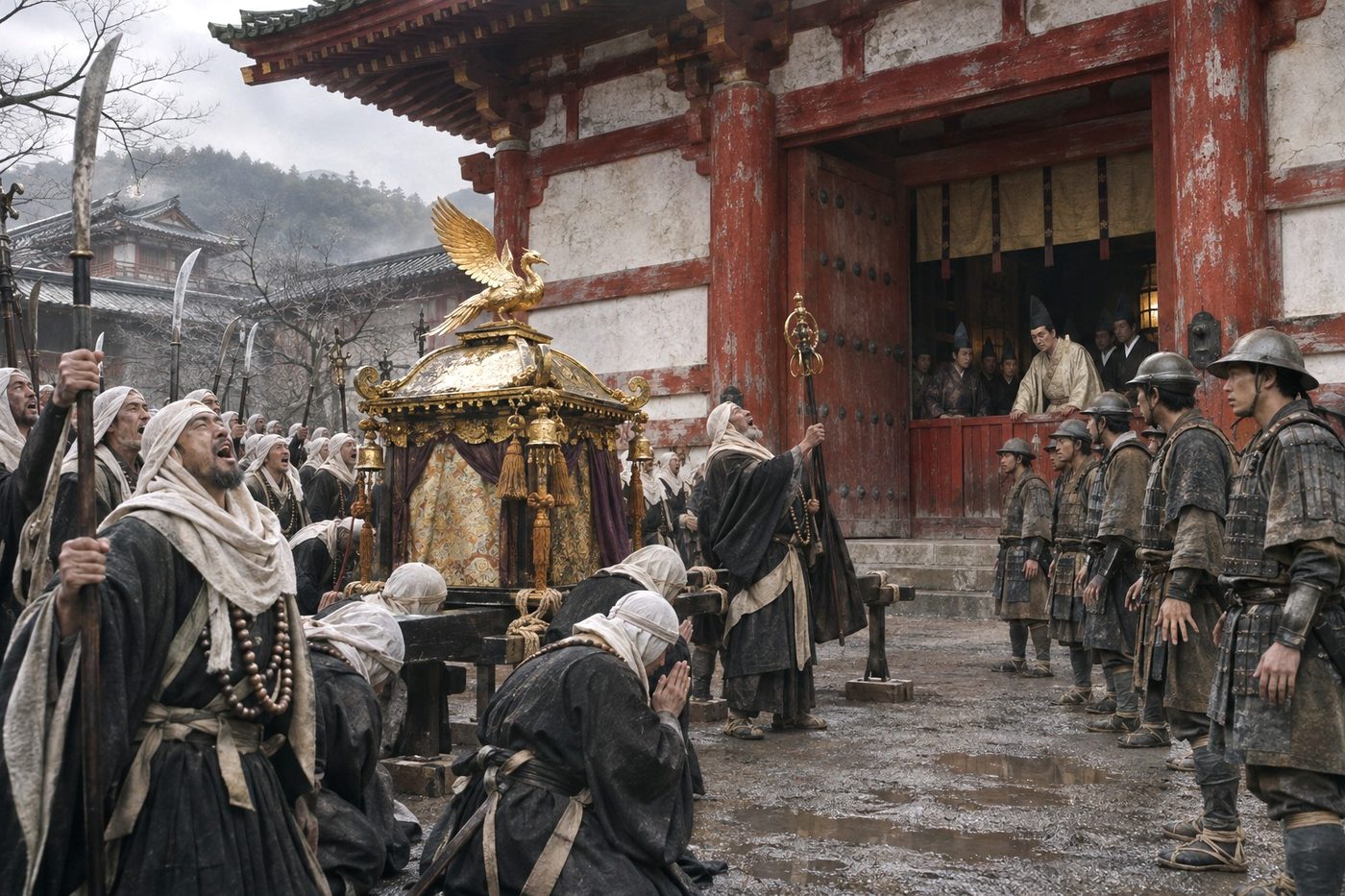
For centuries the Akebana regents made Emperors abdicate young, so that a child would reign and an Akebana grandfather could rule. The Emperors learned to answer in kind. A retired Emperor takes Buddhist vows and moves into a cloister in the temple hills. Freed of the throne's endless ceremony, he can do what a reigning Emperor can't: keep his own office and stewards, hold estates, receive envoys, and issue his own decrees (inzen), which the court obeys as readily as it obeys the throne, and sometimes more readily.
Today's Cloistered Emperor is the reigning Emperor's father. He is shrewd, worldly, and in no hurry to reach the Western Paradise. He has two great weapons:
- The warrior monks. The Cloister is the greatest patron of Thunder Peak, and its head temple, Raihō-ji, stands just over the hills in Hōzuki. When the Cloistered Emperor is displeased, the monks are displeased.
- His son's ear. The reigning Emperor seldom acts against his father's wishes.
The descent of the palanquin. When Thunder Peak wants something from the court, its warrior monks march down from the mountains carrying the sacred palanquin of their mountain kami, and set it down before the palace gate. No soldier dares touch it, because to strike the god's palanquin is sacrilege and to block its path is worse. The monks stay, chanting, until the court gives way. It has given way every time but one, and that time the city burned. A hero who harms the palanquin or the monks carrying it loses 4 Honor and gains two steps of pollution (Chapter 4), whatever their reason.
The Cloister and the Regent are rivals, and their rivalry is the court. The Regent controls the offices, the ranks, and the paperwork. The Cloister controls the monks and, often, the Emperor's mind. A lord who wants something from Seikyō must win one of them and keep the other from blocking it.
The Court Families#
Behind the Regent and the Cloister, a few dozen court families compete for offices, marriages, and the gifts of provincial lords. Three matter most:
- The Akebana, the regents' family. Their five branch houses hold most of the high offices, and an Akebana daughter is always married to the Emperor or his heir. They sell ranks and titles to any lord who pays, and they are the only family in the realm older and prouder than the Kagamino. Their head is the Regent, Akebana Tsunemaro.
- The Mitsuhara, a minor family raised up by the Cloister to run its office. Its head, the Cloister's steward Mitsuhara Akimaro, is clever, low-born by court standards, and hated by the Akebana. Whoever wants the Cloister's decree must get past Akimaro's door.
- The Tachieda, keepers of ritual precedent. They know the forms of every rite, robe, and bow back to the founding of Seikyō, and no rite is performed without a Tachieda master of ceremonies. Their head, Tachieda Masunari, is a frail old man who is the single most important person in every rite of the year. Both the Regent and the Cloister court him, and anyone who wanted to spoil a rite would start with him.
Dozens of poorer families scrape by on court stipends, teaching, and introductions. Many have taken refuge with provincial lords, as the Sainami have in Kurogane (Part 1), where they lend their hosts the court's glamour and send news back to Seikyō.
Court intrigue uses the rules for etiquette, gifts, insults, and duels of words in Chapter 4. A campaign set in Seikyō can be a game of its own: little blood is spilled at court, but reputations, marriages, titles, and lives are lost there every season.
What the Throne Can Give#
The Emperor rarely acts. When he does, the whole realm feels it. Each act below needs the Emperor's seal, and in practice the agreement of the Regent or the Cloister, and preferably both.
| Act | What it does |
|---|---|
| Court rank or title | Raises a lord or hero to a court rank, or names them governor of a province. The title gives no land, but everyone who cares about rank must address the holder by it. A hero granted court rank joins the court's ladder (Chapter 2) as well as their own group's. |
| The Shogun's commission | Appoints a Shogun. Only the Emperor can do it, which is why Sadatsugu's allies court the Regent and the Shikken watches the Cloister. |
| A prayer for victory | An Imperial prayer offered for one side in a war. In a mass battle (Chapter 5), the blessed army adds +1 to its Morale rolls. |
| Recall or displeasure | The Emperor withdraws a title, recalls an official, or lets it be known that he is displeased with a lord. The lord's allies grow cold: the GM may apply –2 to Persuasion rolls with them until the lord makes amends. |
| Naming an enemy of the court | An Imperial order names a lord an enemy of the court (chōteki). Anyone who fights that lord fights for the throne. The lord's domains roll Loyalty one die type lower until the order is lifted, and his retainers may leave his service without loss of Honor (Chapter 5). The order is the throne's heaviest weapon, and it has been used only three times in 12 centuries. |
| Pardon | The Emperor pardons a crime, lifts an order, or restores a disgraced house. Few dare to refuse an Imperial pardon. |
Serving the Emperor#
To serve the Emperor in person is the highest honor in the isles. A hero who carries out the Emperor's own command, saves an Imperial rite from failure, or protects the Emperor, his family, or the sacred treasures of the throne gains Honor (Chapter 4) by how high the news climbs: +3 when the deed becomes known, +4 when the court proclaims it in a proclamation or address by the Regent or the Chancellor, and +5 if the Emperor himself mentions it, even in passing. No other deed in the isles is worth as much, and a court rank usually comes with it. Every group in the realm that cares about Honor treats such a hero with respect, whatever their blossom.
The reverse is just as true. A hero who spoils a rite, harms the Emperor's messenger, or strikes inside the palace walls loses 4 Honor or more, and risks being named an enemy of the court in their own right.
People of Seikyō#
| Name | Who they are | Side |
|---|---|---|
| The Emperor | The realm's high priest, unnamed and seldom seen | None, officially |
| Akebana Tsunemaro | The Regent, head of the Akebana, and the court's chief power broker | Whoever pays |
| The Cloistered Emperor | The Emperor's father, retired into vows, and master of the warrior monks | His own |
| Mitsuhara Akimaro | Steward of the Cloister, the Regent's rival | The Cloister's |
| Tachieda Masunari | Master of ceremonies for every Imperial rite | The rites' |
| Watanaga Narimaro | Head of the Bureau of Yin and Yang | The court's |
| Uchimori Shigetane | The Shogun's Deputy at Seikyō | Red |
| Kagamino Tomokiyo | The Shogun's sidelined uncle | Red, for now |
Rumors in Seikyō#
| d6 | Rumor |
|---|---|
| 1 | "The Regent has sold Sadatsugu a court title, and Kuzuhara the same title a month later." (T) |
| 2 | "The Emperor is ill and has no adult heir." (F) He is in good health. The rumor is spread by someone who wants a succession crisis. |
| 3 | "Lord Tomokiyo means to change sides." (F) Not yet. But he is listening. |
| 4 | "The oni of the Southern Gate took a court noble's son last month, and the family hushed it up." (T) |
| 5 | "The diviners have closed the eastern direction for the whole of next year." (T) That forbids any lord who heeds them to march east from Seikyō, toward Kurogane. |
| 6 | "The palace treasury is empty, and the court will sell anything." (T) |
Savage Tale Hooks#
- A provincial lord hires the heroes to carry a gift to the court and come back with a title. The gift is stolen on the Avenue of Willows.
- The oni of the Southern Gate has taken a hostage, and the Deputy offers a reward for its head.
- Kagamino Tomokiyo asks the heroes to carry a sealed poem to a lord of the white plum. He says it is only a poem.
- The offerings for the Tasting of the New Rice were never sent from the provinces. The rite is in nine days, and the heroes must find the rice, the silk, and the sake, and get them past three barriers and a lord who wants the rite to fail.
- Tachieda Masunari collapses during the Great Purification. Was he poisoned, cursed, or simply old? Whatever the answer, someone must finish the rite before dawn.
- Thunder Peak's monks are carrying their palanquin down to the palace gate to stop the court granting Sadatsugu a title. Both blossoms want the heroes to make sure the descent succeeds, or fails.
Hagane, the Fortress of Steel#
| Province | Kazahaya, in Higashiji (the East Road) |
| People | About 70,000, many of them soldiers and their families |
| Extent | About an hour's walk from the castle to the far end of the wharves |
| Forces | The heart of Kazahaya's muster (Part 3): the Shogun's housemen, the Sekigawa spearmen, and the home port of the war fleet |
| Ruled by | Shogun Kagamino Tomoharu, through the three offices of the Shogunate |
| Allegiance | Red plum |
| Known for | The Shogun's castle, the Hagane Code, the war fleet, and discipline gone to seed |
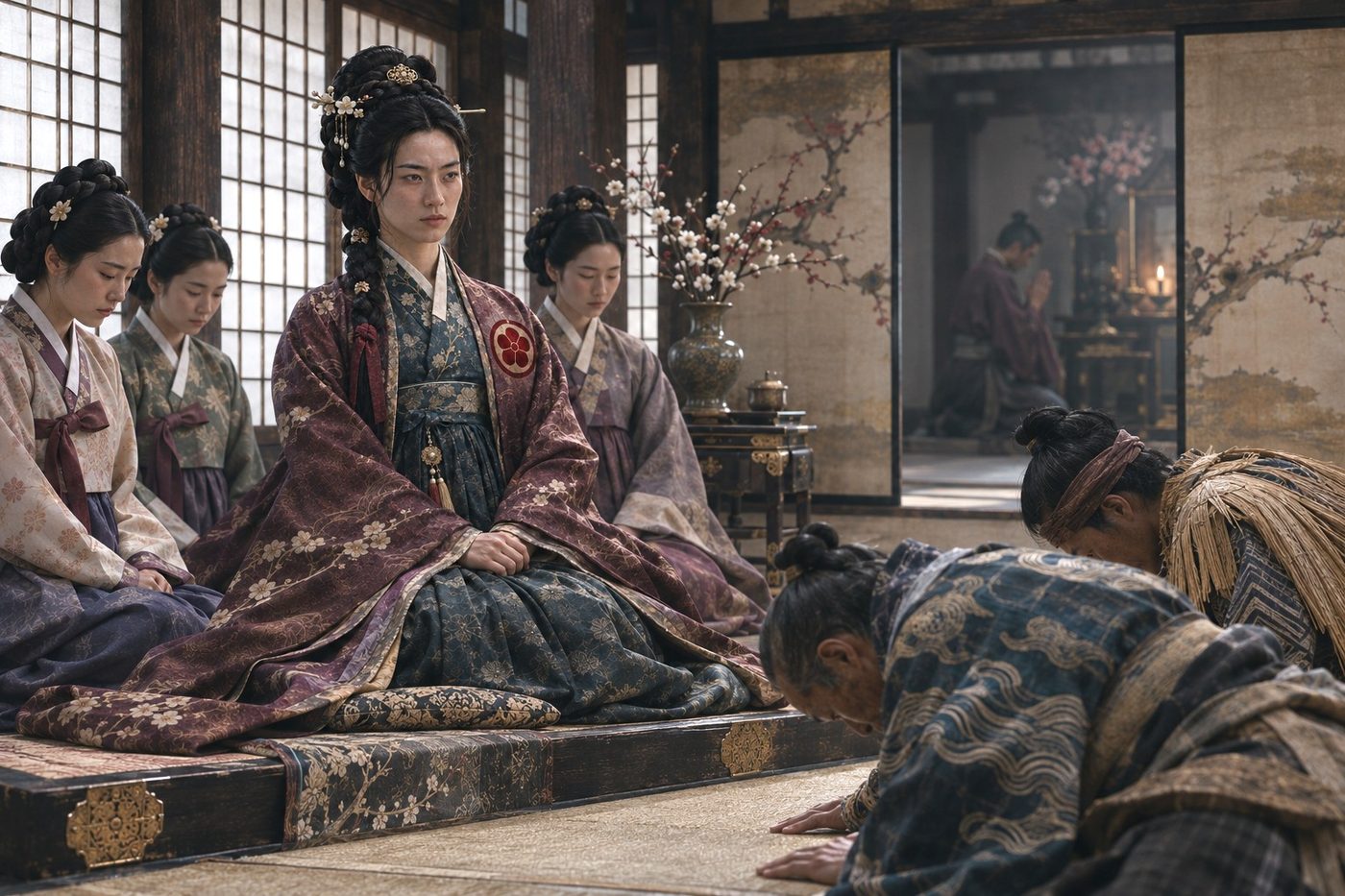
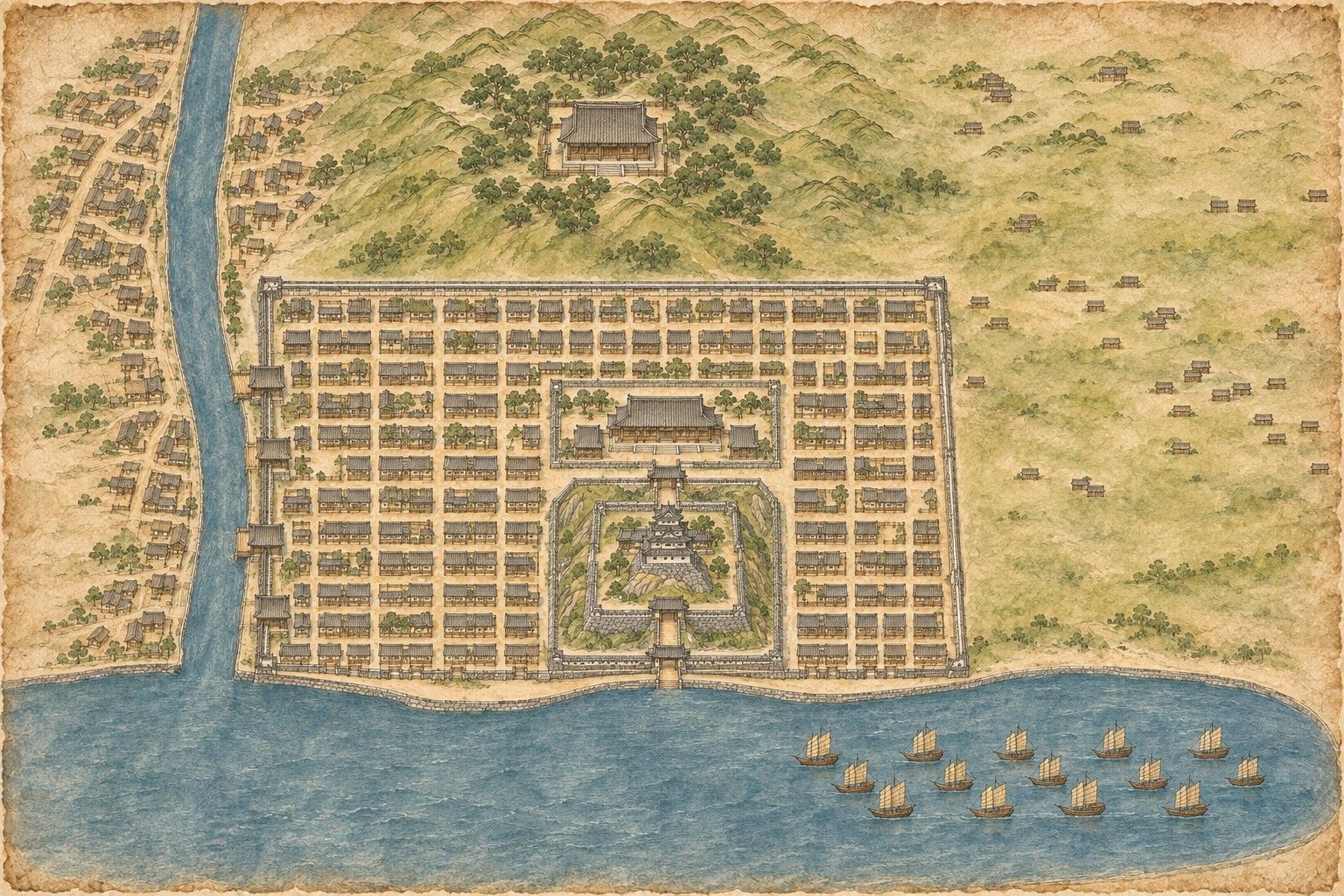
Hagane stands where the eastern plains meet a broad, sheltered bay. Behind it stretch the Mirror Fields, the grasslands that gave the Kagamino their name and still breed the Shogun's horses. In front of it lies the harbor, where the Shogun's war junks ride at anchor behind a stone breakwater. Between them, the city crowds inside stone walls and a moat, and above it all, on a crag of gray stone at the water's edge, rises the Shogun's castle.
Hagane was built as a fortress, and it still looks like one: gray, stern, and orderly, with straight streets laid out for marching. For three centuries it was the true center of the realm. Today its offices are half-empty, its fleet is half-manned, and its soldiers are unpaid. The Shogun prays, the Shikken governs from Kanagura, and Hagane waits to learn what it is for.
Districts and Places#
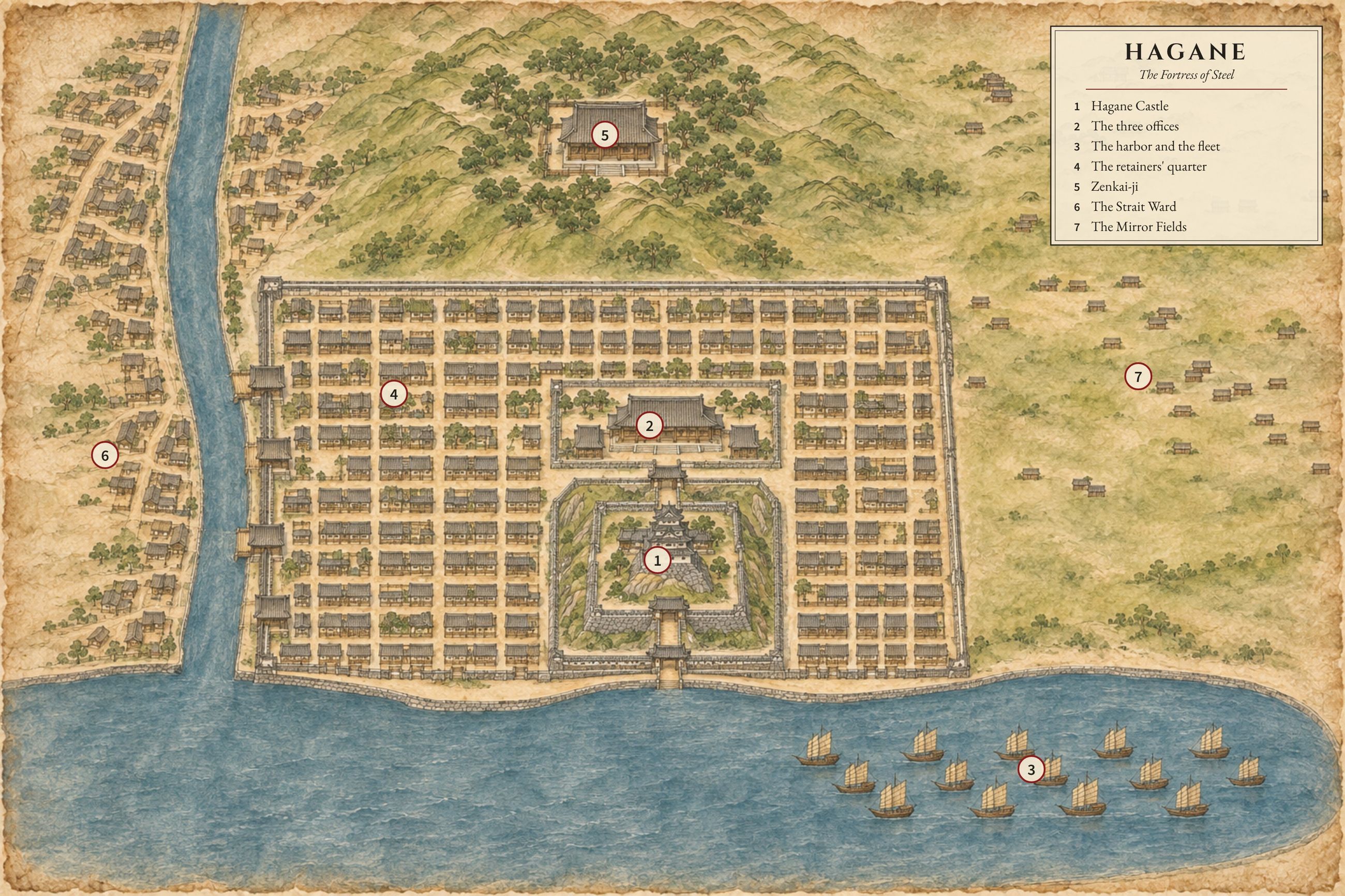
1. Hagane Castle. The Shogun's castle covers a whole crag above the harbor: sloping walls of fitted gray stone, gate towers, a water gate where boats enter the inner moat, and a great dark keep. The Shogun's residence lies in the inner ring, with its audience halls, gardens, and a private chapel where Tomoharu spends his mornings in prayer. Lady Hyoseon keeps her own court in the eastern wing, with her Cheongun ladies and guards, and receives more visitors than her husband does.
2. The three offices. Below the castle stand the halls of the Shogunate: the Mandokoro (finance and lands), the Samurai-dokoro (retainers and justice), and the Monchūjo (appeals and lawsuits). Lines of petitioners wait outside the Monchūjo every day with lawsuits over land, some of them a generation old. The head of the Samurai-dokoro, Hatamori Yoshichika, is an old soldier who served under the late Shogun Tomonori, despises the Shikken, and is very carefully saying nothing about Sadatsugu.
3. The harbor and the fleet. The Shogun's fleet of 60 war junks and 100 transports rides in the harbor, under the command of the Shogun's admiral, Shimanaga Kageyuki. The fleet carried the armies to Cheongun and brought them home, and it can land an army anywhere in the isles faster than any lord can march. Half its ships need repair, and its sailors are owed six months' pay. Whoever pays them will have the fleet.
4. The retainers' quarter. The Shogun's housemen and retainers live in long streets of walled houses near the castle. Many of the houses are empty: their families went home to the provinces when the stipends stopped. Those who remain practice archery in the mornings, drink in the evenings, and argue about the blossoms all night.
5. Zenkai-ji. The great Still Mind temple of Hagane, on a wooded hill north of the city, where the sons of the Shogun's housemen learn meditation, calligraphy, and the tea ceremony. The Shogun visits it often. Its abbot is the Shogun's closest friend and confessor, and the Shikken's spies watch everyone who comes to see him.
6. The Strait Ward. Outside the walls, along the river, a sprawl of shacks and taverns houses the veterans of the Cheongun War who came home to nothing. They call themselves the Strait Men, wear their old war badges, and hate the Shikken with a pure, patient hatred. Some sell their swords. Many wear the white plum. The city's constables don't enter the Strait Ward, and the Strait Men keep their own order there.
7. The Mirror Fields. The grasslands behind the city, where the Shogun's horse herds run and the housemen practice mounted archery. An old burial mound in the fields, said to be the first Shogun's, is a place of pilgrimage for warriors of both blossoms.
People of Hagane#
| Name | Who they are | Side |
|---|---|---|
| Kagamino Tomoharu | The fifteenth Shogun, gentle and pious | Red |
| Lady Hyoseon | The Shogun's wife, a princess of Cheongun, and the will behind the throne | Red |
| Hatamori Yoshichika | Head of the Samurai-dokoro, an old soldier | Red, outwardly |
| Shimanaga Kageyuki | The Shogun's admiral, commander of an unpaid fleet | Undecided |
Rumors in Hagane#
| d6 | Rumor |
|---|---|
| 1 | "The Shogun talks to people who aren't in the room." (T) Chapter 7 explains why. |
| 2 | "Lady Hyoseon is a spy for Cheongun." (F) She is loyal to her husband, and to her own ambitions. |
| 3 | "The admiral has been meeting Sadatsugu's men." (T) He hasn't decided yet. |
| 4 | "The Shikken plans to move the Shogun to Kanagura, for his safety." (T) |
| 5 | "The first Shogun's mound bled on the anniversary of the Usurpation." (F) It was red paint, put there by Strait Men. |
| 6 | "The Strait Men are drilling with spears at night." (T) |
Savage Tale Hooks#
- Lady Hyoseon needs someone outside the castle's walls to find out who is poisoning her husband's dreams.
- A Strait Man the heroes fought beside in Cheongun asks for help: the Shikken's men have marked his ward for burning.
- The admiral wants a message carried to Sadatsugu, and a second, contradicting message carried to the Shikken, by the same heroes.
Kanagura, the Gold Storehouse#
| Province | Miyabi, in Uchikuni (the Inner Provinces) |
| People | About 140,000, the largest city in the realm |
| Extent | Nearly two hours' walk along the waterfront |
| Forces | The Shikken's castle guard of 1,000 veteran samurai and three companies of matchlock gunners, the core of Miyabi's muster (Part 3), with the Lion's Roar townsmen armed in their own wards |
| Ruled by | Shikken Ōtaki Kiyoaki, from his great castle |
| Allegiance | Red plum, in the Shikken's own color of it |
| Known for | Money, merchants, the greatest castle in the isles, and hostages |
Kanagura sits at the mouth of the river below Seikyō, where the Inland Sea's shipping meets the road to the capital. Rice, salt, iron, timber, silk, and coin pour through its harbor, and the Shikken taxes all of it. Its streets are crowded, loud, and rich, lined with the white plaster storehouses that give the city its name. Above them rises the Shikken's castle, ring upon ring of stone walls and white towers, crowned by a five-story keep with black walls and gold-tipped roofs that catches the sunset like a second sun.
Kanagura has replaced Hagane as the place where the realm's business is done. Lords who want a ruling, merchants who want a license, and petitioners who want justice all come here, and all of them bring gifts.
Districts and Places#
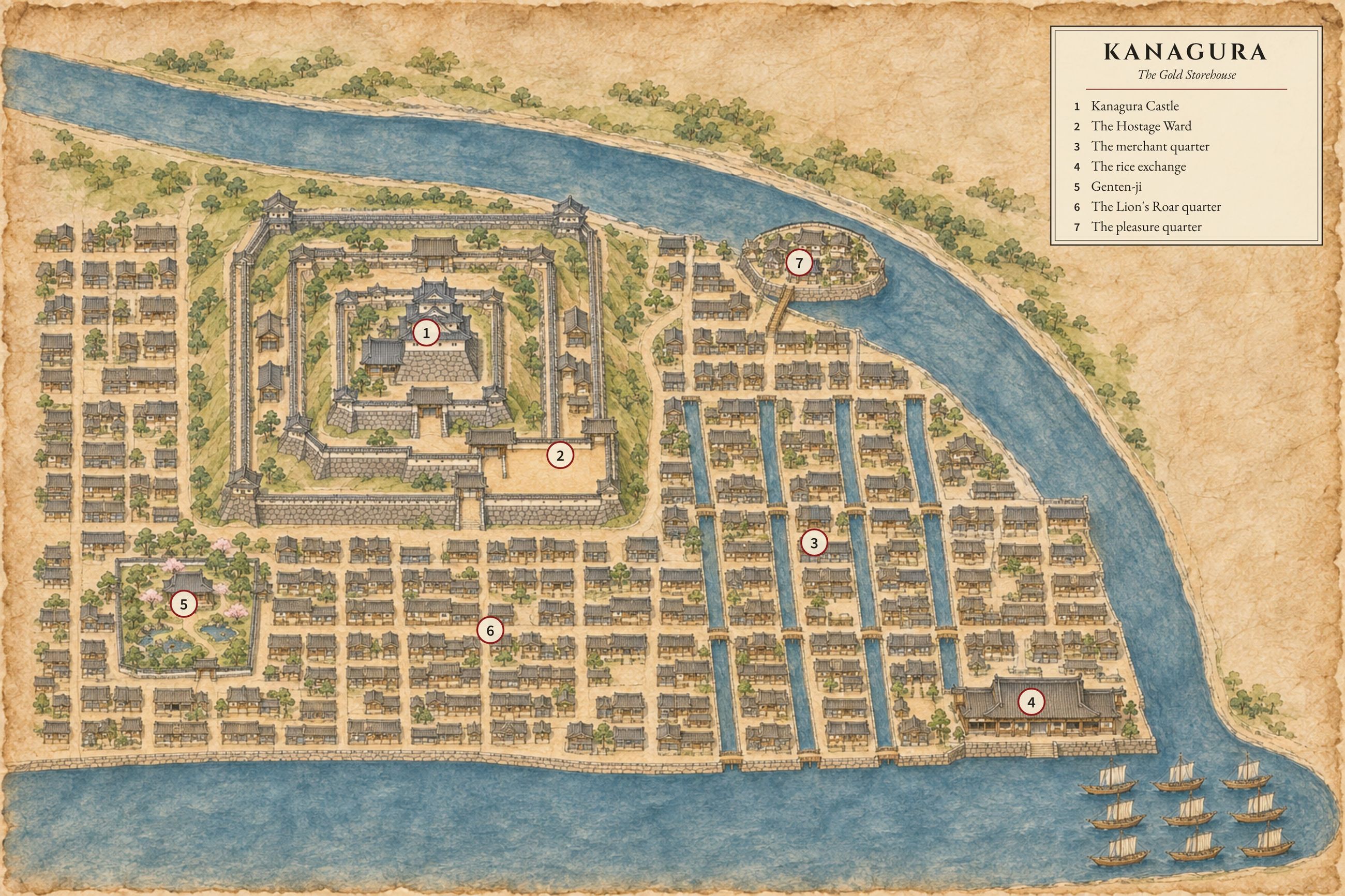
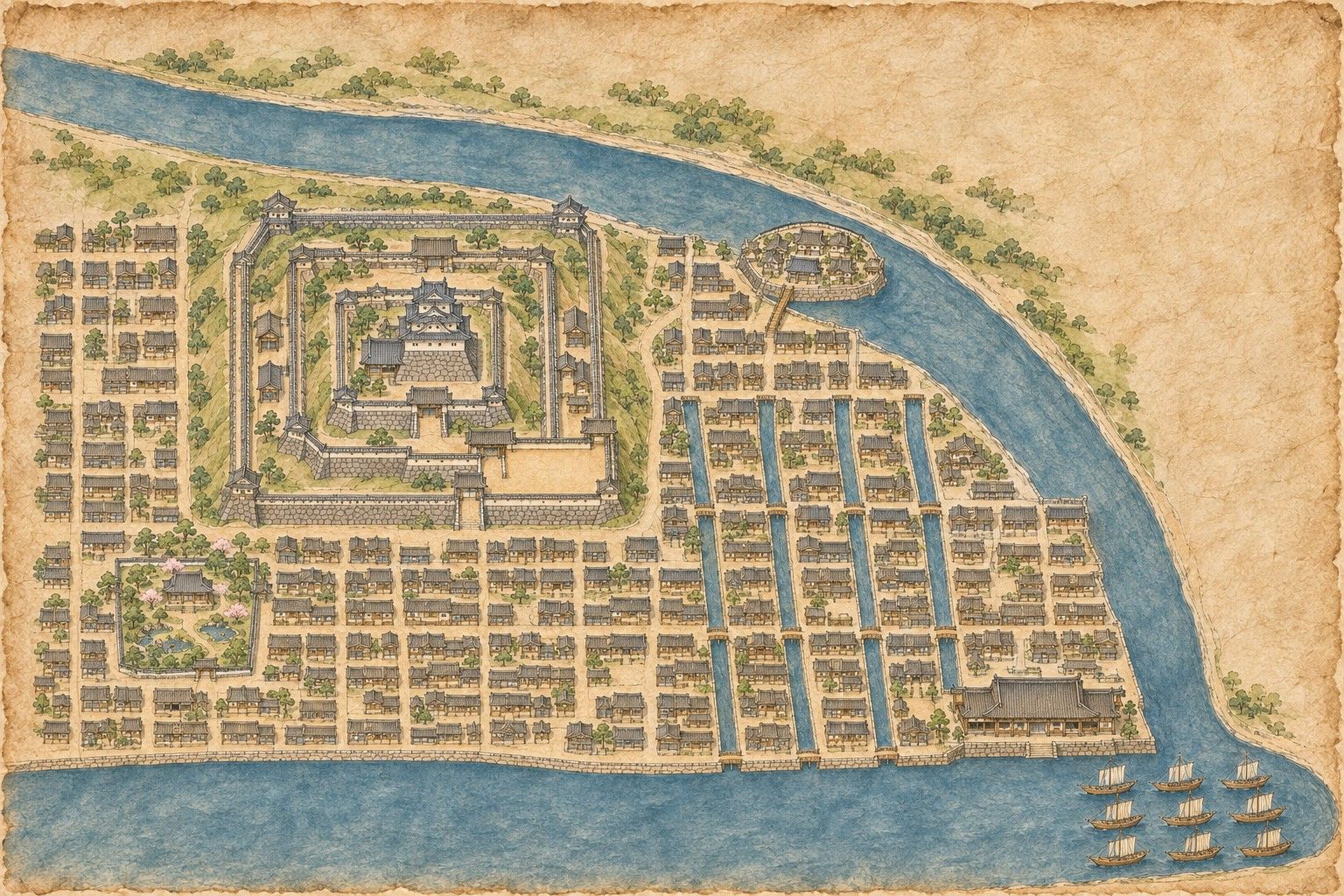
1. Kanagura Castle. The greatest castle in Tsurugishima: three rings of stone walls and moats, 20 gate towers, storehouses for a three-year siege, and the gold-roofed keep. The Shikken rules from the audience hall of the inner ring, surrounded by his relatives, who hold every post that pays. No army has ever tested the castle's walls, and no lord wants to be the first.
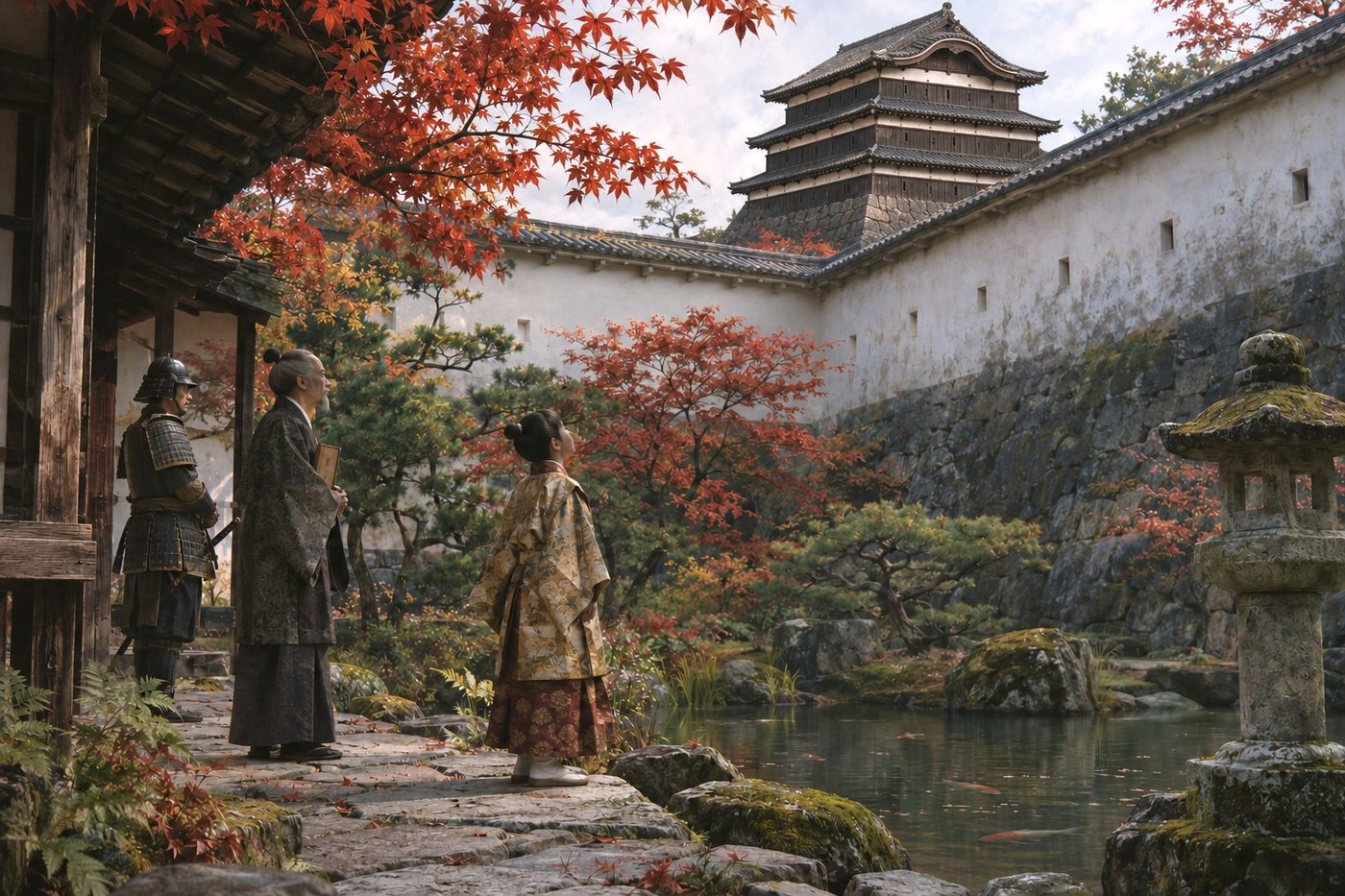
2. The Hostage Ward. A walled district of fine mansions inside the castle's outer ring, where the Shikken keeps the "honored guests" of the great clans: sons, daughters, wives, and mothers of lords whose loyalty he doubts. Each lives in comfort, with servants, tutors, and guards who never leave. Among them is Botanmaru, the boy heir of Kurogane (Part 1). If a lord rebels, his hostage dies. Everyone knows it, and no one says it.
3. The merchant quarter. Along the canals that run from the river to the harbor, the great merchant houses keep their shops, storehouses, and counting rooms. The Council of Ten Houses, the city's merchant elders, governs the wards, the markets, the fire watch, and the city's money, under the Shikken's license. Its chief is Jinbei of the house of Toyonaga, a rice and silk broker so rich that the Shikken borrows from him. The Council can raise a ward militia in an hour, and its members fear only two things: fire and a change of masters.
4. The rice exchange. A great open hall by the harbor where rice brokers buy and sell next year's harvest with shouts, hand signals, and slips of paper. Fortunes are made and lost here in a day. A lord who wants to know whether a rival can feed an army watches the rice exchange, not the rival.
5. Genten-ji. The great Still Mind temple of Kanagura, built with the Shikken's money, where he and his household worship and where the sons of his allies are educated. Its gardens are the most famous in the realm, and the tea served there is the best. Business is done in its tea rooms that is done nowhere else.
6. The Lion's Roar quarter. Kanagura's artisans and townsmen are fierce followers of the Lion's Roar sect. Their preachers beat drums on the street corners, denounce every other sect, and organize the townsmen into armed brotherhoods that guard the wards against Western Light leagues and robbers alike. The Shikken tolerates them because they keep the city's poor busy and his enemies' preachers out.
7. The pleasure quarter. A walled island in the river, reached by a single bridge, with teahouses, theaters, and the houses of courtesans, lit all night. Officials, merchants, and samurai meet there as equals, and say things they would never say at court. The quarter's underworld boss knows the price of every official in the city, and sells the list.
People of Kanagura#
| Name | Who they are | Side |
|---|---|---|
| Ōtaki Kiyoaki | The Shikken: greedy, clever, and hated | Red (his own) |
| Ōtaki Munetane | His eldest son and heir, master of the castle's guard | Red |
| Jinbei of Toyonaga | Chief of the Council of Ten Houses, the Shikken's banker | Whoever repays |
| Botanmaru | The boy heir of Kurogane, an honored hostage | Unwilling |
Rumors in Kanagura#
| d6 | Rumor |
|---|---|
| 1 | "The Shikken is buying up the rice harvest to starve Sadatsugu's allies." (T) |
| 2 | "One of the hostages escaped last month, and a servant was executed in her place." (T) |
| 3 | "The Shikken's son plots against his father." (F) Munetane is utterly loyal. The rumor comes from the Shikken's nephews, who would like to be heir. |
| 4 | "The Council of Ten Houses has sent money to Sadatsugu, just in case." (T) |
| 5 | "The keep's gold roof tiles are only gilt lead." (F) They are real gold, which is why the Shikken never lets anyone up there. |
| 6 | "A fire in the merchant quarter would ruin the Shikken in a night." (T) And someone has thought of it. |
Savage Tale Hooks#
- A lord hires the heroes to get his daughter out of the Hostage Ward before he declares for the white plum.
- Jinbei of Toyonaga needs a shipment of silver guarded from Kanagura to Hagane, and it is not his silver.
- Botanmaru smuggles a letter out of the Hostage Ward, addressed to his mother at Matsunoki Convent in Kurogane. The heroes are the only ones who can carry it.
Umikado, the Sea Gate#
| Province | Akashio, on Kissaki-jima (the Point) |
| People | About 50,000, including several thousand foreigners |
| Extent | An hour's climb from the harbor to the temples on the hills |
| Forces | Lord Takekuni's 300 foreign matchlocks, the core of Akashio's muster (Part 3), and the Port Commissioner's guards |
| Ruled by | The daimyo of Akashio, with the Shikken's Port Commissioner beside him |
| Allegiance | Red plum, uneasily |
| Known for | Foreign ships, firearms, the Teaching of the Black Book, Daqian goods, and pirates |
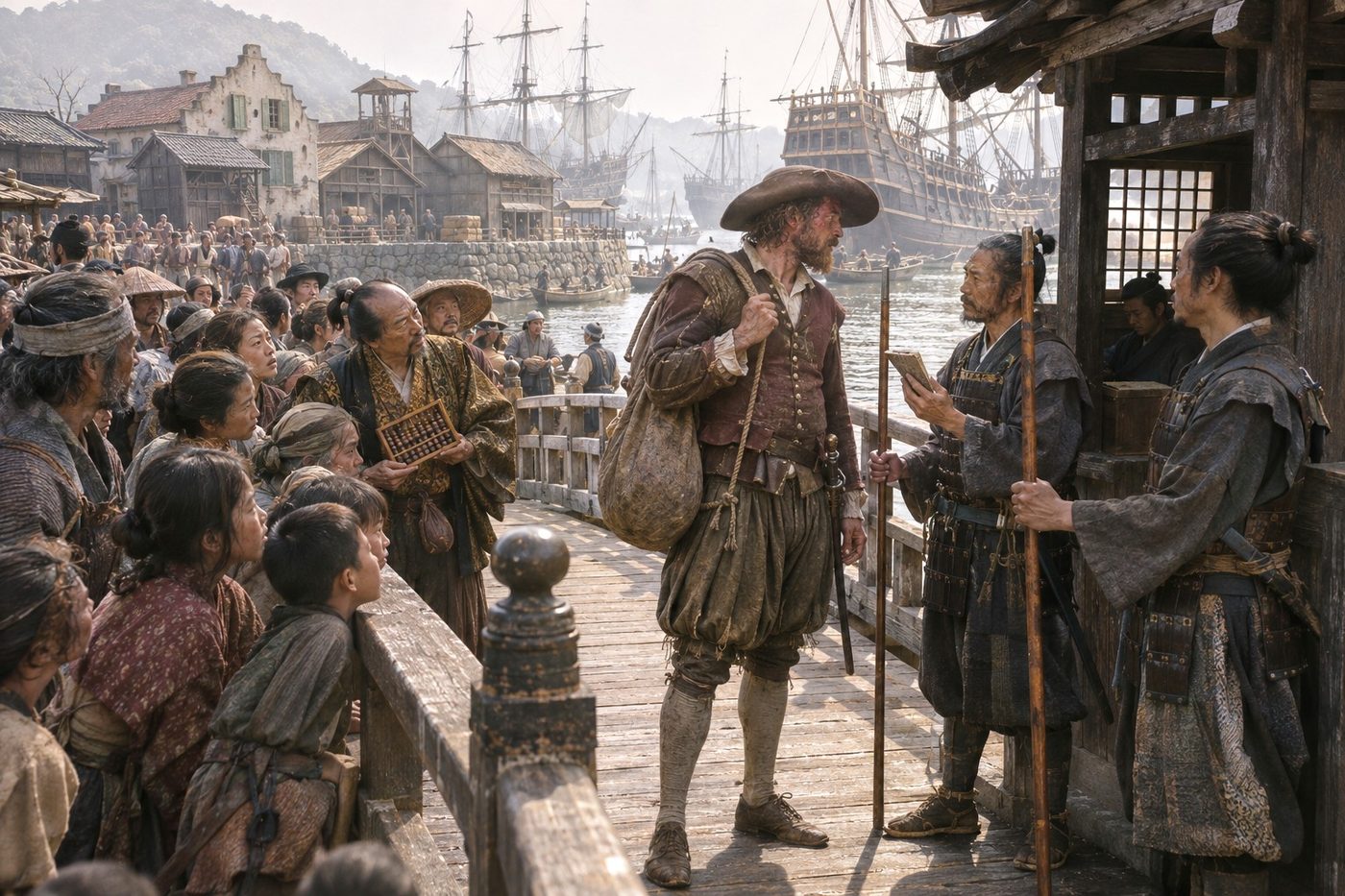
Umikado lies in a deep, mountain-ringed bay on the western coast of Kissaki-jima, the realm's nearest harbor to Daqian and Cheongun. Junks from the mainland have put in here for a thousand years. In the last 10 years, they have been joined by the great black ships of the far westerners, ijin ("strangers") to the islanders, who come from beyond Daqian with firearms, glass, wine, clocks, and the Teaching of the Black Book. Umikado's streets climb the hills from the harbor in steep lanes, and every lane smells of something foreign: incense, gunpowder, roasting meat, or tar.
Umikado is the realm's busiest harbor and its most dangerous. Everything new reaches the isles here first, and the temples, the Shikken, and the daimyo all want to control what comes through.
Districts and Places#
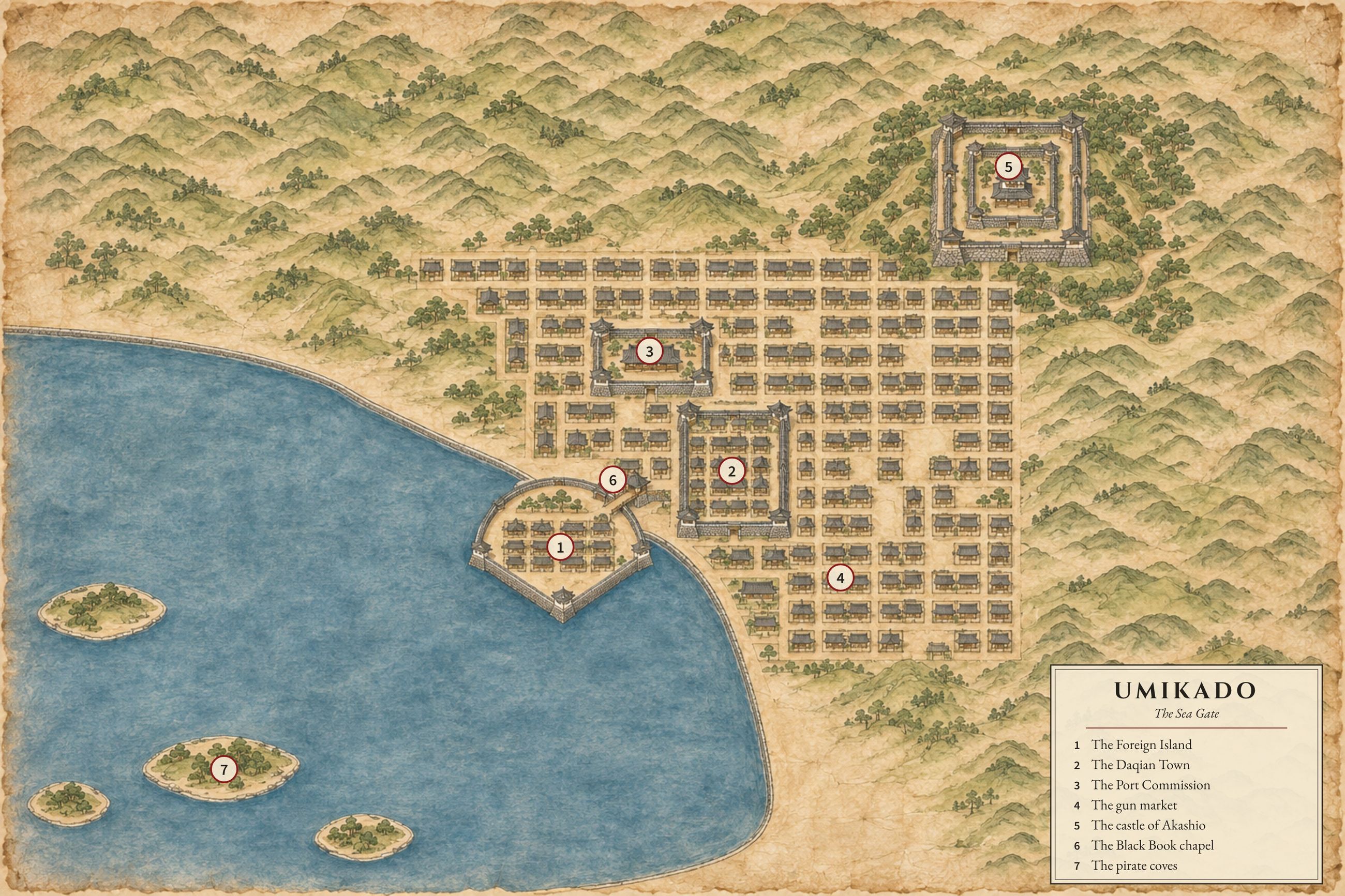
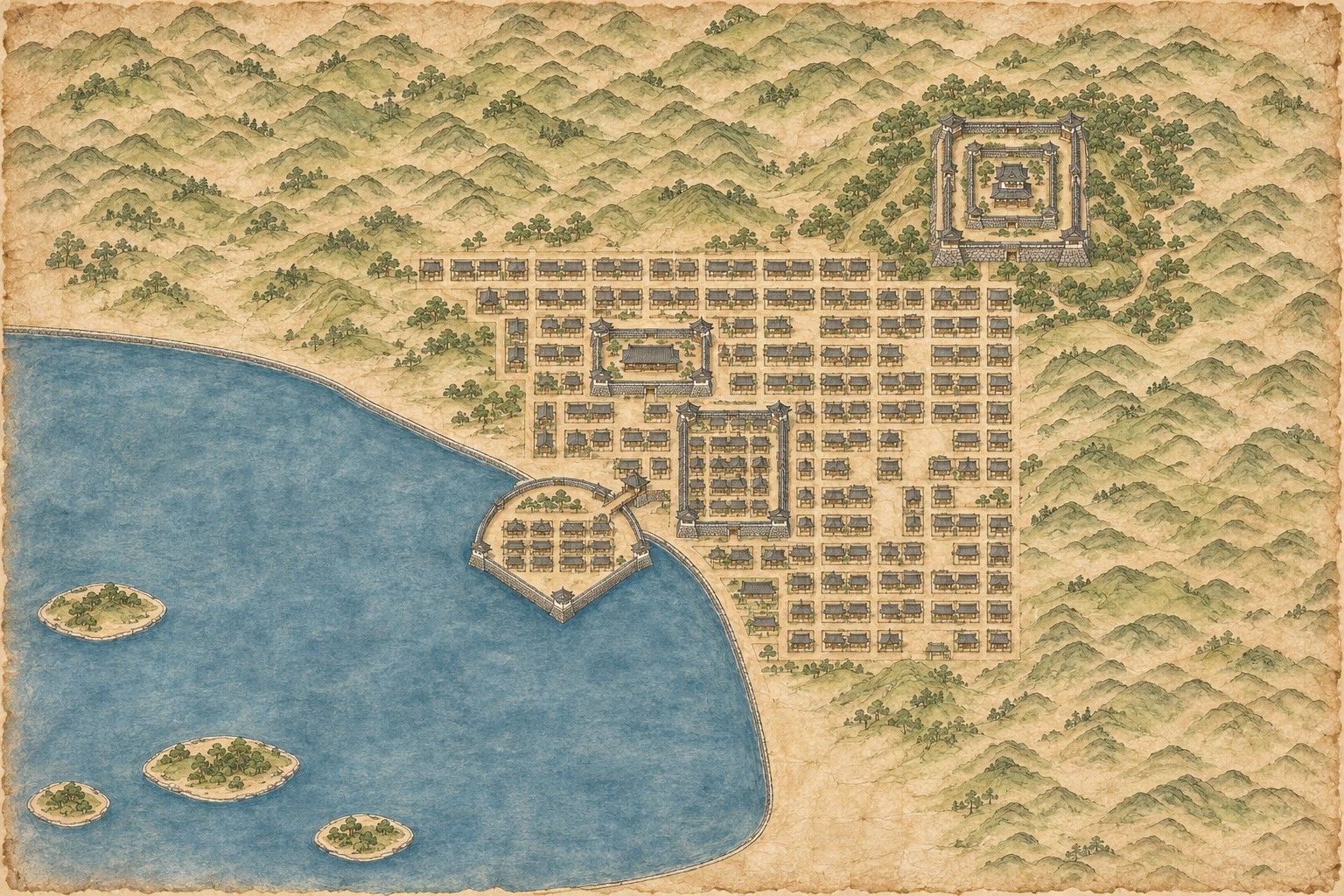
1. The Foreign Island (Ijin-jima). A fan-shaped island built of fill and stone in the harbor, linked to the city by a single guarded bridge, where the far westerners must live and trade. Its walls hold their warehouses, lodgings, and a chapel of the Black Book. No foreigner may cross the bridge without the Port Commissioner's leave, and no islander may cross it without a pass. Both rules are broken every night.
2. The Daqian Town. A walled ward of red lacquered gates, mainland temples, and tile-roofed shops, where Daqian merchants and their island-born families have lived for generations. Its elders are led by Gao Hongde, a silk and porcelain trader who speaks four languages and lends money to the daimyo. The Daqian Town is older than the Foreign Island and looks down on it.
3. The Port Commission. A fortified hall above the harbor where the Shikken's Port Commissioner, Asanaga Ujimoto, taxes every cargo, licenses every gun sale, and keeps a register of every islander who has taken the Black Book. He is efficient, incorruptible, and the most hated man in Umikado, and he reports directly to Kanagura.
4. The gun market. Behind the harbor, a street of smiths' shops sells matchlocks, powder, and shot: foreign-made guns at fantastic prices, and island-made copies at merely ruinous ones. Every gun sold needs the Commissioner's license. About half of them get one.
5. The castle of Akashio. On a forested hill above the city stands the castle of the daimyo of Akashio, Nishioka Takekuni. The Nishioka grew rich on the foreign trade and are red plum because the Shikken protects that trade. Lord Takekuni owns 300 foreign guns, has listened to the Black Book's preachers with interest, and has a daughter who has taken the faith in secret. The temples are watching him closely.
6. The Black Book chapel. A plain wooden hall on the Foreign Island, and a second, secret one in the city, where islander converts meet at night. Its preachers wear black robes, carry their black books everywhere, and are courteous, learned, and utterly certain. A few thousand islanders have joined them, mostly fishermen, merchants, and the poor.
7. The pirate coves. The bay's outer islands and inlets hide the anchorages of the sea raiders, island and mainland pirates who prey on the trade and sell their plunder in Umikado's back streets. The Commissioner hunts them. Several of Umikado's merchant houses finance them. Part 4 tells more of them.
People of Umikado#
| Name | Who they are | Side |
|---|---|---|
| Nishioka Takekuni | Daimyo of Akashio, rich on foreign trade | Red, uneasily |
| Asanaga Ujimoto | The Shikken's Port Commissioner | Red (the Shikken's) |
| Gao Hongde | Elder of the Daqian Town, trader and moneylender | His own |
| Old Isono | Keeper of a small teahouse in the harbor quarter who never seems to listen (Chapter 10) | Her own |
| The captain of the great black ship | Commander of the far westerners' largest ship, who trades in guns and keeps his own counsel | Foreign |
Rumors in Umikado#
| d6 | Rumor |
|---|---|
| 1 | "The westerners will sell a thousand guns to whichever blossom pays first." (T) |
| 2 | "Lord Takekuni has taken the Black Book himself." (F) His daughter has. He hasn't decided. |
| 3 | "A black book stops bullets." (F) Many believe it anyway. |
| 4 | "The Commissioner's register of converts is going to Kanagura, and the Shikken means to use it." (T) |
| 5 | "The pirates have a hidden harbor in the ghost-lit waters off Shiranui." (T) |
| 6 | "Daqian is building a fleet to take back what Cheongun lost." (F) But Part 4 says what Daqian is building. |
Savage Tale Hooks#
- A lord sends the heroes to Umikado with a chest of silver to buy guns, and the Commissioner's license is the hard part.
- Lord Takekuni's daughter asks the heroes to get her converted friends out of the city before the register reaches Kanagura.
- Something came ashore from a black ship in a sealed crate, and the dockhands who opened it have not stopped screaming.
Notes#
- The Rites of the Year follow the court rites described in W. G. Aston, Shinto: The Way of the Gods (1905), including the Great Purification and the Tasting of the New Rice.
- The descent of the palanquin follows the temple monks who marched on the old capital carrying their god's sacred car, as told in F. Brinkley, A History of the Japanese People (1915).
- The thing in the Southern Gate echoes the tale of the warrior who fought a demon on a ruined city gate, retold in Helen C. Gunsaulus, Japanese Sword-Mounts (1923).
Part 3: The Provinces#
The Realm at a Glance#
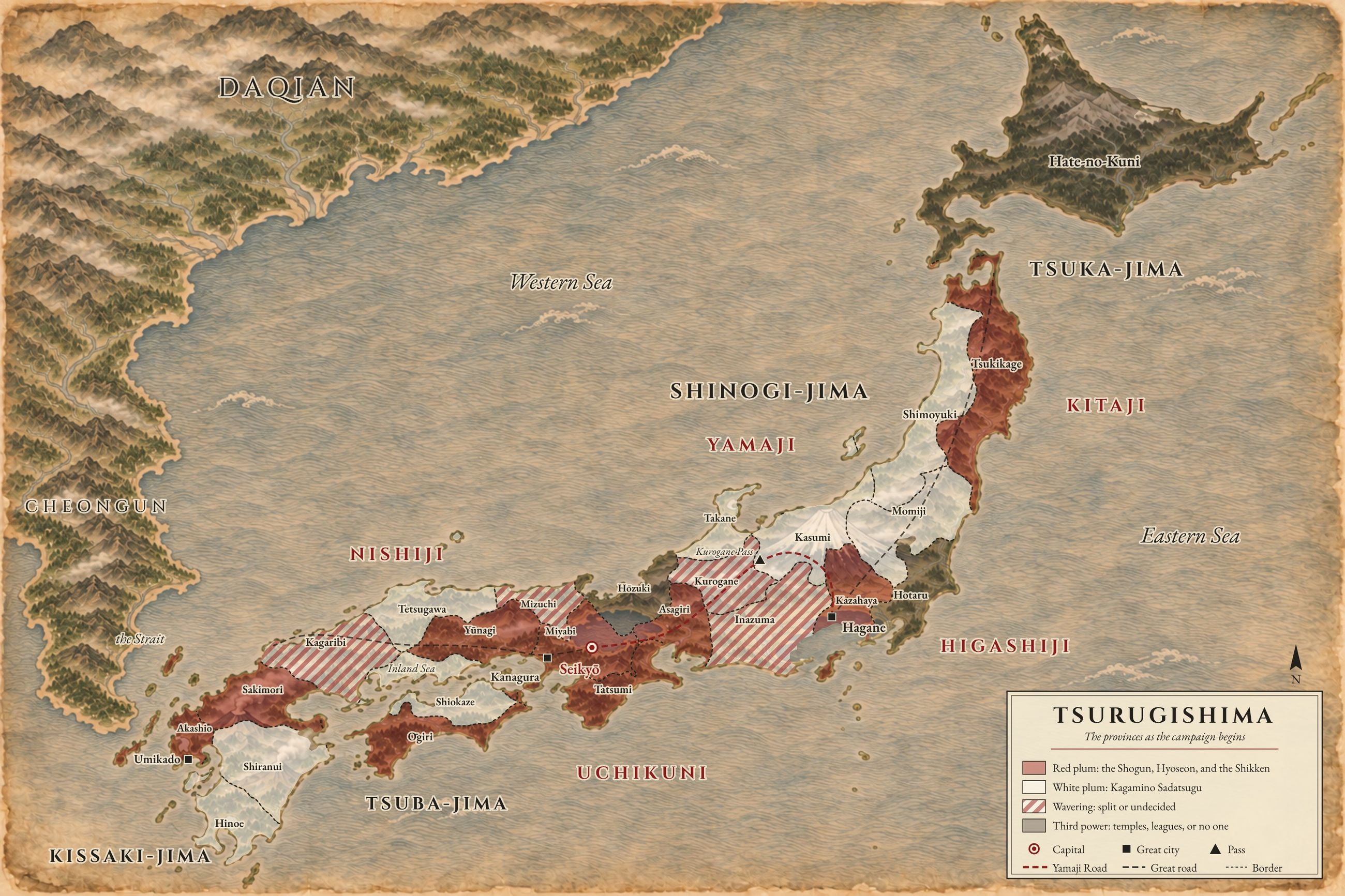
Tsurugishima's 24 provinces are choosing sides. The table below shows where each one stands when the campaign begins. Red provinces follow the Shogun, Lady Hyoseon, and the Shikken. White provinces look to Kagamino Sadatsugu. Wavering provinces are split between rival clans or haven't decided. Third power provinces are held by temples, leagues, or no one.
| Region | Province | Ruled by | Blossom |
|---|---|---|---|
| Kissaki-jima | Akashio | The Nishioka | Red |
| Shiranui | The Tsuruzaki | White | |
| Hinoe | The Tokumoto | White | |
| Sakimori | The Takanaga, for the Shogunate | Red | |
| Tsuba-jima | Shiokaze | The Ashiura | White |
| Ōgiri | The Kayanuma | Red | |
| Nishiji | Yūnagi | The Kanezaki | Red |
| Tetsugawa | The Kurobishi | White | |
| Kagaribi | The Ōsato | Wavering | |
| Mizuchi | The Ukinami | Wavering | |
| Uchikuni | Miyabi | The Shikken (the Ōtaki) | Red |
| Asagiri | The Kayamori | Red | |
| Hōzuki | Raihō-ji and the Thunder Peak monks | Third power | |
| Tatsumi | The Hatakura | Red | |
| Yamaji | Kurogane | The Amanuma, the Kitamori, and the Sekitani League (Part 1) | Wavering |
| Takane | The Ameyama | White | |
| Kasumi | Kagamino Sadatsugu | White | |
| Higashiji | Kazahaya | The Shogun | Red |
| Hotaru | The Western Light leagues | Third power | |
| Inazuma | The Mizunaga and the Nobuyama | Wavering | |
| Momiji | The Fujinaga | White | |
| Kitaji | Shimoyuki | The Mizusawa | White |
| Tsukikage | The Kuzuhara | Red | |
| Tsuka-jima | Hate-no-Kuni | No one, in the Warden's view | Third power |
That is nine provinces red, eight white, four wavering, and three in the hands of the third power. The red hold the capitals, the money, and the sea. The white hold the mountains, the swordsmiths, and the veterans. Whoever wins the wavering provinces wins the war, and Kurogane, whose pass joins Sadatsugu's Kasumi to the capital, is the first of them.
The Armies of the Realm#
Every domain musters about two soldiers for every 100 koku of its yield (Chapter 5). Each province's entry gives its Forces: the soldiers it can raise, and any special troops. When the GM sets Force Tokens for a mass battle, count troops by quality as below, then give the larger army 10 tokens and the smaller a proportional number (Chapter 5).
| Quality | Who they are | Count each soldier as |
|---|---|---|
| Raw levies | Farmers called up with bamboo spears and no training | ½ |
| Soldiers | Ordinary foot soldiers and retainers | 1 |
| Veterans | Hardened troops: Cheongun veterans, border garrisons, well-armed companies | 1½ |
| Elite | The realm's famous troops: the Asaoka horse archers, Raihō-ji's warrior monks, a great lord's guard | 2 |
Better equipment counts too. A matchlock company fighting in its formation on its own ground, or troops in their own mountains, may count one step higher, at the GM's call.
| Side | Koku | Soldiers at muster | What that hides |
|---|---|---|---|
| Red | About 2,300,000 | About 46,000 | Half the red's strength is the Shikken's and the Kuzuhara's, and the Kuzuhara are busy in the north. The Shogun's own housemen are unpaid and uncertain. |
| White | About 1,200,000 | About 24,000 | Fewer, but harder: Sadatsugu's veterans, the Asaoka horse archers, and swords from the best forges in the realm. |
| Wavering | About 660,000 | About 13,000 | Whoever wins these provinces wins the war. |
| Third power | About 480,000 | About 10,000, and many more when the drums sound | Warrior monks and league fighters, who march for their temples, not for a blossom. |
On paper, the red outnumber the white two to one. In the field, it is closer than that.
How to Read an Entry#
Each province gives its ruler, seat, size, and blossom, then an overview, its extent and forces, three notable places, a d6 rumor table, and Savage Tale hooks. True rumors are marked (T) and false ones (F), for the GM's eyes only. Personalities' stat blocks are in Chapter 9.
Kissaki-jima: The Point#
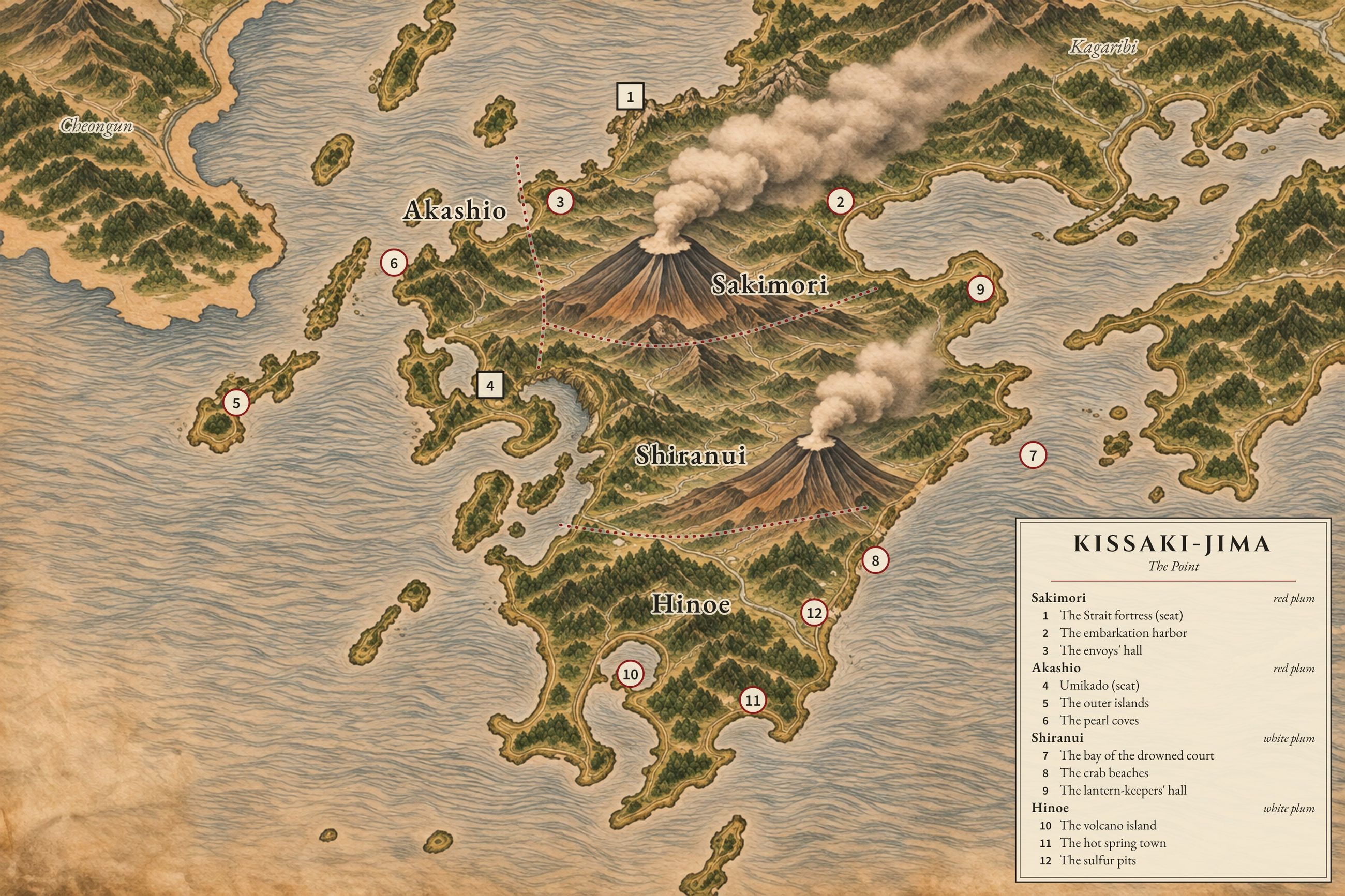
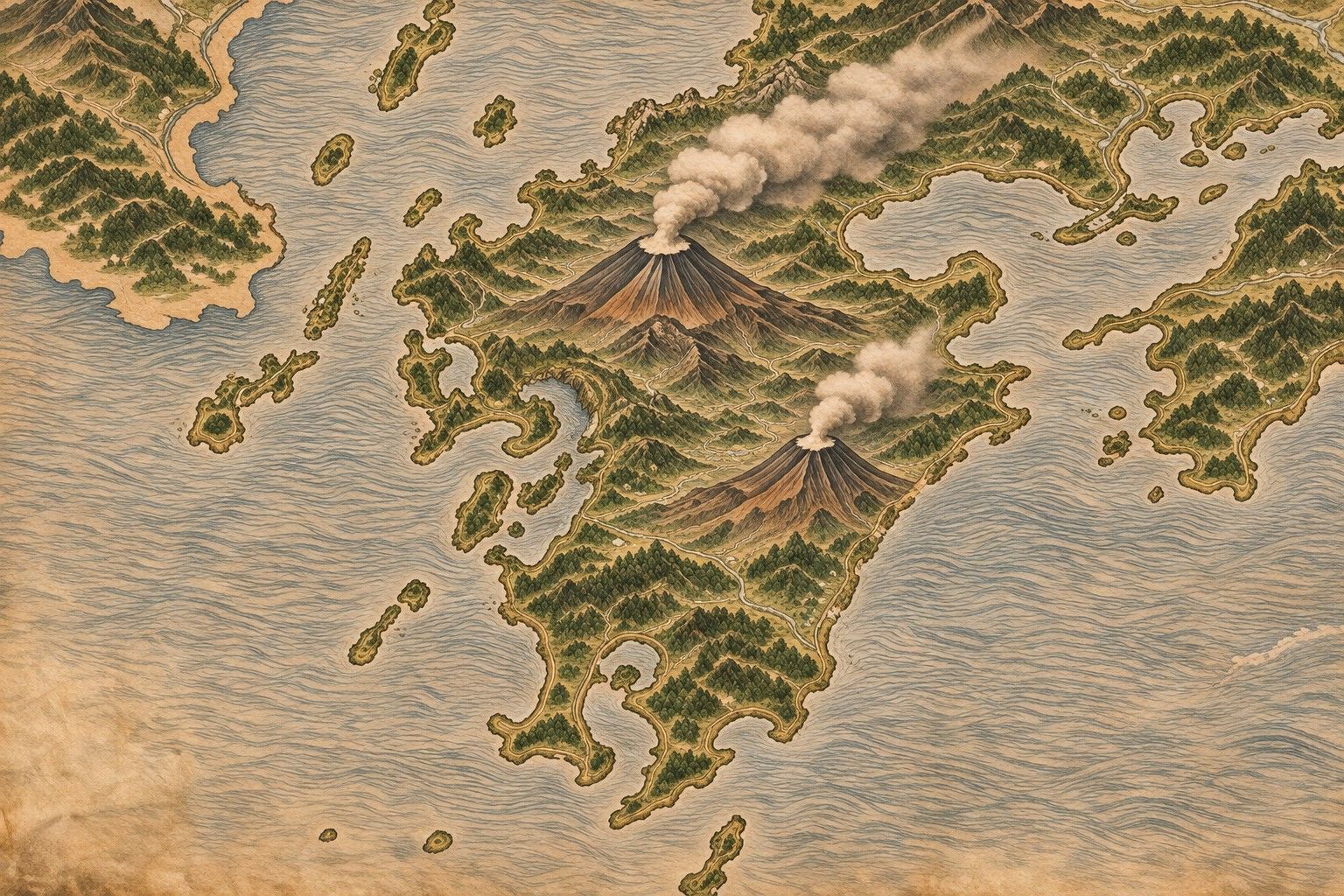
The southwestern island is hot, volcanic, and proud. It faces the mainland across the Strait, so it sees foreign ships, foreign armies, and foreign faiths first. Its four provinces are split two and two between the blossoms.
Akashio (赤潮), "Red Tide"#
| Ruler | Seat | Size | Blossom |
|---|---|---|---|
| Nishioka Takekuni | Umikado | About 200,000 koku | Red |
Akashio is the western coast of Kissaki-jima: a tangle of bays, islands, and green hills around the great harbor of Umikado (Part 2). It is the richest province on the Point, and its wealth comes from the sea: fish, pearls, mainland trade, and now the far westerners' guns. The Nishioka clan rules it from its castle above Umikado and is red, because the Shikken protects the trade, but uneasily, because the Shikken's Port Commissioner taxes every cargo and watches every convert. The Teaching of the Black Book has spread from Umikado to the fishing villages of the outer islands.
Extent. Three days along the coast, with 100 islands offshore. Forces. About 4,000 at muster. Elite: Lord Takekuni's company of 300 foreign matchlocks, the best-armed gunners in the realm.
Places.
- Umikado (city, about 50,000). The Sea Gate, described in Part 2.
- The outer islands (hamlets and villages). Fishing villages on a scatter of islands where whole families have quietly taken the Black Book. Their chapels are hidden in barns, and their black books are wrapped in oilcloth under the floor.
- The pearl coves (hamlets). Sheltered coves where women divers bring up pearls for the merchants of Umikado. The divers say a sea kami lives in the deepest cove and takes one diver every few years as its due.
| d6 | Rumor |
|---|---|
| 1–2 | "Half the outer islands have taken the Black Book." (F) About a tenth. But the Commissioner believes it is half. |
| 3–4 | "The far westerners want a harbor of their own, and Lord Takekuni might give them one." (T) |
| 5–6 | "The sea kami of the pearl coves has been angry since the black ships came." (T) |
Savage Tale hooks. The Commissioner sends soldiers to the outer islands to search for black books, and a village asks the heroes for help. A great pearl, meant as a gift for the Emperor, is stolen from a diver's boat.
Shiranui (不知火), "Unknown Fires"#
| Ruler | Seat | Size | Blossom |
|---|---|---|---|
| Tsuruzaki Haruchika | The cliff castle | About 110,000 koku | White |
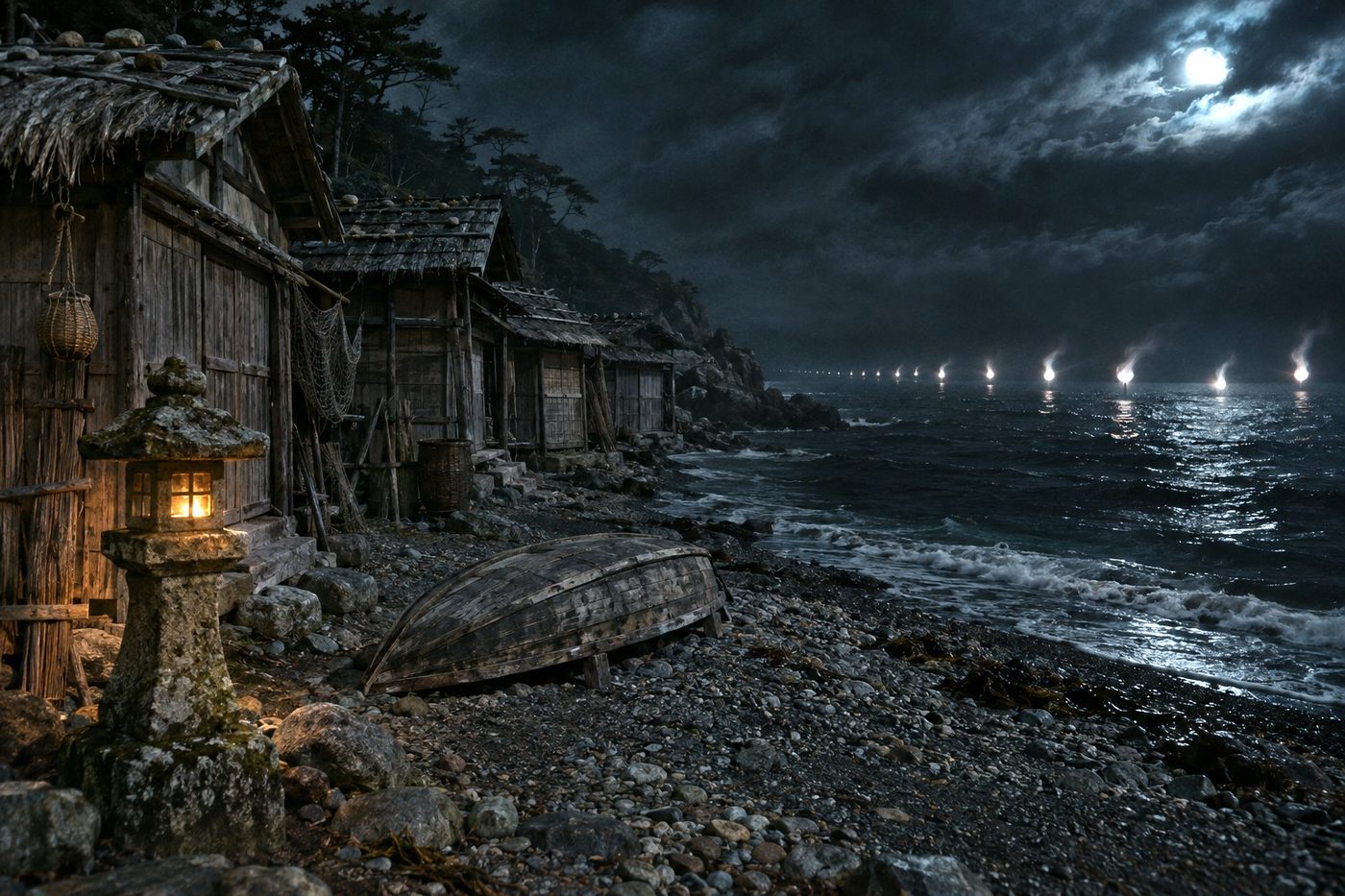
Shiranui is a coast of dark bays and shallow seas on the inner shore of Kissaki-jima, where the last child-emperor of the Kamaeda drowned with his court in the great sea battle that ended the Minazuki Return. On summer nights, ghost-lights burn on the water: a long line of pale fires where the Kamaeda fleet went down. Fishermen won't put out on those nights. Spirit hunters come from across the realm to study the lights, lay the restless dead, and sometimes to be laid themselves. The Tsuruzaki clan rules the coast and is white: Lord Tsuruzaki Haruchika lost two sons in Cheongun under Sadatsugu's command, and blames the Shikken, who starved them of supplies.
Extent. Two days along the coast. Forces. About 2,200 at muster, mostly fishermen, plus a band of spirit hunters who are worth more against the dead than any army.
Places.
- The bay of the drowned court (Profane Ground at sea). The waters where the Kamaeda fleet sank. When the wind rises at night, fishermen hear the shouting of a battle out on the water. The drowned rise around boats that pass after dark and try to drag them under, and they pull down anyone who swims there. Some ask politely from the waves for the loan of a ladle. Wise sailors carry one with the bottom knocked out, because a ghost given a whole ladle uses it to fill the boat until it sinks.
- The crab beaches (hamlets). The crabs of these beaches carry shells shaped like the angry faces of samurai. Fishermen throw them back, out of respect for the Kamaeda dead, and never eat them.
- The lantern-keepers' hall (temple). A temple on a headland, built to appease the drowned court, with a graveyard of memorial stones carved with the names of the child-emperor and his lords. Its monks say services for the dead every day, and the ghosts have been quieter since it was built. Spirit hunters train here.
| d6 | Rumor |
|---|---|
| 1–2 | "The ghost-lights are getting closer to shore every year." (T) |
| 3–4 | "The pirates have a hidden harbor among the ghost-lights, where no one dares follow them." (T) |
| 5–6 | "The drowned child-emperor's sword lies on the seabed, and whoever recovers it can claim the throne." (F) It lies there, but it claims nothing. Chapter 6 says what it does. |
Savage Tale hooks. A fishing boat drifts home at dawn, half full of seawater, with no one aboard and a ladle on its deck. The heroes are hired to dive for a treasure on the wreck of the Kamaeda flagship, on the one night of the year when the drowned stay quiet.
Hinoe (火江), "Fire Inlet"#
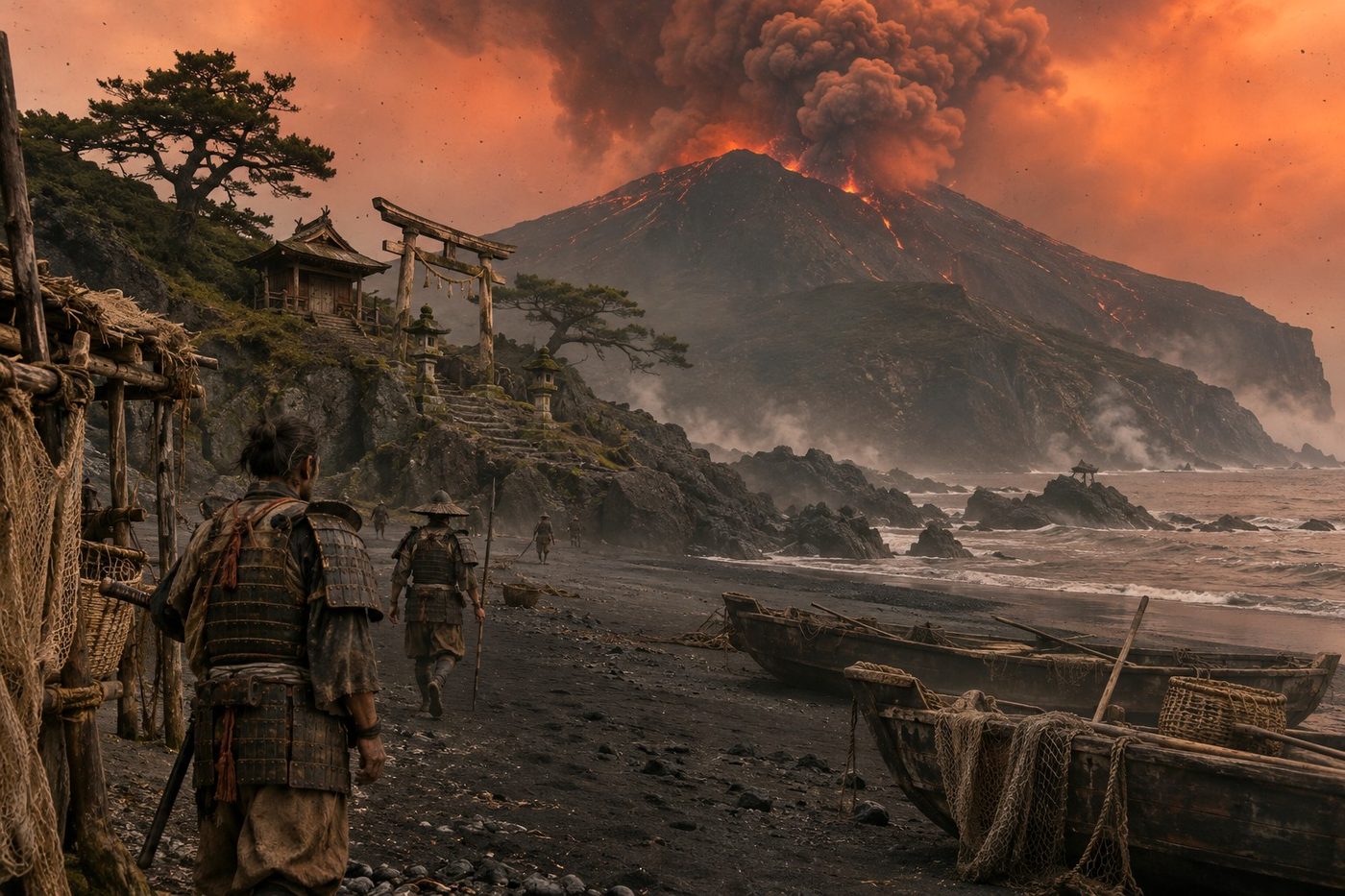
| Ruler | Seat | Size | Blossom |
|---|---|---|---|
| Tokumoto Katsutane | The castle under the volcano | About 180,000 koku | White |
Hinoe is the volcanic south of Kissaki-jima: smoking mountains, black sand beaches, hot springs, sulfur pits, and a great inlet with a volcano island in its middle that rumbles every few years and covers the castle town in ash. Its people are fierce, proud, and clannish, and its samurai are the hardest fighters in the realm. Half the soldiers in Tomonori's Cheongun army came from Kissaki-jima, and most of those came from Hinoe. When the Treaty of the Strait gave back what they had bled for, Hinoe never forgave the Shikken. The Tokumoto clan rules it, and Lord Tokumoto Katsutane was among the first great lords to raise the white plum.
Extent. Three days across. Forces. About 3,600 at muster, nearly all of them Cheongun veterans or the sons of veterans (veterans). Elite: the Tokumoto guard, 500 samurai who have never retreated.
Places.
- The volcano island (great shrine). A smoking island in the inlet with a shrine to the fire kami on its slopes. When the island rumbles, the lord himself goes to make offerings.
- The hot spring town (market town). A town of inns and steaming baths in a valley below the mountains, where wounded soldiers come to heal and lords meet in secret.
- The sulfur pits (Profane Ground). Yellow, steaming pits in the mountains where convicts dig sulfur for gunpowder. The air burns the throat, and the dead are left where they fall.
| d6 | Rumor |
|---|---|
| 1–2 | "Lord Katsutane will march to join Sadatsugu as soon as the harvest is in." (T) |
| 3–4 | "The volcano will erupt when the Shogun dies." (F) But it rumbled the night the treaty was signed. |
| 5–6 | "Hinoe's sulfur goes to Sadatsugu's gunpowder makers." (T) |
Savage Tale hooks. A secret meeting of white plum lords at the hot spring town must be protected from the Shikken's shinobi. The volcano rumbles, and the fire kami demands an offering that no one in the castle wants to give.
Sakimori (防人), "Border Guards"#
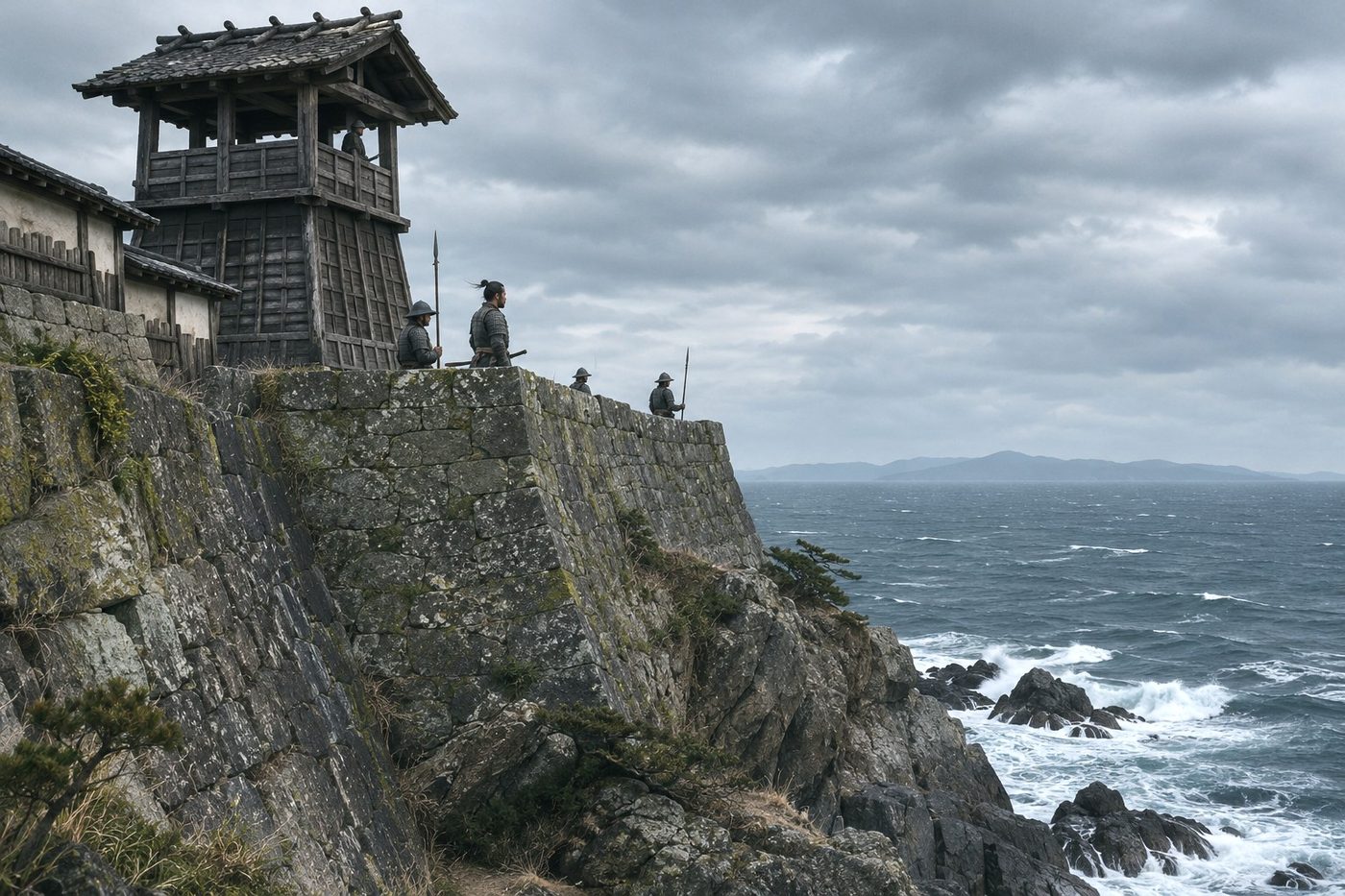
| Ruler | Seat | Size | Blossom |
|---|---|---|---|
| Takanaga Morinobu, Warden of the Strait for the Shogunate | The Strait fortress | About 130,000 koku | Red |
Sakimori is the northern tip of Kissaki-jima, facing Cheongun across the narrow Strait. It is the realm's first line of defense against the mainland, and it has been a garrison province for a thousand years. Its coast is lined with stone walls, watchtowers, and beacon posts, and its people are soldiers' families. The Cheongun War's armies sailed from here, and its survivors came home through here. The province belongs to the Shogunate, and the Takanaga clan holds it as Wardens of the Strait. Lord Takanaga Morinobu is red because his oath is to the Shogun, not because he likes the Shikken.
Extent. Two days across. Forces. About 2,600 at muster, plus the Strait garrison of 1,500 (veterans), and a squadron of 20 war junks.
Places.
- The Strait fortress (great castle). A stone fortress on a headland above the Strait, with walls built to face a mainland army. On a clear day, its watchmen can see the hills of Cheongun.
- The embarkation harbor (castle town). The harbor where the Cheongun War's armies sailed. Its quays are lined with memorial stones for those who didn't come back.
- The envoys' hall (residence). A hall where envoys from Cheongun and Daqian wait for permission to travel on to Hagane and Kanagura. Every envoy is watched, and every one of them is watching.
| d6 | Rumor |
|---|---|
| 1–2 | "Cheongun is rebuilding its fleet." (T) For defense, it says. |
| 3–4 | "The Warden would open the Strait to Sadatsugu if the Shogun were dead." (T) |
| 5–6 | "The memorial stones weep on the anniversary of the treaty." (T) |
Savage Tale hooks. A Cheongun envoy disappears from the envoys' hall the night before he sails for Hagane. A Strait Man returns from Cheongun after 10 years in captivity, with a message he will give only to Sadatsugu.
Tsuba-jima: The Guard#
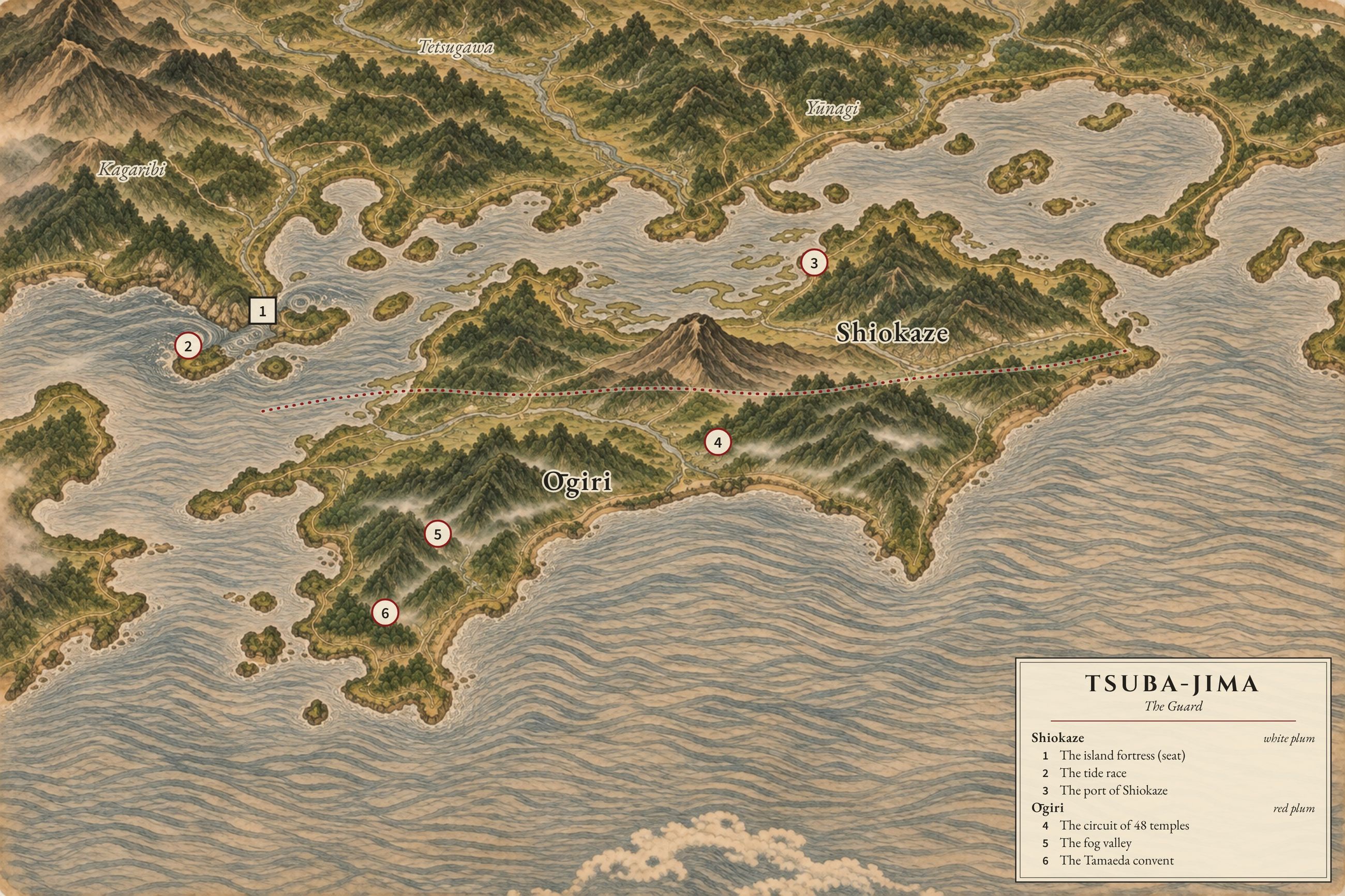
The small southern island is rugged, pious, and divided: its pirate coast to the north wears the white plum, and its temple mountains to the south wear the red.
Shiokaze (潮風), "Sea Breeze"#
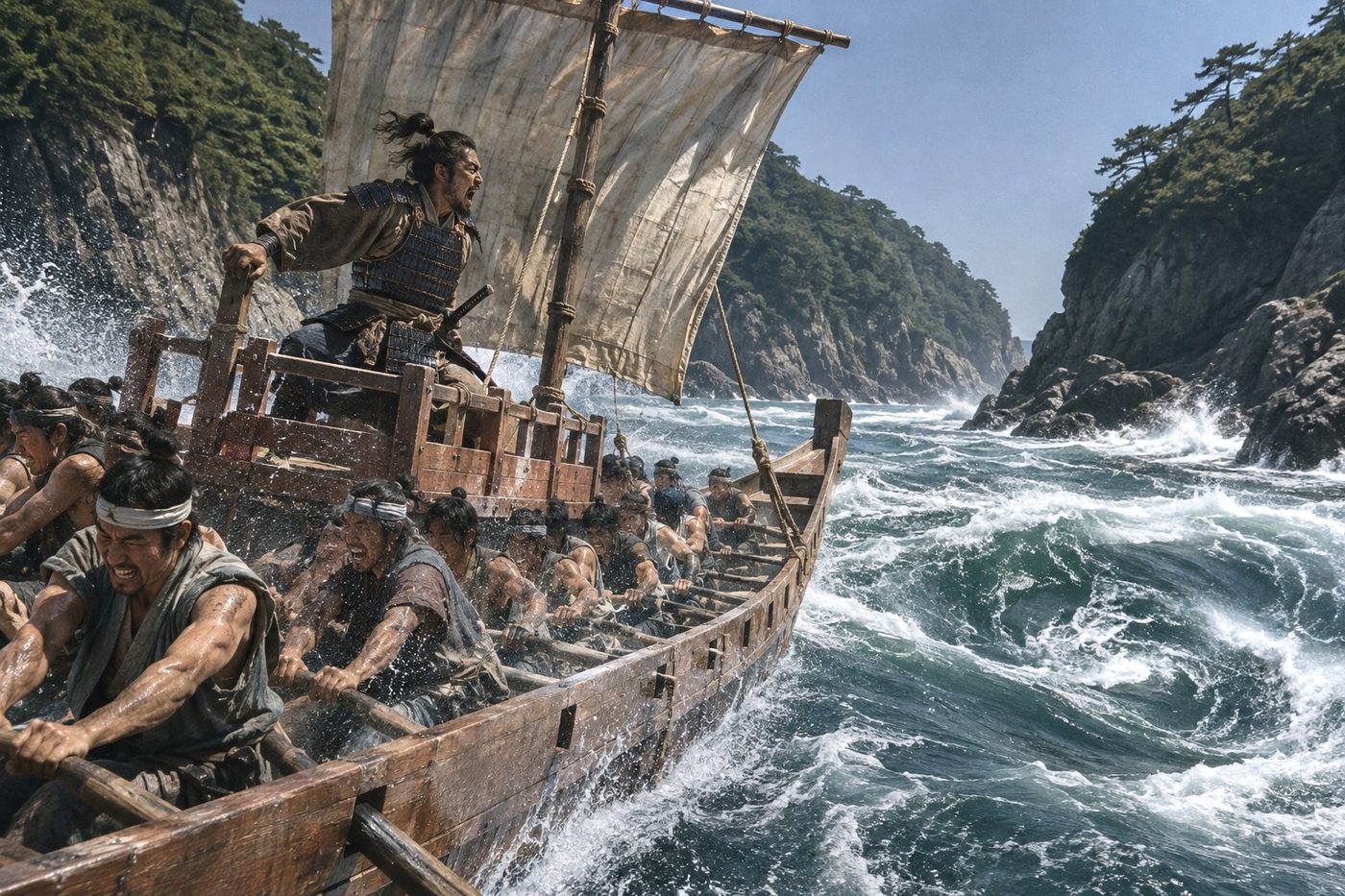
| Ruler | Seat | Size | Blossom |
|---|---|---|---|
| Ashiura Kagenobu | The island fortress of the Ashiura | About 90,000 koku | White |
Shiokaze is the north coast of Tsuba-jima, facing the Inland Sea: fishing villages, rocky coves, and the island's only real port. The Ashiura clan rules it, and the Ashiura are sea lords, half samurai and half pirates. They sell safe-conduct flags to ships crossing the Inland Sea, and they sink the ships that don't buy one. The Shikken has called them pirates and sent his ships to hunt them, so Lord Ashiura Kagenobu has gone white plum. His fleet is small, fast, and expert, and in narrow waters it can beat ships twice its size.
Extent. Two days along the coast. Forces. About 1,800 at muster, most of them sailors, and a fleet of 80 light warships (veterans at sea).
Places.
- The island fortress (castle). The Ashiura seat stands on a rocky islet in the strait, ringed by tide-swept reefs that only Ashiura pilots can cross.
- The tide race (dangerous waters). A narrow strait where the tides of the Inland Sea meet and churn into whirlpools twice a day. Ships that try it at the wrong hour are lost.
- The port of Shiokaze (market town). A busy harbor town where every ship in the Inland Sea stops to buy water, fish, and an Ashiura flag.
| d6 | Rumor |
|---|---|
| 1–2 | "The Ashiura will carry Sadatsugu's army across the Inland Sea." (T) If he can pay. |
| 3–4 | "The whirlpools of the tide race are the breath of a sea kami." (T) |
| 5–6 | "Lord Kagenobu has a Daqian wife and a fleet of mainland junks." (F) He has the wife, not the junks. |
Savage Tale hooks. The heroes' ship is stopped by an Ashiura galley demanding a flag the heroes never bought. The Shikken hires the heroes to slip onto the island fortress and steal the Ashiura's pilot charts.
Ōgiri (大霧), "Great Fog"#
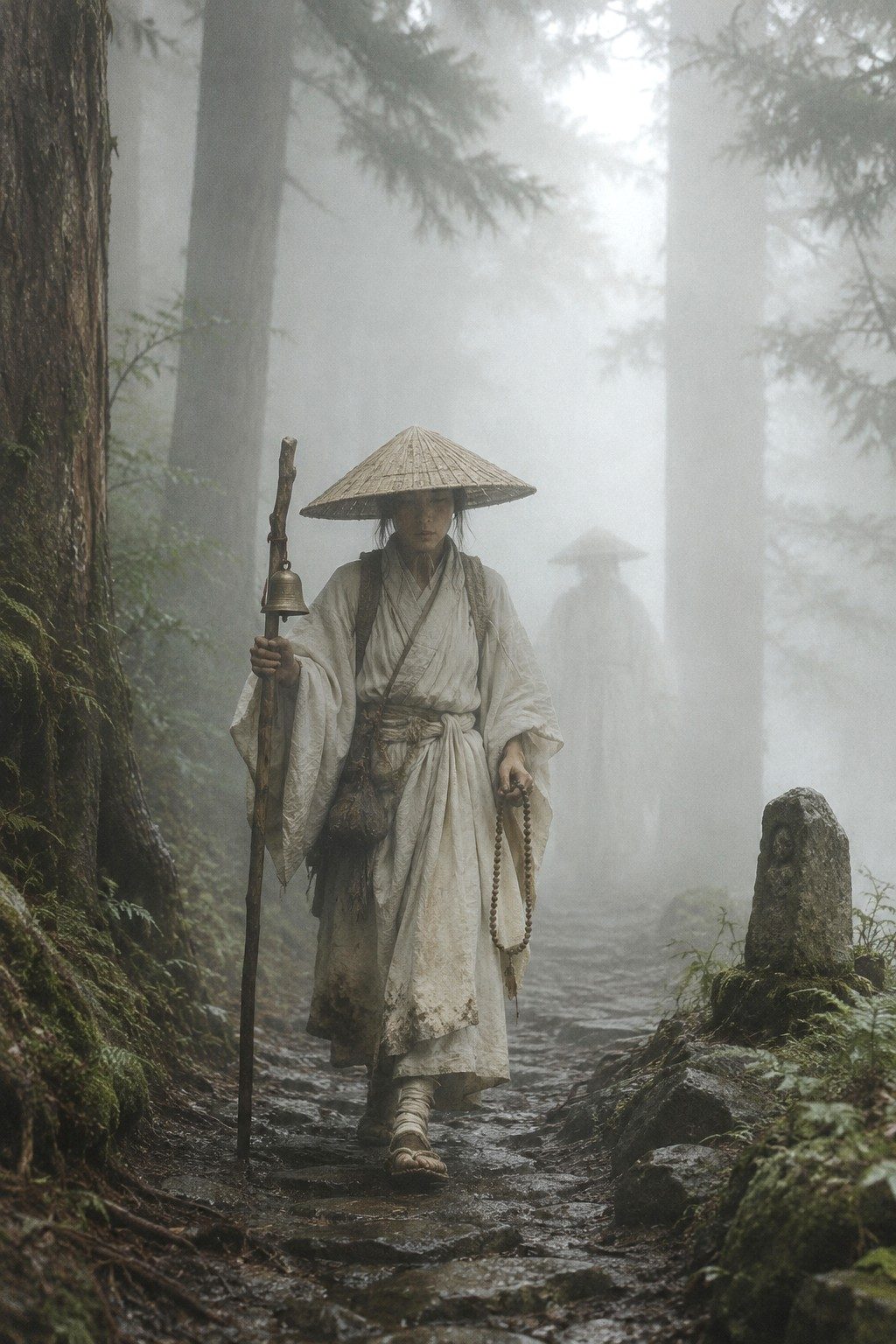
| Ruler | Seat | Size | Blossom |
|---|---|---|---|
| Kayanuma Moritsune | The fog castle | About 70,000 koku | Red |
Ōgiri is the mountainous south of Tsuba-jima, a land of steep green valleys and peaks lost in fog for half the year. It is famous for its pilgrimage: a circuit of 48 temples around the island that pilgrims in white walk on foot, taking two months to complete. The Kayanuma clan rules its poor valleys and is red, because the Shikken's gifts to the temples keep the pilgrims coming. Lord Kayanuma Moritsune is pious, poor, and mostly concerned with keeping the pilgrim roads safe. The Tamaeda School of the glaive has its hall here, at a convent on the circuit, where the nuns have taught the glaive for three centuries. At one river crossing of the circuit, the old ferryman Kenzawa Arikazu won't carry anyone who is rude to the river kami (Chapter 10).
Extent. Three days across the mountains. The pilgrim circuit takes two months. Forces. About 1,400 at muster, plus warrior monks from the circuit temples, about 500 (veterans).
Places.
- The circuit of 48 temples (temples of every size, from hermitages to a great temple). Each temple stamps the pilgrim's book. A pilgrim who completes the circuit is cleansed of all pollution (Chapter 4) and has one wish heard by the Buddha.
- The fog valley (hamlet). A deep valley on the circuit where the fog never lifts. Pilgrims who walk it alone sometimes meet another pilgrim who walks beside them and gives good advice. Some say it is the founder of the circuit. Some say it is not.
- The Tamaeda convent (temple and great school). A mountain convent where nuns and samurai daughters train with the glaive at dawn. Its abbess is the headmistress of the school.
| d6 | Rumor |
|---|---|
| 1–2 | "Bandits on the circuit are robbing pilgrims, and the temples are hiding it." (T) |
| 3–4 | "The companion in the fog valley is a fox." (F) Chapter 7 says what it is. |
| 5–6 | "Lord Moritsune means to become a monk and leave the province to the temples." (T) |
Savage Tale hooks. A pilgrim carrying a great lord's secret walks the circuit, and the heroes must keep him alive for two months. The Tamaeda convent is attacked by bandits who know too much about its treasury.
Nishiji: The West Road#
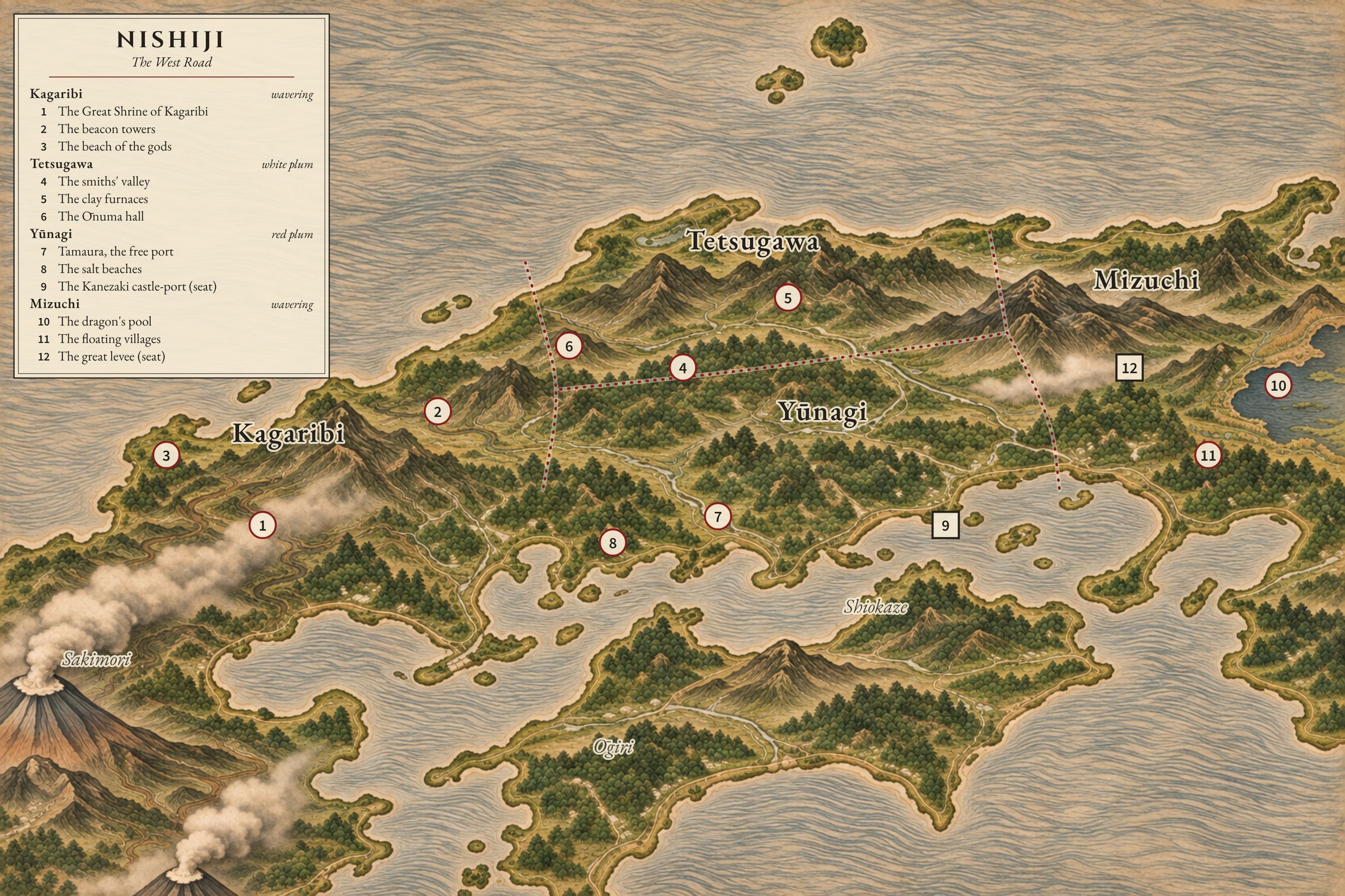
The four provinces of the West Road run along the Inland Sea and the western shore toward the Strait. They are old country, where the first kingdoms rose, and rich country, where salt, iron, and trade make lords and merchants wealthy. Two have chosen sides, and two are still bargaining.
Yūnagi (夕凪), "Evening Calm"#
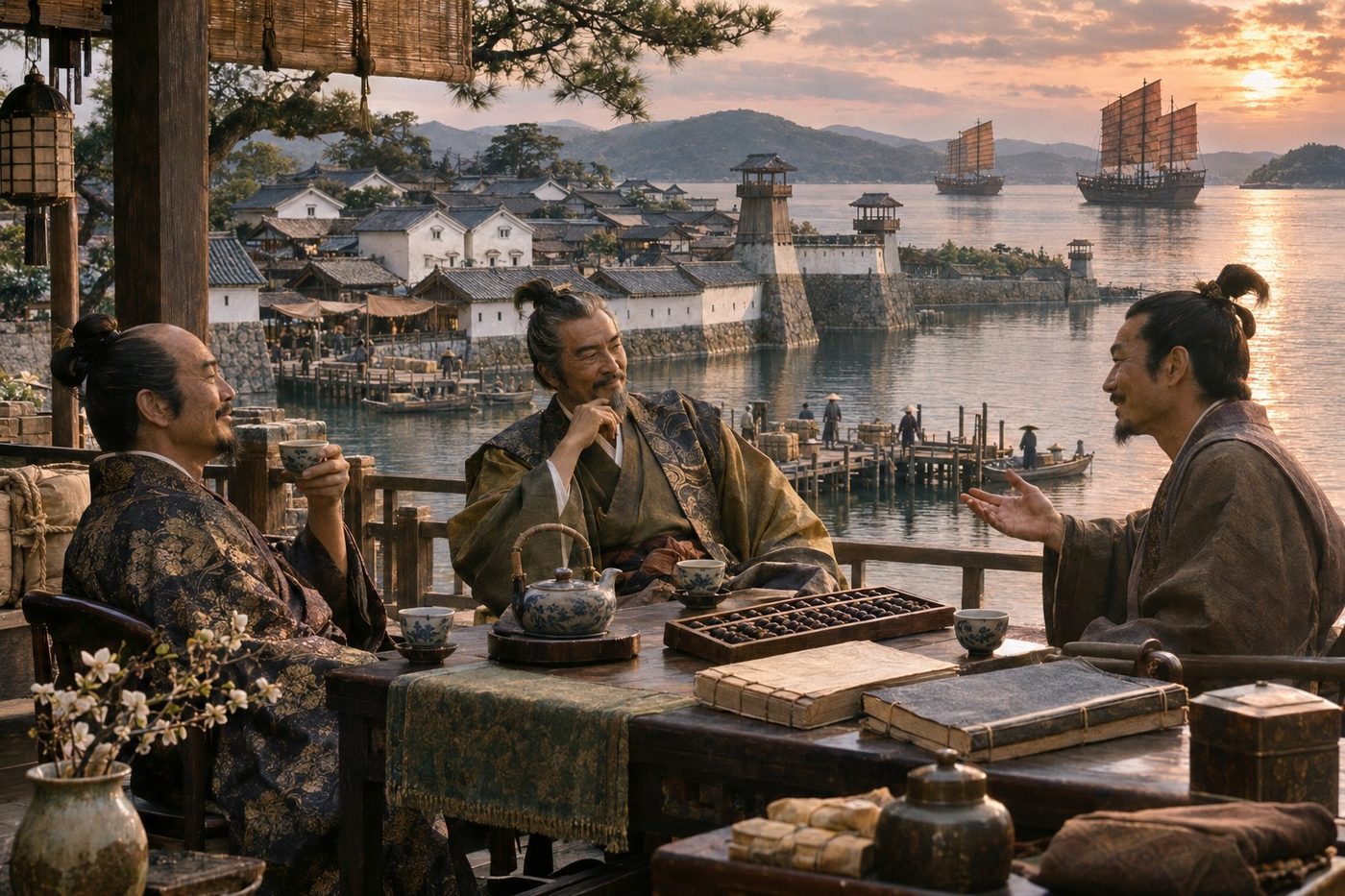
| Ruler | Seat | Size | Blossom |
|---|---|---|---|
| Kanezaki Takeuji | The Kanezaki castle-port | About 260,000 koku | Red |
Yūnagi is the Inland Sea coast west of Kanagura: a long shore of salt pans, fishing harbors, and wealthy merchant towns, where the sea is so calm at evening that sailors call it the mirror. Its wealth comes from salt, shipping, and the trade that flows to Kanagura. The Kanezaki clan rules it and is red, because the Shikken's trade is its trade. Lord Kanezaki Takeuji is more merchant than warrior, and proud of it. The townsfolk are fierce Lion's Roar faithful, and their brotherhoods guard the harbors against pirates and Western Light preachers alike.
Extent. Four days along the coast, but never more than a day inland. Forces. About 5,200 at muster, plus the town brotherhoods (count as soldiers) and a coastal fleet of 30 armed ships.
Places.
- Tamaura, the free port (city, about 30,000). A harbor town ringed by moats, governed by a council of 36 merchant elders who buy their freedom from the Kanezaki every year. Tamaura's merchants trade with Daqian, finance pirates and lords alike, and practice the tea ceremony as seriously as samurai practice the sword. No lord's soldiers may enter without the council's leave.
- The salt beaches (a string of villages). Miles of raked sand where salt-makers spread seawater to dry. Salt is the province's wealth, and the salt-makers are among the poorest people in it.
- The Kanezaki castle-port (castle town). A white castle on a headland above the harbor, with the clan's warehouses below its walls.
| d6 | Rumor |
|---|---|
| 1–2 | "Tamaura's council lends money to Sadatsugu as well as the Shikken." (T) |
| 3–4 | "Lord Takeuji will sell his province to whoever wins." (T) |
| 5–6 | "A sea dragon rises on calm evenings to watch the sunset." (F) It is a whale, and it only watches. |
Savage Tale hooks. Tamaura's council hires the heroes to find out which of its 36 elders is selling its secrets to the Shikken. A shipment of salt bound for Kurogane is seized by pirates who seem to know its route.
Tetsugawa (鉄川), "Iron River"#
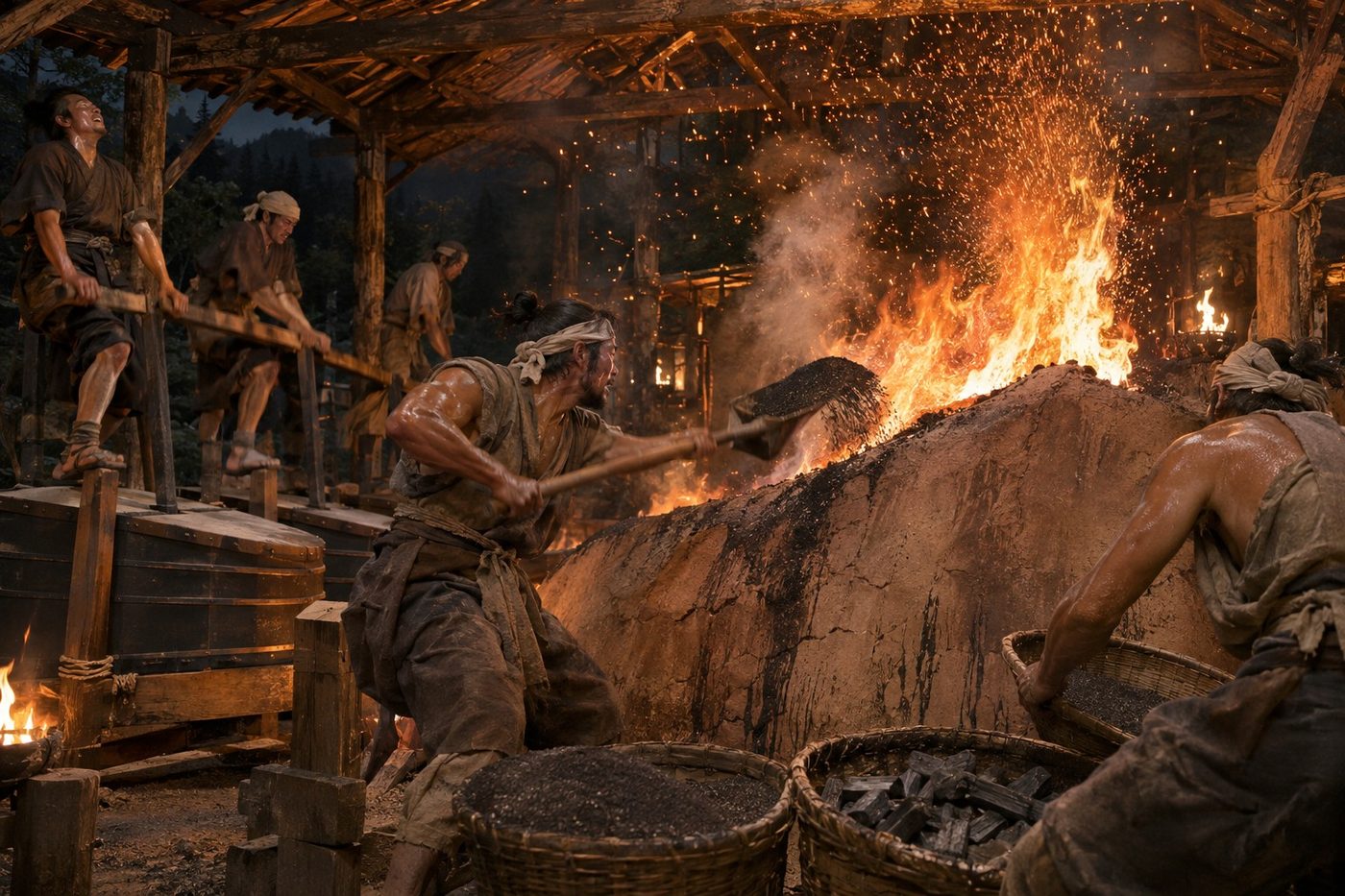
| Ruler | Seat | Size | Blossom |
|---|---|---|---|
| Kurobishi Hidesada | The iron castle | About 160,000 koku | White |
Tetsugawa is the iron country of the west, where the rivers run black with iron sand and the hills glow at night with the fires of clay furnaces. The ancient kingdom of Tatara rose here on iron, and iron still rules. Its swordsmiths are the finest in the realm, and a Tetsugawa blade is worth a village. The Kurobishi clan holds the province, and it is white, because the Shikken ended the war contracts that fed its forges, and Sadatsugu has promised to buy everything they make. The Ōnuma School of the two swords has its hall here, among the smiths.
Extent. Three days across, hill and river valley. Forces. About 3,200 at muster, every one of them well armed (count as veterans when armed from the province's own forges).
Places.
- The smiths' valley (market town). A valley of forges, charcoal kilns, and polishers' shops along the river, where the great smith families work. The greatest, Master Masuhiro, is forging a blade for Sadatsugu that he says will cut the Shogunate in two.
- The clay furnaces (hamlets in the hills). The great furnaces burn for three days and nights to make a single bloom of steel. Washing the iron sand from the hills turns the rivers to mud, and the rice farmers downstream hate the smiths for it.
- The Ōnuma hall (great school). The hall of the two swords stands near the smiths' valley, and its students practice with blades on loan from the smiths, who want to see how they cut.
| d6 | Rumor |
|---|---|
| 1–2 | "Master Masuhiro's new blade is cursed." (T) Chapter 6 tells how. |
| 3–4 | "The ruins of the old kingdom of Tatara hold a forge of the gods." (T) Chapter 7 says whose. |
| 5–6 | "The Shikken will pay any price for a Tetsugawa smith to come to Kanagura." (T) And has. |
Savage Tale hooks. A great smith is kidnapped on the road, and both blossoms accuse each other. The downstream farmers rise against the smiths, and the Kurobishi want them stopped without blood.
Kagaribi (篝火), "Watchfire"#
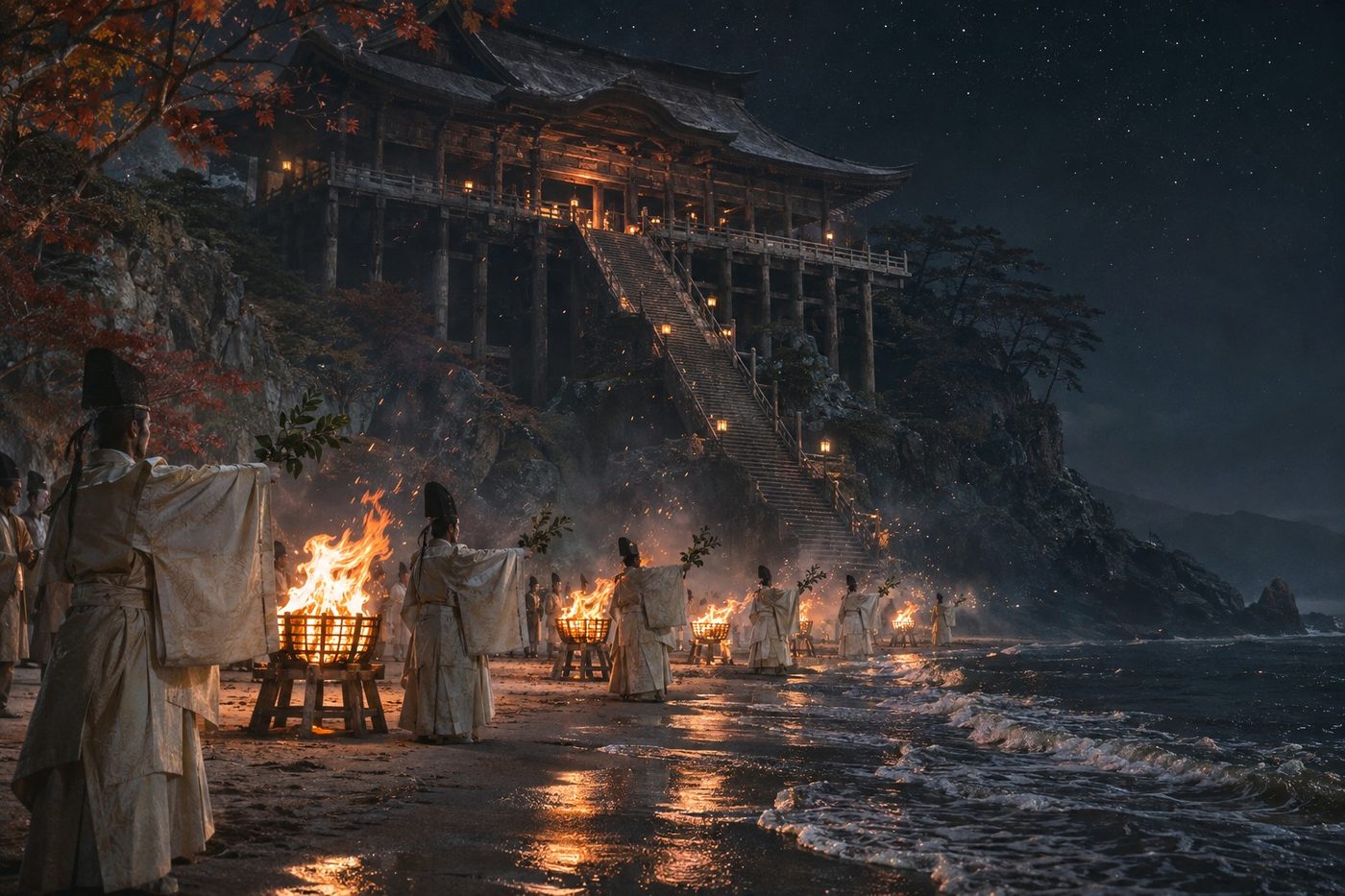
| Ruler | Seat | Size | Blossom |
|---|---|---|---|
| Ōsato Tsugumasa | The beacon castle | About 120,000 koku | Wavering |
Kagaribi is a land of grassy hills and long beaches on the western shore, facing the sea toward Cheongun and Daqian. A chain of beacon towers runs along its hills, ready to carry the news of an invasion to Seikyō in a single night. Kagaribi is also home to the oldest shrine in the realm, where, the people say, all the kami of the isles gather once a year. The Ōsato clan rules it and hasn't chosen a side. Lord Ōsato Tsugumasa has married his son to a red plum house and his daughter to a white one, and waits to see which marriage was the clever one.
Extent. Three days along the shore. Forces. About 2,400 at muster, plus the beacon garrisons, 300 men in towers along the coast.
Places.
- The Great Shrine of Kagaribi (great shrine). A vast shrine of plain, ancient wood, whose main hall is the tallest wooden building in the isles. In the Tenth Month, the Month without Gods, the people of Kagaribi say the gods of every province gather here in council. (People in the east say they gather on Mount Hōrai instead, and the two shrines' priests have argued about it for centuries.) Its chief priest's family is older than the Imperial line, and say so.
- The beacon towers (hill forts). A line of stone towers on the hilltops, each with a stack of pine wood and a small garrison. Lighting a beacon without cause is punishable by death.
- The beach of the gods (hamlet). The beach where, in the Tenth Month, the kami are welcomed ashore at night with bonfires. No one looks back at the sea while the welcome is underway.
| d6 | Rumor |
|---|---|
| 1–2 | "Someone lit a beacon last month, and the whole coast spent a night under arms." (T) No one knows who. |
| 3–4 | "The kami at the gathering decide who will win the war." (F) They decide something, but not that. |
| 5–6 | "Lord Tsugumasa has promised Kagaribi to both blossoms." (T) |
Savage Tale hooks. During the gathering of the gods, a kami fails to arrive at the Great Shrine, and the priests need someone to find out why. A beacon is lit by a traitor, and the heroes have one night to find the false fire before the whole realm marches west.
Mizuchi (蛟), "Water Dragon"#
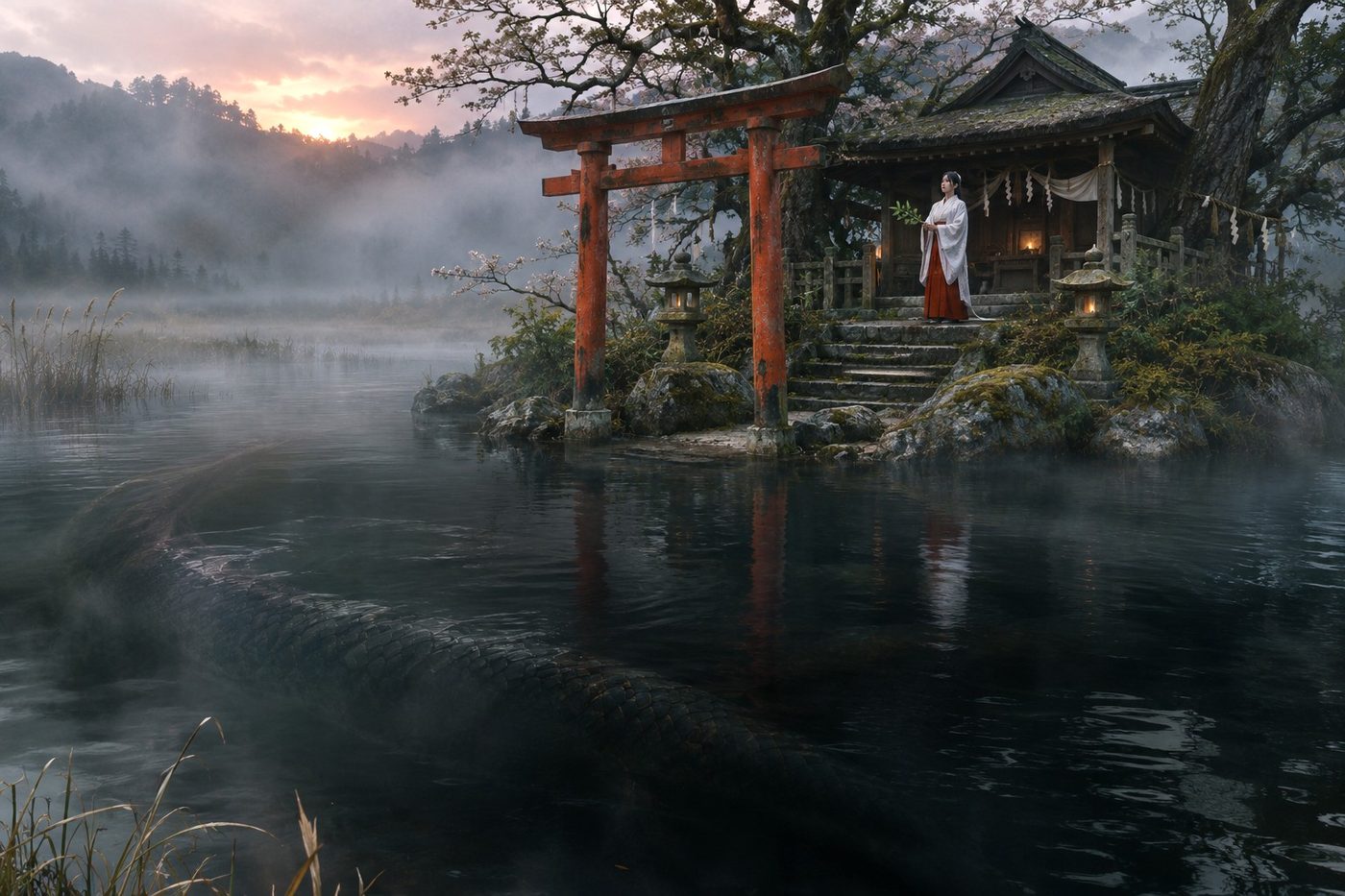
| Ruler | Seat | Size | Blossom |
|---|---|---|---|
| Ukinami Nobuhira | The castle on the levee | About 140,000 koku | Wavering |
Mizuchi is a low country of rivers, marshes, reed beds, and floating villages on the Western Sea coast, north of Tetsugawa. Its rivers flood every year, and every few years they drown whole districts. Its people worship the water dragon, the great river kami of the province, with rites the temples call heathen and the shrine priests call too old to question. The dragon's cult is led by priestesses who live on an island in the marshes, and the people obey them before their lord. The Ukinami clan rules the levees and the towns, and Lord Ukinami Nobuhira has learned to ask the priestesses before he does anything. They haven't yet told him which blossom to choose.
Extent. Two days across, but four by the winding waterways. Forces. About 2,800 at muster, plus marsh folk who fight from boats as Skirmishers.
Places.
- The dragon's pool (great shrine). A deep, dark lake at the heart of the marshes, with an island shrine where the dragon's priestesses live. Offerings are thrown into the pool every month. In bad years, the rumors say, the offerings are people.
- The floating villages (villages). Houses on rafts and stilts among the reeds, moving with the seasons and the floods. Strangers get lost among them in an hour.
- The great levee (castle town). The Ukinami castle and town stand on an earth levee higher than any house, built over three centuries. When the levee breaks, the province drowns.
| d6 | Rumor |
|---|---|
| 1–2 | "The priestesses give children to the dragon in famine years." (F) They give rice, sake, and swords. The children are adopted into the cult. |
| 3–4 | "Thunder Peak has sent monks to stamp out the dragon cult." (T) They haven't come back. |
| 5–6 | "The dragon is real and lives in the pool." (T) |
Savage Tale hooks. Thunder Peak's missing monks must be found, alive or dead, before the temple sends warrior monks after them. The great levee is being undermined by someone who wants the province drowned.
Uchikuni: The Inner Provinces#
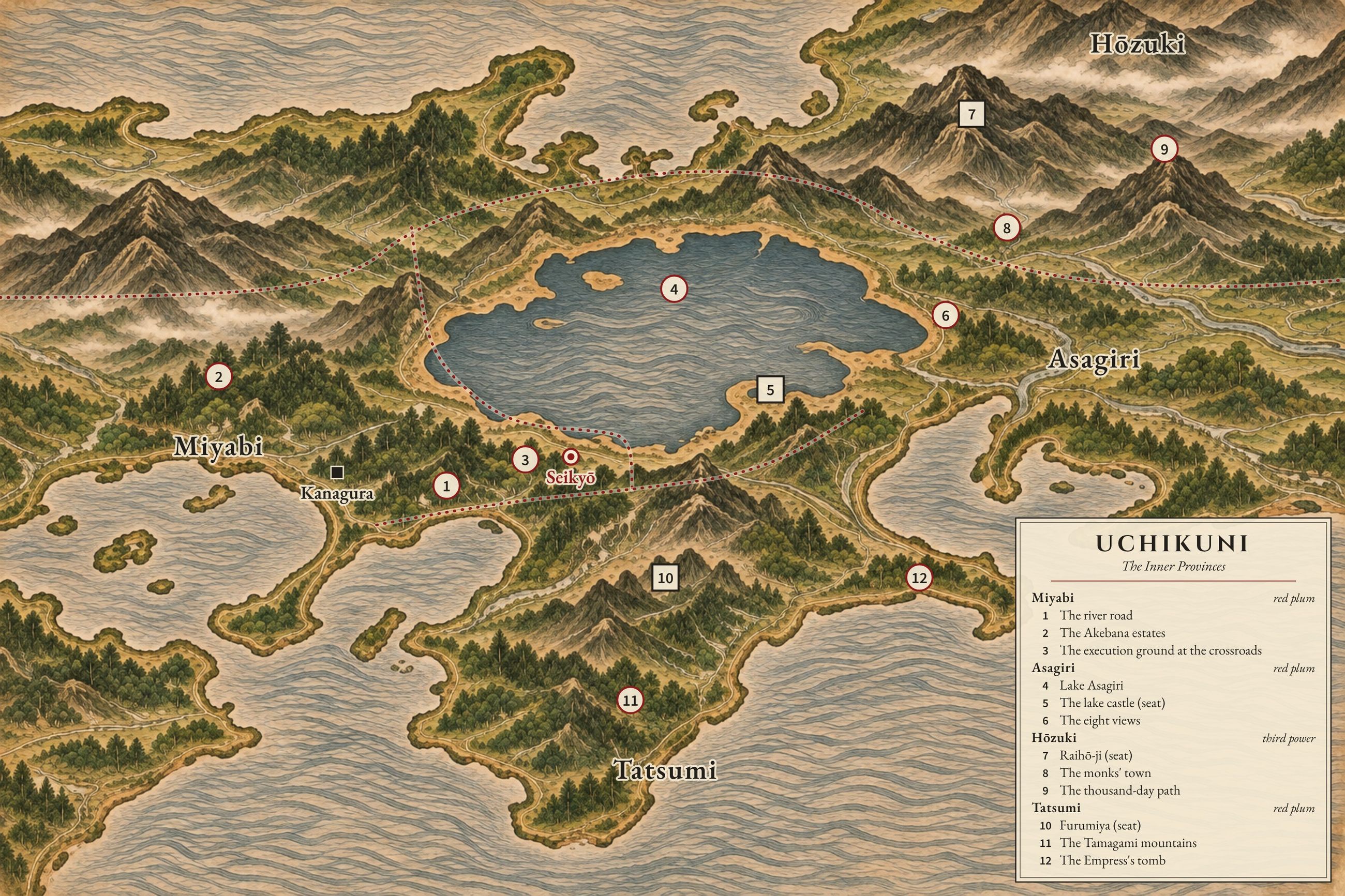
The four provinces around the Pure Capital are the oldest, richest, and most crowded in the realm. Everything here is close to the throne, so everything here is political.
Miyabi (雅), "Elegance"#
| Ruler | Seat | Size | Blossom |
|---|---|---|---|
| Shikken Ōtaki Kiyoaki | Kanagura Castle | About 400,000 koku | Red |
Miyabi is the Shikken's province and the heart of the realm. Seikyō and Kanagura both stand in it (Part 2), joined by a river road lined with temples, villas, inns, and toll stations. Its fields are rich, its villages are prosperous and tired of soldiers, and every second official is an Ōtaki or married to one.
Extent. About two days across on foot. Forces. About 8,000 at muster. Elite: the Shikken's castle guard of Kanagura, 1,000 veteran samurai, and three companies of matchlock gunners armed at Umikado. The rest are well-fed levies who have never fought.
Places.
- The river road (road). A day's walk of busy road from Seikyō down to Kanagura, with a toll station every few miles, each paying a different relative of the Shikken. It is the safest road in the realm by day, and the most watched.
- The Akebana estates (villages). The regents' family still holds wide estates in the hills west of Seikyō, the last of the old court lands. Their stewards pay the Shikken's taxes slowly, and the Shikken's collectors are not welcome.
- The execution ground at the crossroads (place of interest). Where the river road meets the Yamaji Road, the Shikken's magistrates display the heads of bandits, rebels, and anyone else who has displeased him. The place is Profane Ground (Chapter 4), and the crows never leave.
| d6 | Rumor |
|---|---|
| 1–2 | "The Shikken has 12 nephews, and every one of them holds an office." (T) Eleven, actually. |
| 3–4 | "The Akebana are hiding white plum envoys on their estates." (T) |
| 5–6 | "The heads at the crossroads speak at night." (F) But one of them does open its eyes. |
Savage Tale hooks. A toll collector on the river road is cheating his uncle, the Shikken, and the heroes are hired to prove it. An Akebana steward needs a white plum envoy smuggled out before the Shikken's men search the estate.
Asagiri (朝霧), "Morning Mist"#
| Ruler | Seat | Size | Blossom |
|---|---|---|---|
| Kayamori Harutsuna | The lake castle on Lake Asagiri | About 250,000 koku | Red |
Asagiri is the rice basket of the capital: a great lake ringed by paddies, fishing villages, and old temples, with the mountains of Kurogane on its eastern shore. Its morning mists are famous in poetry, and so are its eels. The Kayamori have ruled it for six generations, and Lord Harutsuna married the Shikken's niece to keep it. He is a cautious, comfortable lord who lives in terror of the Sekitani League next door, because his own lakeside villages are full of Western Light faithful.
Extent. Three days around the lake on foot, or one by boat. Forces. About 5,000 at muster, with a flotilla of 40 war barges on the lake. Many of the levies are Western Light faithful, and the GM may treat a third of them as unreliable against the League.
Places.
- Lake Asagiri (lake). The largest lake in the realm, crossed by ferries, fishing boats, and the Kayamori's war barges. Islands in the lake hold shrines, a famous temple, and one island that no boatman will land on.
- The lake castle (castle). The Kayamori castle stands on a spit of land in the lake, its walls rising straight from the water. It can only be reached by boat or by a single causeway.
- The eight views (places of interest). Poets have named eight views of the lake that every cultured traveler must see. A contest of refinement (Chapter 4) held at one of them counts as a great occasion.
| d6 | Rumor |
|---|---|
| 1–2 | "Lord Harutsuna will march on the Sekitani League in the autumn." (F) He talks about it every year. |
| 3–4 | "Something huge moves under the lake ice in winter." (T) |
| 5–6 | "The lakeside villages are sending rice to the League." (T) |
Savage Tale hooks. A ferry vanishes in the morning mist with an envoy aboard. Lord Harutsuna wants proof that his villages are sending rice to the League, and the villages want the proof to disappear.
Hōzuki (鬼灯), "Demon Lantern"#
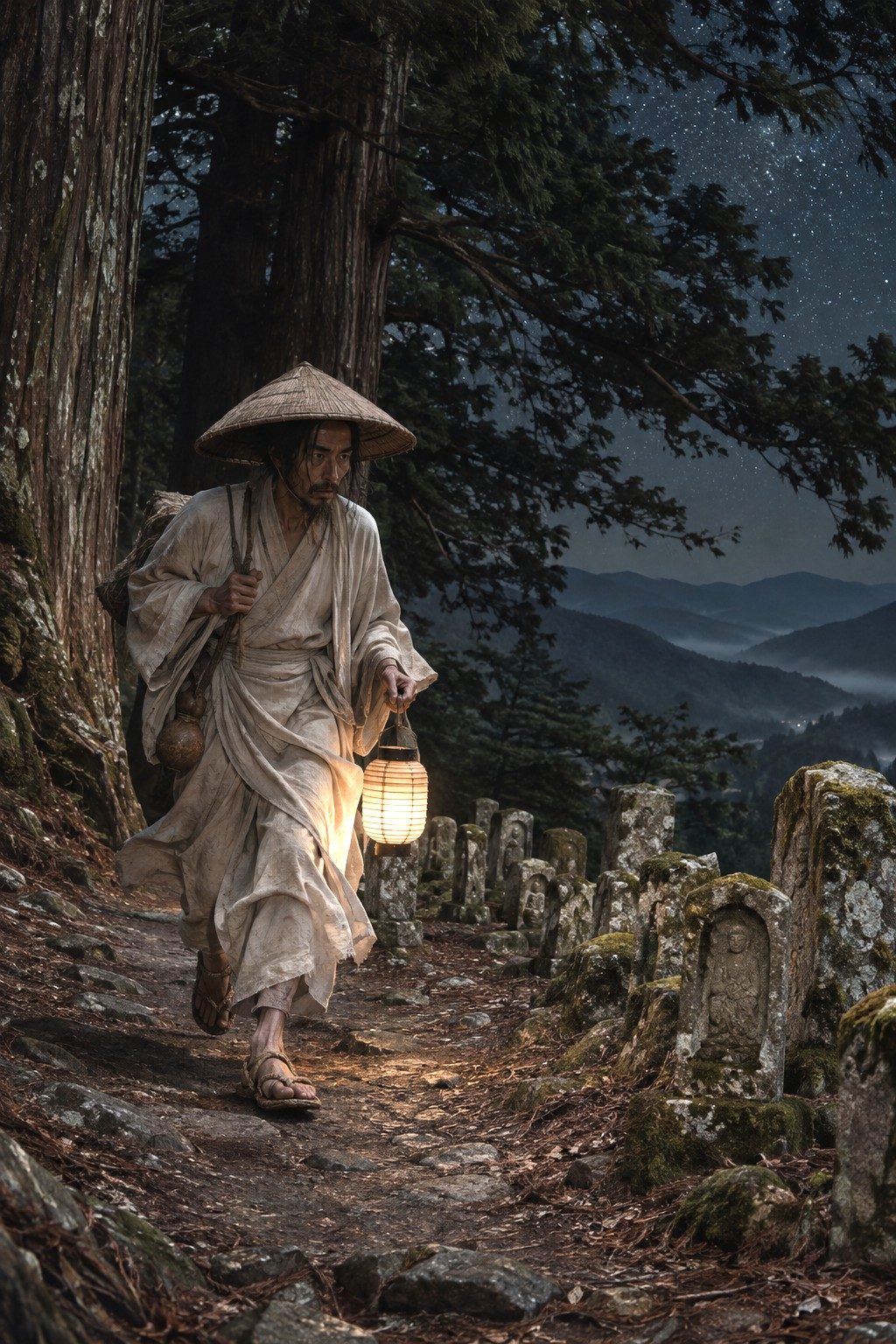
| Ruler | Seat | Size | Blossom |
|---|---|---|---|
| The Prince-Abbot of Raihō-ji | Raihō-ji, on Mount Raihō | About 150,000 koku in temple lands | Third power |
Hōzuki is a province of forested mountains north of the capital, and almost all of it belongs to Raihō-ji, the head temple of Thunder Peak, which stands on the mountain above Seikyō's northeastern demon gate. The temple's 3,000 halls, sub-temples, and hermitages cover the mountain, and its warrior monks, several thousand strong, answer to no lord but the Prince-Abbot. By custom he is always a son of the Imperial house. The present Prince-Abbot, Taishun, is the Cloistered Emperor's younger brother, which is why the Cloister commands the monks (Part 2).
Extent. Two days across, all of it mountain. Forces. About 4,000 warrior monks (elite), with temple servants and the monks' town militia behind them. The monks fight as a Temple League formation (Chapter 5).
Places.
- Raihō-ji (head temple). The head temple, on its storm-wrapped mountain, with its great halls, its eternal lamp, and its library of secret rites. Lightning strikes the peak so often that the monks say the Immovable King lives there.
- The monks' town (market town). At the foot of the mountain, a town of moneylenders, sake brewers, and armorers serves the temple. The temple's moneylenders hold the debts of half the court.
- The thousand-day path (place of interest). A trail around the mountain's peaks that ascetics walk every night for a thousand days. Those who complete it are living saints. Those who fail are expected to take their own lives, and the path is lined with their graves.
| d6 | Rumor |
|---|---|
| 1–2 | "The monks are ready to carry the palanquin to Seikyō again." (T) |
| 3–4 | "The Prince-Abbot is the true power behind the Cloister." (F) The brothers rule together, and quarrel in private. |
| 5–6 | "A demon is chained beneath the mountain, and the monks' rites keep it there." (T) Chapter 7 says what kind. |
Savage Tale hooks. A walker on the thousand-day path has vanished halfway through his vigil, and the monks want to know if he fled or was taken. Thunder Peak hires the heroes to find a Lion's Roar preacher who has been mocking them in Seikyō's streets, and shut him up.
Tatsumi (巽), "Southeast"#
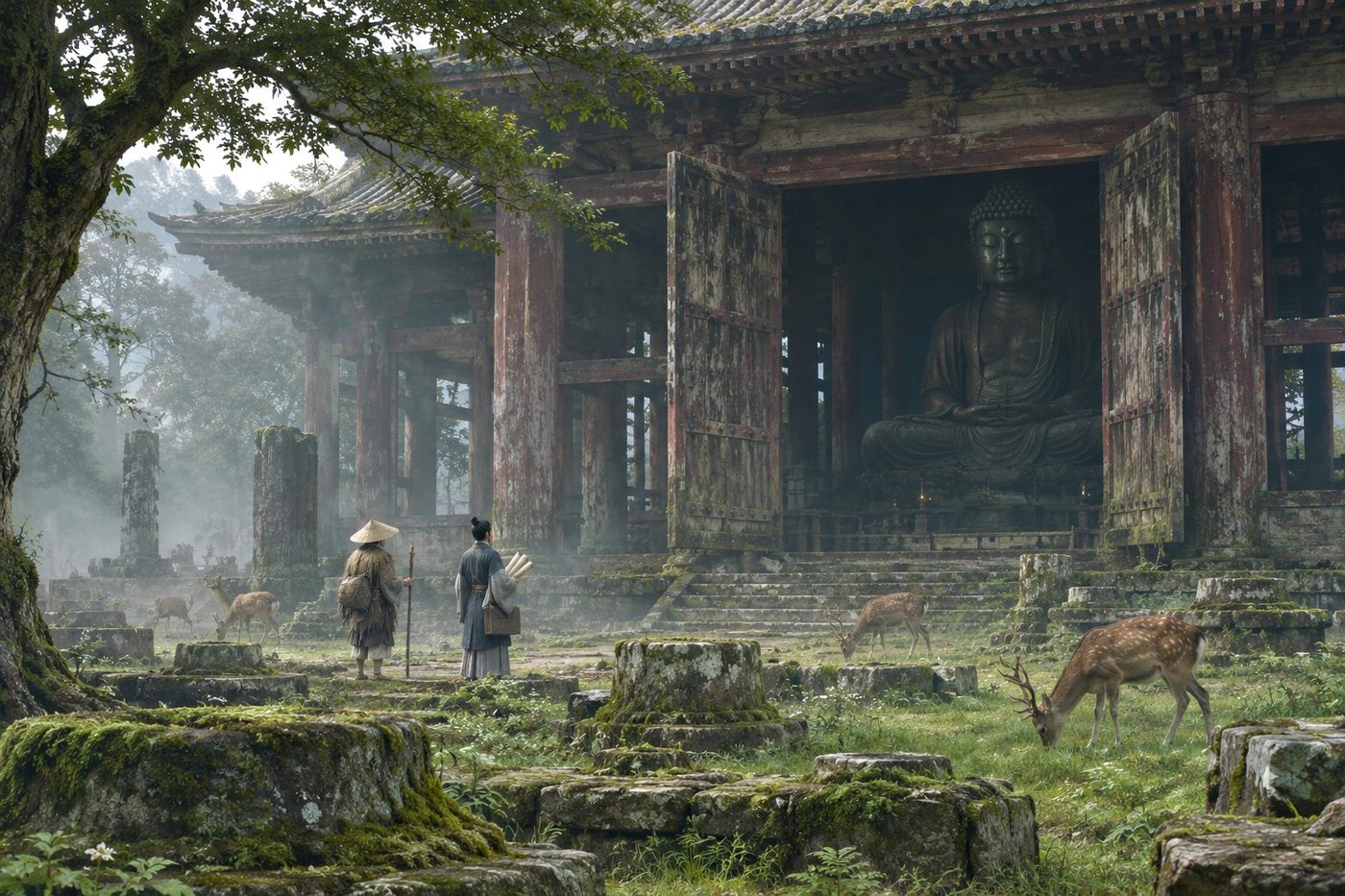
| Ruler | Seat | Size | Blossom |
|---|---|---|---|
| Hatakura Michitaka | Furumiya | About 200,000 koku | Red |
Tatsumi is a land of holy mountains and deep forests south of the capital, and the home of Furumiya, the first permanent capital, which the court left eight centuries ago. Furumiya is a city of 30,000 among the ruins of a city of 200,000: great temples of the old scholarly sects, giant bronze statues, deer that wander the streets unafraid, and the overgrown foundations of palaces. South of the city rise the Tamagami mountains, the holiest range of the Mountain Way, where mountain ascetics walk the ridge paths between shrines. The Hatakura clan rules from Furumiya and is red, because the Shikken pays the old temples well.
Extent. Four days across, mostly forest and mountain. Forces. About 4,000 at muster, plus mountain ascetics and hunters who fight as Skirmishers in their own hills.
Places.
- Furumiya (city, about 30,000). The old capital, its great temples, and its sacred deer. Scholars, pilgrims, and antiquarians crowd it, and its temples hold treasures older than Seikyō. On moonless nights, a ghostly temple swordsman guards the ruined great south gate (Chapter 10).
- The Tamagami mountains (holy mountains). The ridge path of the mountain ascetics, from shrine to shrine, through forests where tengu, mountain kami, and worse are said to dwell. The ascetics' great lodge is here, and most mountain ascetics in the realm have trained on its paths at least once.
- The Empress's tomb (place of interest). The tomb of Empress Shōkei, founder of Furumiya, a great wooded mound ringed by a moat outside the city. The court sends envoys to it every spring.
| d6 | Rumor |
|---|---|
| 1–2 | "The old temples of Furumiya keep the true history of the realm, and it isn't the one we're taught." (T) Chapter 7 says what it is. |
| 3–4 | "A tengu on the Tamagami ridge is teaching a young samurai the sword." (T) |
| 5–6 | "Lord Michitaka plans to move his seat out of Furumiya." (F) The temples wouldn't allow it. |
Savage Tale hooks. A temple treasure older than the Kenreki is stolen from Furumiya, and a Seikyō court noble is the buyer. A mountain ascetic asks the heroes to escort him along the ridge path to a shrine that hasn't been visited in 100 years.
Yamaji: The Mountain Road#
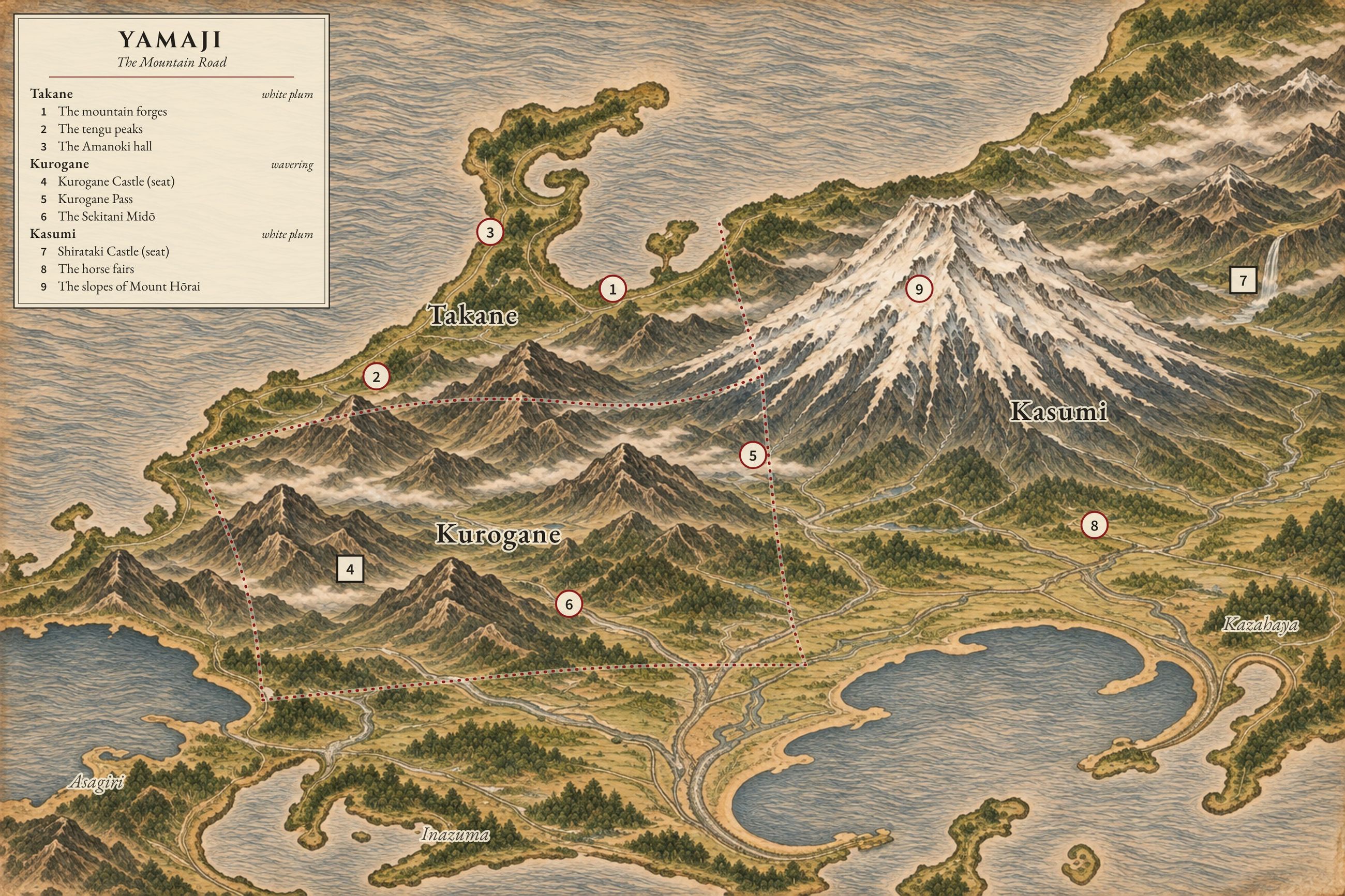
The three provinces of the Mountain Road guard the passes between the Inner Provinces and the east. Kurogane, the Starter Province, is described in Part 1. Its neighbors, Takane and Kasumi, both wear the white plum.
Takane (高嶺), "High Peaks"#
| Ruler | Seat | Size | Blossom |
|---|---|---|---|
| Ameyama Tadamune | Ameyama Castle, in the high valleys | About 90,000 koku | White |
Takane is the roof of the realm: a wilderness of snow peaks, high valleys, and gorges north of Kurogane, where winter lasts half the year. The Ameyama clan holds its few valleys and its mountain forges. Lord Tadamune is a gruff, loyal old warrior who fought beside Sadatsugu in Cheongun. Since the war, his forges have made Sadatsugu's swords, spearheads, and armor from iron carried over the mountains, much of it from Kurogane's Kitamori mines. The Amanoki School of the waiting sword has its hall in Takane's high valleys, and its students say their founder learned from a tengu. Above the snow line in the tengu peaks lives the hermit Nui of the Snows (Chapter 10).
Extent. Three days across in summer, impassable in winter. Forces. About 1,800 at muster, all well armed from the clan's own forges (count them as veterans), plus mountain hunters who fight as Skirmishers.
Places.
- The mountain forges (hamlet). In a gorge below Ameyama Castle, a dozen forges work day and night, their smoke hidden by the clouds. Sadatsugu's quartermasters collect a load of blades every month.
- The tengu peaks (holy mountains). The highest peaks of the realm, where tengu are said to train the worthy and punish the proud. Swordsmen climb them every year hoping to be chosen. Some come back changed, and some don't come back.
- The Amanoki hall (great school). A plain wooden hall in a snowbound valley, where the students of the waiting sword train barefoot on frozen ground.
| d6 | Rumor |
|---|---|
| 1–2 | "Lord Tadamune's forges make a thousand blades a year for Sadatsugu." (T) |
| 3–4 | "The tengu have chosen sides in the war." (F) The tengu don't care about blossoms. |
| 5–6 | "The Shikken has sent shinobi to burn the forges." (T) They haven't arrived yet. |
Savage Tale hooks. An iron caravan from Kurogane is lost in a snowstorm on the high passes, and both Sadatsugu and Lady Kitamori want it found. A tengu kidnaps a young lord who boasted that he was the best swordsman in Takane.
Kasumi (霞), "Haze"#
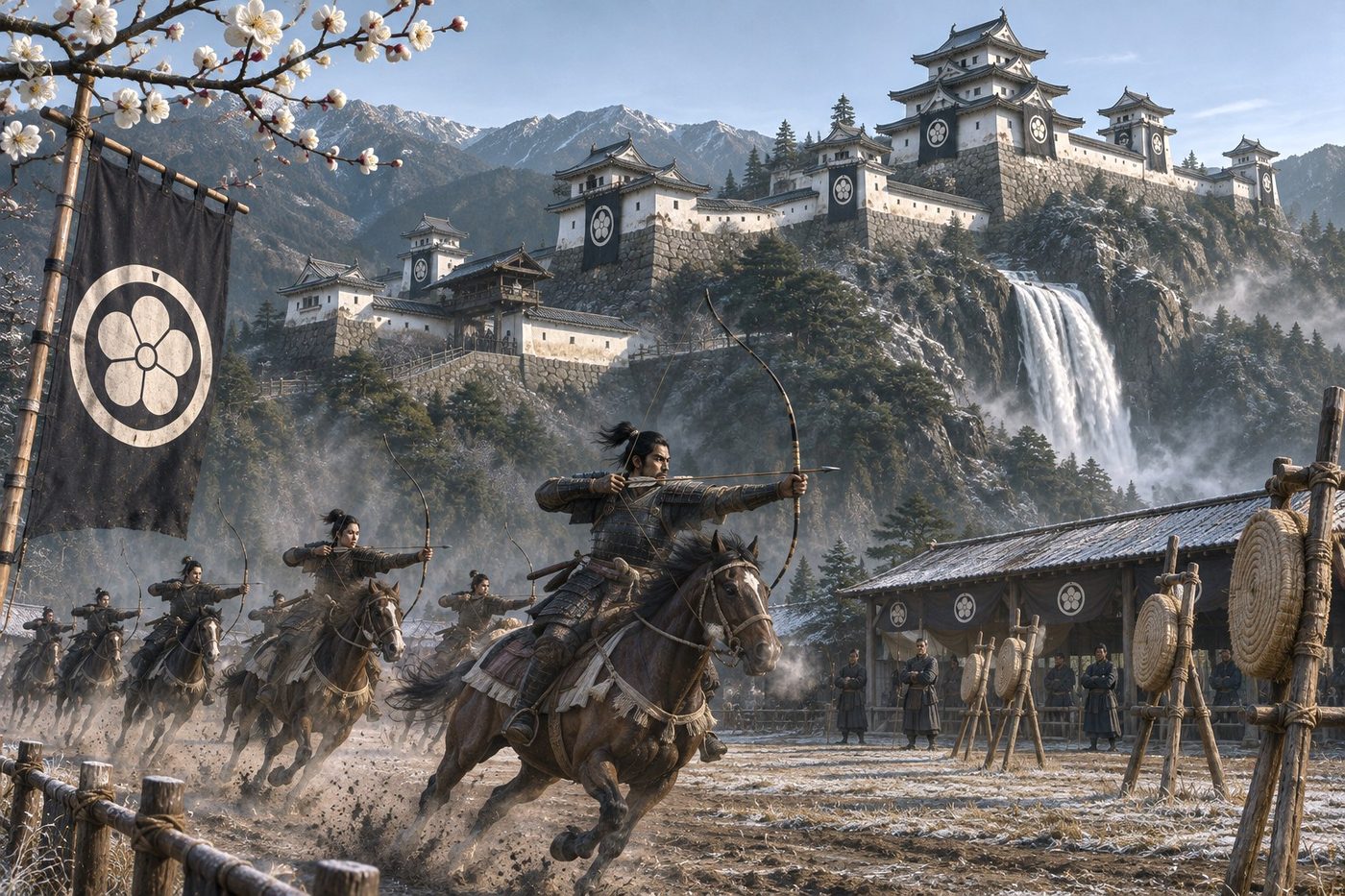
| Ruler | Seat | Size | Blossom |
|---|---|---|---|
| Kagamino Sadatsugu | Shirataki Castle | About 230,000 koku | White |
Kasumi is a province of high valleys, grassy uplands, and horse herds east of Kurogane Pass, and it is Sadatsugu's own domain, held by his branch of the Kagamino since the Usurpation. Its uplands breed the finest horses in the realm, and its cavalry is famous. The Asaoka clan, the hereditary masters of the mounted bow, are Sadatsugu's chief retainers, and their school, the Asaoka School, trains every horse archer worth the name. Mount Hōrai rises on Kasumi's southern border, white and vast, visible from every valley.
Kasumi sits between Kurogane and the Shogun's Kazahaya. If Sadatsugu holds Kurogane Pass, the road to the capital is open to him. If the Shogun's armies hold it, Kasumi is surrounded.
Extent. Three days across the uplands. Forces. About 4,600 at muster, plus Sadatsugu's own Cheongun veterans, about 2,000 strong (veterans). Elite: the Asaoka horse archers, 800 riders, the finest cavalry in the realm.
Places.
- Shirataki Castle (castle). Sadatsugu's seat, on a ridge above a white waterfall. It is new, strong, and full of veterans of Cheongun, who drill on its training ground every morning. White plum banners hang from every tower.
- The horse fairs (place of interest). Every autumn, the great horse fair on the uplands draws buyers from across the realm. This year, Sadatsugu has bought every warhorse in it.
- The slopes of Mount Hōrai (holy mountain). The northern slopes of the sacred mountain, with their shrines, pilgrim huts, and forests. Pilgrims climb to the summit in summer. In other seasons, the mountain's kami don't welcome visitors, and the Chapter 7 secrets of the mountain lie here.
| d6 | Rumor |
|---|---|
| 1–2 | "Sadatsugu will march on Kurogane Pass this autumn." (F) Not until he has the Kitamori's iron and a promise from Kurogane's castle. |
| 3–4 | "Sadatsugu has a letter from the Cloistered Emperor." (T) It is friendly, and promises nothing. |
| 5–6 | "Strange lights have been seen on Mount Hōrai's slopes at night, and an old man in mainland robes." (T) |
Savage Tale hooks. Sadatsugu needs heroes he can trust to carry his messages into Kurogane, past the barrier at the pass. A pilgrim party on Mount Hōrai's slopes vanishes, and its one survivor speaks only an ancient form of the mainland tongue.
Higashiji: The East Road#
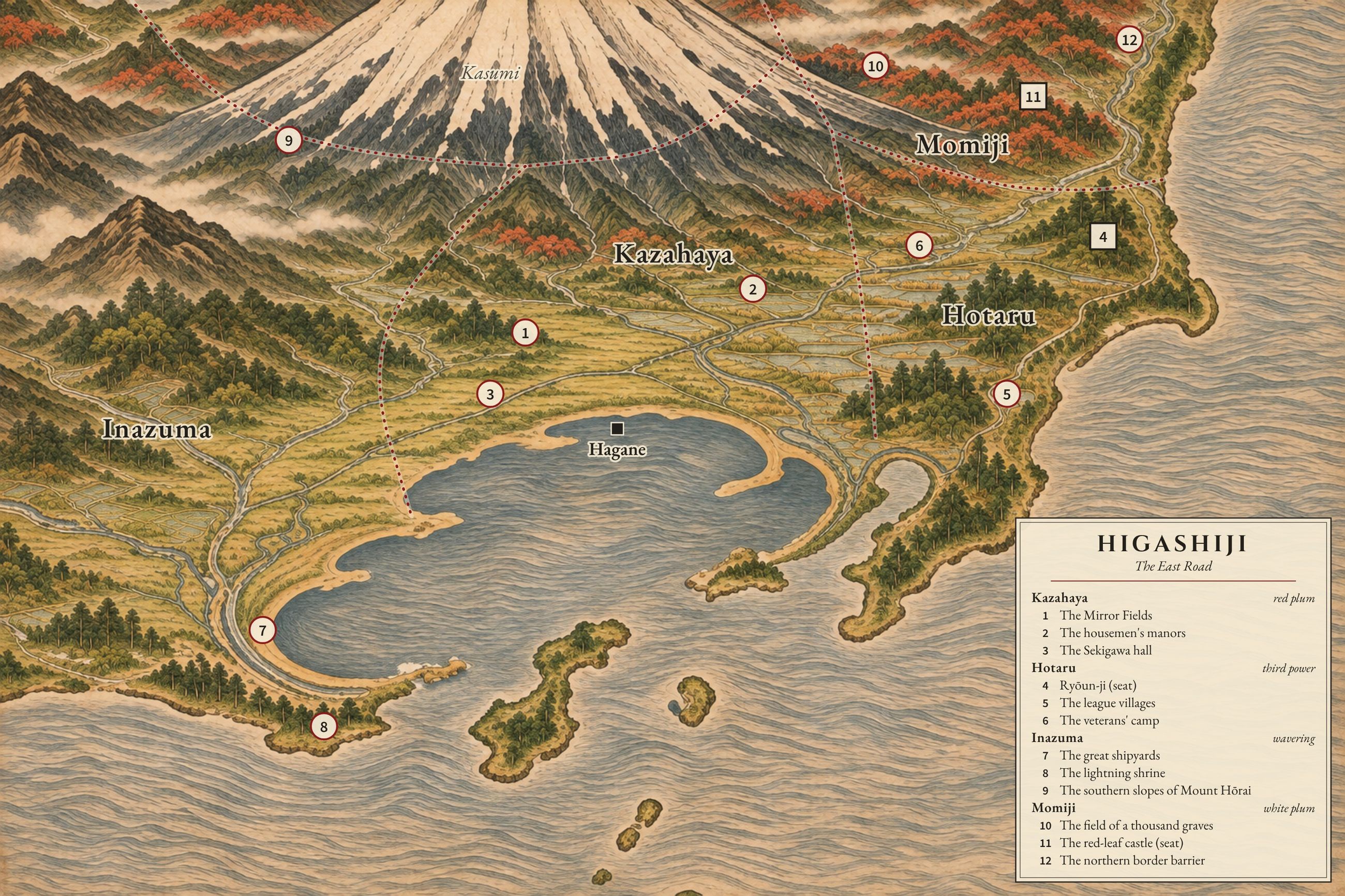
The four provinces of the East Road are broad plains, storm coasts, and old battlefields. The Shogun's own province is here, and so is the rebellion the Shogun fears most.
Kazahaya (風早), "Swift Wind"#
| Ruler | Seat | Size | Blossom |
|---|---|---|---|
| Shogun Kagamino Tomoharu | Hagane | About 350,000 koku | Red |
Kazahaya is the Shogun's own province: wide, windswept plains of grass and rice around the bay of Hagane (Part 2), crossed by rivers and dotted with the fortified manors of the Shogun's housemen. It is warrior country, proud of its horses and archers. The Sekigawa School of the spear has its hall in Hagane, and its students fill the Shogun's companies. The province's housemen are loyal to the Kagamino, but many served under Tomonori and Sadatsugu in Cheongun, and their loyalty to the son is not the same as their love for the father.
Extent. Four days across the plains. Forces. About 7,000 at muster, if the housemen come. Elite: the Shogun's mounted housemen, about 1,000 riders, and the Sekigawa spearmen of Hagane (veterans). The Shogun's fleet of 60 war junks can carry 5,000 soldiers by sea.
Places.
- The Mirror Fields (grasslands). The grasslands behind Hagane that gave the Kagamino their name, with the Shogun's horse herds and the first Shogun's mound.
- The housemen's manors (fortified houses). Fortified farmhouses with earth walls, gates, and watchtowers, each the seat of a houseman family that has served the Kagamino for centuries. In a crisis, the Shogun calls them to Hagane, if they come.
- The Sekigawa hall (great school). A great hall of the spear near Hagane's castle, where hundreds of students drill in ranks. Its headmaster is a cousin of the Hatamori.
| d6 | Rumor |
|---|---|
| 1–2 | "Half the housemen of Kazahaya would ride for Sadatsugu if he asked." (F) A third, perhaps. |
| 3–4 | "The Shogun's horse herds are being sold to pay the fleet." (T) |
| 5–6 | "The first Shogun's mound is empty." (T) Chapter 7 says where he went. |
Savage Tale hooks. A houseman family refuses the Shogun's summons, and the heroes are sent to find out why. Horse thieves are stealing from the Shogun's herds, and the trail leads toward Kasumi.
Hotaru (蛍), "Firefly"#
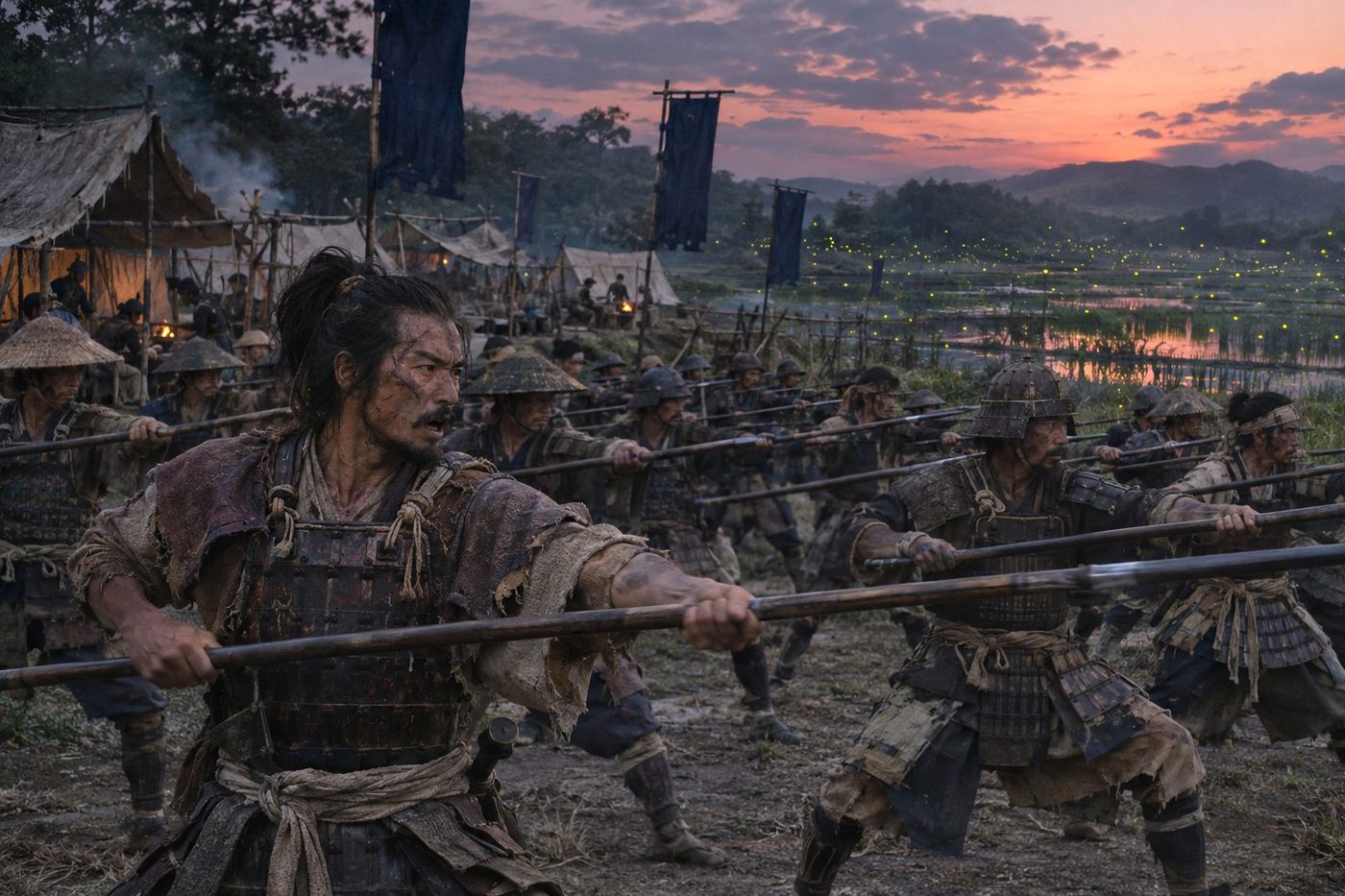
| Ruler | Seat | Size | Blossom |
|---|---|---|---|
| The Western Light leagues | Ryōun-ji, the Western Light head temple | About 300,000 koku | Third power |
Hotaru is the richest farmland in the east, a flat, wet country of rice paddies, canals, and reed marshes north of the Shogun's plains, where fireflies rise from the fields on summer nights. It is also the most dangerous province in the realm for a lord. Ten years ago, the farmers and gentry of Hotaru, swearing oaths before the Buddha of Boundless Light, drove out their daimyo and his retainers. Since then the province has been ruled by its Western Light leagues, with Ryōun-ji, the sect's head temple, at their center. Every sect league in the realm, including the Sekitani League in Kurogane, takes its letters from Ryōun-ji.
Now unpaid veterans of the Cheongun War, the Strait Men, are flocking to Hotaru, and the leagues are arming them. Their leader, a former foot soldier named Ichizō, wants to march on Hagane and burn the Shikken's tax registers. The head abbot, Ryōken, wants peace. The leagues are listening to Ichizō.
Extent. Three days across, flat and wet. Forces. About 6,000 sworn league fighters and as many more farmers when the drums sound, fighting as a Temple League. Ichizō's Strait Men, about 3,000 Cheongun veterans, are the leagues' hard core (veterans).
Places.
- Ryōun-ji (head temple). The head temple of the Western Light, a fortified temple city on an island in the marshes, ringed by canals and earthworks, with a great hall that holds 10,000 worshippers.
- The league villages (villages). Hundreds of villages, each with its own meeting hall, its own drum, and its own spearmen. Samurai who ride through Hotaru do it quickly and quietly.
- The veterans' camp (place of interest). On the edge of the marshes, a sprawling camp of Strait Men, drilling with spears and old matchlocks under league banners.
| d6 | Rumor |
|---|---|
| 1–2 | "Ichizō will march on Hagane before the New Rice." (T) If no one stops him. |
| 3–4 | "Sadatsugu is paying the veterans in Hotaru." (F) He would like to, but the leagues refuse his money. |
| 5–6 | "The fireflies of Hotaru are the souls of the dead lord's samurai." (F) Most of them, anyway. |
Savage Tale hooks. Abbot Ryōken secretly asks the heroes to stop Ichizō's march before it ruins the leagues. The Shogun's officers want a spy in the veterans' camp, and the Strait Men want the spy found.
Inazuma (稲妻), "Lightning"#
| Ruler | Seat | Size | Blossom |
|---|---|---|---|
| The Mizunaga (red) and the Nobuyama (white) | Two castles, a day apart | About 220,000 koku between them | Wavering |
Inazuma is a storm coast of cliffs, coves, and shipyards south of Kasumi, in the shadow of Mount Hōrai. Summer storms batter it, lightning strikes it more than anywhere in the realm, and its shipwrights build the best ships in the isles, including most of the Shogun's fleet. Two clans share it and hate each other. The Mizunaga hold the western shipyards and are red, because the Shogun pays for their ships. The Nobuyama hold the eastern coast and the mountain border and are white, because Sadatsugu has promised them the shipyards. Lord Mizunaga Sanekuni and Lord Nobuyama Hidetsura were once sworn brothers, before a marriage between their houses ended in murder.
Extent. Three days along the coast. Forces. The Mizunaga muster about 2,400 and the Nobuyama about 2,000. The Mizunaga also hold the shipyards' marines, 500 fighters used to boarding ships (veterans).
Places.
- The great shipyards (market town). Slipways, timber yards, and rope walks in a sheltered bay, where a war junk takes a year to build. Whoever holds them holds the Shogun's fleet's future.
- The lightning shrine (district shrine). A shrine on a headland where lightning strikes every summer, kept by priests who read the storms as omens. Both clans pray there before war.
- The southern slopes of Mount Hōrai (holy mountain). The steeper, wilder side of the sacred mountain, with fewer shrines and stranger stories than the Kasumi side.
| d6 | Rumor |
|---|---|
| 1–2 | "The Nobuyama will attack the shipyards before winter." (T) |
| 3–4 | "The murder that broke the brotherhood was the Shikken's doing." (T) No one in either clan knows it. |
| 5–6 | "The lightning shrine's priests can call down the storm." (F) They can only see it coming. |
Savage Tale hooks. The heroes uncover proof that the Shikken arranged the murder that split the clans, and both clans will kill to own the proof. A new war junk is sabotaged on the slipway the night before launch.
Momiji (紅葉), "Autumn Leaves"#
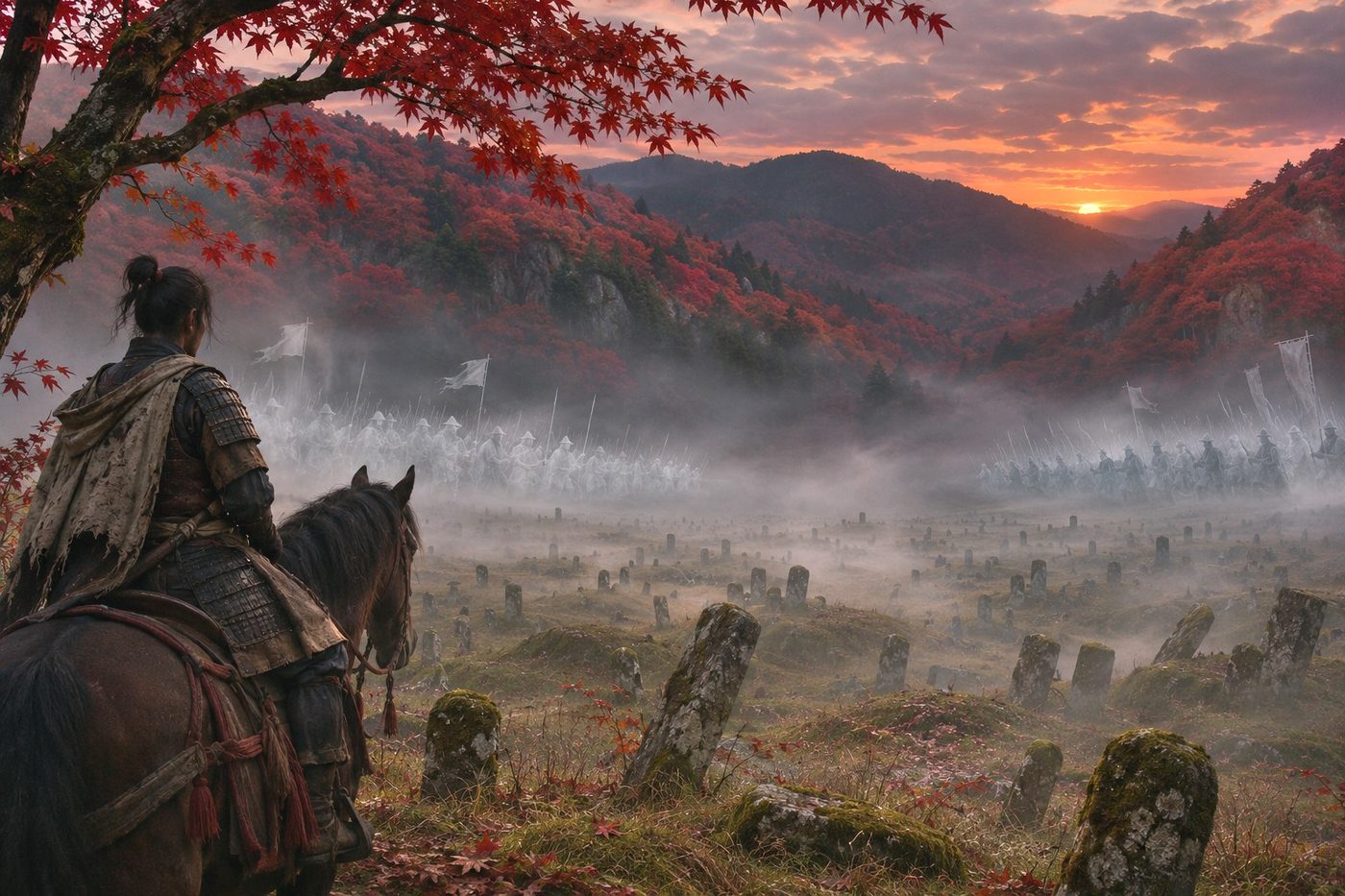
| Ruler | Seat | Size | Blossom |
|---|---|---|---|
| Fujinaga Kagemori | The red-leaf castle | About 120,000 koku | White |
Momiji is a hilly border province between the Shogun's east and the north, famous for its autumn maples and its battlefields. The great battles of the Minazuki Return were fought here, and the dead of four centuries lie under its hills. Every autumn, when the maples turn red, the ghosts walk. The Fujinaga clan holds it, and it has gone white because Lord Fujinaga Kagemori is married to a Mizusawa, and because the war between the Kuzuhara and the Mizusawa in the north is spilling over his border. The Kanemori School of the great sword has its hall here, among the old battlefields.
Extent. Two days across, all hills. Forces. About 2,400 at muster, hardened by border raids (count half as veterans). Elite: a company of 100 Kanemori great-swordsmen, sworn to the school's hall.
Places.
- The field of a thousand graves (Profane Ground). The greatest battlefield of the Minazuki Return, a wide valley of mounds and leaning stones. It is Profane Ground (Chapter 4), and in autumn the ghosts of both armies refight the battle every night.
- The red-leaf castle (castle). The Fujinaga seat, ringed by maples, which the Kuzuhara have already tried once to take.
- The northern border barrier (barrier station). A fortified barrier on the road north, where Kuzuhara raiders and Mizusawa refugees cross every week.
| d6 | Rumor |
|---|---|
| 1–2 | "Kuzuhara Akitada means to take Momiji before he finishes Shimoyuki." (T) |
| 3–4 | "The ghosts of the thousand graves will fight for whoever cleanses their field." (T) Chapter 6 says how. |
| 5–6 | "Lord Kagemori is secretly loyal to the Shikken." (F) |
Savage Tale hooks. Lord Kagemori needs the field of a thousand graves cleansed before he must fight a battle there. A Mizusawa refugee carries a secret that the Kuzuhara will kill to get back.
Kitaji: The North Road#
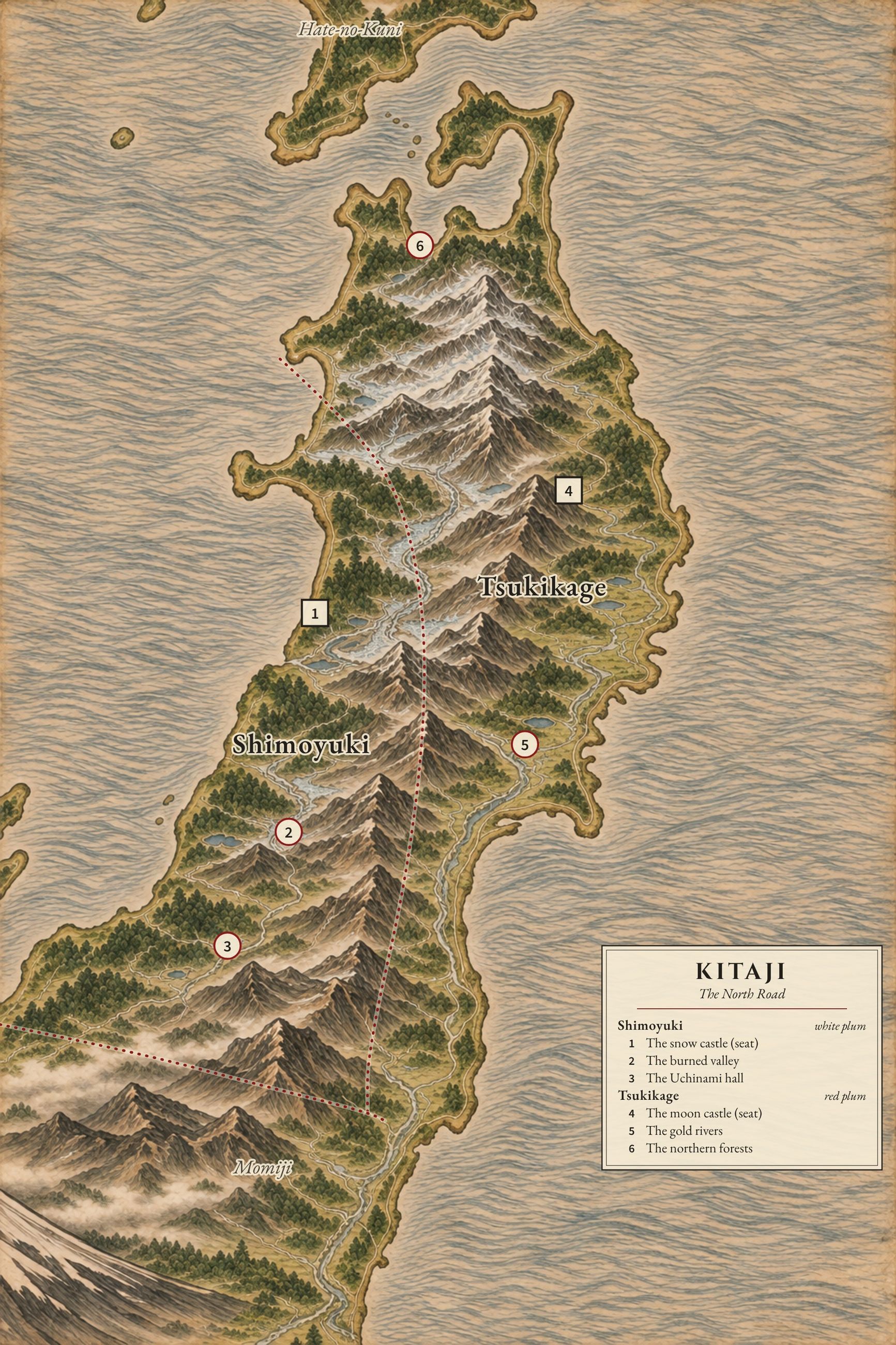
The two northern provinces of Shinogi-jima are cold, vast, and at war with each other. Their war is the first war of the two blossoms, though neither lord will call it that.
Shimoyuki (霜雪), "Frost and Snow"#
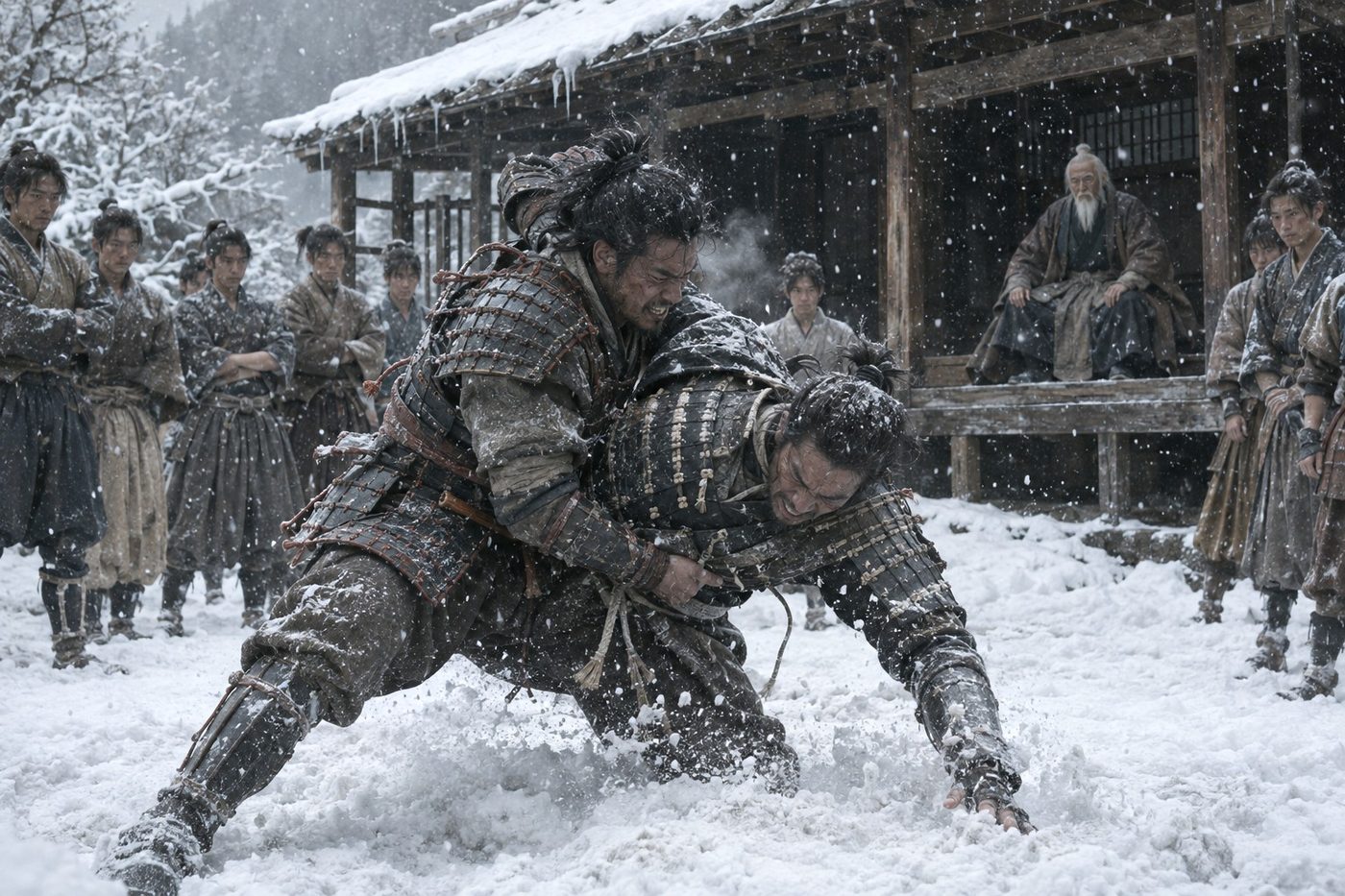
| Ruler | Seat | Size | Blossom |
|---|---|---|---|
| Mizusawa Kagehisa | The snow castle | About 200,000 koku | White |
Shimoyuki is the western half of the north: a land of deep snow, high passes, pine forests, and isolated valleys along the Western Sea, where winter lasts five months and the clans keep to themselves. Its daimyo, Mizusawa Kagehisa, is Sadatsugu's brother-in-law: Sadatsugu's wife is his sister. He is at war with his neighbor Kuzuhara Akitada of Tsukikage, who has the Shikken's blessing, and he is losing slowly. The war began over a border valley and a stolen bride, and both sides have long since forgotten which came first. The Uchinami School of armored wrestling has its hall here, where snow-country warriors learn to fight in armor on frozen ground.
Extent. Five days across in summer, and in winter only by the coast road. Forces. About 4,000 at muster, toughened by two years of war (count half as veterans). Elite: the Mizusawa snow riders, 300 horsemen who fight in winter when no one else can.
Places.
- The snow castle (castle). The Mizusawa seat, on a ridge above a frozen river, with walls buried to the battlements in winter.
- The burned valley (Profane Ground). The border valley where the war began, burned three times by both sides. Its villages are empty, and its restless dead don't know whose side they were on.
- The Uchinami hall (great school). A long, low hall in a snowbound village, where students wrestle in full armor in the snow.
| d6 | Rumor |
|---|---|
| 1–2 | "Sadatsugu will send an army north to save his brother-in-law." (F) He can't, until he holds Kurogane Pass. |
| 3–4 | "The stolen bride is alive and living as a nun." (T) |
| 5–6 | "The Kuzuhara will take the snow castle this winter." (F) The snow will save it one more year. |
Savage Tale hooks. The heroes must carry a message from Sadatsugu to Lord Kagehisa through the Kuzuhara lines in the dead of winter. The stolen bride is found, and her testimony could end the war, if both lords will listen.
Tsukikage (月影), "Moonlight"#
| Ruler | Seat | Size | Blossom |
|---|---|---|---|
| Kuzuhara Akitada | The moon castle | About 450,000 koku | Red |
Tsukikage is the largest province in the realm: the eastern half of the north, a land of wide valleys, horse plains, gold-bearing rivers, and endless forest along the Eastern Sea. Its daimyo, Kuzuhara Akitada, is the most powerful lord in Tsurugishima after the Shikken, and some say before him. He bought the Shogun's blessing for his war with Shimoyuki through the Shikken, and he wears the red plum because it suits him. No one, least of all the Shikken, believes he would stay red if red stopped being useful.
Extent. Eight days from south to north. Forces. About 9,000 at muster, the largest army of any lord, with northern horses for 2,000 riders. Most are fighting in Shimoyuki or guarding the long borders.
Places.
- The moon castle (great castle). The Kuzuhara seat, a great white castle on a hill above a river plain, whose keep is said to have been built to outshine Kanagura's.
- The gold rivers (villages). Rivers in the eastern hills where villages pan for gold in the shallows. The gold goes to the Kuzuhara treasury, and some of it goes to the Shikken.
- The northern forests (wilderness). Endless forests of beech and cedar, where hunters, charcoal burners, and exiles live, and where, the rumors say, oni have been seen again.
| d6 | Rumor |
|---|---|
| 1–2 | "Akitada pays the Shikken in gold for every month of his war." (T) |
| 3–4 | "Oni have been seen in the northern forests." (T) The Bestiary says what they are. |
| 5–6 | "Akitada means to make himself Shogun one day." (T) He has told no one, but everyone knows. |
Savage Tale hooks. A shipment of Kuzuhara gold bound for Kanagura disappears in the northern forests. A village on the forest edge begs for help: something comes out of the trees at night and takes livestock, and now it has taken a child.
Tsuka-jima: The Hilt#
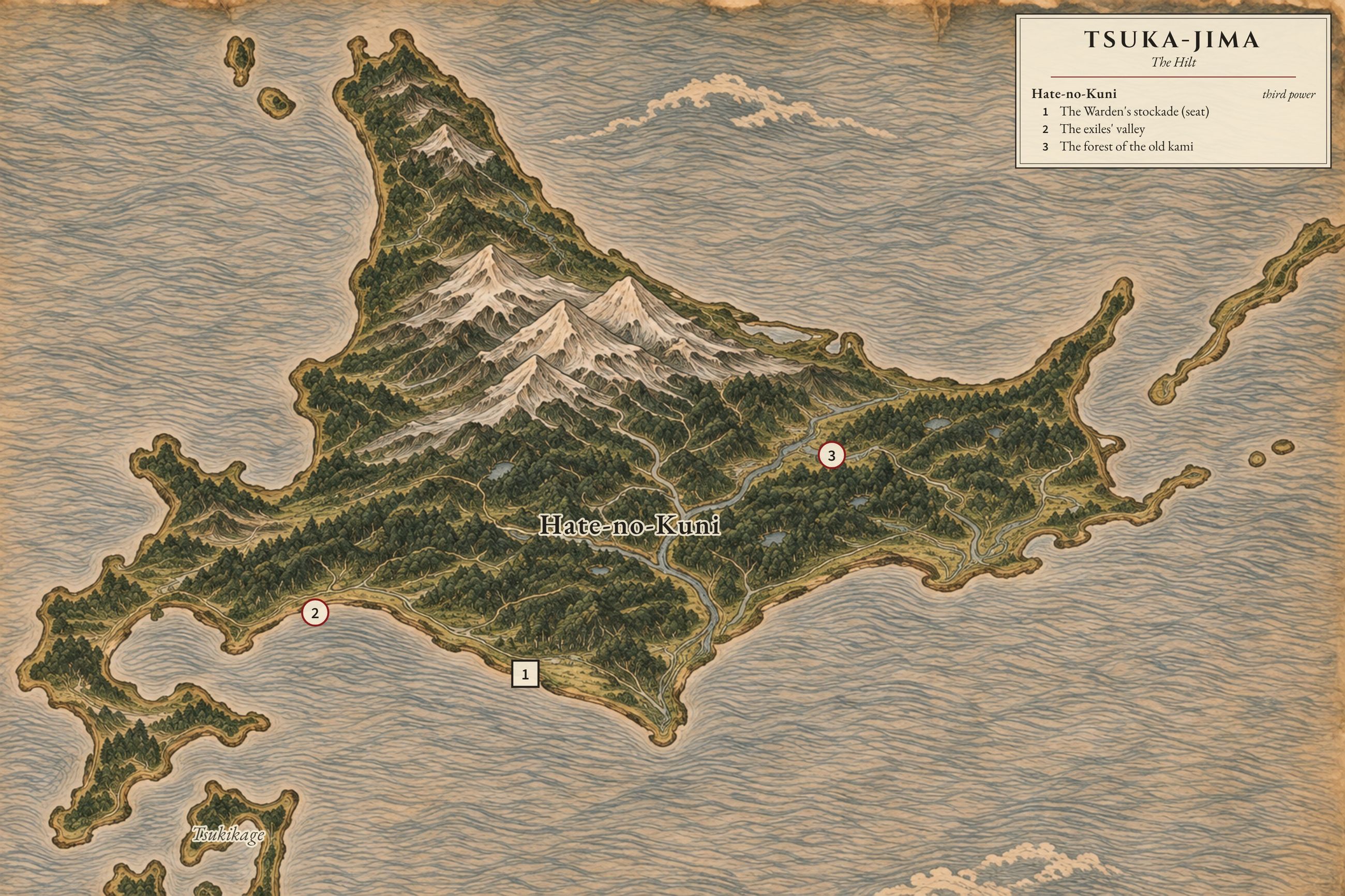
Hate-no-Kuni (果ての国), "Land at the End"#
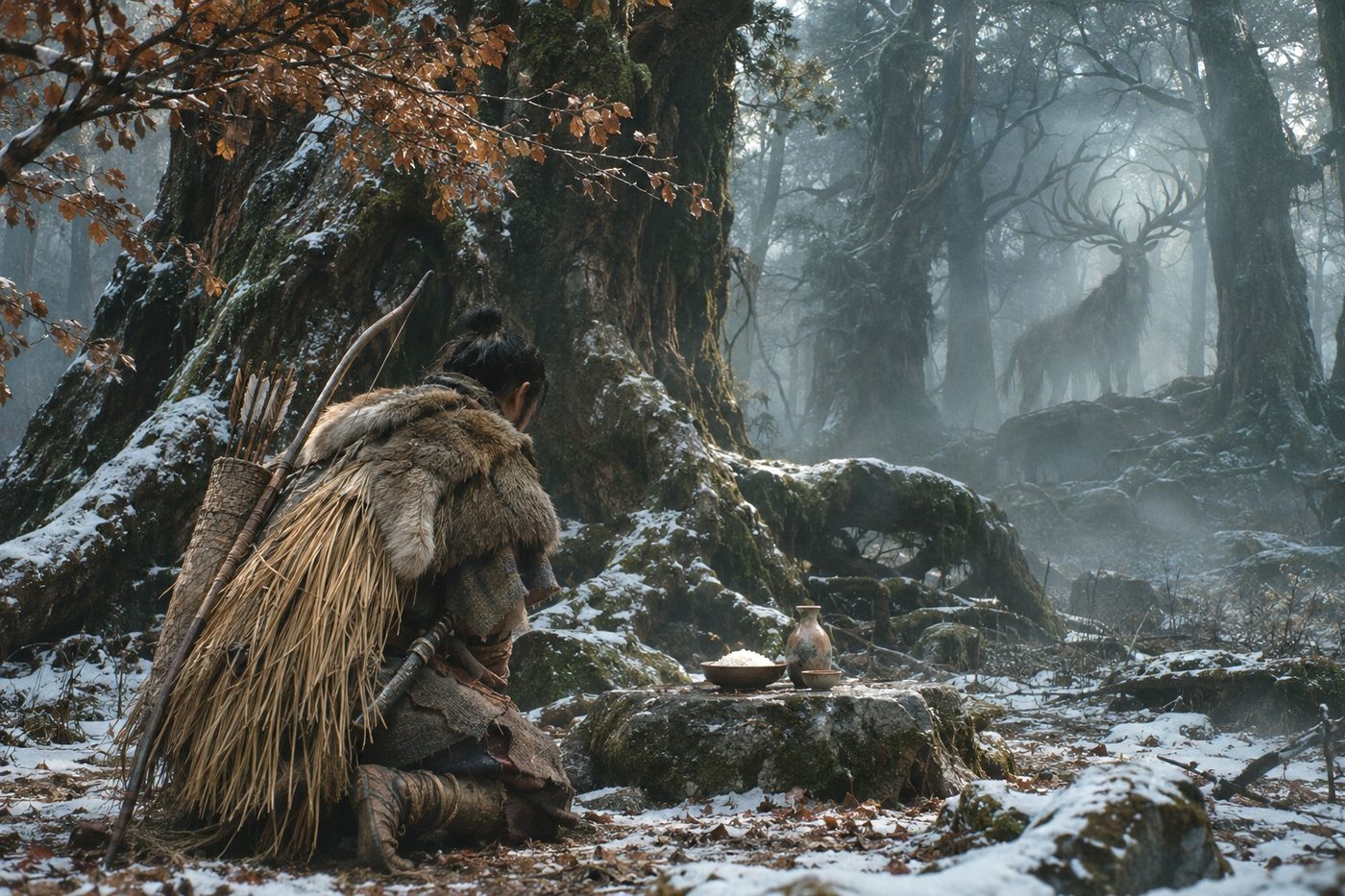
| Ruler | Seat | Size | Blossom |
|---|---|---|---|
| No lord of the realm, in the Warden's view (the river villages answer to their own headmen); a Warden of the March holds a stockade for the Shogunate | The Warden's stockade | About 30,000 koku in a few settled valleys | Third power |
Hate-no-Kuni is the northern island, a vast frontier of snow, forest, mountain, and bog that the realm claims but does not rule. It is one province only because no one has ever bothered to divide it. A few settled valleys on the southern coast grow barley and catch fish. Beyond them is wilderness, where the spirits are older than the gods' sword. The Shogunate sends its exiles here, and keeps a Warden of the March, Hirasato Tatsuoki, in a stockade on the southern shore with a few hundred soldiers, mostly men being punished. He rules what he can see from his walls. The frontier officials call the rest empty land. It isn't. The river people of the interior lived there long before the realm claimed it, and still do, with the forest, the bears, and the kami as their neighbors.
Extent. No one in the Warden's stockade knows; the river people know their own valleys. More than a month to cross, if it can be crossed at all. Forces. About 600 at muster, from the settled valleys and the Warden's garrison. No army has ever marched into the interior and come back whole.
Places.
- The Warden's stockade (hill fort). A timber fort on the southern shore, with a harbor for the supply ship that comes twice a year and a graveyard bigger than the fort.
- The exiles' valley (village). A settlement of exiled nobles, disgraced samurai, and political prisoners, who farm, write poetry, and plot. Some of the realm's cleverest people live here, and all of them want to go home.
- The river villages (villages). Hunters and fishers in bark-roofed villages along the great rivers, with their own speech, their own headmen, and their own rites to the old kami. They trade furs and salmon at the Warden's stockade and answer to no one there. They know which valleys the old kami allow and which they don't, and they speak for their land: a hero who wants to go inland goes with a headman's leave and a guide, or alone. Their elders have their own view of the kami's waking, and of the prospectors.
- The forest of the old kami (wilderness). The great forests of the interior, where the kami are vast, ancient, and nothing like the kami of the shrines. Hunters who enter make offerings at its edge and ask permission. Those who don't ask don't return.
| d6 | Rumor |
|---|---|
| 1–2 | "An exiled court noble in the exiles' valley holds a secret that could bring down the Akebana." (T) |
| 3–4 | "The kami of the north are older than the Forging Gods." (T) Chapter 7 says how much older. |
| 5–6 | "There is gold in the interior rivers, more than in all of Tsukikage." (F) But the Kuzuhara believe it, and have sent men to look. |
Savage Tale hooks. A hero's family member is exiled to Hate-no-Kuni, and the heroes go to bring them home, or to free them. The Kuzuhara's gold prospectors have angered a forest kami, and the exiles' valley is paying the price. A river village's headman comes to the stockade to say the prospectors must leave, and will not leave until someone with authority listens.
Notes#
- Shiranui's drowned court, its face crabs, and its demon-fires draw on "The Story of Mimi-Nashi-Hōïchi" in Lafcadio Hearn, Kwaidan (1904).
- The ship ghost who asks for a ladle comes from "Little Silver's Dream of the Shoji" in William Elliot Griffis, Japanese Fairy World (1880).
Part 4: Beyond the Isles#
The World Across the Water#
Most islanders never see the sea, let alone what lies beyond it. Yet the world beyond the Sword Isles shaped them from the start. Lu Xian came from the mainland with bronze and horses, the Buddha's Law came with mainland monks, the realm's coins are mainland copper, and the war that broke the Shogunate's heart was fought in Cheongun. Now ships from the far west have brought guns and a new faith, and pirates from both shores prowl between them.
This part describes the four foreign powers heroes are most likely to meet: Daqian, the mainland empire; Cheongun, the peninsula kingdom; the far westerners of the great black ships; and the sea raiders who prey on them all. It ends with the sea roads that link them. Foreign names come from the Daqian and Cheongun tables in Chapter 2. True rumors are marked (T) and false ones (F), for the GM's eyes only.
Daqian, the Great Heaven#
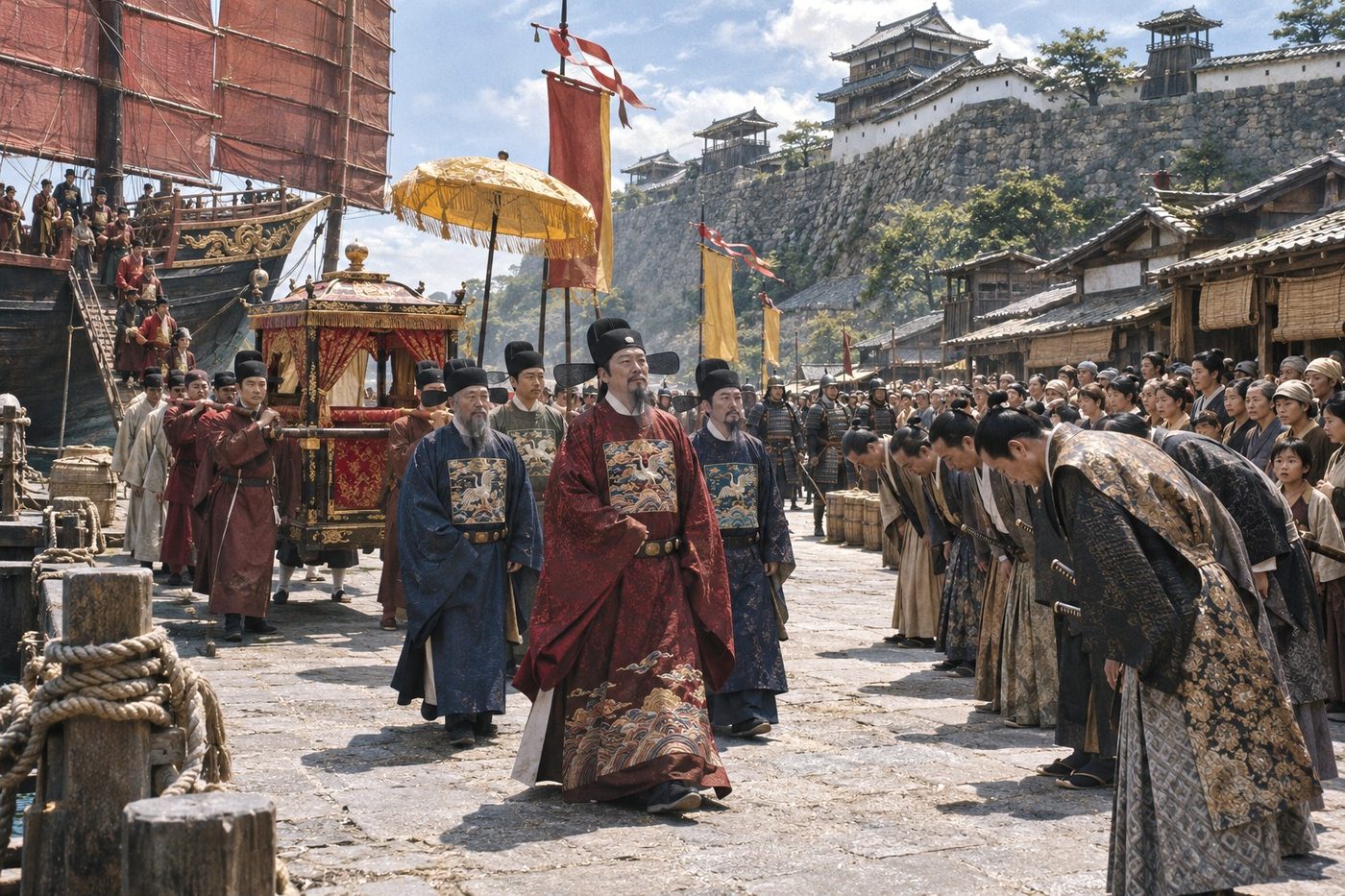
| Islanders call it | Daiken (大乾), "Great Heaven," or simply "the mainland" |
| Ruled by | The Emperor of Daqian, the Son of Heaven, from a capital so far inland that no islander has seen it |
| Size | Vast: more people than the isles 50 times over |
| Toward the isles | Lofty, distant, and lately irritated |
| In the isles | The Daqian Town of Umikado, monks and scholars in the great temples, and copper cash in every purse |
Daqian is the oldest and greatest power the islanders know: an empire of rivers, walled cities, scholars, and bureaucrats so vast that its provinces are larger than all of Tsurugishima. It is the heir of Shenyuan, the ancient dynasty that sent Lu Xian to find Mount Hōrai (Chapter 2). From Daqian came writing, the Buddha's Law, the calendar, the Way of Yin and Yang, tea, and the very idea of an Emperor. Islanders of learning admire it, read its classics, and write poems in its language. Islanders of war think it soft. Both are wrong.
How Daqian sees the isles. To the court of Daqian, Tsurugishima is a distant, rustic tributary that once received a golden seal and has been forgetting its manners ever since. The Son of Heaven does not deal with shoguns. He deals with kings, and he considers the Emperor of the isles a king. Official envoys travel rarely, carry letters that offend the court at Seikyō with their condescension, and return with gifts that Daqian records as tribute.
Trade. Daqian forbids its own subjects to trade privately by sea, so most trade with the isles is official, licensed, and rare, or illegal, unlicensed, and constant. Daqian silk, porcelain, books, medicines, tea, and above all copper cash flow to the isles. Island silver, sulfur, swords, fans, and lacquer flow back. Most of the mon in every purse in Tsurugishima was cast in Daqian (Chapter 2 Daily Life).
Daqian today. The empire is strong but distracted, troubled by floods, famines, rebellions in its far provinces, and the endless politics of its palace. Its coasts suffer from sea raiders, many of them islanders, and the Daqian court blames the Shogunate for failing to stop them. In the last two years, the coastal provinces have begun building a great war fleet under the admiral Shen Weining. The court says it is meant for the raiders. Some islanders fear it is meant for them.
Daqian in the Isles#
- The Daqian Town of Umikado (Part 2), led by the trader Gao Hongde.
- Monks and scholars of Daqian in the great temples of Seikyō, Hagane, and Kanagura, teaching meditation, medicine, painting, and the classics. Every great lord wants a Daqian scholar at his side.
- Rare weapons from Daqian, including the staff-flails, short forked truncheons, and side-handled batons of Chapter 3 Gear, brought by sailors and sold in port towns.
| d6 | Rumor |
|---|---|
| 1 | "The Daqian fleet is coming to punish the isles for the raiders." (F) Not yet. But the admiral has asked for leave to burn the raiders' island havens, and he doesn't much care whose islands they are. |
| 2 | "The Son of Heaven has sent a letter to Sadatsugu, calling him King of the Isles." (F) It was the Shikken's forgery, meant to discredit Sadatsugu. |
| 3 | "The Daqian court keeps the true record of Lu Xian's voyage." (T) Chapter 7 says what it says. |
| 4 | "Daqian copper is being debased, and the mon in your purse is worth less every year." (T) |
| 5 | "Gao Hongde of Umikado is a spy for the Daqian court." (T) And for the Shikken, and for himself. |
| 6 | "A Daqian sorcerer has come to Mount Hōrai looking for the immortals." (T) He is not the first. |
Savage Tale hooks. A Daqian envoy must be escorted from Sakimori to Seikyō, and three different lords want him to arrive with a different letter. A Daqian scholar in a lord's household is found dead, and his last calligraphy names his murderer in a riddle.
Cheongun, the Blue Clouds#
| Islanders call it | Seiun (靑雲), "Blue Clouds" |
| Ruled by | The King of Cheongun, Lady Hyoseon's father, and his council of scholar-officials |
| Size | A long, mountainous peninsula, about as large and as populous as Shinogi-jima |
| Toward the isles | Bitter, wary, and bound by a marriage |
| In the isles | Lady Hyoseon's court at Hagane, the envoys' hall at Sakimori, and the memories of every veteran |
Cheongun is the mountainous peninsula across the Strait, a kingdom of terraced valleys, walled towns, pine-clad mountains, and fortress temples. It is ruled by a king and an aristocracy of scholar-officials who rise by examination in the classics, a system that islander samurai find either admirable or absurd. Cheongun's own faith mixes the Buddha's Law, ancestor rites, and the ancient spirit-callers of its villages, women and men who dance and drum to speak with the dead.
The war. In Kenreki 1222, Shogun Tomonori invaded Cheongun and conquered half the kingdom (Chapter 2). The war lasted nearly 30 years. Its armies burned towns, emptied valleys, and carried off potters, printers, and scholars as captives. Cheongun's people remember it as a catastrophe, and its fighters remember that they never stopped resisting. Under the Treaty of the Strait (Kenreki 1250), the conquered lands were returned and Princess Hyoseon married Shogun Tomoharu. In Cheongun, the treaty is seen as a victory bought with a princess.
Cheongun today. The kingdom is rebuilding its towns, its temples, and its fleet. Its court is divided: one faction wants peace with the isles through Lady Hyoseon, and another wants never to be invaded again, by any means. Both watch the war of the blossoms closely, because Sadatsugu was the general who wanted to fight on, and if he wins, he may want to finish what Tomonori began.
Cheongun in the Isles#
- Lady Hyoseon's court at Hagane (Part 2), with her Cheongun ladies, guards, and scholars. Her chief envoy, Yeom Taejin, is a quiet, careful scholar who sends letters home by every ship.
- The envoys' hall at Sakimori (Part 3), where Cheongun envoys wait to be received.
- Captives and their children. Thousands of Cheongun people were carried to the isles during the war: potters, printers, physicians, and servants. Many still live in the isles, especially on Kissaki-jima. Their kilns make the finest tea bowls in the realm, and their families are caught between two homes.
| d6 | Rumor |
|---|---|
| 1 | "Cheongun's new fleet is built to keep the islanders out, not to invade." (T) For now. |
| 2 | "Lady Hyoseon sends the Shogunate's secrets home to her father." (F) She sends him reports, but she keeps the secrets. |
| 3 | "The Cheongun court has promised to support whichever blossom swears never to invade again." (T) |
| 4 | "Cheongun spirit-callers can speak with the islanders' war dead buried there." (T) And some of the dead have things to say. |
| 5 | "The potters of Kissaki-jima are planning to sail home." (T) The lords who own their kilns will not let them. |
| 6 | "The treasure of a Cheongun royal temple, looted in the war, is hidden in a castle in Hinoe." (T) |
Savage Tale hooks. A captive potter's family hires the heroes on its own terms: the kiln's elder has bought passage, forged the papers, and chosen the night, and needs swords on the road to the harbor. She decides who sails and who stays to keep the kiln's secrets from the lord. Yeom Taejin needs a letter carried to the King of Cheongun that the Shikken must never see. A Strait Man who looted a Cheongun temple in the war is haunted by what he took, and wants the heroes to return it.
The Far Westerners#
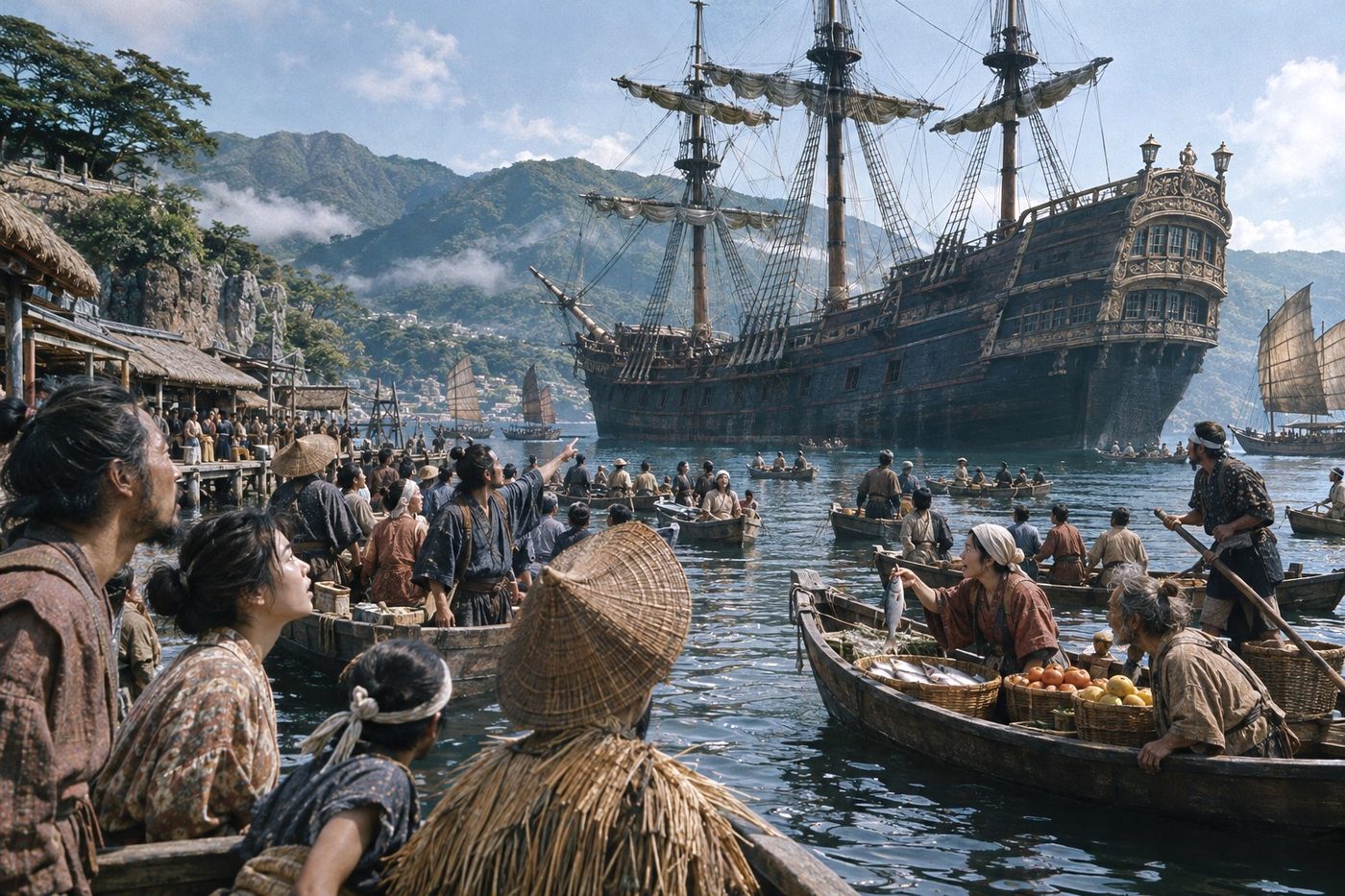
| Islanders call them | Ijin ("strangers"), or "the black-ship people" |
| They come from | A land far to the west, beyond Daqian and beyond the deserts and seas past it, which islanders have never seen. Its name is never given; islanders cannot say it, and the westerners' attempts to teach it go nowhere. |
| In the isles | The Foreign Island at Umikado, a few hundred traders and sailors, and a few dozen preachers of the Black Book |
| Toward the isles | Curious, greedy, devout, and very far from home |
Ten years ago, the first of the great black ships put into Umikado: a tall, tar-black ship of three masts and many sails, bigger than any junk, with cannon on its decks. Its crew were tall, bearded, and pale or sun-browned, and they wore stiff clothes, wide hats, and boots. They had sailed for two years to reach the isles. They brought firearms, glass, clocks, wine, spectacles, maps of a world larger than the islanders had imagined, and priests of the Teaching of the Black Book (Chapter 2).
What they want. Trade, first: Daqian silk and island silver, which they buy and sell between the isles and Daqian at a fat profit, because Daqian won't trade with either side directly. Converts, second: their preachers want souls, and their captains know that a converted lord is a friendly harbor. A base, third: a harbor of their own on the coast of the isles, which no lord has yet granted.
What they bring. The matchlock, above all. The islanders copied the westerners' guns within a year, and island smiths now make them by the hundred, but the best and newest still come from the black ships. Cannon, too, which few island lords can afford. And the Black Book, which spreads slowly among the fishermen and merchants of Akashio, and which the temples fear more than the guns.
How islanders see them. As strangers: rich, rude, unwashed, and fascinating. Lords want their guns, merchants want their trade, the curious want their maps and clocks, and the temples want them gone. Most islanders have never seen one, and the stories about them grow in the telling.
Using the far westerners. Keep them strange and few. They are a sign that the world is bigger than the isles, a source of guns and trouble, and a mirror for the islanders' own customs. They are not villains or saviors, and the Black Book is a faith to be treated with the same respect as any other.
| d6 | Rumor |
|---|---|
| 1 | "The westerners eat beef and drink blood-red wine." (T) The wine, anyway. |
| 2 | "Their priests can raise the dead with the black book." (F) |
| 3 | "They have sold guns to both blossoms." (T) |
| 4 | "Their captain has asked Lord Nishioka for a harbor, and offered 100 cannon for it." (T) It was 30. |
| 5 | "More black ships are coming, and soldiers on them." (F) Two more ships are coming next year. They carry traders and preachers. |
| 6 | "One of the westerners has gone into the mountains to study with the yamabushi." (T) |
Savage Tale hooks. A lord hires the heroes to bring a westerner's cannon over the mountains to his castle before the snows. A western sailor has deserted his ship and fled into the hills, and the captain, the Port Commissioner, and a temple all want him found first.
The Sea Raiders#
| Islanders call them | Kaizoku, "sea bandits" |
| Who they are | Islanders, mainlanders, Cheongun exiles, ronin, and deserters, sailing together |
| Where they hide | The ghost-lit waters of Shiranui, the outer islands of Akashio, and a hundred coves on both shores |
| Toward everyone | Whatever pays |
For a century, sea raiders have plagued the coasts of Daqian, Cheongun, and the isles. They are not a nation but a trade: crews of islanders and mainlanders together, led by whoever is boldest, raiding coastal towns, seizing ships, and smuggling the goods Daqian forbids. Since the Treaty of the Strait sent thousands of unpaid veterans home, the raiders have never had so many recruits.
The raiders are not the same as the sea lords of the Inland Sea, such as the Ashiura of Shiokaze (Part 3), who sell protection from inside the realm and fly their clan's banners. But the line between them is thin, and the Shikken has stopped bothering to draw it.
The raider kings. Several great captains lead fleets of a dozen ships or more. The most feared is Zhuo Xianfeng, a Daqian merchant's son turned outlaw, who commands 50 ships from a hidden harbor among the ghost-lights of Shiranui, where no one dares to follow him. He trades with half the merchants of Umikado, pays the Tsuruzaki to look away, and has been offered a pardon by the Daqian court, a commission by Sadatsugu, and a price on his head by the Shikken. He has accepted none of them yet.
What the raiders do in a campaign. Raid a coastal domain (a Spades event in Chapter 5), carry a cargo the heroes need, kidnap a hostage, offer passage to Cheongun or Daqian to anyone who can pay, or join a lord's fleet in exchange for a pardon.
| d6 | Rumor |
|---|---|
| 1 | "Zhuo Xianfeng's harbor is protected by the drowned Kamaeda dead." (T) He pays them, and Chapter 7 says how. |
| 2 | "The raiders will sail for Sadatsugu if he pays them in land." (T) |
| 3 | "The Daqian fleet is coming to burn every raider haven in the isles." (T) Eventually. |
| 4 | "A raider crew carries a cargo of black ship cannon." (T) |
| 5 | "Zhuo Xianfeng is an island-born samurai in disguise." (F) |
| 6 | "The Ashiura are the raiders' partners." (F) They are rivals, and hate each other. |
Savage Tale hooks. The heroes must buy passage to Cheongun from a raider crew and survive the voyage. A coastal village asks the heroes to defend it from a raid that is coming at the next new moon.
The Sea Roads#
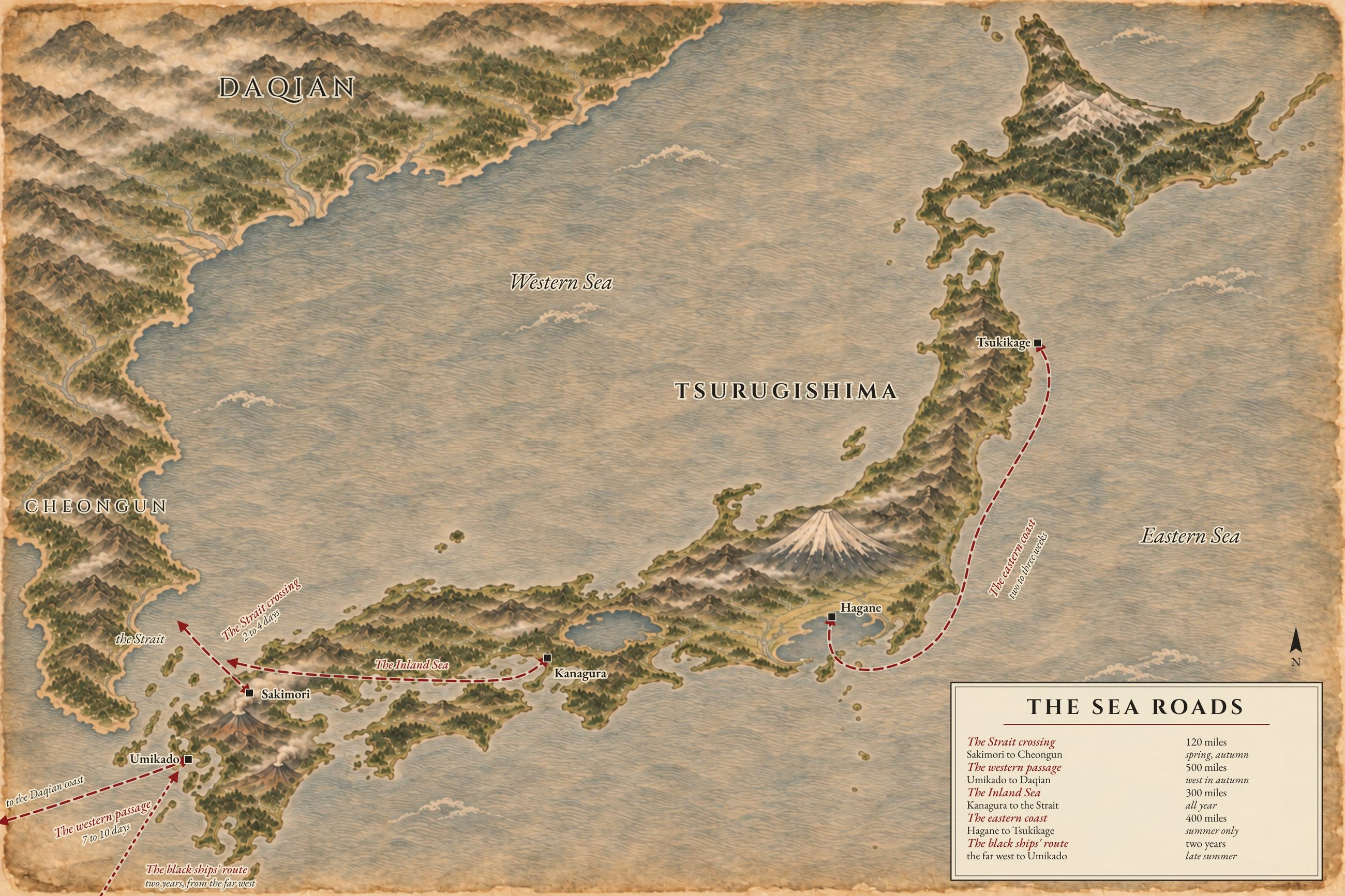
The isles are linked to the mainland by a few sea roads, each with its own season, dangers, and masters.
| Route | Distance and time | Season | Dangers |
|---|---|---|---|
| The Strait crossing: Sakimori to Cheongun | About 120 miles, two to four days by junk | Spring and autumn are best | Storms, raiders, and Cheongun patrols |
| The western passage: Umikado to the Daqian coast | About 500 miles, 7 to 10 days | Sail west in autumn and home in summer, with the monsoon winds | Typhoons in late summer, raiders, and Daqian's patrols, which treat unlicensed ships as smugglers |
| The Inland Sea: Kanagura to the Strait | About 300 miles, 10 to 15 days, stopping each night | All year | Sea lords' tolls, raiders, and the tide race of Shiokaze |
| The eastern coast: Hagane to Tsukikage | About 400 miles, two to three weeks | Summer only | Storms, the open ocean, and the Shogun's patrols |
| The black ships' route: the far west to Umikado | Two years | Arrives in late summer | Unknown, and the westerners won't say |
Sea travel uses the core rules for boats and ships, and the coastal ship speed from Chapter 2 Daily Life. A typhoon is a Dramatic Task for the ship's pilot, and a raider attack can be a Chase, a boarding fight, or a mass battle at sea.